Most commented posts
- PRONUNCIATION – the ED sound — 4 comments
- GRAMMAR – The Passive Voice — 3 comments
- Adjectives + Prepositions (OF) — 2 comments
- Mastering the Modal: Understanding the Versatility of “Would” — 2 comments
- TOO vs. ENOUGH — 1 comment


Jun 01
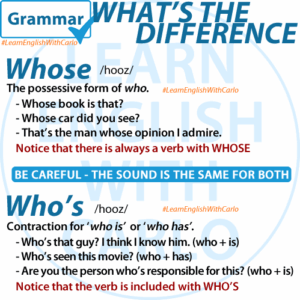
The words WHOSE and WHO’S may sound the same when spoken (both pronounced /ho͞oz/), but they have very different meanings and uses in English. Learning to use them correctly will help you avoid common mistakes in writing and speaking. WHOSE: Possessive Pronoun WHOSE is a possessive pronoun used to ask or talk about ownership or …
May 28
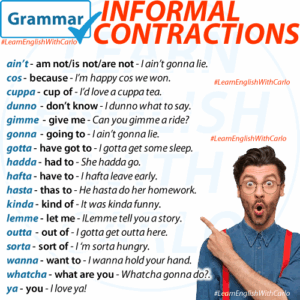
VOCABULARY – Informal (spoken) Contractions In English, as in most other languages, there are ways to shorten groups of words that commonly go together. We don’t do this in writing, just when we speak. They are called informal or spoken, contractions. ain’t – am not/is not/are not – I ain’t gonna lie. cos – because …
May 16
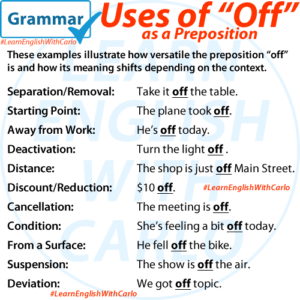
The preposition “off” has many different uses in English, depending on the context. Here’s a breakdown of its main uses: 1. Separation or Removal 2. Starting Point (in Time or Space) 3. Away from Work or Duty 4. Deactivation or Disconnection 5. Distance or Separation 6. Reduced or Discounted 7. Cancellation or Suspension 8. Condition …
May 15
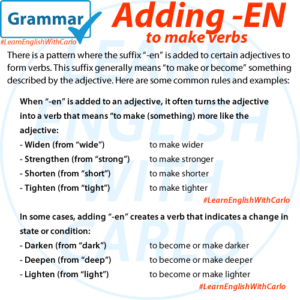
Turn Adjectives & Nouns into Verbs! Did you know you can add -EN to some adjectives and nouns to create verbs? This is a powerful and useful suffix in English. It often means “to make” or “to become” something. In this post, we’ll look at how this suffix works and give you plenty of examples …
May 13
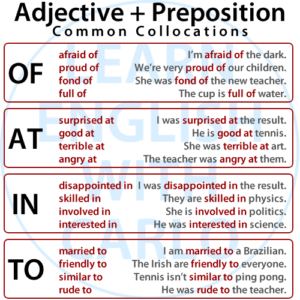
Adjectives are words used to describe a person, place, or thing, for example, The tall man in the red shirt is a friend of mine. We drove along a quiet road until reaching a small town. I’m reading an interesting book. Prepositions are words used to connect two ideas or to demonstrate the relationship between …
May 12
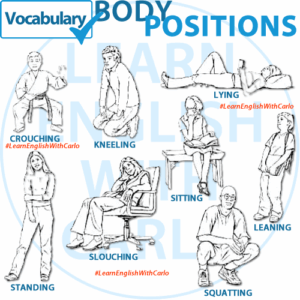
We place our bodies in different positions depending on what we are doing. Do you know the names of the different positions? One of my INSTAGRAM followers asked to use each one in a sentence, so here you go: Can you think of any other positions? If you have any questions or doubts, please ask …
May 04
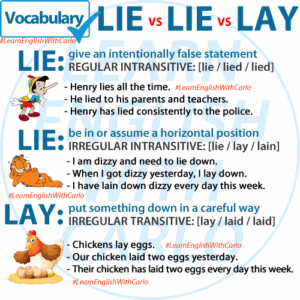
English can be tricky, especially when it comes to words that sound the same but have different meanings and uses. A common source of confusion is the difference between “lie,” “lie,” and “lay.” These three words are often mixed up, but understanding their meanings and how they are used can help you use them correctly. …
Apr 28
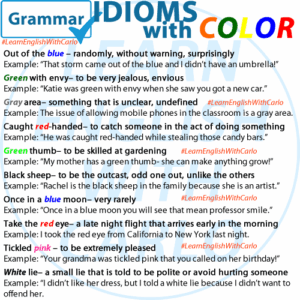
Out of the blue – randomly, without warning, surprisinglyExample: “That storm came out of the blue and I didn’t have an umbrella!” Green with envy– to be very jealous, enviousExample: “Katie was green with envy when she saw you got a new car for your birthday.” Gray area – something that is unclear, undefinedExample: The …
Apr 26
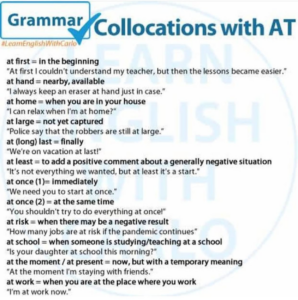
The preposition “at” is used in many common expressions in English, each with unique meanings. Below, you’ll find clear explanations and examples to help you understand and use these expressions confidently. Let’s explore! 1. At First = In the beginning This expression describes the initial phase of something, often followed by a change. Examples: 2. …
Apr 25
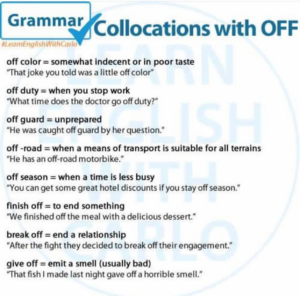
The English preposition “off” has a variety of meanings and uses, often forming part of idiomatic expressions and collocations. In this blog post, we’ll explore some common expressions with “off,” provide clear definitions, and share examples for each. Let’s dive in! 1. Off Color Definition: Something that is somewhat indecent, inappropriate, or in poor taste.Examples: …