Most commented posts
- PRONUNCIATION – the ED sound — 4 comments
- GRAMMAR – The Passive Voice — 3 comments
- Adjectives + Prepositions (OF) — 2 comments
- Mastering the Modal: Understanding the Versatility of “Would” — 2 comments
- TOO vs. ENOUGH — 1 comment


Jan 01
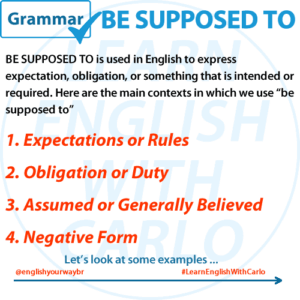
English learners often encounter the phrase “be supposed to” in everyday conversations. It’s a common expression used to talk about expectations, obligations, rules, and assumptions. In this post, we’ll explore what “be supposed to” means, how it’s used, and the grammatical rules that guide its usage. 1. What Does “Be Supposed To” Mean? “Be supposed …
Dec 31
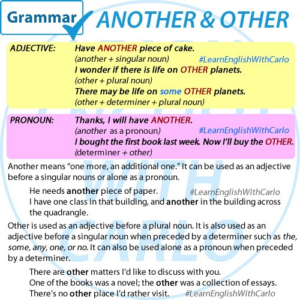
Use of Another and Otheranother + singular noun (Have another sandwich.) another (Thanks. I’ll have another.) other + plural noun (I wonder if there is life on other planets.) determiner + other + noun (There may be life on some other planets.) determiner + other (“I have one book.” “I have the other.”) Another means …
Dec 30
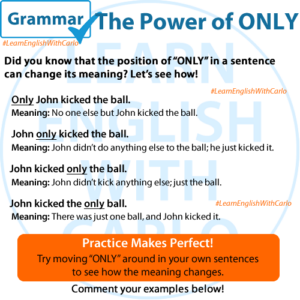
Using “only” correctly can make a big difference in the meaning of a sentence. It’s a small word with a powerful impact! Let’s dive into how to place “only” correctly to convey the exact meaning you want. Understanding the Role of “Only”: “Only” is a versatile word that can modify different parts of a sentence. …
Dec 29

The preposition “above” is commonly used in English to describe position, comparison, and superiority. This post will explore its various uses and provide examples to help you understand how to use “above” correctly. 1. Physical Location “Above” is often used to indicate a higher position relative to something else. 2. Comparison “Above” can also be …
Dec 25
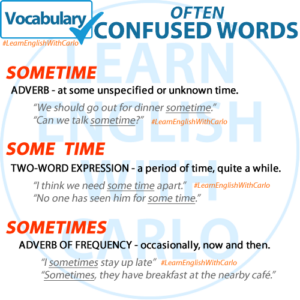
These three words are often confused. So, here’s an explanation of the differences between “sometime,” “sometimes,” and “some time”: 1. Sometime: 2. Sometimes: 3. Some time: Usage Tips: Examples: Understanding these differences will help you use these words correctly in various contexts. Practice using them in sentences with the QUIZ below!
Dec 21
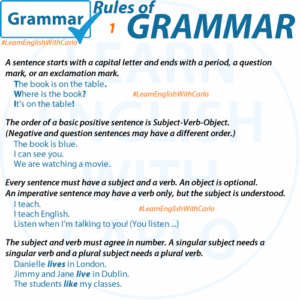
Mastering English grammar helps you communicate clearly and naturally. Here’s a guide to some fundamental rules, complete with examples and exceptions to be aware of. 1. Indefinite Articles (A/An) 2. Countable and Uncountable Nouns with Quantifiers 3. Possessive Form with Apostrophes 4. Active vs. Passive Voice 5. Contractions: ‘He’d’, ‘They’d’, and More 6. Proper Nouns …
Dec 19
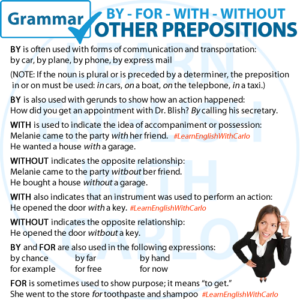
By is often used with forms of communication and transportation:by car, by plane, by phone, by express mail (‘Note: If the noun is plural or is preceded by a determiner, the preposition in or on must be used: in cars, on a boat, on tbe telepbone, in a taxi.) By is also used with gerunds …
Dec 18
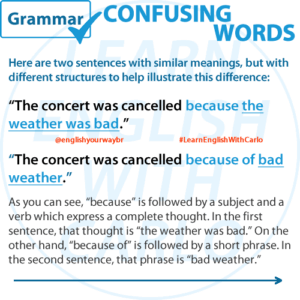
What’s the difference between “because” and “because of”? In most cases, “because” is followed by a subject and a verb, and “because of” is typically followed by a single word or phrase. Here are two sentences with similar meanings, but with different structures to help illustrate this difference: “The concert was canceled because the weather …
Dec 16
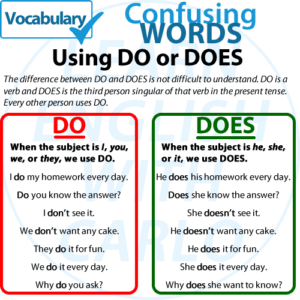
The difference between DO and DOES is not difficult to understand.DO is a verb and DOES is the third person singular of that verb in the present tense. Every other person in the conjugation uses DO. When the subject is I, you, we, or they, we use DO. I do my homework every day.Do you …
Dec 15

Modal verbs play a crucial role in shaping the meaning and tone of our language. Among these, “would” stands out as a versatile tool with a myriad of uses and implications. In this blog post, we’ll delve into the depths of “would”, exploring its various meanings, functions, and usage in everyday language. Understanding “Would”: At …