Most commented posts
- PRONUNCIATION – the ED sound — 4 comments
- GRAMMAR – The Passive Voice — 3 comments
- Adjectives + Prepositions (OF) — 2 comments
- Mastering the Modal: Understanding the Versatility of “Would” — 2 comments
- TOO vs. ENOUGH — 1 comment


Oct 26
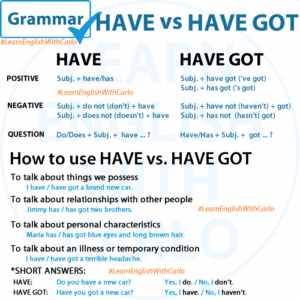
When we talk about possession, relationships, illnesses, or characteristics, English gives us two ways to express the same idea:👉 HAVE and HAVE GOT Both mean the same thing, but they’re used slightly differently in everyday English. 🧩 1. Meaning and Usage Both HAVE and HAVE GOT are used to talk about things we own, relationships, …
Oct 25

DURING, UNTIL, SINCE, and FOR Prepositions can sometimes be tricky to use correctly, especially when they refer to time. Let’s explore the nuances of DURING, UNTIL, FOR, and SINCE, along with deeper explanations and examples to make their usage clearer. DURING Definition: Refers to a specific period of time when something happens, or indicates that …
Oct 24

In English, when multiple adjectives are used to describe a noun, they typically follow a specific order. This order helps maintain clarity and natural-sounding language. The general order of adjectives is as follows: Here’s an example sentence using multiple adjectives in their correct order: “The beautiful small old wooden Italian music box.” In this sentence:“The” …
Oct 24

Possessive nouns can seem tricky at first, but once you grasp the rules, you’ll find them easy to use. In this post, we’ll explore how to form possessive nouns in different contexts, ensuring that you can confidently show ownership in your writing. 1. Singular Nouns For most singular nouns, showing possession is straightforward. Simply add …
Oct 24

The Difference Between -ed and -ing Forms In English, many verbs that describe emotions or feelings can be transformed into adjectives by using their present or past participle forms. However, it’s important to note that these two forms convey different meanings. Let’s explore how to use these participial adjectives correctly. Present Participle (-ing Form) The …
Oct 23

Common Internet Abbreviations in Everyday Use With the rise of online communication, abbreviations have become a fast and convenient way to convey messages. Here are some common internet abbreviations you might come across: How Abbreviations Change the Way We Communicate Internet abbreviations not only save time but also add a casual tone to conversations. They …
Oct 21
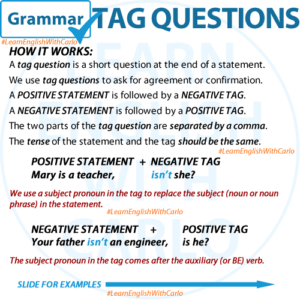
A tag question is a short question added to the end of a statement. They are used to confirm information, seek agreement, or invite a response from the listener. Tag questions are characterized by their structure: they typically consist of an auxiliary verb and a pronoun that matches the subject of the statement. For example: …
Oct 19
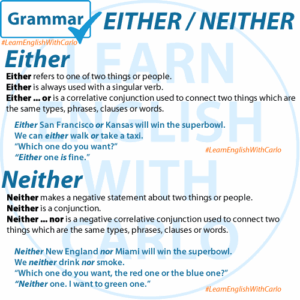
GRAMMAR – Either & Neither Either refers to one of two things or people. Either is always used with a singular verb. Either … or is a correlative conjunction used to connect two things which are the same types, phrases, clauses or words. Neither makes a negative statement about two things or people. Neither …
Oct 15
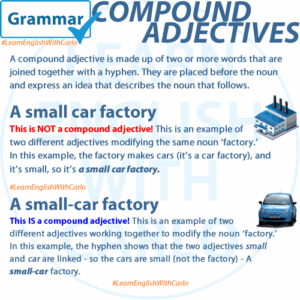
Understanding Compound Adjectives in English Compound adjectives are a fascinating aspect of English grammar that allow us to express detailed ideas about nouns in a concise and efficient way. As the name suggests, a compound adjective is made up of two or more words that work together as a single unit to describe a noun. …
Oct 14
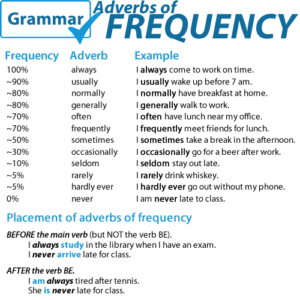
Adverbs of frequency describe how often something occurs 100% – always – I always come to work on time.~90% – usually – I usually wake up before 7 am.~80% – normally – I normally have breakfast at home.~80% – generally – I generally walk to work.~70% – often – I often have lunch near my …