Most commented posts
- PRONUNCIATION – the ED sound — 4 comments
- GRAMMAR – The Passive Voice — 3 comments
- Adjectives + Prepositions (OF) — 2 comments
- Mastering the Modal: Understanding the Versatility of “Would” — 2 comments
- TOO vs. ENOUGH — 1 comment


Sep 17

A conjunction is a part of speech that joins two words, phrases, or clauses (both dependent and independent) together. There are three different kinds of conjunctions — coordinating, correlative, and subordinating — each serving a different purpose, but all working to bring words together.Let’s see how they work… Coordinating conjunctions are used to join equal …
Sep 15
When talking about past habits or repeated actions, learners of English often encounter two phrases: “used to” and “would.” While these two expressions have similarities, they are not interchangeable in every context. Let’s explore their meanings, uses, and differences in detail. What Does “Used to” Mean? “Used to” refers to habits, actions, or states that …
Sep 11
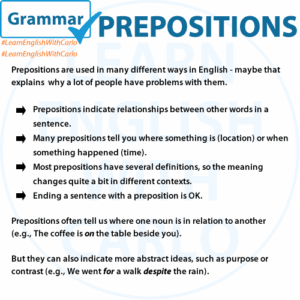
Types of Prepositions The different types of prepositions are used to provide us with different information with regard to time (prepositions of time), place (prepositions of place), and direction (prepositions of movement). Besides these three, there are others: prepositions of manner and prepositions of cause and reason. Time: We’ve been working since yesterday.Direction: Go to …
Sep 10
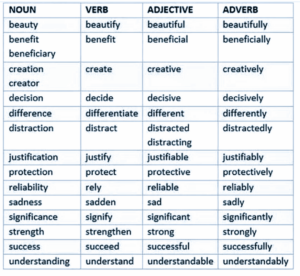
Welcome to our guide on how words can take different forms as nouns, verbs, adjectives, and adverbs! Many words in English change form depending on their role in a sentence, and understanding these transformations is key to mastering grammar and building vocabulary. Here you’ll find tables that show how specific words change across these categories, …
Sep 07
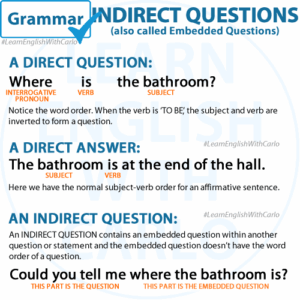
Indirect questions are a polite and often more formal way of asking questions. They differ from direct questions in their structure and use. Let’s break down what indirect questions are, how to form them, and provide examples to illustrate their use. What Are Indirect Questions? Indirect questions are questions embedded within statements or other questions. …
Sep 06
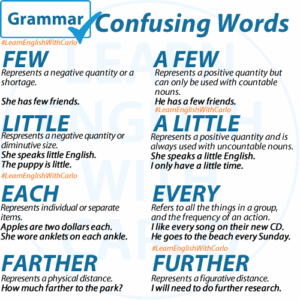
GRAMMAR – Adjectives that quantify. The words in this image can be adjectives, pronouns, or determiners.
Sep 04

Mastering the simple past tense is an essential skill in English grammar. Regular verbs, which form the backbone of everyday communication, follow specific spelling rules when conjugated into the simple past tense. Understanding these rules empowers learners to express past actions accurately and confidently. In this blog post, we’ll explore the key spelling rules governing …
Sep 01
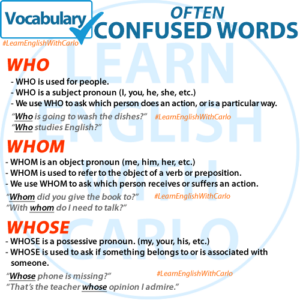
These three words are often confused. Here’s a brief explanation of the differences between “who,” “whom,” and “whose”: 1. Who: 2. Whom: 3. Whose: Usage Tips: Examples: Understanding these differences will help you choose the correct word in various contexts. Practice using them in sentences with the QUIZ below!
Aug 31
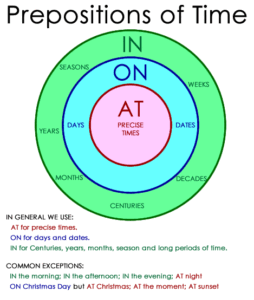
Understanding prepositions of time can be tricky, but they’re essential for clear and accurate communication. Let’s break down the use of “in,” “on,” and “at” with examples to make them easier to grasp. 1. IN Use “in” for longer periods of time, such as months, years, centuries, and long periods: 2. ON Use “on” for …
Aug 31
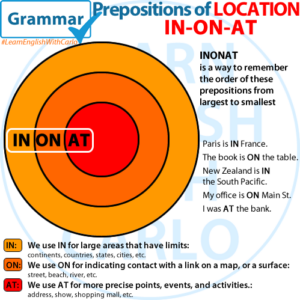
Prepositions of location are essential in English as they help us describe where something or someone is located. Among the most commonly used prepositions are IN, ON, and AT. While they may seem similar, they are used in specific contexts to indicate different types of locations. Let’s explore how to use each one correctly. 1. …