GRAMMAR – (be) used to

In English, expressions like “used to” and “be used to” can be confusing because they look similar but have distinct meanings and uses. This guide will help you understand the difference and use them correctly.
What Does “Used To” Mean?

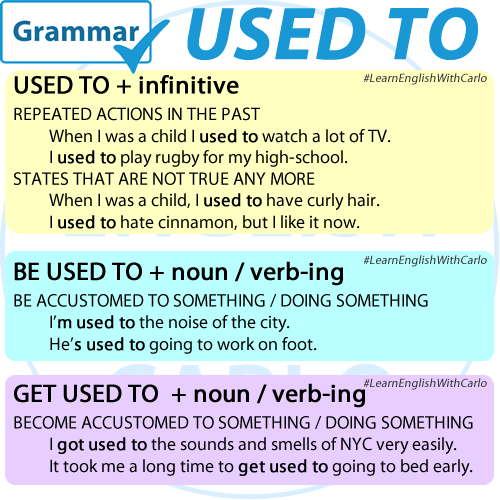
“Used to” is used to talk about habits, actions, or states that were true in the past but are no longer true. It highlights a contrast between the past and the present.

Structure:

  • Used to + base verb (infinitive without “to”)

Examples:

  • I used to play soccer every weekend, but now I don’t.
  • She used to live in London, but now she lives in Paris.
  • There used to be a cinema in this area, but it was demolished.

Key Point: “Used to” can describe past habits (repeated actions) or states (conditions).

What Does “Be Used To” Mean?

“Be used to” means being accustomed to something or finding it familiar, usually through experience. It does not refer to the past but rather describes a state of familiarity in the present.

Structure:

  • Be used to + noun/gerund (verb + ing)

Examples:

  • I am used to cold weather because I grew up in Canada. (Noun)
  • He is used to waking up early for work. (Gerund)

Why Gerunds? When “be used to” is followed by an action, the verb must be in gerund form because “to” functions as a preposition in this expression.

What Does “Be Used To” Mean?

“Be used to” means being accustomed to something or finding it familiar, usually through experience. It does not refer to the past but rather describes a state of familiarity in the present.

Structure:

  • Be used to + noun/gerund (verb + ing)

Examples:

  • I am used to cold weather because I grew up in Canada. (Noun)
  • He is used to waking up early for work. (Gerund)

Why Gerunds? When “be used to” is followed by an action, the verb must be in gerund form because “to” functions as a preposition in this expression.


Key Differences Between “Used To” and “Be Used To”

FeatureUsed ToBe Used To
Describes actionsYesNo
Describes statesYesYes
FocusPast habits or states no longer trueFamiliarity or adaptation
StructureUsed to + base verbBe used to + noun/gerund
ExampleShe used to live in New York.She is used to living in New York.

Common Mistakes to Avoid

  1. Confusing the Two Expressions:
    • Incorrect: I used to waking up early.
    • Correct: I am used to waking up early.
  2. Using “Would” Instead of “Used To” for States:
    • Incorrect: She would live in London.
    • Correct: She used to live in London.

Here are a few exercises to test your understanding:

  1. Fill in the blanks with the correct expression (used to or be used to):
    • When I was a child, I ______ (ride) my bike to school every day.
    • He ______ (live) in a small town, so he finds city life overwhelming.
    • We ______ (study) late at night, so staying up doesn’t bother us now.
  2. Identify whether the sentence refers to the past or present:
    • She is used to spicy food.
    • They used to go camping every summer.

Quick Summary

ExpressionUseExample
Used toPast habits or states no longer trueI used to drink coffee every day.
Be used toFamiliarity or adaptationI am used to drinking tea now.

Understanding and practicing these expressions will help you express yourself more clearly and confidently in English. Keep practicing, and soon you’ll find them second nature!

Wrong shortcode initialized
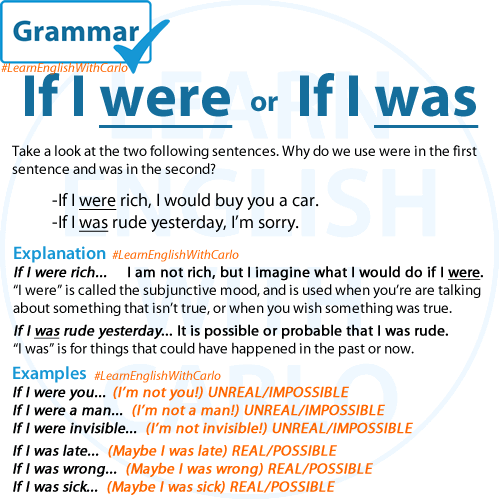
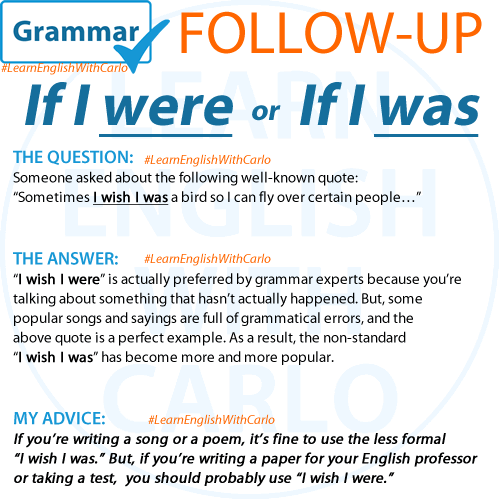
‘If I was’ vs ‘If I were’

Take a look at the two following sentences. Why do we
use were in the first sentence and was in the second?

  • If I were rich, I would buy you a car.
  • If she was feeling sick, it’s good that she went home.

In the first sentence, “If I were rich”, “were” is used because it’s a hypothetical or unreal condition, which requires the subjunctive mood (used for unreal or imagined situations).

In the second sentence, “If she was feeling sick”, “was” is used because it’s a statement about a real past possibility or condition. The speaker is talking about something that might have actually happened in the past, so the indicative mood is used instead of the subjunctive.

Here are a few more examples to highlight the contrast between the subjunctive (unreal or hypothetical) and indicative (real past) moods:

  1. Subjunctive (hypothetical):
    • If I were the president, I would lower taxes.
      (Unreal situation; I’m not the president)
  2. Indicative (real past):
    • If she was late yesterday, she might have missed the meeting.
      (Talking about a real possibility in the past)
  3. Subjunctive:
    • If he were here, he would help us.
      (Hypothetical; he’s not here)
  4. Indicative:
    • If he was here earlier, we must have missed him.
      (A real possibility in the past)

These examples show how “were” is used in unreal conditions, while “was” is for real past situations.

Wrong shortcode initialized
SEE ALSO: The Subjunctive Mood.

Understanding the Difference Between SOME and ANY

As an English learner, you’ve probably come across some and any and wondered why we use one instead of the other. These two words have very similar meanings—they both refer to an unspecified amount or number—but their usage depends on the context. Let’s explore the differences with simple rules, examples, and tips.

Key Differences Between SOME and ANY

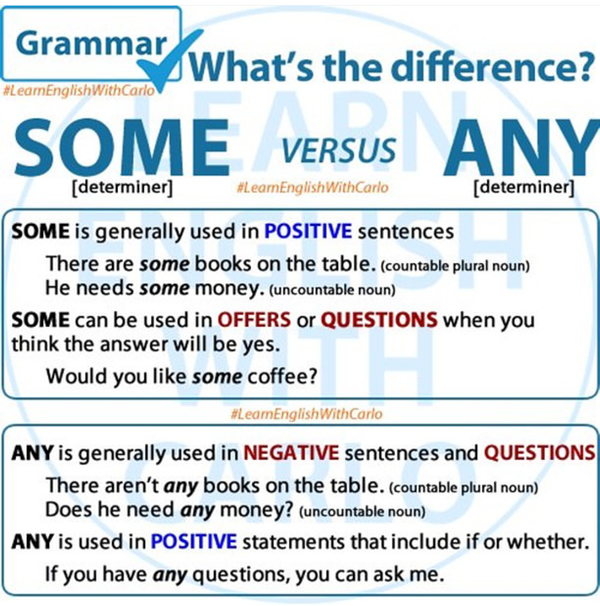
1. SOME

  • Used in Positive Statements
    Some is typically used in affirmative (positive) sentences.
    • I have some friends in New York.
    • She bought some bread at the store.
  • Used in Offers and Suggestions
    When making an offer or suggestion, we use some because we expect the answer to be “yes.”
    • Would you like some coffee?
    • Can I get you some water?
  • Used in Certain Questions
    In questions where the speaker expects a positive response, some is used.
    • Did you buy some apples? (The speaker assumes the answer is likely “yes.”)

2. ANY

  • Used in Negative Statements
    Any is commonly used in negative sentences.
    • I don’t have any money.
    • She didn’t see any birds in the park.
  • Used in Questions
    In general questions, any is preferred because the speaker isn’t sure about the answer.
    • Do you have any siblings?
    • Is there any milk in the fridge?
  • Used in Positive Statements with “Whether” or “If”
    When the sentence starts with “whether” or “if,” any is used.
    • Let me know if you need any help.
    • I’m not sure whether she has any information about the meeting.

Quick Comparison Table

SOMEANY
Positive statementsNegative statements
I need some paper for the printer.I don’t need any paper for the printer.
Offers or suggestionsGeneral questions
Would you like some tea?Do you have any tea?
Expected positive answers in questionsNeutral or unsure answers in questions
Did you get some cookies?Did you find any cookies?

Tips to Remember

  1. Think of positivity vs. uncertainty: Use some when you’re confident or positive and any when you’re unsure or negative.
  2. Offers and requests lean toward “some”: If you’re being polite or expect agreement, go with some.
  3. Watch out for “if” and “whether”: When these words start a clause, any is your go-to choice.

Wrong shortcode initialized
Good vs. Well

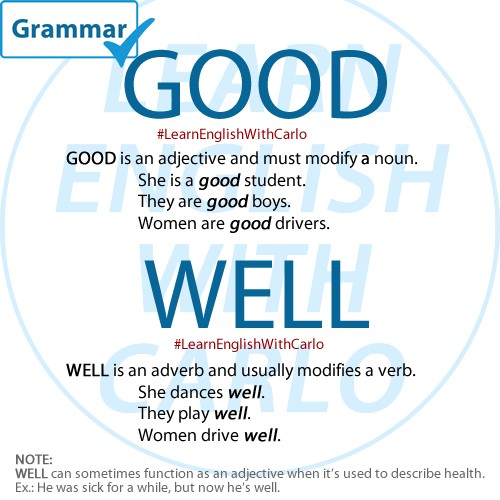
Good is an adjective and must modify a noun.
Well is usually an adverb.
Well is occasionally used as an adjective but only when referring to someone’s health.

“Good” as an Adjective:

  • Example: “She is a good teacher.”
  • Here, “good” describes the noun “teacher,” giving us more information about the quality of the person.

“Well” as an Adverb:

  • Example: “He sings well.”
  • “Well” modifies the verb “sings,” telling us how he sings.

“Well” as an Adjective (Health):

  • Example: “She isn’t feeling well today.”
  • In this context, “well” describes someone’s health condition.

Here are some common mistakes to avoid when using “good” and “well”:

  1. Using “good” instead of “well” to describe actions:
    • Incorrect: “She sings good.”
    • Correct: “She sings well.”
    • Tip: Use “well” to modify verbs (describe how an action is done).
  2. Using “well” instead of “good” to describe nouns:
    • Incorrect: “He is a well student.”
    • Correct: “He is a good student.”
    • Tip: Use “good” to modify nouns (describe a person, place, or thing).
  3. Confusing health with skill:
    • Incorrect: “He is a good after being sick.”
    • Correct: “He is well after being sick.”
    • Tip: Use “well” to describe health, not “good.”

These points can help you better understand the differences and avoid common pitfalls.

Wrong shortcode initialized
GRAMMAR – Still vs. Yet vs. Already

“Still,” “yet,” and “already” are commonly used adverbs in English that can sometimes be confusing. They help indicate time and the progression of events, but each has its own specific use and nuance. This guide will explain the differences between these three words, complete with definitions and examples to clarify their correct usage.

STILL

Definition: “Still” is used to indicate that an action or situation that began in the past continues to the present and may continue into the future. It suggests that something has not changed.

Examples:

  1. Affirmative Sentences:
    • “She is still working on her project.”
    • “They are still living in the same house.”
  2. Negative Sentences:
    • “He hasn’t still finished his homework.” (Less common, but can be used for emphasis)

Usage Tips:

  • “Still” is often placed before the main verb but after auxiliary verbs like “be,” “have,” or “will.”
  • It emphasizes the continuity or persistence of an action or situation.

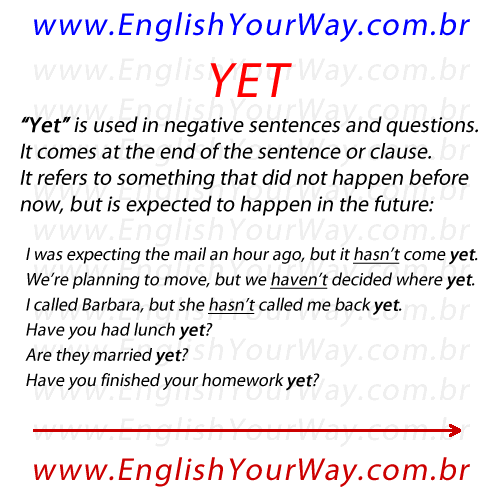
YET

Definition: “Yet” is used to indicate that an action or situation is expected to happen but has not happened up to the present moment. It is commonly used in questions and negative sentences.

Examples:

  1. Questions:
    • “Have you finished your assignment yet?”
    • “Is the report ready yet?”
  2. Negative Sentences:
    • “I haven’t seen that movie yet.”
    • “They haven’t arrived yet.”

Usage Tips:

  • “Yet” is typically placed at the end of the sentence.
  • It conveys a sense of anticipation or expectation for something that has not occurred.

STILL and YET can both be used in negative sentences to express that something hasn’t happened before now, They are similar but STILL shows a higher level of impatience. Also remember that YET goes at the end of the sentence.

ALREADY

Definition: “Already” is used to indicate that an action or situation has occurred earlier than expected or earlier than another event. It shows that something has happened before now.

Examples:

  1. Affirmative Sentences:
    • “She has already finished her homework.”
    • “They have already left for the airport.”
  2. Questions:
    • “Have you already eaten lunch?”
    • “Did they already know about the meeting?”

Usage Tips:

  • “Already” is usually placed before the main verb or between the auxiliary and main verb.
  • It emphasizes that an action has been completed sooner than expected.

ALREADY is used to express that something happened sooner than expected.

Key Differences:

  • Still: Indicates continuation from the past into the present (e.g., “She is still here.”).
  • Yet: Indicates that something expected has not happened up to now (e.g., “He hasn’t called yet.”).
  • Already: Indicates that something happened sooner than expected (e.g., “They have already arrived.”).

Conclusion: Understanding the differences between “still,” “yet,” and “already” is crucial for expressing time and progression accurately in English. By paying attention to the context and the placement of these words in sentences, you can effectively convey whether an action is ongoing, anticipated, or completed.

Wrong shortcode initialized
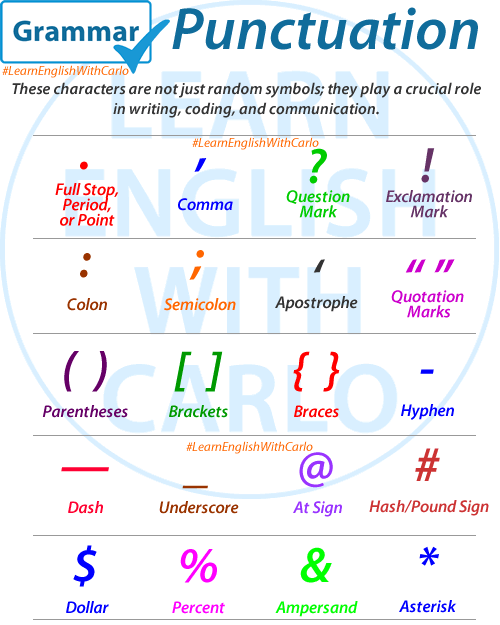
Keyboard Characters and Punctuation Marks

These characters are not just random symbols; they play a crucial role in writing, coding, and communication. You will learn their names, definitions, and multiple uses with practical examples. Whether you’re writing an email, composing a document, or exploring programming, knowing how to use these symbols correctly will enhance your efficiency and effectiveness.

  1. Period (.) Also called Full Stop, and Point (with numbers)
    Definition 1: Used to indicate the end of a sentence.
    Example: “This is a sentence.”
    Definition 2: Used in decimal numbers.
    Example: “Pi is $3.14.” (three point one four)
  2. Comma (,)
    Definition 1: Used to separate items in a list.
    Example: “I bought apples, oranges, and bananas.”
    Definition 2: Used to indicate a pause in a sentence.
    Example: “After dinner, we went for a walk.”
  3. Question Mark (?)
    Definition: Used at the end of a sentence to indicate a question.
    “What is your name?”
  4. Exclamation Mark (!)
    Definition: Used to show excitement, emphasis, or a command.
    “Wow! That was amazing!”
  5. Colon (:)
    Definition 1: Used to introduce a list, a quotation, or an explanation.
    Example: “She bought the following: apples, oranges, and bananas.”
    Definition 2: Used in time expressions.
    Example: “The meeting is at 3:30 PM.”
  6. Semicolon (;)
    Definition: Used to connect closely related independent clauses.
    “I have a big test tomorrow; I can’t go out tonight.”
  7. Apostrophe (‘)
    Definition 1: Used to indicate possession.
    Example: “It’s John’s book.”
    Definition 2: Used in contractions to show omitted letters.
    Example: “It’s a beautiful day.”
  8. Quotation Marks (” “)
    Definition 1: Used to enclose direct speech or quotations.
    Example: “He said, ‘Hello!'”
    Definition 2: Used to indicate titles of short works.
    Example: “I love the short story ‘The Lottery.'”
  9. Parentheses ( )
    Definition 1: Used to enclose additional information or clarifying details.
    Example: “He finally answered (after taking five minutes to think).”
    Definition 2: Used in mathematical expressions to indicate grouping.
    Example: “(3 + 2) * 5 = 25”
  10. Brackets [ ]
    Definition 1: Used to insert additional information or explanations within quoted text.
    Example: “She said it was ‘a wonderful [but challenging] experience.'”
    Definition 2: Used in technical manuals to indicate optional items.
    Example: “Press [Enter] to continue.”
  11. Braces { }
    Definition 1: Used in mathematics and programming to group statements or expressions.
    Example: “if (x > 0) { y = 1; }”
    Definition 2: Used in sets to indicate elements.
    Example: “{1, 2, 3, 4, 5}”
  12. Hyphen (-)
    Definition 1: Used to join words.
    Example: “Long-term project”
    Definition 2: Used to indicate a range.
    Example: “The event is from 3-5 PM.”
  13. Dash (—)
    Definition 1: Used to indicate a break or interruption in a sentence.
    Example: “He was going to—well, never mind.”
    Definition 2: Used to set off parenthetical elements.
    Example: “My friend—who is also my colleague—will join us.”
  14. Underscore (_)
    Definition: Used to create space in usernames or email addresses.
    “My_username”
  15. At Sign (@)
    Definition 1: Commonly used in email addresses to separate the username from the domain.
    Example: “My email is example@domain.com”
    Definition 2: Used in social media to mention or tag someone.
    Example: “Follow us @ourcompany”
  16. Hash/Pound Sign (#)
    Definition 1: Used to indicate numbers.
    Example: “Please enter your #.”
    Definition 2: Used on social media for hashtags.
    Example: “I love #learning”
  17. Dollar Sign ($)
    Definition: Represents currency in the United States and other countries.
    “This book costs $15.”
  18. Percent Sign (%)
    Definition: Indicates a percentage.
    “50% of the students passed the test.”
  19. Caret (^)
    Definition 1: Used in mathematical expressions to indicate exponents.
    Example: “2^3 means 2 to the power of 3.”
    Definition 2: Used in editing to indicate where something should be inserted.
    Example: “Insert the word here ^”
  20. Ampersand (&)
    Definition: Represents the word “and.”
    “Salt & pepper”
  21. Asterisk (*)
    Definition 1: Often used to indicate a footnote.
    Example: “Check the note at the bottom*”
    Definition 2: Used in programming and coding for various purposes, such as pointers in C.
    Example: “int *ptr”
  22. Equal Sign (=)
    Definition 1: Used in mathematics to show equality.
    Example: “2 + 2 = 4”
    Definition 2: Used in programming to assign values.
    Example: “x = 10”
  23. Plus Sign (+)
    Definition 1: Indicates addition.
    Example: “5 + 3 = 8”
    Definition 2: Used to indicate a positive value.
    Example: “+10 degrees”
  24. Minus Sign (-)
    Definition 1: Indicates subtraction.
    Example: “10 – 5 = 5”
    Definition 2: Used to indicate a negative value.
    Example: “-10 degrees”
  25. Backslash (\)
    Definition 1: Used in file paths.
    Example: “C:\Users\Username”
    Definition 2: Used in coding to escape characters.
    Example: “newline character is \n”
  26. Forward Slash (/)
    Definition 1: Used in URLs.
    Example: “http://www.example.com”
    Definition 2: Used to separate directories.
    Example: “/home/user/docs”

Wrong shortcode initialized
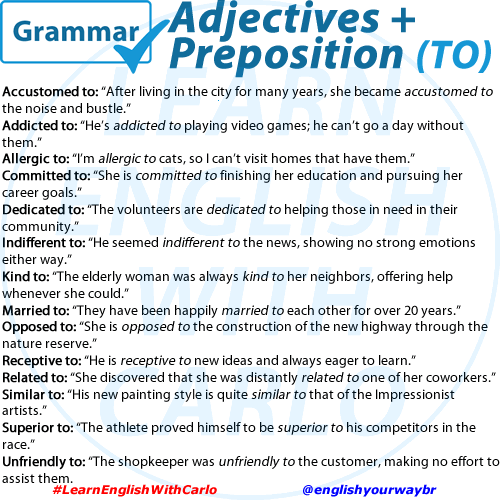
Adjectives + Prepositions (TO)

Let’s dive into the fascinating world of adjectives paired with prepositions! In English, certain adjectives are commonly followed by specific prepositions to express various relationships, attitudes, and qualities. Understanding these combinations can greatly enhance our language skills and enrich our expressions. Join me as we explore some examples of adjectives paired with prepositions and discover how they bring depth and nuance to our communication.

ADJECTIVE + TO

  1. Accustomed to: Familiar with something through habit or experience.
    For example, “After living in the city for many years, she became accustomed to the noise and bustle.”
  2. Addicted to: Physically or mentally dependent on something, often in a harmful way.
    For example, “He’s addicted to playing video games; he can’t go a day without them.”
  3. Allergic to: Having a hypersensitivity or immune reaction to a particular substance.
    For example, “I’m allergic to cats, so I can’t visit homes that have them.”
  4. Committed to: Dedicated and loyal to a cause, activity, or person.
    For example, “She is committed to finishing her education and pursuing her career goals.”
  5. Dedicated to: Devoted and focused on a particular purpose or goal.
    For example, “The volunteers are dedicated to helping those in need in their community.”
  6. Indifferent to: Showing no interest, concern, or sympathy.
    For example, “He seemed indifferent to the news, showing no strong emotions either way.”
  7. Kind to: Showing kindness and compassion towards others.
    For example, “The elderly woman was always kind to her neighbors, offering help whenever she could.”
  8. Married to: In a legally recognized marriage with someone.
    For example, “They have been happily married to each other for over 20 years.”
  9. Opposed to: In conflict or disagreement with something.
    For example, “She is opposed to the construction of the new highway through the nature reserve.”
  10. Receptive to: Open and responsive to new ideas, experiences, or suggestions.
    For example, “He is receptive to new ideas and always eager to learn.”
  11. Related to: Connected by blood or family ties.
    For example, “She discovered that she was distantly related to one of her coworkers.”
  12. Similar to: Resembling or having characteristics in common with something else.
    For example, “His new painting style is quite similar to that of the Impressionist artists.”
  13. Superior to: Higher in quality, rank, or importance than something else.
    For example, “The athlete proved himself to be superior to his competitors in the race.”
  14. Unfriendly to: Not showing friendliness or warmth towards someone.
    For example, “The shopkeeper was unfriendly to the customer, making no effort to assist them.”

Wrong shortcode initialized

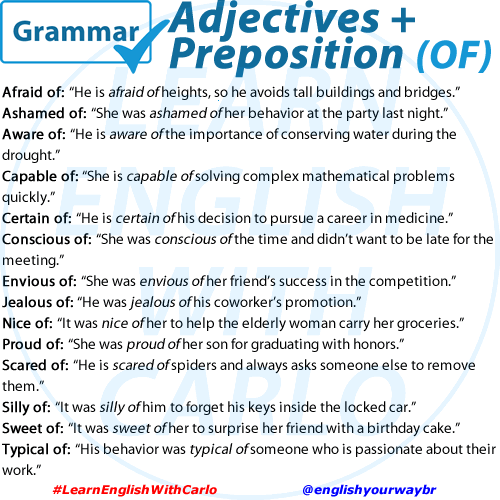
Adjectives + Prepositions (OF)

We are continuing our dive into the fascinating world of adjectives paired with prepositions! In English, certain adjectives are commonly followed by specific prepositions to express various relationships, attitudes, and qualities. Understanding these combinations can greatly enhance our language skills and enrich our expressions. Join me as we explore examples of adjectives paired with prepositions and discover how they bring depth and nuance to our communication.

  • Afraid of: Feeling fear or apprehension about something.
    “He is afraid of heights, so he avoids tall buildings and bridges.”
  • Ashamed of: Feeling shame or embarrassment about something one has done.
    “She was ashamed of her behavior at the party last night.”
  • Aware of: Having knowledge or consciousness about something.
    “He is aware of the importance of conserving water during the drought.”
  • Capable of: Having the ability or capacity to do something.
    “She is capable of solving complex mathematical problems quickly.”
  • Certain of: Having complete confidence or assurance about something.
    “He is certain of his decision to pursue a career in medicine.”
  • Conscious of: Being aware or mindful of something.
    “She was conscious of the time and didn’t want to be late for the meeting.”
  • Envious of: Feeling jealousy or resentment towards someone for their possessions, qualities, or achievements.
    “She was envious of her friend’s success in the competition.”
  • Jealous of: Feeling resentment or suspicion towards someone’s possessions, relationships, or achievements.
    “He was jealous of his coworker’s promotion.”
  • Nice of: Showing kindness or generosity towards someone.
    “It was nice of her to help the elderly woman carry her groceries.”
  • Proud of: Feeling a sense of satisfaction or accomplishment regarding oneself or someone else.
    “She was proud of her son for graduating with honors.”
  • Scared of: Feeling fear or apprehension towards something.
    “He is scared of spiders and always asks someone else to remove them.”
  • Silly of: Behaving in a foolish or nonsensical manner.
    “It was silly of him to forget his keys inside the locked car.”
  • Sweet of: Showing affection or thoughtfulness towards someone.
    “It was sweet of her to surprise her friend with a birthday cake.”
  • Typical of: Exhibiting the characteristics or qualities that are usual or expected for a particular person, thing, or group.
    “His behavior was typical of someone who is passionate about their work.”

Wrong shortcode initialized

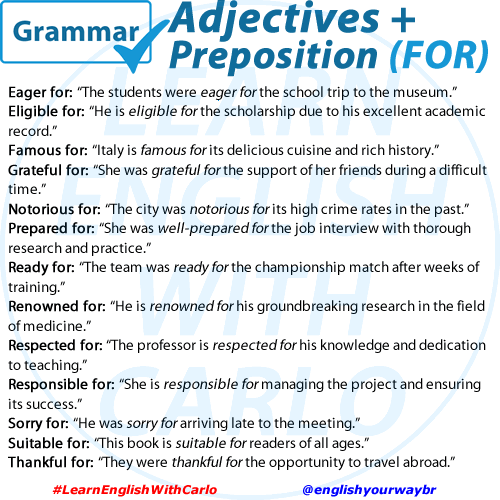
Adjectives + Prepositions (FOR)

We are continuing our dive into the fascinating world of adjectives paired with prepositions! In English, certain adjectives are commonly followed by specific prepositions to express various relationships, attitudes, and qualities. Understanding these combinations can greatly enhance our language skills and enrich our expressions. Join me as we explore examples of adjectives paired with prepositions and discover how they bring depth and nuance to our communication.

  • Eager for: Showing keen interest or enthusiasm for something.
    Example: “The students were eager for the school trip to the museum.”
  • Eligible for: Meeting the criteria to qualify for something.
    Example: “He is eligible for the scholarship due to his excellent academic record.”
  • Famous for: Well-known or recognized for a particular trait or achievement.
    Example: “Italy is famous for its delicious cuisine and rich history.”
  • Grateful for: Feeling or expressing thanks or appreciation for something.
    Example: “She was grateful for the support of her friends during a difficult time.”
  • Notorious for: Known widely and unfavorably for something negative or infamous.
    Example: “The city was notorious for its high crime rates in the past.”
  • Prepared for: Ready or equipped for a particular situation or task.
    Example: “She was well-prepared for the job interview with thorough research and practice.”
  • Ready for: Prepared and in a suitable condition for something.
    Example: “The team was ready for the championship match after weeks of training.”
  • Renowned for: Widely acclaimed and respected for excellence or achievement.
    Example: “He is renowned for his groundbreaking research in the field of medicine.”
  • Respected for: Held in high regard or esteem for qualities or achievements.
    Example: “The professor is respected for his knowledge and dedication to teaching.”
  • Responsible for: Having an obligation or duty to deal with or oversee something.
    Example: “She is responsible for managing the project and ensuring its success.”
  • Sorry for: Feeling regret or remorse for something.
    Example: “He was sorry for arriving late to the meeting.”
  • Suitable for: Appropriate or fitting for a particular purpose or situation.
    Example: “This book is suitable for readers of all ages.”
  • Thankful for: Feeling or expressing gratitude or appreciation for something.
    Example: “They were thankful for the opportunity to travel abroad.”

Wrong shortcode initialized

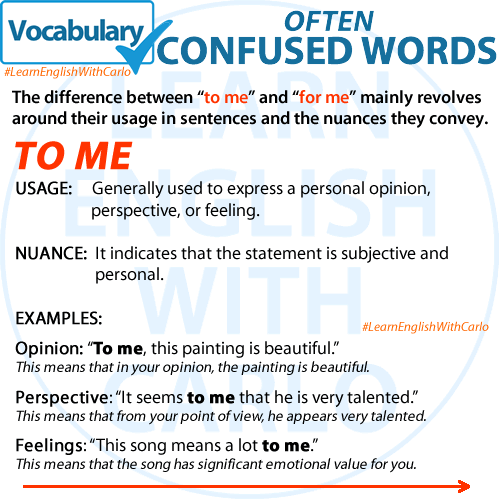
TO ME or FOR ME

The difference between “to me” and “for me” mainly revolves around their usage in sentences and the nuances they convey. Here’s a breakdown:

“To me”

  • Usage: Generally used to express a personal opinion, perspective, or feeling.
  • Nuance: It indicates that the statement is subjective and personal.

Examples:

  1. Opinion: “To me, this painting is beautiful.”
    • This means that in your opinion, the painting is beautiful.
  2. Perspective: “It seems to me that he is very talented.”
    • This means that from your point of view, he appears very talented.
  3. Feelings: “This song means a lot to me.”
    • This means that the song has significant emotional value for you.

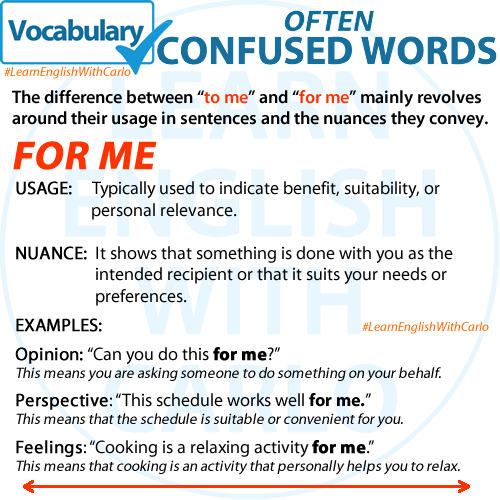
“For me”

  • Usage: Typically used to indicate benefit, suitability, or personal relevance.
  • Nuance: It shows that something is done with you as the intended recipient or that it suits your needs or preferences.

Examples:

  1. Benefit: “Can you do this for me?”
    • This means you are asking someone to do something on your behalf.
  2. Suitability: “This schedule works well for me.”
    • This means that the schedule is suitable or convenient for you.
  3. Personal relevance: “Cooking is a relaxing activity for me.”
    • This means that cooking is an activity that personally helps you to relax.

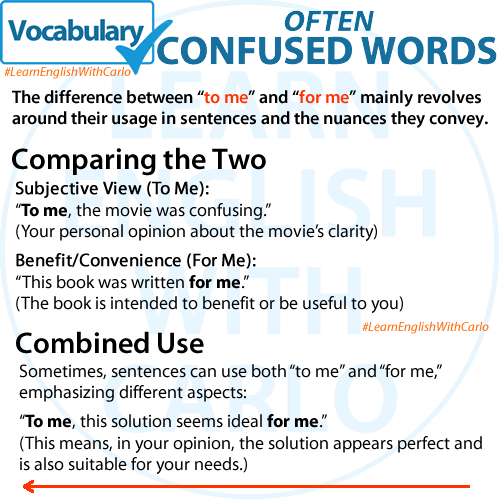
Comparing the Two

  • Subjective View (To Me):
    • “To me, the movie was confusing.” (Your personal opinion about the movie’s clarity)
  • Benefit/Convenience (For Me):
    • “This book was written for me.” (The book is intended to benefit or be useful to you)

Combined Use

Sometimes, sentences can use both “to me” and “for me,” emphasizing different aspects:

  • “To me, this solution seems ideal for me.”
    • This means, in your opinion, the solution appears perfect and is also suitable for your needs.

Understanding the difference between “to me” and “for me” helps in conveying your thoughts more precisely and appropriately in various contexts.

Wrong shortcode initialized