WHOSE vs. WHO’S: What’s the Difference?

The words WHOSE and WHO’S may sound the same when spoken (both pronounced /ho͞oz/), but they have very different meanings and uses in English. Learning to use them correctly will help you avoid common mistakes in writing and speaking.
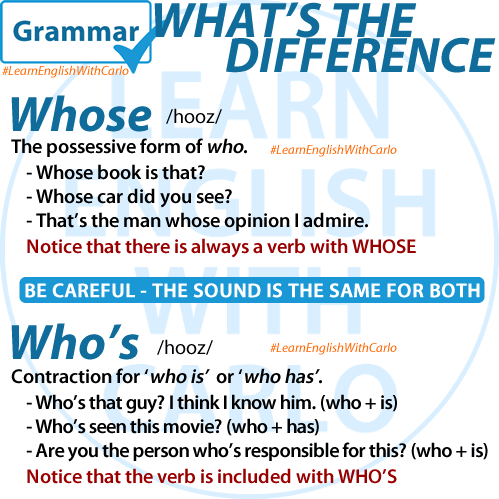
WHOSE: Possessive Pronoun

WHOSE is a possessive pronoun used to ask or talk about ownership or relationships. It shows that something belongs to someone or is connected to someone.

Examples:

  • Whose bag is this?
    (Asking who owns the bag.)
  • I met a girl whose brother is a famous actor.
    (Talking about the girl’s brother.)
  • Whose idea was it to organize the trip?
    (Asking about the person who had the idea.)

Tip: If you see WHOSE in a sentence, it’s always asking or referring to possession.


WHO’S: Contraction

WHO’S is a contraction, meaning it’s a shorter form of who is or who has.

Examples:

  • Who’s coming to the meeting?
    (Who is coming to the meeting?)
  • Who’s been to Italy before?
    (Who has been to Italy before?)
  • Do you know who’s in charge of this project?
    (Who is in charge of this project?)

Tip: To test if WHO’S is correct, try replacing it with who is or who has. If the sentence still makes sense, you’re using the right word.


BE CAREFUL: They Sound the Same!

Both words are pronounced /ho͞oz/, which makes it easy to confuse them when writing. To avoid mistakes, check the following:

Is it asking about or showing possession?
If yes, use WHOSE.

Does the sentence need a verb?
If yes, use WHO’S (who is or who has).

Summary Chart: WHOSE vs. WHO’S

WordFunctionMeaningExample
WHOSEPossessive PronounBelonging to someoneWhose book is this?
WHO’SContractionWho is / Who hasWho’s calling me? / Who’s been here?

By understanding these differences and practicing with real examples, you’ll never confuse WHOSE and WHO’S again!

Practice Makes Perfect: Try This Quiz!

Fill in the blank with WHOSE or WHO’S:

  1. ___ jacket is on the chair?
  2. ___ the person in charge of the event?
  3. I have a neighbor ___ dog barks all night.
  4. ___ been to this restaurant before?
  5. Do you know ___ turn it is to speak?
  6. The man ___ wallet was found came to the office.
  7. ___ ready to leave now?

Answers

  1. Whose (Possession: Whose jacket?)
  2. Who’s (Who is the person?)
  3. Whose (Possession: Whose dog?)
  4. Who’s (Who has been?)
  5. Whose (Possession: Whose turn?)
  6. Whose (Possession: Whose wallet?)
  7. Who’s (Who is ready?)

VOCABULARY – Informal Contractions

VOCABULARY – Informal (spoken) Contractions

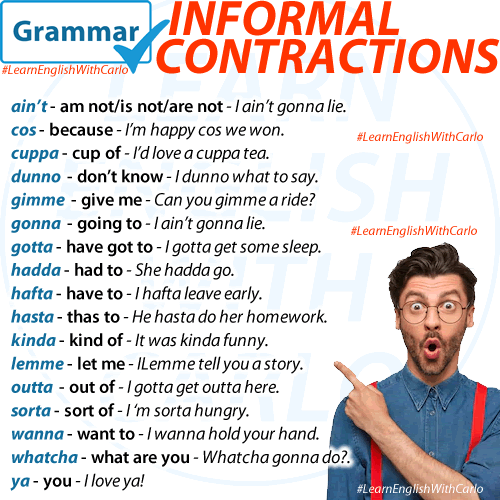
In English, as in most other languages, there are ways to shorten groups of words that commonly go together. We don’t do this in writing, just when we speak. They are called informal or spoken, contractions.

  • ain’t – am not/is not/are not – I ain’t gonna lie.
  • cos – because – I’m happy cos we won.
  • cuppa – cup of – I’d love a cuppa tea.
  • dunno – don’t know – I dunno what to say.
  • gimme – give me – Can you gimme a ride?
  • gonna – going to – I ain’t gonna lie.
  • gotta – have got to – I gotta get some sleep.
  • hadda – had to – She hadda go.
  • hafta – have to – I hafta leave early.
  • hasta – thas to – He hasta do her homework.
  • kinda – kind of – It was kinda funny.
  • lemme – let me – ILemme tell you a story.
  • outta – out of – I gotta get outta here.
  • sorta – sort of – I ‘m sorta hungry.
  • wanna – want to – I wanna hold your hand.
  • whatcha – what are you – Whatcha gonna do?
  • ya – you – I love ya!

Uses of “Off” as a Preposition

The preposition “off” has many different uses in English, depending on the context. Here’s a breakdown of its main uses:

1. Separation or Removal

  • “Off” indicates that something is being moved away from or removed.
  • Examples:
    • “He took his jacket off.”
    • “She fell off the chair.”
    • “I cut a piece off the cake.”

2. Starting Point (in Time or Space)

  • It can indicate the beginning of something or a point of departure.
  • Examples:
    • “The plane took off at noon.” (departure)
    • “The meeting is off to a great start.”

3. Away from Work or Duty

  • Used to refer to a break or time away from work or regular activities.
  • Examples:
    • “I’m taking the day off tomorrow.”
    • “She’s off work today.”

4. Deactivation or Disconnection

  • “Off” indicates that something is no longer active, connected, or operational.
  • Examples:
    • “Turn the light off.”
    • “The alarm went off.” (meaning it sounded)

5. Distance or Separation

  • Used to describe physical distance or separation from something.
  • Examples:
    • “The restaurant is just a few miles off the highway.”
    • “The island is located 20 kilometers off the coast.”

6. Reduced or Discounted

  • Used to show a reduction in price or quantity.
  • Examples:
    • “Everything in the store is 20% off.”
    • “You get $5 off your next purchase.”

7. Cancellation or Suspension

  • “Off” can also mean that something has been canceled or postponed.
  • Examples:
    • “The meeting is off due to bad weather.”
    • “The deal is off.”

8. Condition or Behavior

  • It can indicate someone’s state or behavior, often implying something is wrong.
  • Examples:
    • “She seems a bit off today.” (meaning she is not acting like herself)
    • “His behavior was a little off.”

9. Not Touching or Not Attached

  • Indicates that something is not attached or connected.
  • Examples:
    • “Keep your hands off the table.”
    • “The lid won’t come off.”

10. From a Surface or Higher Place

  • When something is removed from a surface or a higher position.
  • Examples:
    • “Please get your feet off the couch.”
    • “He jumped off the wall.”

11. Suspension or Pause in an Action

  • When an action is paused or stopped temporarily.
  • Examples:
    • “The TV show is off the air.” (temporarily not broadcast)
    • “We’ll pick up where we left off.”

12. Away from Focus or Purpose

  • Indicates deviation from the main subject or goal.
  • Examples:
    • “We got off track during the meeting.”
    • “I think I’m off topic.”

Summary of Common Uses of “Off” as a Preposition:

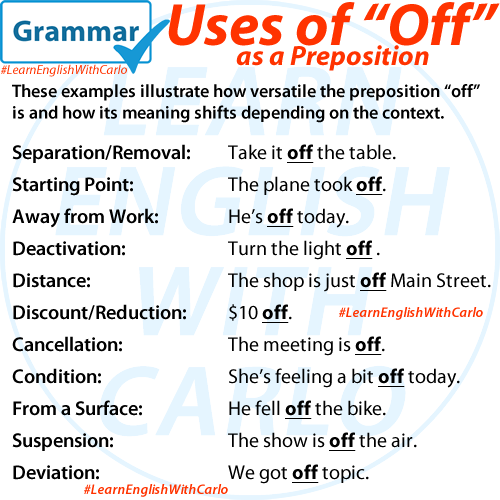
  • Separation/Removal: Take it off the table.
  • Starting Point: The plane took off.
  • Away from Work: He’s off today.
  • Deactivation: Turn the light off.
  • Distance: The shop is just off Main Street.
  • Discount/Reduction: $10 off.
  • Cancellation: The meeting is off.
  • Condition: She’s feeling a bit off today.
  • From a Surface: He fell off the bike.
  • Suspension: The show is off the air.
  • Deviation: We got off topic.

These examples illustrate how versatile the preposition “off” is and how its meaning shifts depending on the context.

Wrong shortcode initialized

Grammar: Verb Suffix -EN

Turn Adjectives & Nouns into Verbs!

Did you know you can add -EN to some adjectives and nouns to create verbs? This is a powerful and useful suffix in English. It often means “to make” or “to become” something.

In this post, we’ll look at how this suffix works and give you plenty of examples to help you use it correctly.


🔤 What Does the Suffix -EN Mean?

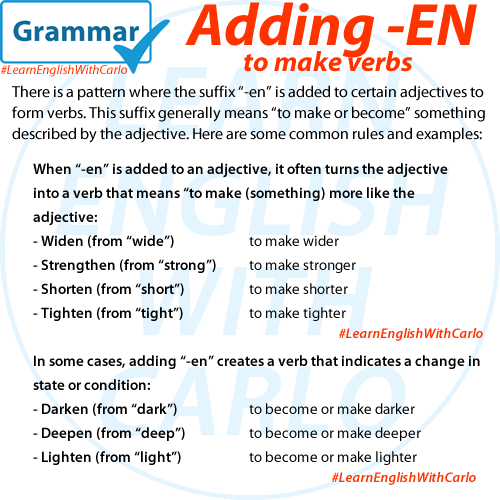
The -EN suffix is added to certain adjectives and nouns to form verbs. These new verbs usually describe a change in state — something becoming or being made a certain way.


Adjective ➡ Verb

When added to an adjective, -EN means “to make” the quality stronger or more true.

AdjectiveVerb with -ENMeaning
widewidento make wide
shortshortento make short or shorter
darkdarkento make or become dark
deepdeepento make or become deep
brightbrightento make brighter
looseloosento make loose
tighttightento make tight or tighter

📌 Examples in sentences:

  • We need to widen the road.
  • The days shorten in winter.
  • Please tighten the lid.
  • Clouds began to darken the sky.

Noun ➡ Verb

Some nouns can also take the -EN suffix to form verbs, often with the meaning “to make more of that quality.”

NounVerb with -ENMeaning
strengthstrengthento make stronger
lengthlengthento make longer
heightheightento make higher
depthdeepento make deeper

📌 Examples in sentences:

  • We need to strengthen the structure.
  • They want to lengthen the school day.
  • Meditation can deepen your focus.

⚠️ Not All Adjectives or Nouns Use -EN

Unfortunately, you can’t add -EN to every adjective or noun. For example:

  • beautyen (instead: beautify)
  • smarten (instead: smart is already an adjective and verb)

If you’re unsure, check a dictionary to see if the verb form exists.


🧠 Practice Time!

Choose the correct -EN verb to complete each sentence:

  1. The coach told us to ______ our focus.
  2. You should ______ your grip on the handle.
  3. Can we ______ the meeting by 30 minutes?
  4. The medicine helped to ______ the pain.
  5. The sunset began to ______ the sky.

Answers:

  1. deepen
  2. tighten
  3. lengthen
  4. lessen
  5. darken

📝 Summary

The -EN suffix:

  • Turns adjectives and nouns into verbs
  • Means “to make” or “to become”
  • Is used with certain words, not all

Learning how to use -EN verbs can help you express change and transformation clearly in English!

GRAMMAR Adjective + Preposition


Adjectives are words used to describe a person, place, or thing, for example, The tall man in the red shirt is a friend of mine. We drove along a quiet road until reaching a small town. I’m reading an interesting book. Prepositions are words used to connect two ideas or to demonstrate the relationship between two concepts.
Examples of prepositions in English include at, in, on, for, to, with, and from.

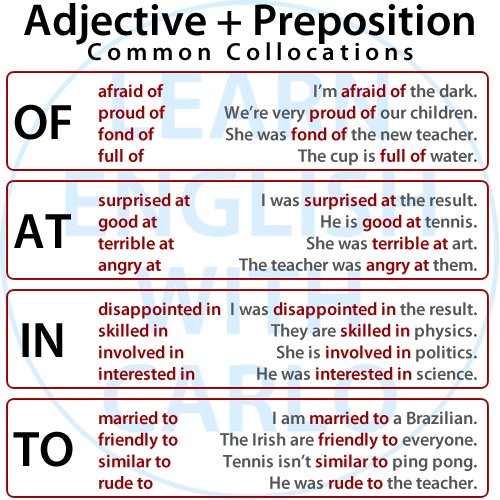
Adjective + Preposition Combinations
There are many cases in which adjectives are combined with prepositions – but there is no rule stating when to use which combination.
As you read and listen to more English, you will become more and more familiar with how these adjective-prepositions combinations are used. Here are a few of the more common combinations of adjectives and prepositions in English.

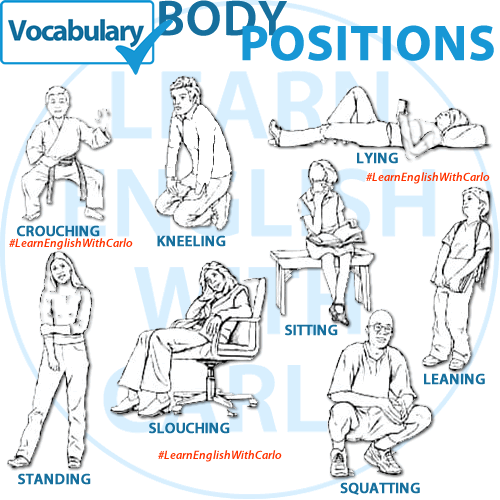
VOCABULARY – Body Positions

We place our bodies in different positions depending on what we are doing.

Do you know the names of the different positions?

One of my INSTAGRAM followers asked to use each one in a sentence, so here you go:

  • Kneeling – He was kneeling when he asked her to marry him.
  • Lying – My daughter loves lying in the sun.
  • Slouching – Sometimes when a student is  bored or tired you might see them slouching in their chair during class.
  • Crouching – When you want to make yourself smaller, or lower your center of gravity, you could be seen crouching.
  • Leaning – The kids in the playground are often seen leaning against the side of the building and chatting.
  • Squating – I saw him squatting down to pet the little dog. You can also see people squatting at the gym. It helps to strengthen legs and buttocks.
  • Sitting – I am currently sitting n front of my computer typing this!
  • Standing – When you’re on your feet but not moving – you’re standing.

Can you think of any other positions?

If you have any questions or doubts, please ask in the comments or send me a private message.

Follow me on Instagram: @englishyourwaybr
or look for the hashtag #LearnEnglishWithCarlo

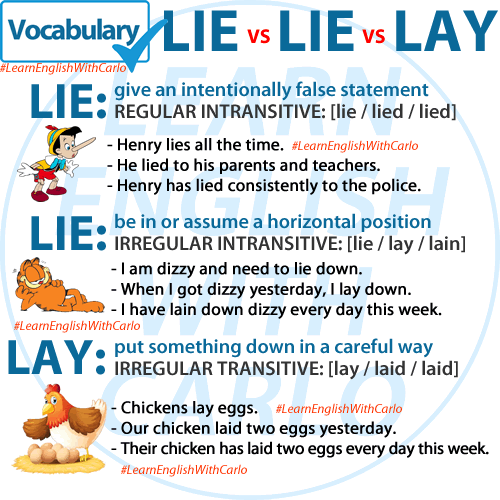
Lie vs. Lie vs. Lay: Understanding the Differences

English can be tricky, especially when it comes to words that sound the same but have different meanings and uses. A common source of confusion is the difference between “lie,” “lie,” and “lay.” These three words are often mixed up, but understanding their meanings and how they are used can help you use them correctly. Let’s break it down:

1. LIE (to give an intentionally false statement)

  • Meaning: This “lie” is used when someone says something untrue on purpose.
  • Type of Verb: Regular Intransitive (It doesn’t take a direct object)
  • Forms: lie / lied / lied

Examples:

  • Present: Henry lies all the time.
  • Past: He lied to his parents and teachers.
  • Present Perfect: Henry has lied consistently to the police.

Tip: If you’re talking about telling an untruth, this is the “lie” you want to use.

2. LIE (to be in or assume a horizontal position)

  • Meaning: This “lie” refers to the act of being in a flat position, usually on a surface like a bed or the ground.
  • Type of Verb: Irregular Intransitive (It doesn’t take a direct object)
  • Forms: lie / lay / lain

Examples:

  • Present: I am dizzy and need to lie down.
  • Past: When I got dizzy yesterday, I lay down.
  • Present Perfect: I have lain down dizzy every day this week.

Tip: Think of this “lie” when you’re talking about resting, reclining, or being in a flat position.

3. LAY (to put something down carefully)

  • Meaning: This verb is used when you are placing something down gently or with care.
  • Type of Verb: Irregular Transitive (It requires a direct object)
  • Forms: lay / laid / laid

Examples:

  • Present: Chickens lay eggs.
  • Past: Our chicken laid two eggs yesterday.
  • Present Perfect: Their chicken has laid two eggs every day this week.

Tip: Use “lay” when you’re talking about placing something down. Remember, this verb always needs a direct object – something that is being laid down.

How to Remember the Differences:

  • Lie (untruth) – Focuses on something false. Think: “Tell a lie.”
  • Lie (recline) – Focuses on resting or reclining. Think: “Lie down.”
  • Lay (place) – Focuses on placing something. Think: “Lay an object down.”

Quick Reference Table

VerbMeaningTypeFormsExample Sentence
Lie (1)To say something untrueRegular Intransitivelie / lied / lied“He lied to his parents.”
Lie (2)To recline or restIrregular Intransitivelie / lay / lain“I lay down yesterday.”
LayTo place something downIrregular Transitivelay / laid / laid“She laid the book on the table.”

Wrong shortcode initialized

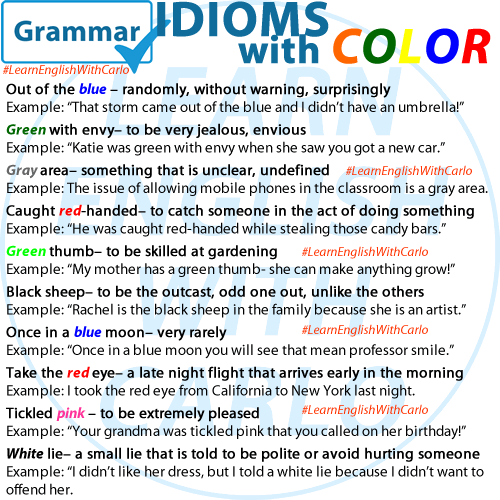
GRAMMAR – Idioms with color

Out of the blue – randomly, without warning, surprisingly
Example: “That storm came out of the blue and I didn’t have an umbrella!”

Green with envy– to be very jealous, envious
Example: “Katie was green with envy when she saw you got a new car for your birthday.”

Gray area – something that is unclear, undefined
Example: The issue of allowing mobile phones in the classroom is a gray area right now- it could go either way.

Caught red-handed – to catch someone in the act of doing something
Example: “He was caught red-handed while stealing those candy bars.”

Green thumb – to be skilled at gardening
Example: “My mother has a green thumb- she can make anything grow!”

Black sheep – to be the outcast, the odd one out, unlike the others
Example: “Rachel is the black sheep in the family because she is an artist whereas everyone else is an economist.”

Once in a blue moon – very rarely
Example: “Once in a blue moon you will see that mean professor smile.”

Take the Red Eye – a late-night flight that arrives early in the morning
Example: “I took the red eye from California to New York last night and now I am exhausted.”

Tickled pink – to be extremely pleased
Example: “Your grandma was tickled pink that you called on her birthday!”

White lie – a small lie that is told to be polite s
Example: “I didn’t like her dress, but I told a white lie because I didn’t want to offend her.

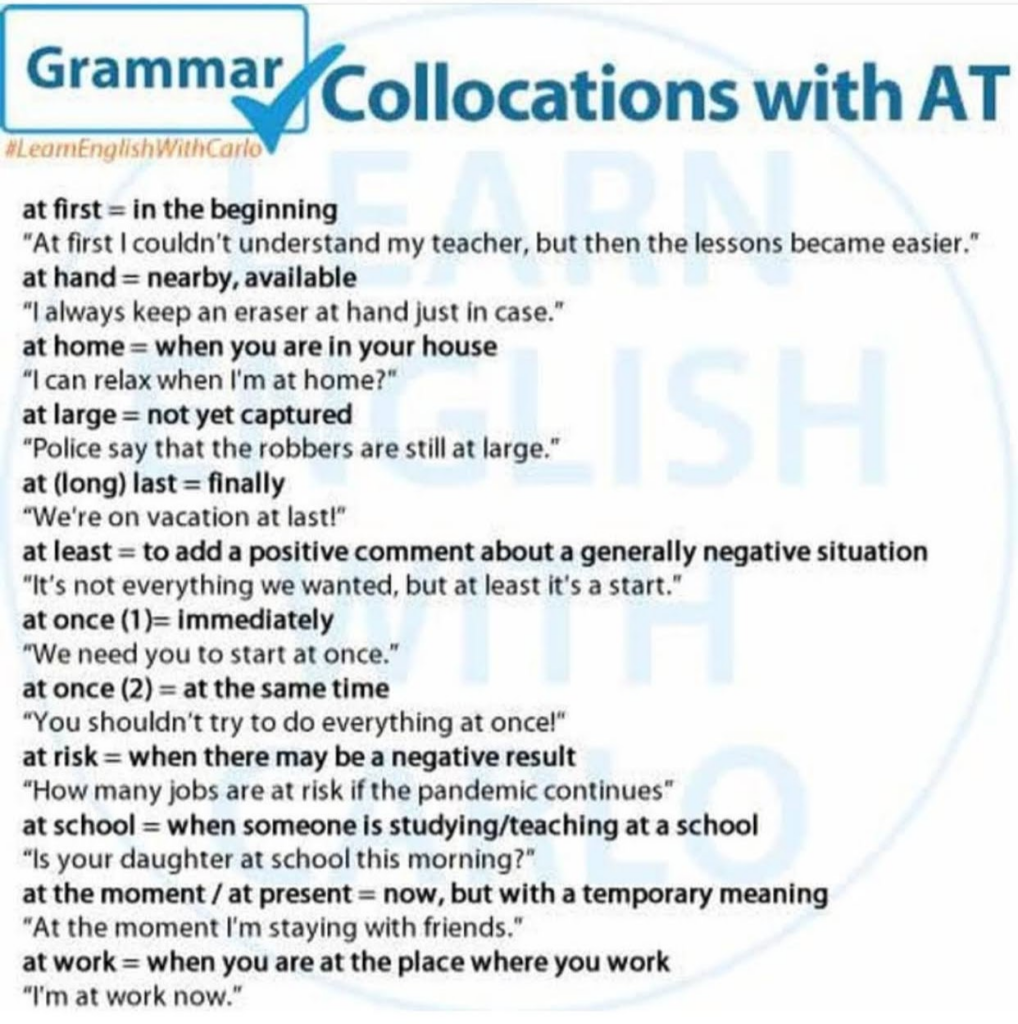
GRAMMAR – Collocations with AT

The preposition “at” is used in many common expressions in English, each with unique meanings. Below, you’ll find clear explanations and examples to help you understand and use these expressions confidently. Let’s explore!

1. At First = In the beginning

This expression describes the initial phase of something, often followed by a change.

Examples:

  • At first, I couldn’t understand my teacher, but then the lessons became easier.
  • At first, she didn’t like her new job, but now she loves it.
  • At first, we thought the movie was boring, but it got exciting halfway through.

2. At Hand = Nearby or available

This phrase refers to something that is close by and ready to use.

Examples:

  • I always keep an eraser at hand just in case.
  • Make sure you have all the documents at hand before the meeting.
  • With my phone at hand, I never miss an important call.

3. At Home = When you are in your house

This phrase refers to the comfort or state of being in your own living space.

Examples:

  • I can relax when I’m at home.
  • Is your brother at home, or has he gone out?
  • At home, we usually eat dinner together as a family.

4. At Large = Not yet captured

This expression is often used in reports about someone, usually a criminal, who hasn’t been caught.

Examples:

  • Police say that the robbers are still at large.
  • The escaped prisoner is still at large and considered dangerous.
  • Several suspects remain at large following the bank robbery.

5. At (Long) Last = Finally

Use this expression to express relief or happiness when something you’ve been waiting for happens.

Examples:

  • We’re on vacation at last!
  • At last, the construction of the new library is complete.
  • After years of hard work, she achieved her dream at long last.

6. At Least = To add a positive comment about a generally negative situation

This phrase highlights a small benefit in an otherwise disappointing scenario.

Examples:

  • It’s not everything we wanted, but at least it’s a start.
  • The weather isn’t great, but at least it’s not raining.
  • We didn’t win the game, but at least we tried our best.

7. At Once (1) = Immediately

This version is used to demand or describe immediate action.

Examples:

  • We need you to start at once.
  • Call an ambulance at once—this is an emergency!
  • The manager asked them to fix the issue at once.

8. At Once (2) = At the same time

This version describes multiple actions or events happening simultaneously.

Examples:

  • You shouldn’t try to do everything at once!
  • It’s hard to focus when too many people are talking at once.
  • The children started shouting and laughing at once.

9. At Risk = When there may be a negative result

This expression describes situations where danger, harm, or loss is possible.

Examples:

  • How many jobs are at risk if the pandemic continues?
  • The company’s reputation is at risk after the scandal.
  • Without proper safety measures, workers are at risk of injury.

10. At School = When someone is studying or teaching at a school

This phrase refers to being physically present at an educational institution.

Examples:

  • Is your daughter at school this morning?
  • The kids are at school until 3 p.m.
  • At school, we learned about different cultures and traditions.

11. At the Moment / At Present = Now, but with a temporary meaning

These phrases are used to describe a current situation that is likely to change.

Examples:

  • At the moment, I’m staying with friends.
  • We’re not hiring at present, but check back next month.
  • At the moment, they’re renovating their house, so it’s a bit chaotic.

12. At Work = When you are at the place where you work

This phrase indicates that someone is physically present at their job or workplace.

Examples:

  • I’m at work now.
  • She’s always very busy when she’s at work.
  • At work, we’re preparing for a big presentation next week.

Final Thoughts

Expressions with “at” are incredibly versatile and useful in everyday English. By practicing these phrases in context, you’ll not only expand your vocabulary but also sound more fluent and natural.

Which of these expressions do you find the most challenging or useful? Share your thoughts and examples in the comments below!

Wrong shortcode initialized

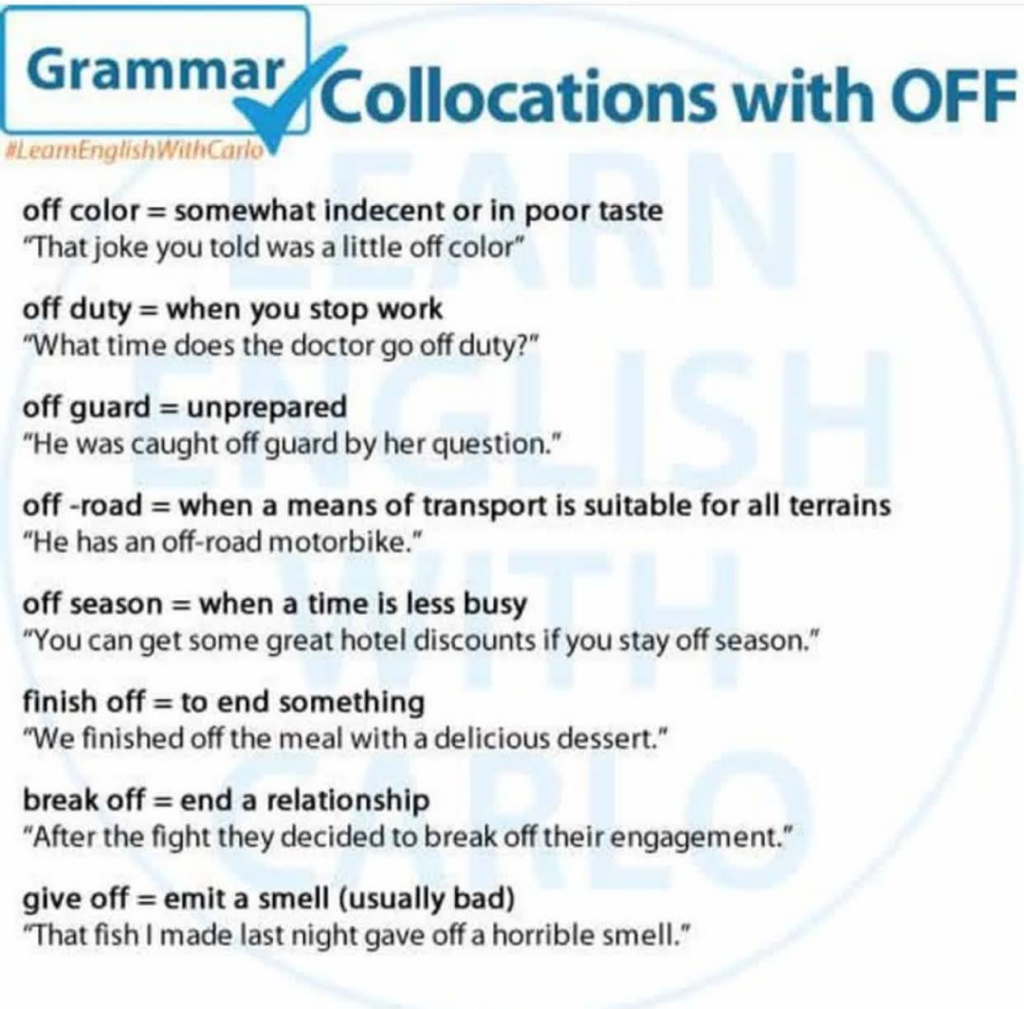
GRAMMAR – Collocations with off

The English preposition “off” has a variety of meanings and uses, often forming part of idiomatic expressions and collocations. In this blog post, we’ll explore some common expressions with “off,” provide clear definitions, and share examples for each. Let’s dive in!

1. Off Color

Definition: Something that is somewhat indecent, inappropriate, or in poor taste.
Examples:

  • “That joke you told at the dinner party was a little off color; some people seemed uncomfortable.”
  • “His remarks during the meeting were slightly off color and didn’t sit well with the team.”
  • “The comedian apologized after his off-color comments upset the audience.”

Additional Collocations:

  • Off-color humor
  • Off-color remarks

2. Off Duty

Definition: Not working; no longer on a shift.
Examples:

  • “What time does the doctor go off duty? I need to speak to her before she leaves.”
  • “The police officer was off duty but still helped control the situation.”
  • “We saw a firefighter enjoying his day off duty with his family at the park.”

Additional Collocations:

  • Off-duty hours
  • Off-duty conduct

3. Off Guard

Definition: Unprepared or surprised by something.
Examples:

  • “He was caught off guard by her unexpected question during the interview.”
  • “The sudden announcement caught everyone off guard.”
  • “I didn’t study for the pop quiz, so I was completely off guard when the teacher handed it out.”

Additional Collocations:

  • Catch someone off guard
  • Be off guard

4. Off-Road

Definition: Refers to vehicles or transport that is designed to handle rough or all-terrain environments.
Examples:

  • “He bought an off-road motorbike for his weekend adventures in the mountains.”
  • “The SUV’s off-road capabilities are perfect for exploring unpaved trails.”
  • “They went on an off-road trip through the desert last summer.”

Additional Collocations:

  • Off-road vehicle
  • Off-road racing

5. Off Season

Definition: A period when an activity, business, or tourist destination is less busy or popular.
Examples:

  • “You can get some great hotel discounts if you visit during the off season.”
  • “The beach was almost empty because we traveled in the off season.”
  • “Many attractions are closed in the off season, so plan your trip carefully.”

Additional Collocations:

  • Off-season prices
  • Off-season travel

6. Finish Off

Definition: To complete or end something.
Examples:

  • “We finished off the meal with a delicious chocolate mousse.”
  • “He decided to finish off his work before heading out for the evening.”
  • “The movie finished off with a dramatic twist no one saw coming.”

Additional Collocations:

  • Finish off a project
  • Finish off the day

7. Break Off

Definition: To end a relationship, agreement, or negotiation.
Examples:

  • “After the heated argument, they decided to break off their engagement.”
  • “The company broke off negotiations with the supplier after months of discussion.”
  • “She had to break off her friendship with him because of constant disagreements.”

Additional Collocations:

  • Break off talks
  • Break off a friendship

8. Give Off

Definition: To emit something, often a smell, light, or heat.
Examples:

  • “That fish I made last night gave off a horrible smell; I had to throw it away.”
  • “The candle gave off a soft glow, creating a cozy atmosphere.”
  • “The flowers in the garden give off a pleasant fragrance every morning.”

Additional Collocations:

  • Give off a scent
  • Give off heat

Final Thoughts

The preposition “off” is versatile and packed with meaning. From describing smells to discussing relationships and work shifts, these expressions highlight the richness of English vocabulary. As you continue to learn and practice, try incorporating these phrases into your conversations or writing.

What other expressions with “off” do you know? Share them in the comments below!

Wrong shortcode initialized