Commonly Confused Words

There are a lot of words in English that look or sound the same but have very different meanings, such as accept and except or affect and effect. Here’s a quick-reference list of pairs of words that sometimes cause people problems.

Word 1MeaningWord 2Meaning
acceptagree to receive or do; believeexceptnot including
adverseunfavorable; harmfulaversestrongly disliking; opposed
advice (n)recommendations about what to doadvise (v)to recommend something
affect (v)to change or make a difference toeffect (n)a result; to bring about a result
aislea passage between rows of seatsislean island
all togetherall in one place, all at oncealtogethercompletely; on the whole
alongmoving or extending horizontally ona longreferring to something of great length or time
aloudout loudallowedpermitted
altara sacred table in a churchalterto change
amoralnot concerned with right or wrongimmoralnot following accepted moral standards
appraiseto assessappriseto inform someone
assentagreement, approvalascentthe action of rising or climbing up
auralrelating to the ears or hearingoralrelating to the mouth; spoken
barenaked; to uncoverbearto carry; to put up with;
large mammal
bazaara Middle Eastern marketbizarrestrange
bertha bunk in a ship, train, etc.birththe emergence of a baby from the womb
bornhaving started lifebornecarried
bougha branch of a treebowto bend the head; the front of a ship
brakea device for stopping a vehicle; to stop a vehiclebreakto separate into pieces;
a pause
breachto break through, or break a rule; a gapbreechthe back part of a gun barrel
broachto raise a subject for discussionbroocha piece of jewellery
canvasa type of strong clothcanvassto seek people’s votes
censureto criticize stronglycensorto ban parts of a book or film; a person who does this
cereala grass producing an edible grain; a breakfast food made from grainsserialhappening in a series
chorda group of musical notescorda length of string; a cord-like body part
climacticforming a climaxclimaticrelating to climate
coarseroughcoursea direction; a school subject; part of a meal
complacentsmug and self-satisfiedcomplaisantwilling to please
complementto add and improve; an addition that improves somethingcomplimentto praise or express approval;
an admiring remark
councila group of people who manage or advisecounseladvice; to advise
cuea signal for action; a wooden rodqueuea line of people or vehicles
curbto keep something in check; a control or limitkerb(in British English) the stone edge of a pavement
curranta dried grapecurrenthappening now; a flow of water, air, or electricity
defuseto make a situation less tensediffuseto spread over a wide area
deserta waterless, empty area;
to abandon someone
dessertthe sweet part of a meal
discreetcareful not to attract attentiondiscreteseparate and distinct
disinterestedimpartialuninterestednot interested
draughta current of airdrafta first version of a piece of writing
drawan even score at the end of a gamedrawera sliding storage compartment
dualhaving two partsduela fight or contest between two people
elicitto draw out a reply or reactionillicitnot allowed by law or rules
ensureto make certain that something will happeninsureto provide compensation if a person dies or property is damaged
envelopto cover or surroundenvelopea paper container for a letter
exercisephysical activity; to do physical activityexorciseto drive out an evil spirit
fawna young deer; light brownfauna mythical being, part man, part goat
flauntto display ostentatiouslyfloutto disregard a rule
forewordan introduction to a bookforwardonwards, ahead
grislygruesome, revoltinggrizzlya type of bear
hoardto amass or stockpilehordea large crowd of people
implyto suggest indirectlyinferto draw a conclusion
looseto unfasten; to set free; not tightloseto be unable to find
pedala foot-operated leverpeddleto sell goods
polea long, slender piece of woodpollvoting in an election
pourto flow or cause to flowporea tiny opening; to study something closely
principalmost important;
the head of a school
principlea fundamental rule or belief
sceptica person inclined to doubtsepticinfected with bacteria
sightthe ability to seesitea location
stationarynot movingstationerywriting materials
storeya level of a buildingstorya tale or account

Infinitives

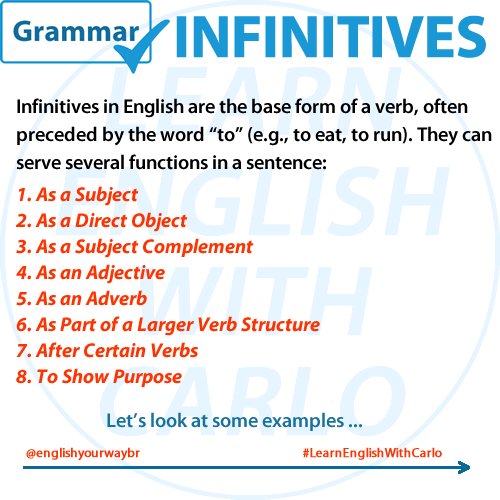
Infinitives in English are the base form of a verb, often preceded by the word “to” (e.g., to eat, to run). They can serve several functions in a sentence:

1. As a Subject:

  • To learn a new language is challenging.
  • Here, the infinitive phrase to learn a new language acts as the subject of the sentence.

2. As a Direct Object:

  • She wants to travel the world.
  • The infinitive to travel is the direct object of the verb wants.

3. As a Subject Complement:

  • Her goal is to become a doctor.
  • The infinitive phrase to become a doctor completes the subject Her goal by telling us what the goal is.

4. As an Adjective:

  • I have a lot of work to do.
  • The infinitive to do modifies the noun work by describing what kind of work it is.

5. As an Adverb:

  • He came to help us.
  • The infinitive to help explains why he came, acting as an adverb modifying the verb came.

6. As Part of a Larger Verb Structure:

  • You have to finish your homework.
  • The infinitive to finish is part of the verb phrase have to finish.

7. After Certain Verbs:

  • Certain verbs are often followed by infinitives, such as decide, plan, expect, hope, need, agree, and more.
  • They decided to leave early.

8. To Show Purpose:

  • She went to the store to buy groceries.
  • The infinitive to buy explains the purpose of her going to the store.

GRAMMAR – HEAR & LISTEN

One of the most common questions English learners ask is: “What is the difference between ‘hear’ and ‘listen’?” These two verbs may seem similar, but they are used in different ways and convey distinct meanings. Let’s dive into the nuances of these two words to help you use them confidently in your conversations.

Hear

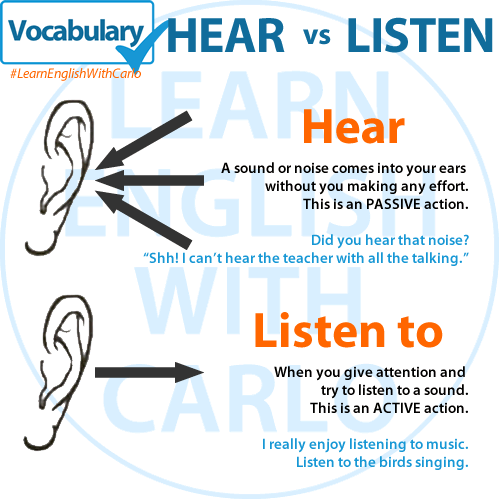
We use hear to describe sounds that come to our ears naturally, without us actively trying to perceive them. Hearing is a passive activity. It happens automatically as long as your ears are functioning and there is sound around you. You don’t need to focus or make an effort to hear; it just happens.

Examples:

  • They heard a strange noise in the middle of the night.
    (The noise came to their ears unexpectedly.)
  • Can you hear the birds outside?
  • I heard the phone ring while I was in the shower.

In all these examples, the action of hearing is unintentional and requires no effort.

Listen

On the other hand, listen is used when we actively focus our attention on a sound or series of sounds. Listening is intentional and often involves some level of effort or concentration. When you listen, you make a conscious choice to pay attention to the sound.

Examples:

  • Last night, I listened to my new Post Malone CD.
    (The speaker chose to focus on the music.)
  • Could you listen to what I’m saying, please?
  • She likes to listen to podcasts while commuting.

In these examples, the action of listening is deliberate and purposeful.

Key Difference

To summarize:

  • Hear refers to sounds that you perceive without trying. It’s passive.
  • Listen refers to actively paying attention to sounds. It’s active.

Practical Use in Conversation

Understanding the difference between “hear” and “listen” is essential for clear communication. Imagine the following exchange between a couple:

Partner 1: “Did you hear what I just said?”
Partner 2: “No, sorry, darling, I wasn’t listening.”

In this example:

  • The first speaker uses “hear” to ask if the sound of their words reached the other person’s ears.
  • The second speaker apologizes, explaining that they weren’t paying attention (“listening”) to the words, even though they might have heard the sound.

Tips to Practice

Here are some exercises to help you master the difference:

  1. Identify the Verb: Listen to a recording or watch a short video and decide whether the action described is “hearing” or “listening.”
    • Example: A car horn sounds while you’re walking. Are you hearing it or listening to it?
  2. Make Sentences: Practice creating sentences for each verb.
    • Use “hear” for unexpected or passive situations. (I heard thunder during the storm last night.)
    • Use “listen” for situations requiring focus. (I listened to my teacher explain the homework instructions.)
  3. Role Play: Pair up with a friend and act out scenarios where one person “hears” something and the other “listens.”

Final Thoughts

Remember, the key to using “hear” and “listen” correctly is understanding the level of intention involved. If it’s passive and just happens, use “hear.” If it’s active and focused, use “listen.” With practice, these words will soon become second nature in your everyday English.

Do you have a sentence in mind but are unsure which verb to use? Share it in the comments, and we’ll help you figure it out!

Wrong shortcode initialized

Mastering the Differences: Below, Beneath, Underneath, and Under

The English language often offers several words to convey similar meanings, each with subtle distinctions that can add depth to our communication. Words like below, beneath, underneath, and under all suggest a lower position, but each carries its unique nuance. In this post, we’ll explore these differences with clear definitions, examples, and usage tips.

1. Below

Definition: “Below” generally refers to something at a lower level, often without direct contact. It’s commonly used for abstract or comparative ideas, such as measurements, levels, or ranks, where something is positioned at a lower point than a reference.

Usage: Use “below” for general positions that aren’t physically touching. You’ll often encounter it in discussions about height, temperature, or rank.

Examples:

  • “The airplane flew below the clouds.” (No direct contact; the plane is at a lower altitude.)
  • “Temperatures dipped below freezing last night.” (Used to describe an abstract level.)
  • “He is ranked below her in the company hierarchy.” (Used to describe a lower level in terms of rank.)

2. Beneath

Definition: “Beneath” is often similar to “below” but has a slightly more formal or old-fashioned tone. It can imply something directly underneath, often adding a sense of depth, hierarchy, or even something hidden. Sometimes it conveys a metaphorical meaning, as in situations involving respect or worth.

Usage: Use “beneath” in more formal contexts, or when you want to convey a sense of depth or hidden position. It’s also useful in abstract contexts, especially those involving status or worth.

Examples:

  • “The treasure was buried beneath the ancient oak tree.” (Physical depth and placement directly under.)
  • “She felt that task was beneath her abilities.” (Implies a metaphorical hierarchy or sense of worth.)
  • “Beneath the cheerful façade, he was actually very worried.” (Suggests something hidden, figuratively beneath the surface.)

3. Underneath

Definition: “Underneath” suggests being covered or concealed by something, typically physical objects. It’s similar to “under” but often emphasizes a sense of being hidden or out of view.

Usage: Use “underneath” when you want to highlight that something is obscured or covered by another object, adding an element of concealment.

Examples:

  • “The keys were underneath the newspaper.” (Implying the keys are hidden from view by the newspaper.)
  • “They found shelter underneath a rocky ledge during the storm.” (The ledge provides cover or concealment.)
  • “She had a hidden compartment underneath her desk for important documents.” (Emphasizes hidden or secret placement.)

4. Under

Definition: “Under” is the most general term for indicating a lower position and is commonly used in everyday speech. It usually describes something directly beneath or covered by something else.

Usage: Use “under” for direct, concrete relationships, especially in physical locations or situations where one thing is directly below another.

Examples:

  • “The cat is hiding under the table.” (Physical location directly below the table.)
  • “He stored the boxes under the bed.” (Physical placement directly beneath the bed.)
  • “They found a cool spot under the tree.” (A concrete location directly below the tree’s canopy.)

Additional Tips for Choosing the Right Word

Understanding these differences can help you choose the right word based on your context. Here’s a quick guide:

  1. General positioning with no direct contact: Use below.
    • “The shelf is just below the ceiling.”
  2. A formal, metaphorical, or hidden sense: Opt for beneath.
    • “He believed that kind of behavior was beneath him.”
  3. Emphasis on being covered or concealed: Choose underneath.
    • “Her journal was tucked away underneath a pile of blankets.”
  4. For straightforward, physical locations or conditions: Go with under.
    • “The puppy is resting under the chair.”

Summary

By mastering the subtle distinctions between “below,” “beneath,” “underneath,” and “under,” you can improve the clarity and richness of your language. Whether you’re describing an object’s position, expressing an abstract idea, or using figurative language, selecting the right term can help your meaning shine through.

Wrong shortcode initialized

Understanding Noun Phrases in English

When you’re learning English, understanding the structure of sentences is essential. One important part of many sentences is a noun phrase. In this post, we’ll break down what noun phrases are, how they’re used, and give you some examples to help you recognize and create your own.

What Is a Noun Phrase?

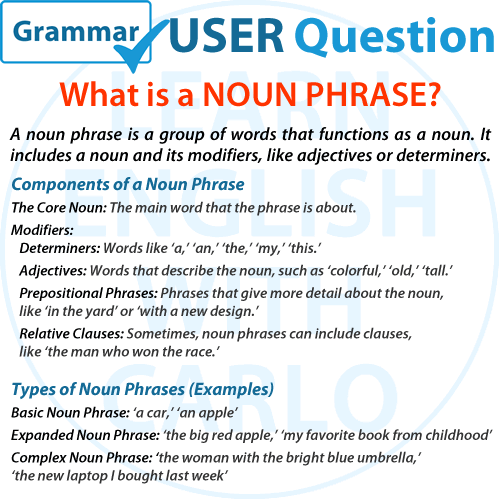
A noun phrase is a group of words that functions like a noun in a sentence. It includes a noun (the main part of the phrase) and can also have other words that give more information about that noun. These additional words might include articles (a, an, the), adjectives (describing words), or other elements like determiners, prepositional phrases, or quantifiers.

In simple terms, if you can replace a group of words with a single noun or pronoun and it still makes sense, you’re likely dealing with a noun phrase.

Basic Structure of a Noun Phrase

A noun phrase typically follows this structure:

  1. Determiner (e.g., the, a, some, my)
  2. Modifier(s) (optional) – can be adjectives or other descriptors
  3. Noun (the main word in the phrase)
  4. Additional Modifiers (optional) – often prepositional phrases or other descriptors following the noun

Example:

  • The tall building (Determiner: The, Modifier: tall, Noun: building)

Examples of Noun Phrases

Here are some examples to show how noun phrases look and work:

  1. A lovely sunset
    • A (Determiner), lovely (Adjective), sunset (Noun)
  2. The little boy in the red shirt
    • The (Determiner), little (Adjective), boy (Noun), in the red shirt (Prepositional phrase as additional modifier)
  3. Some fresh vegetables from the market
    • Some (Quantifier), fresh (Adjective), vegetables (Noun), from the market (Prepositional phrase as additional modifier)
  4. Her big blue book
    • Her (Possessive Determiner), big and blue (Adjectives), book (Noun)

Why Are Noun Phrases Important?

Noun phrases help us add detail and description to our writing and speaking. Instead of just saying “cat,” a noun phrase allows you to say “the fluffy white cat on the windowsill,” which paints a clearer picture for the reader or listener.

Types of Noun Phrases

Here’s a quick look at different types of noun phrases based on the words they include:

  1. Simple Noun Phrase: Contains just a noun and possibly a determiner.
    • Example: The book
  2. Expanded Noun Phrase: Includes adjectives or prepositional phrases for more detail.
    • Example: The old, leather-bound book on the table
  3. Complex Noun Phrase: Includes other elements like quantifiers, possessives, or additional phrases.
    • Example: Several of her favorite science-fiction novels from the 1980s

How to Identify a Noun Phrase

When you’re reading or writing, you can spot a noun phrase by looking for a group of words that functions as a single noun in the sentence. You can test this by replacing the noun phrase with a pronoun (like “it” or “they”) and seeing if the sentence still makes sense.

Example:

  • Original sentence: “The beautiful garden behind our house is full of flowers.”
  • Test: “It is full of flowers.”

Since “The beautiful garden behind our house” can be replaced with “it,” we know it’s a noun phrase.

Using Noun Phrases in Sentences

Noun phrases can be used in various parts of a sentence:

  1. As the subject: The main “actor” of the sentence.
    • Example: The young girl in the yellow dress danced gracefully.
  2. As the object: The noun phrase that receives the action.
    • Example: She bought a bouquet of fresh flowers for her friend.
  3. As the complement: Provides more information about the subject or object.
    • Example: The best part of the day was our long walk by the beach.

Warm Up Exercises

To help you recognize noun phrases, try underlining the noun phrases in these sentences:

  1. The bright red car sped down the road.
  2. She found an old coin from ancient Rome.
  3. Several people in the crowded restaurant looked over at us.

See below for a multiple-choice Noun Phrase Exercise


Key Points to Remember

  • A noun phrase acts as a noun in a sentence and includes a noun plus any modifiers.
  • Noun phrases can add detail, description, and context to sentences.
  • Look for a main noun and think about whether the phrase could be replaced with a pronoun to check if it’s a noun phrase.

By practicing with noun phrases, you’ll be able to add more detail and clarity to your sentences in English. Try writing a few of your own noun phrases, and see how descriptive you can be!

Wrong shortcode initialized

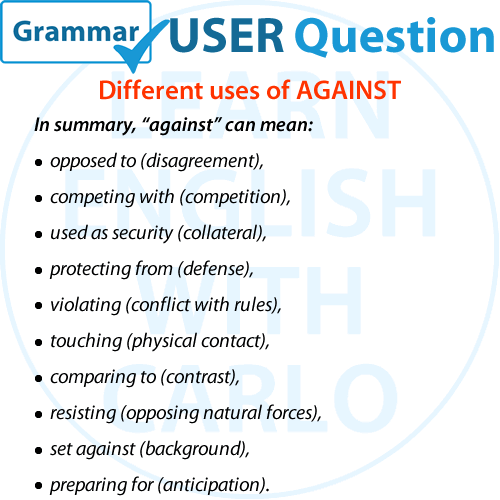
The uses of AGAINST

This question was sent to me by an Instagram follower as a DM asking to explain different uses of the word AGAINST.

Uses of “Against”

  1. Opposed to (disagreement): Indicating disagreement or opposition to rules, ideas, or actions.
    • “We are against these rules.”
    • “Many citizens are against the new law.”
  2. Competing with (competition): Referring to engaging in a contest or rivalry with others.
    • “The team played against the champions.”
    • “She raced against her fastest competitor.”
  3. Used as security (collateral): Indicating something given to secure a loan or obligation.
    • “They offered their house against the loan.”
    • “He put his car against the loan agreement.”
  4. Protecting from (defense): Used to express protection from harm or danger.
    • “A healthy diet protects you against diseases.”
    • “Vaccinations help protect children against illness.”
  5. Violating (conflict with rules): Indicating actions that go against established rules or norms.
    • “Her actions are against our rules.”
    • “Driving over the speed limit is against the law.”
  6. Touching (physical contact): Indicating physical contact or leaning on a surface.
    • “She leaned against the wall.”
    • “He pressed his hand against the glass.”
  7. Comparing to (contrast): Used to evaluate or measure something in relation to another.
    • “The results were measured against last year’s data.”
    • “We compared our performance against industry standards.”
  8. Resisting (opposing natural forces): Indicating opposition to natural elements or forces.
    • “They struggled against the heavy rain.”
    • “The ship fought against the rough seas.”
  9. Set against (background): Describing something viewed with a specific backdrop or setting.
    • “The silhouette looked striking against the twilight.”
    • “The artwork stands out beautifully against the white wall.”
  10. Preparing for (anticipation): Taking actions in preparation for a future event or situation.
    • “She invested money against future emergencies.”
    • “They saved up against the possibility of a recession.”

This format includes clear definitions and two relevant examples for each use of “against.”

Wrong shortcode initialized

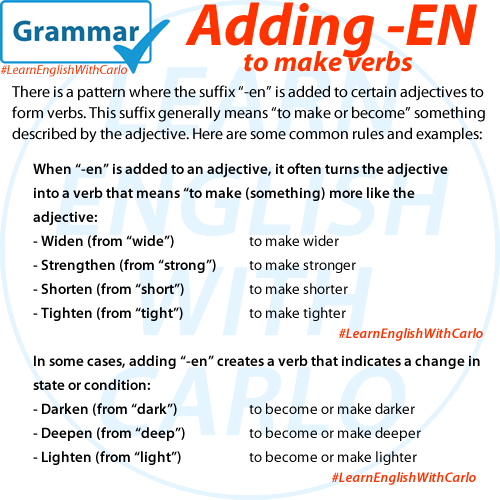
Turning Adjectives into Verbs with “-en”

In English, some adjectives can be turned into verbs by adding the suffix -en. These verbs usually indicate the process of becoming or making something have the quality described by the adjective. Understanding how and when to use -en to form verbs can greatly expand your vocabulary and improve your communication skills.

How Does It Work?

When you add -en to certain adjectives, the word becomes a verb that either:

  1. Describes a change in state (for example, becoming something).
  2. Describes an action where you cause something to change (for example, making something become a certain way).

Common Examples:

  1. Adjective: WideVerb: Widen
    • Meaning: To make something wider or become wider.
    • Example: “The city plans to widen the streets to reduce traffic.”
  2. Adjective: DeepVerb: Deepen
    • Meaning: To make something deeper or become deeper.
    • Example: “They need to deepen the river to prevent flooding.”
  3. Adjective: WeakVerb: Weaken
    • Meaning: To reduce strength or become less strong.
    • Example: “His illness weakened him considerably.”
  4. Adjective: SoftVerb: Soften
    • Meaning: To make something softer or become softer.
    • Example: “She used conditioner to soften her hair.”
  5. Adjective: ShortVerb: Shorten
    • Meaning: To make something shorter or become shorter.
    • Example: “The tailor will shorten the pants to fit you.”

Patterns and Exceptions:

  • Not all adjectives can be turned into verbs using -en. For example, adjectives like beautiful or happy do not have -en verb forms. There is no verb form like beautifen or happien.
  • Some adjectives already have their own verb forms without needing -en, such as strongstrengthen or longlengthen. In these cases, we use a slightly modified form, but the concept is similar.

Special Cases:

  • Some verbs in English have an -en ending but are irregular or don’t follow the typical pattern. For example:
    • Adjective: RedVerb: Redden
      • Example: “His face reddened in embarrassment.”
    • Adjective: BlackVerb: Blacken
      • Example: “The smoke blackened the walls.”
  • In some cases, the opposite process happens. For example, instead of adding -en to make a verb, English often uses other forms or entirely different verbs to describe the process:
    • Adjective: HardVerb: Harden
      • Example: “The concrete needs time to harden.”

Tips for ESL Students:

  1. Practice with common adjectives: Start by learning the most frequently used adjectives that can become verbs with -en, such as widen, soften, shorten, and deepen.
  2. Be aware of exceptions: Remember that not all adjectives will work with this pattern, so it’s important to check and practice regularly.
  3. Listen for these verbs: Native speakers use these verbs frequently in daily conversations, so try to notice how they are used when listening to English.

By learning how to turn adjectives into verbs with -en, you’ll increase your flexibility and range in English. The more you practice, the easier it will be to recognize and use these forms.


Wrong shortcode initialized

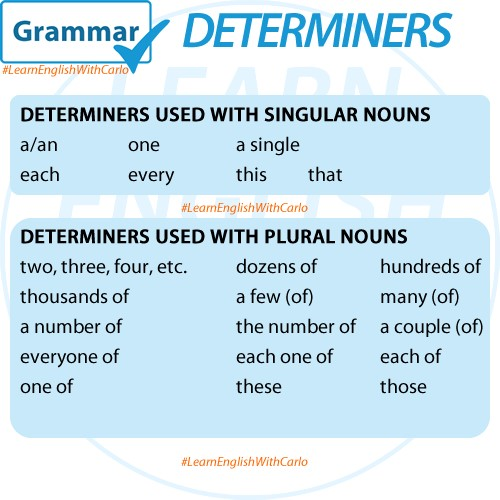
GRAMMAR – Determiners

Determiners are words that come before a noun to clarify what the noun refers to. They help specify whether we’re talking about something specific or general, countable or uncountable, and they can show possession, quantity, or definiteness. Mastering the use of determiners is key to sounding more fluent and accurate in English.

Types of Determiners

  1. Articles
    Articles are the most common type of determiners and are used to indicate whether a noun is specific or nonspecific.
    • Definite Article: “the”
      Used to refer to a specific noun that both the speaker and listener know.
      • Example: The car outside is mine. (specific car)
    • Indefinite Articles: “a” and “an”
      Used for non-specific singular nouns.
      • Example: I saw a dog in the park. (any dog, not specific)
  2. Demonstratives
    Demonstratives point to specific nouns and indicate their proximity to the speaker in terms of space or time.
    • This/These (for things near the speaker)
      • Example: This book is interesting. (close by)
      • Example: These apples are fresh.
    • That/Those (for things farther away)
      • Example: That house over there is mine.
      • Example: Those people are my friends.
  3. Possessive Determiners
    Possessive determiners show ownership or possession of the noun.
    • Examples: my, your, his, her, its, our, their
    • Example: Her cat is very friendly.
    • Example: Our house is by the lake.
  4. Quantifiers
    Quantifiers indicate how much or how many of something is being discussed. They can be used with both countable and uncountable nouns.
    • Examples with Countable Nouns:
      • Many people attended the event.
      • Few students passed the exam.
    • Examples with Uncountable Nouns:
      • I need some water.
      • There isn’t much time left.
    • Examples for Both Countable and Uncountable Nouns:
      • All students must take the exam.
      • Some furniture was damaged in the move.
  5. Numbers
    Numbers can function as determiners to specify exact quantities.
    • Example:
      • Three cars were parked outside.
      • She has two brothers.
  6. Interrogative Determiners
    These determiners are used to ask questions about a noun.
    • Which
      • Example: Which book did you read?
    • What
      • Example: What color is your car?
  7. Distributive Determiners
    These determiners refer to individual members of a group.
    • Each
      • Example: Each student must bring their own materials.
    • Every
      • Example: Every house on this street has a garden.
    • Either
      • Example: You can choose either movie to watch.
    • Neither
      • Example: Neither option looks good to me.
  8. Relative Determiners
    These connect clauses or phrases to a noun.
    • Whose
      • Example: The man whose car was stolen is my neighbor.

Tips for Using Determiners

  • Countable vs. Uncountable Nouns:
    Remember that some determiners are only used with countable nouns (e.g., many, few) and others with uncountable nouns (e.g., much, little).
    • Many people (correct with countable)
    • Much time (correct with uncountable)
  • Plural Nouns and Articles:
    The indefinite articles a and an are not used with plural nouns. Instead, you use some when referring to an unspecified amount of plural or uncountable nouns.
    • I bought some apples.
    • I need some help.
  • Possessive vs. Possessive Pronouns:
    Be careful not to confuse possessive determiners with possessive pronouns.
    • That is my car. (Possessive determiner: my)
    • That car is mine. (Possessive pronoun: mine)

Conclusion

Determiners are an essential part of English grammar, helping us provide clarity and precision in communication. By understanding how and when to use them, you’ll make your sentences more meaningful and accurate.

Practice Exercise

Wrong shortcode initialized

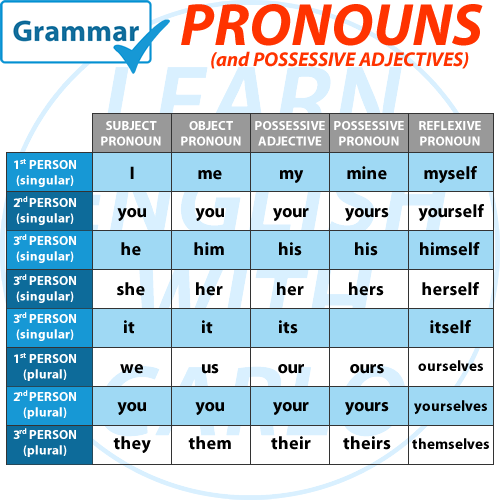
GRAMMAR – Pronouns (and adjectives)

Personal pronouns and possessive adjectives are essential elements of English grammar. They help us talk about people, things, and ownership without repeating the same nouns over and over again. In this post, we’ll explore five key types: subject pronouns, object pronouns, possessive adjectives, possessive pronouns, and reflexive pronouns. Understanding how to use each one correctly will improve your communication skills and make your English sound more natural.

What Are Personal Pronouns?

Personal pronouns are words that stand in for specific nouns (people, places, or things). Depending on how they are used in a sentence, personal pronouns can either act as the subject or the object.

1. Subject Pronouns

Subject pronouns replace the subject of a sentence — the person or thing performing the action.

  • Examples: I, you, he, she, it, we, you, they
  • How to use them:
    • I love reading books.
    • She is studying for the test.
    • They are going to the party.

2. Object Pronouns

Object pronouns replace the object in a sentence — the person or thing receiving the action.

  • Examples: me, you, him, her, it, us, you, them
  • How to use them:
    • Can you help me with this task?
    • We saw them at the concert last night.
    • The manager thanked us for our hard work.

What Are Possessive Adjectives?

Possessive adjectives show who or what owns something. They always appear before a noun.

  • Examples: my, your, his, her, its, our, your, their
  • How to use them:
    • My car is parked outside.
    • Is this your bag?
    • They invited us to their house.

What Are Possessive Pronouns?

Possessive pronouns replace a noun phrase to show ownership, and unlike possessive adjectives, they stand on their own.

  • Examples: mine, yours, his, hers, ours, yours, theirs
  • How to use them:
    • That book is mine.
    • This jacket is yours, not mine.
    • The house on the corner is theirs.

What Are Reflexive Pronouns?

Reflexive pronouns are used when the subject and object of a sentence are the same person or thing. These pronouns add emphasis or indicate that someone is doing something to themselves.

  • Examples: myself, yourself, himself, herself, itself, ourselves, yourselves, themselves
  • How to use them:
    • I taught myself to play the guitar.
    • She prepared the meal herself.
    • They enjoyed the show by themselves.

Comparison Chart: Pronouns and Possessive Adjectives

TypeSingularPlural
Subject PronounsI, you, he, she, itwe, you, they
Object Pronounsme, you, him, her, itus, you, them
Possessive Adjectivesmy, your, his, her, itsour, your, their
Possessive Pronounsmine, yours, his, hersours, yours, theirs
Reflexive Pronounsmyself, yourself, himself, herself, itselfourselves, yourselves, themselves

Wrong shortcode initialized

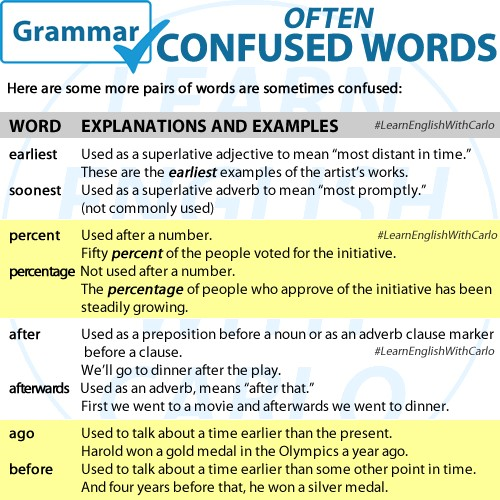
GRAMMAR – More Confusing Words

Here are expanded explanation with examples for each pair:

EARLIEST vs. SOONEST

  • Earliest
    Definition: Used as a superlative adjective to mean “the first or most distant in time.”
    Usage: Refers to the time farthest back from the present or from a specified moment in the past.
    Examples:
    • “These are the earliest records we have of the civilization.” (Most distant in time)
    • “The earliest I can arrive is 7 a.m.” (The first possible time)
  • Soonest
    Definition: Used as a superlative adverb to mean “the quickest or most prompt time.”
    Usage: Refers to the earliest time something could happen but focuses on how quickly it can occur. It’s not commonly used in conversation and is more often replaced by “as soon as possible.”
    Examples:
    • “I’ll get this done the soonest I can.” (Most promptly)
    • “Let me know the soonest you can meet.” (First available time)

PERCENT vs. PERCENTAGE

  • Percent
    Definition: Refers to a part of a whole and is used directly after a number (e.g., 20%, 50%).
    Usage: Always used after a number to indicate a portion of 100.
    Examples:
    • “Thirty percent of the class passed the exam.” (Used after a number)
    • “Only 10 percent of the participants completed the survey.”
  • Percentage
    Definition: Refers to a portion or proportion of something, but is not directly followed by a number.
    Usage: It is often used to describe the relative amount or proportion of something without specifying a number.
    Examples:
    • “The percentage of students who passed the test is quite high.” (Describes a portion but without a number)
    • “We are aiming to increase the percentage of renewable energy usage.”

AFTER vs. AFTERWARDS

  • After
    Definition: Used as a preposition to indicate that one event happens following another. It can also be used as a conjunction introducing a dependent clause.
    Usage: Functions as a preposition before a noun or as a subordinating conjunction before a clause.
    Examples:
    • “We’ll have dessert after dinner.” (Preposition before a noun)
    • “After we finish the meeting, let’s go for lunch.” (Conjunction before a clause)
  • Afterwards
    Definition: An adverb meaning “at a later time,” or “after an event.”
    Usage: Used to refer back to a specific time or event mentioned earlier.
    Examples:
    • “We watched a movie and afterwards went for ice cream.” (Refers to what happened after the movie)
    • “He made a speech, and afterwards, there was a Q&A session.”

AGO vs. BEFORE

  • Ago
    Definition: Used to refer to a period of time that has passed from the present moment.
    Usage: It’s used to anchor an event to the present moment, typically used with time phrases (e.g., minutes, hours, days, years).
    Examples:
    • “I saw her a week ago.” (Anchored to the present)
    • “That happened ten years ago.”
  • Before
    Definition: Used to describe something happening earlier than a specific point in time, which may not be the present.
    Usage: Refers to a time earlier than another event or moment, either in the past or the future.
    Examples:
    • “We arrived before the event started.” (Earlier than the event)
    • “They moved to the city two years before we did.” (Earlier than another point in time, not anchored to the present)

These explanations and examples highlight the subtle differences between these similar words and expressions in English.

Wrong shortcode initialized