Your Guide to Building Better Sentences When you’re learning English, you might hear a lot about clauses. But what exactly are they, and why are they important? This guide will break down the basics of …
Figures of speech are words or expressions used in a non-literal, creative way to make language more vivid and expressive.Writers and speakers use them to create imagery, add emotion, and make ideas easier to remember. …
QUIT “Quit” is a verb that means to stop or cease doing something. When someone quits an activity, job, or habit, they discontinue or give up that particular action or commitment. “Quit” can also imply …
Countable and uncountable nouns are two categories used to classify nouns based on whether they can be counted or not. Countable Nouns:Countable nouns refer to objects or entities that can be counted as discrete units.They …
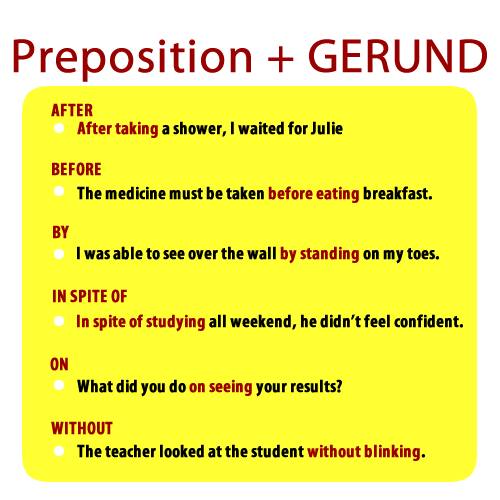
Understanding the correct use of prepositions with gerunds is crucial for mastering English grammar. This guide will help you navigate the common combinations, such as “interested in learning” and “good at cooking,” providing clear examples and practical exercises. Learning these patterns can enhance your writing and speaking skills, making your English more fluent and natural. Dive into this resource to strengthen your grammar and improve your ability to construct accurate and effective sentences.
When a verb follows a preposition, the verb must be in the gerund form [verb+ing]. This is a rules that has no exception. A lot of prepositions follow verbs (adjust to, agree with, depend on, etc), and if a second verb follows the prepositions , it MUST be gerund.
Verb + Preposition + Gerund
adapt to People need to adapt to changing environmental conditions.
adjust to The twins had to adjust to living as singles.
agree (with) on I could not agree on spending more money on the kids.
apologize for I apologize for interrupting.
approve of I don’t approve of leaving small children home alone.
argue about/against You can’t argue about having an extra pair of hands.
ask about She asked about making another cup of tea.
believe in I believe in giving peace a chance.
blame for Who’s to blame for rising food prices?
care about She doesn’t care about getting into this college.
complain about Mother complained about being tired.
consist of Kid’s summers consist of going to the pool or the library.
decide on Ken decided on going abroad next year.
depend on I had come to depend on seeing her in my dreams.
disapprove of Some people disapprove of helping migrants.
discourage from Teenagers should be discouraged from going into internet chat rooms.
engage in Students were engaged in learning the new grammar rules.
forgive for I think Jessica will never forgive for lying.
get used to I can’t get used to living in such a crowded city.
give up Oh, I will never give up trying to find him.
help with Some children require lots of help with reading.
inquire about He inquired about attending Bob Jones University.
insist on He insisted on seeing me off at the airport.
interfere with I’m afraid your dance routine will interfere with studying.
keep on We need to keep on trying.
look forward to I look forward to going home next weekend.
object to I object to changing plans at this late date.
participate in All students participated in doing pantomimes.
persist in Some people persist in calling Pluto the ninth planet.
plan on What do you plan on doing?
prepare for Instructors vary in how they prepare for teaching a course.
profit from Henry profited from selling his parents’ house.
prohibit from We are prohibited from doing lots of things in this school.
put off Do you ever put off going to a doctor?
succeed in She’s succeeded in making you jealous, hasn’t she?
suffer from Doctors say children can suffer from playing video games.
talk about We talked about going to Italy for our summer vacations.
take part in Many people took part in bringing the lost child home.
there’s no point in There is no point in arguing with them.
think about Jake and Julia think about getting married.
warn about They warned us about speeding on this road.
work on Brian really has to work on improving his vocabulary.
worry about I always worry about losing things.
Can you think of any other examples?
If you have any questions or doubts, please ask in the comments or send me a private message.
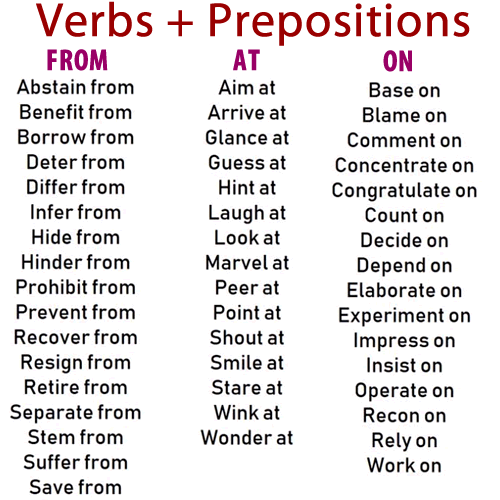
Some verbs are usually followed by prepositions before the object of the verb. These are called dependent prepositions and they are followed by a noun or a gerund (‘ing’ form).
He’s waiting for a bus.
For is the dependent preposition for ‘wait’
We can use other prepositions with ‘wait’ – e.g. He waited at the bus stop – but ‘for’ is the dependent preposition.
Here are some other verbs with their dependent prepositions.
Verbs with ‘for’
He apologised for being late. You can also ‘apologise to someone’
I applied for the job but I didn’t get it.
How do you ask for a coffee in Polish?
She spent many years caring for her aged parents.
I can’t go out tonight because I have to prepare for my interview tomorrow.
Verbs with ‘from’
This spray should protect you from mosquitoes.
Has he recovered from his illness yet?
He won an award because he saved someone from drowning.
I suffer from hay fever.
Verbs with ‘in’
She believes in ghosts.
Our company specializes in computer software.
You have to work hard if you want to succeed in life.
Verbs with ‘of’
I don’t approve of your language, young man.
Our dog died of old age.
This shampoo smells of bananas.
Verbs with ‘on’
The film is based on the novel by Boris Pasternak.
If you make so much noise I can’t concentrate on my work.
Come on! We’re relying on you!
We don’t agree on anything but we’re good friends.
Verbs with ‘to’
Can I introduce you to my wife?
Please refer to the notes at the end for more information.
Nobody responded to my complaint.
Verbs with ‘with’
I agree with everything you’ve said.
My secretary will provide you with more information if you need it.
There are many more verb + dependent preposition combinations – can you think of any?
If you have any questions or doubts, please ask in the comments or send me a private message.
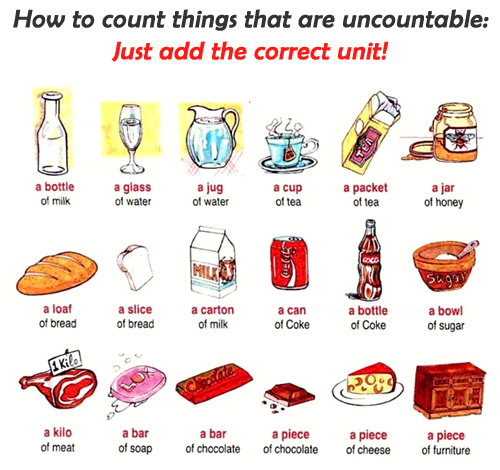
Some nouns are UNCOUNTABLE. That means that they don’t have a plural form and cannot be used with an indefinite article. The most common uncountable nouns are liquids, but there are others too. So, how do we quantify an uncountable noun? We give it a unit!
MILK – a glass or milk, a bottle of milk, a carton of milk, but never a milk*.
WATER – a glass of water, a pitcher of water, but never a water*.
TEA – a packet ot tea, a cup of tea, a pot of tea, but never a tea*.
BREAD – a slice of bread, a loaf of bread, but never a bread.
*NOTE: There are time when you can order something in a restaurant without a unit, but in those cases the unit is understood without being spoken. Look at this example:
“We’d like a tea and a coffee please.”
It would be understood that you are ordering a cup of tea and a cup of coffee.
Wrong shortcode initialized
If you have any questions or doubts, please ask in the comments or send me a private message.
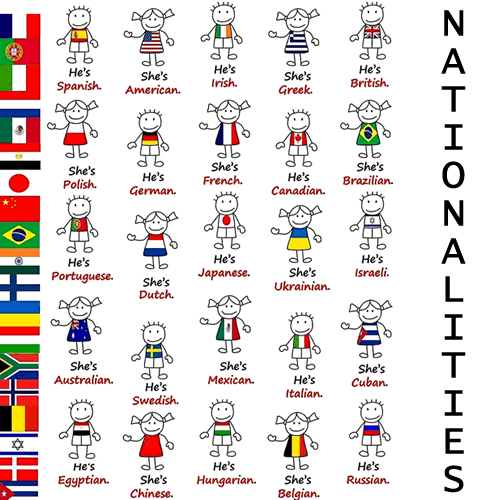
We all come from a country – and the name of the country is a porper noun. Our nationality it the adjective form of the noun (and because it’s derived from a proper noun should always begin with a capital letter.
He’s from Spain – he’s Spanish.
She’s from the USA – she’s American.
He’s from the Republic of Ireland – he’s Irish.
She’s from Greece – she’s Greek.
He’s from England (or Scotland or Wales or Northern Ireland) – he’s British.
She’s Polish so she’s from Poland.
He’s German so he’s from Germany.
She’s French so she’s from France
He’s Canadian so he’s from Canada.
She’s Brazilian so she’s from Brazil.
He’s Portuguese so he’s from Portugal.
She’s Dutch so she’s from Holland.
He’s Japanese so he’s from Japan.
She’s Ukranian so she’s from the Ukrane.
He’s Israeli so he’s from Israel.
She’s Australian so she’s from Australia.
He’s Swedish so he’s from Sweden.
She’s Mexican so she’s from Mexico.
He’s Italian so he’s from Italy.
She’s Cuban so she’s from Cuba.
He’s Egyptian so he’s from Egypt.
She’s Chinese so she’s from China.
He’s Hungarian so he’s from Hungary.
She’s Belgian so she’s from Belguim.
He’s Russian so he’s from Russia.
If you have any questions or doubts, please ask in the comments or send me a private message.
The living room is one of the most important spaces in a home. It’s where families gather, guests are entertained, and relaxation happens. Knowing the vocabulary for common living-room furniture can help you describe your space accurately, whether you’re decorating, moving, or simply talking about your home. This post will introduce you to essential living-room furniture vocabulary with clear definitions and examples.
Common Living-Room Furniture
1. Sofa / Couch
Definition: A long, upholstered seat with a back and arms, for two or more people.
Example: “We bought a new sofa that seats three people comfortably.”
2. Armchair
Definition: A comfortable chair with side supports for a person’s arms.
Example: “He likes to read in his favorite armchair by the window.”
3. Coffee Table
Definition: A low table typically placed in front of a sofa for holding drinks, magazines, and decorative items.
Example: “I placed a vase of flowers on the coffee table.”
4. TV Stand / Entertainment Center
Definition: A piece of furniture designed to hold a television and other media equipment.
Example: “The TV stand has shelves for the DVD player and gaming console.”
5. Bookshelf
Definition: A piece of furniture with shelves for storing books and decorative items.
Example: “The bookshelf is filled with novels and family photos.”
6. Side Table / End Table
Definition: A small table placed beside a sofa or armchair, used for holding small items like lamps or drinks.
Example: “I keep a lamp and some magazines on the side table.”
7. Rug / Carpet
Definition: A thick, woven material used to cover floors for warmth and decoration.
Example: “The rug in the living room adds a pop of color to the space.”
8. Recliner
Definition: An armchair that can be tilted backward for reclining and often has a footrest.
Example: “He loves to watch TV in his recliner.”
9. Ottoman
Definition: A padded, upholstered seat without a back or arms, often used as a footrest or extra seating.
Example: “She uses the ottoman as a footrest while reading.”
10. Console Table
Definition: A long, narrow table typically placed against a wall, used for display and storage.
Example: “The console table in the hallway holds our keys and mail.”
Decorative and Functional Items
1. Lamp
Definition: A device for giving light, especially one with a bulb or flame.
Example: “I bought a new lamp for the living room to brighten the corner.”
2. Cushion / Pillow
Definition: A soft bag filled with feathers, foam, or other material, used for comfort or support.
Example: “The cushions on the sofa make it more comfortable.”
3. Blanket / Throw
Definition: A piece of soft material used to cover oneself for warmth or decoration.
Example: “There’s a cozy blanket draped over the back of the sofa.”
4. Curtain / Drapes
Definition: Pieces of fabric hung to cover windows for privacy and light control.
Example: “The curtains in the living room match the color scheme perfectly.”
5. Wall Art / Decor
Definition: Decorative items such as paintings, photographs, and sculptures hung on walls.
Example: “She decorated the living room with wall art she bought on vacation.”
Conclusion
Knowing the names and purposes of common living-room furniture can help you better describe your space and make informed decisions when decorating or purchasing new items. Whether you’re arranging your living room or discussing home decor, these vocabulary words will be invaluable.
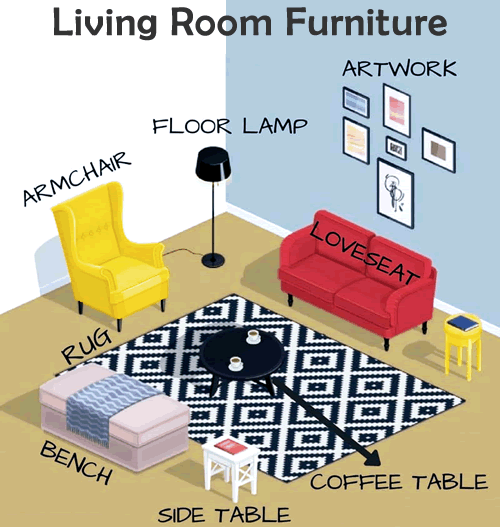
Here is come interesting vocabulary for Living Room Furniture.
In this image you can see:
A bench
A side table
A coffee table
A rug
A loveseat (big enough for too people)
An rmchair
A floor lamp
Some art work
Can you think of any more things that you might find in a living room?
If you have any questions or doubts, please ask in the comments or send me a private message.
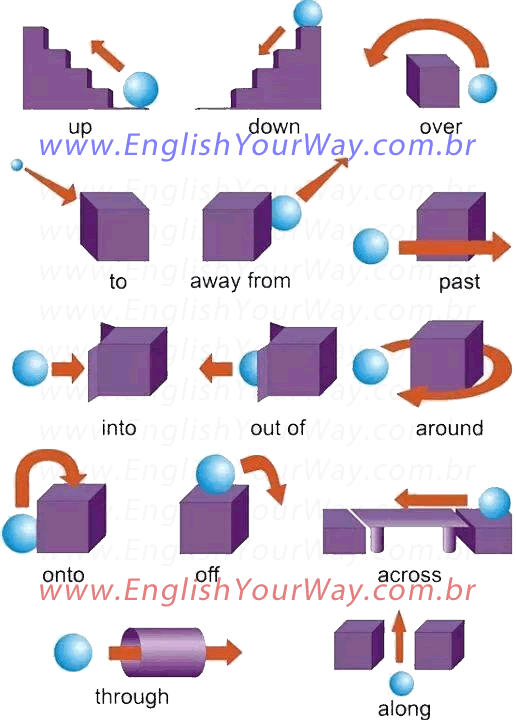
Prepositions of movement describe the direction or movement of someone or something. They are crucial for providing clarity in communication. Let’s explore some common prepositions of movement and how to use them effectively. This graphic shows some of the more common prepositions of movement. Look below for definitions and examples.
1. Up
Definition: Moving from a lower position to a higher one. Example: She climbed up the stairs.
2. Down
Definition: Moving from a higher position to a lower one. Example: The cat jumped down from the table.
3. Over
Definition: Moving above something or someone without touching it. Example: The bird flew over the house.
4. To
Definition: Moving towards a specific destination. Example: He walked to the store.
5. Away From
Definition: Moving in the opposite direction from a particular place or person. Example: She ran away from the barking dog.
6. Towards
Definition: Moving in the direction of someone or something. Example: They walked towards the beach.
7. Past
Definition: Moving beyond a specific point. Example: The car drove past the old barn.
8. Into
Definition: Moving from outside to a point inside. Example: She poured the milk into the glass.
9. Out Of
Definition: Moving from inside to a point outside. Example: He took the keys out of his pocket.
10. Around
Definition: Moving in a circular direction or along the circumference of something. Example: They walked around the park.
11. Onto
Definition: Moving to a position on a surface. Example: The cat jumped onto the sofa.
12. Off Of
Definition: Moving away from a surface. Example: She got off of the bus.
13. Across
Definition: Moving from one side to another. Example: They swam across the river.
14. Through
Definition: Moving from one side and out the other side of something. Example: The tunnel goes through the mountain.
15. Along
Definition: Moving in a line next to something. Example: They walked along the beach.
Practical Tips for Using Prepositions of Movement
Visualize the Movement: Imagine the action described by the verb and how the preposition indicates direction.
Use Context Clues: Consider the context of the sentence to choose the appropriate preposition.
Practice with Examples: Regularly practice by creating sentences using different prepositions of movement.
Conclusion
Understanding and using prepositions of movement correctly can greatly enhance your communication skills. They provide precise information about direction and movement, making your sentences clearer and more informative. Keep practicing, and soon you’ll be using these prepositions like a pro!
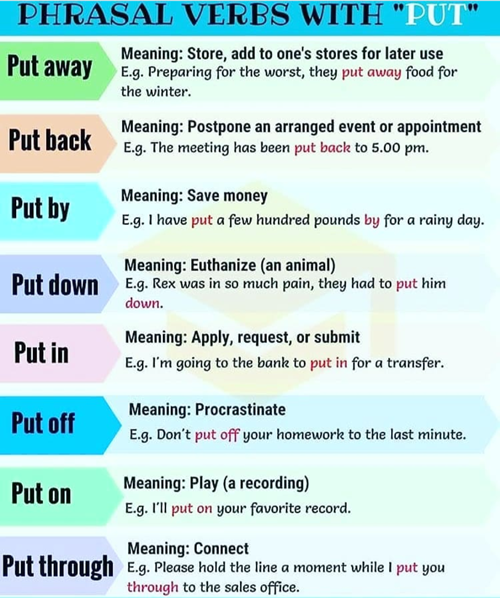
A phrasal verb is a combination of a verb and an adverb or preposition, for example ‘look up’ or ‘look after’, which together have a particular meaning which is different from the verb alone.
Here are the definitions and examples for each of the phrasal verbs listed:
1. Put away – Definition: To place something in its appropriate location; to save money. – Example 1: “She put away the groceries in the pantry.” – Example 2: “He puts away a portion of his salary every month for savings.”
2. Put back – Definition: To return something to its original place. – Example: “After reading the book, she put it back on the shelf.”
3. Put by – Definition: To save money for future use. – Example: “They have put by some money for their children’s education.”
4. Put down – Definition: To place something on a surface; to criticize or belittle someone; to euthanize an animal. – Example 1: “She put down her bag on the table.” – Example 2: “He felt hurt when his boss put him down in front of his colleagues.” – Example 3: “They had to put down their old dog because it was very sick.”
5. Put in – Definition: To install or insert something; to contribute effort or time. – Example 1: “They put in a new dishwasher in the kitchen.” – Example 2: “She put in a lot of hours to complete the project on time.”
6. Put off – Definition: To delay or postpone something; to cause someone to lose interest or enthusiasm. – Example 1: “They decided to put off their vacation until next year.” – Example 2: “The unpleasant smell put her off her food.”
7. Put on – Definition: To dress oneself in clothing; to gain weight; to stage or perform something. – Example 1: “He put on his coat before leaving the house.” – Example 2: “She has put on some weight recently.” – Example 3: “The school is putting on a play next month.”
8. Put through – Definition: To connect someone by phone; to make someone experience something difficult. – Example 1: “Can you put me through to the manager, please?” – Example 2: “She was put through a lot of stress during the project.”
These definitions and examples illustrate the various uses and meanings of each phrasal verb.
If you have any questions or doubts, please ask in the comments or send me a private message.