ADVERBS

ADVERBS
An adverb describes a verb, an adjective or another adverb. Look at this table to see all the things an adverb can tell us.
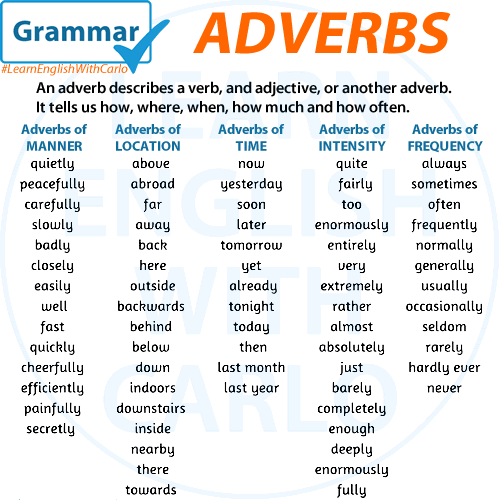
Adverbs are essential parts of speech that modify verbs, adjectives, or other adverbs, giving us more information about how, where, when, how much, or how often something happens. Let’s explore the different types of adverbs and see how they work with examples.

1. Adverbs of Manner

Adverbs of manner describe how an action is performed. They often end in “-ly.”

  • Examples: quickly, slowly, carefully, badly
    • She sings beautifully.
    • He drove slowly in the rain.

2. Adverbs of Location

Adverbs of location (or place) indicate where an action takes place.

  • Examples: here, there, everywhere, outside, upstairs
    • The kids are playing outside.
    • She looked everywhere for her keys.

3. Adverbs of Time

Adverbs of time tell us when an action occurs.

  • Examples: now, later, soon, yesterday, tomorrow
    • We will start the meeting now.
    • He will arrive tomorrow.

4. Adverbs of Intensity

Adverbs of intensity (or degree) describe how much or to what extent something happens.

  • Examples: very, quite, almost, too, extremely
    • She was very happy with the results.
    • The coffee is too hot to drink.

5. Adverbs of Frequency

Adverbs of frequency explain how often an action occurs.

  • Examples: always, often, sometimes, rarely, never
    • He always wakes up early.
    • They rarely go out for dinner.

Summary Chart

Adverb TypeDescribesExamples
MannerHowquickly, carefully, badly
LocationWherehere, outside, upstairs
TimeWhennow, yesterday, tomorrow
IntensityHow much/to what extentvery, too, extremely
FrequencyHow oftenalways, sometimes, never

Wrong shortcode initialized

VERBS: To do

The Verb “To Do”

The verb to do is another common verb in English. It can be used as an auxiliary and a main verb. It is often used in questions.

Affirmative Negative Interrogative Short answers Short answers
I do I don’t .. Do I .. ? Yes, I do. No, I don’t.
You do You don’t .. Do you ..? Yes, you do. No, you don’t.
He does He doesn’t .. Does he .. ? Yes, he does. No, he doesn’t.
She does She doesn’t .. Does she .. ? Yes, she does. No, she doesn’t.
It does It doesn’t .. Does it .. ? Yes, it does. No, it doesn’t.
We do We don’t .. Do we .. ? Yes, we do. No, we don’t.
You do You don’t .. Do you .. ? Yes, you do. No, you don’t.
They do They don’t .. Do they .. ? Yes, they do. No, they don’t.


The verb “do” is a very important verb. We use it to make the present tense, the present tense negative, and for asking questions.

Examples:

  • I do many things on the weekend. (present tense, “do” is the main verb)
  • He doesn’t like to study. (present tense negative, “like” is the main verb)
  • Do you want a coffee? (present tense question, “want” is the main verb)


“Do” is often used as a main verb, but only for particular activities, such as housework, cleaning, studying, research, and shopping.

Examples:

  • I do the dishes every night. (do = wash)
  • She does her grocery shopping at the corner store.
  • They do their homework at home.


The past tense form of “do” is “did.”

Examples:

  • I did the dishes last night.
  • She did her grocery shopping at Cub.


“Do” is also used for creating emphasis:

Example:

  • John said, “You don’t like this very much.”
    Mary answered, “No. I do like it!”

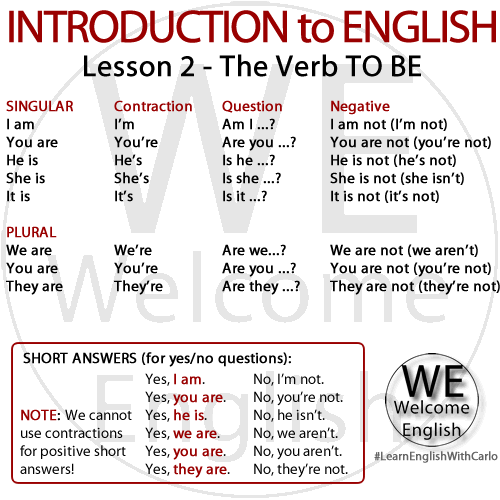
VERBS: To be (or not to be)

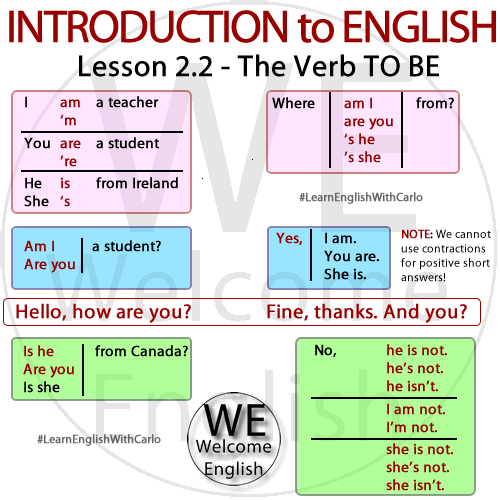
The Verb “to be”


Affirmative Contracted Question  Negative I   Negative II                Short answers
I am .. I’m .. Am I …? I’m not …. I’m not… Yes, I am. No, I’m not.
You are .. You’re.. Are you..? You’re not .. You aren’t .. Yes, you are. No, you aren’t.
He is .. He’s .. Is he ..? He’s not …. He isn’t…. Yes, he is. No, he isn’t.
She is .. She’s .. Is she …? She’s not … She isn’t …. Yes, she is. No, she isn’t.
It is … It’s .. Is it  …? It’s not … It isn’t …. Yes, it is. No, it isn’t.
We are .. We’re .. Are we.. …? We’re not…. We aren’t… Yes, we are. No, we aren’t.
You are .. You’re .. Are you …? You’re not .. You aren’t… Yes, you are. No, you aren’t.
They are .. They’re .. Are they…? They’re not.. They aren’t.. Yes, they are No, they aren’t.

Wrong shortcode initialized

SEE ALSO:
The Present Simple of ‘BE’

Prepositions of Location (with a dog)

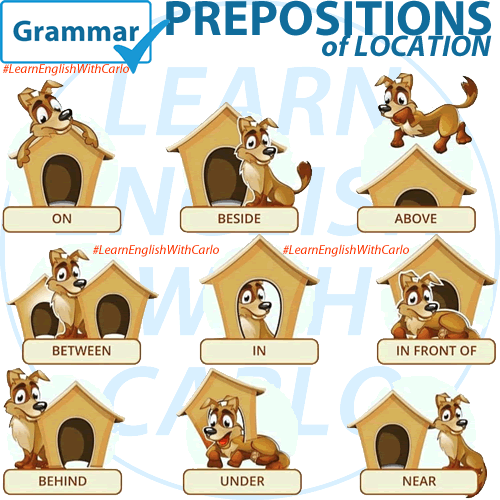
Prepositions of location tell us where one thing is in relation to another thing. REMEMBER: The book is ON the table. In this sentence, the preposition ON tells us the relationship between the book and the table. If we change the preposition, we change the relationship.

Let’s review some common prepositions of location:

  • On: Indicates that something is positioned directly above and in contact with a surface.
  • In: Suggests that something is contained within the boundaries of an area or space.
  • Under: Describes something positioned beneath or below another object.
  • Beside: Indicates that something is positioned next to or alongside another object.
  • At: Refers to a specific point or place.
  • Between: Describes the position of something in the middle of two objects or places.
  • Above: Indicates that something is positioned higher than another object.
  • Below: Describes the position of something lower than another object.
  • Next to: Indicates that something is positioned immediately adjacent to another object.

Wrong shortcode initialized

VOCABULARY – Rob vs Steal

Rob and steal both mean ‘take something from someone without permission’.
Rob focuses on the place or person from which the thing is taken.
Steal focuses on the thing that is taken.

Look at the examples below:

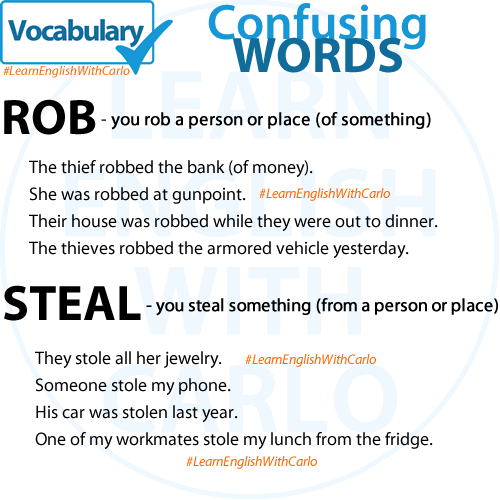
ROB – you rob a person or place (of something)
rob – robbed – robbed
To rob means to take something from someone using force, threat, or violence. It typically involves a confrontation or intimidation of the victim. Robbery often happens in a public setting or a place where the victim is present.

EXAMPLES:
The thieves robbed the bank at gunpoint.
The thief robbed the bank (of money).
She was robbed at gunpoint.
Their house was robbed while they were out to dinner.
The thieves robbed the armored vehicle yesterday.

STEAL – you steal something (from a person or place)
steal – stole – stolen
To steal means to take something that belongs to someone else without permission and with the intention of keeping it for oneself. This act can occur without the knowledge of the owner. It can involve taking something discreetly or without violence.

EXAMPLES:
She stole money from her friend’s purse.
They stole all her jewelry.
Someone stole my phone.
His car was stolen last year.
One of my workmates stole my lunch from the fridge.

In summary, while both involve taking something unlawfully, “steal” is more general and can involve taking something without the owner’s knowledge, whereas “rob” specifically implies using force or threat to take something from someone directly.

Wrong shortcode initialized

GRAMMAR – Simple Present Tense

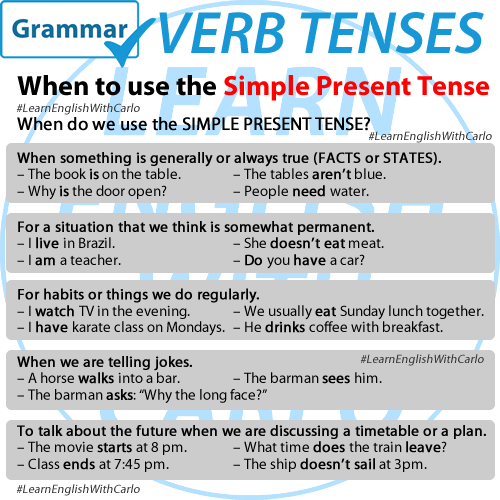
When do we use the SIMPLE PRESENT TENSE?

When something is generally or always true (FACTS or STATES).
The book is on the table.
The tables aren’t blue.
Why is the door open?
People need water.

For a situation that we think is somewhat permanent.
I live in Brazil.
She doesn’t eat meat.
I am a teacher.
Do you have a car?

For habits or things we do regularly.
I watch TV in the evening.
We usually eat Sunday lunch together.
I have a karate class on Mondays.
He drinks coffee with breakfast.

When we are telling jokes.
A horse walks into a bar.
The barman sees him.
The barman asks: Why the long face?

To talk about the future when we are discussing a timetable or a plan.
The movie starts at 8 pm.
What time does the train leave?
The class ends at 7:45 pm.
The ship doesn’t sail at 3 pm.

Wrong shortcode initialized

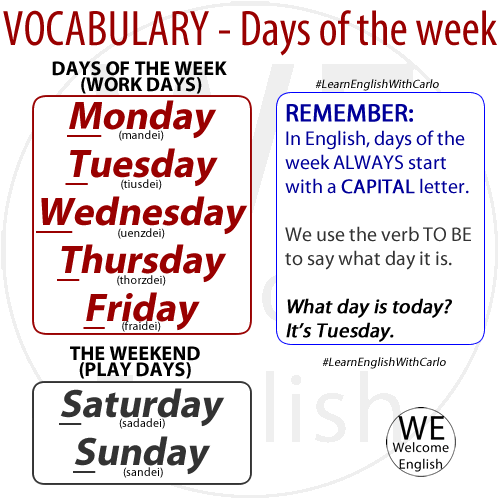
What day is today?

Days of the week (phonetic spelling).

  • Monday (mandei)
  • Tuesday (tiusdei)
  • Wednesday (uenzdei)
  • Thursday (thorzdei)
  • Friday (fraidei)
  • Saturday (sadadei)
  • Sunday (sandei)

REMEMBER: Days of the week always start with a capital letter.

We use the verb TO BE to say what day it is.

  • What day is today?
  • It’s Wednesday.
  • What day is tomorrow?
  • It’s Thursday.
  • What day was yesterday?
  • It was Tuesday.

We use the preposition ON to say which day something happens.

  • My vacation starts on Saturday.
  • The next game is on Sunday.
  • My doctor’s appointment is on Monday.

Other important vocabulary:

  • Yesterday (one day ago)
  • The day before yesterday (two days ago)
  • Tomorrow (one day from now)
  • The day after tomorrow (two days from now)

Wrong shortcode initialized

GRAMMAR – EXCEPT vs. EXCEPT FOR

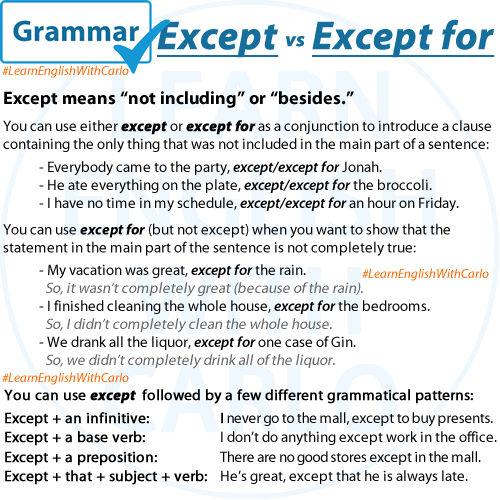
EXCEPT means “not including” or “besides.” You can use either EXCEPT or EXCEPT FOR as a conjunction to introduce a clause containing the only thing that was not included in the main part of a sentence:
Everybody came to the party, EXCEPT/EXCEPT FOR Jonah.
He ate everything on the plate, EXCEPT/EXCEPT FOR the broccoli.
I have no time in my schedule, EXCEPT/EXCEPT FOR an hour on Friday.

You can use EXCEPT FOR when you want to show that the statement in the main part of the sentence is not completely true:
My vacation was great, EXCEPT FOR the rain. (So, not completely great because of the rain).
I finished cleaning the whole house, EXCEPT FOR the bedrooms. (So, I didn’t completely clean.)
We drank all the liquor, EXCEPT FOR one case of Gin. (So, we didn’t completely drunk.)

You can use EXCEPT followed by a few different grammatical patterns:

EXCEPT + AN INFINITIVE:
I never go to the mall, except to buy presents.

EXCEPT + A BASE VERB:
I don’t do anything except work in the office.

EXCEPT + A PREPOSITION:
There are no good stores except in the mall.

EXCEPT + THAT + SUBJECT + VERB
He’s great, except that he is always late.

Wrong shortcode initialized

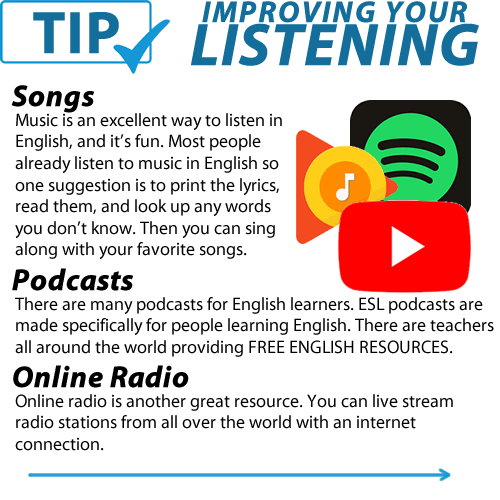
Improve Your Listening

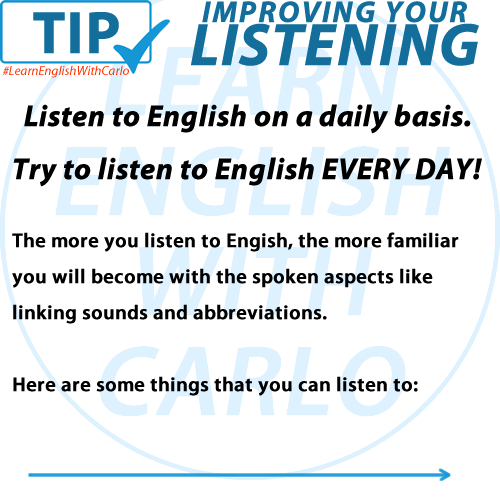
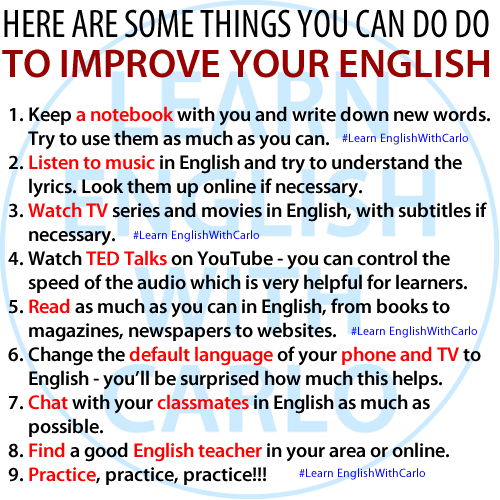
Here are some ideas that you can use every day that might help you to improve your English.

Watch movies, series, and news in English (with subtitles if necessary).

Listen to music in English and try to understand the lyrics.

Watch TED Talks or other speeches in English.

Record yourself and listen to the recording. How does it sound?

Exchange text messages in English with friends and classmates.

Read books, magazines, and newspapers in English.

Switch the operating system on your phone, computer, TV, and cable box to English.

Keep a notebook and write down new words to expand your vocabulary.

IMPROVE YOUR ENGLISH

People always ask me what things they can do during their everyday lives that might help them improve their English. Here are a few suggestions. If you can think of any others, please add them in the comments.