Understanding “Be Supposed To” in English

English learners often encounter the phrase “be supposed to” in everyday conversations. It’s a common expression used to talk about expectations, obligations, rules, and assumptions. In this post, we’ll explore what “be supposed to” means, how it’s used, and the grammatical rules that guide its usage.
1. What Does “Be Supposed To” Mean?

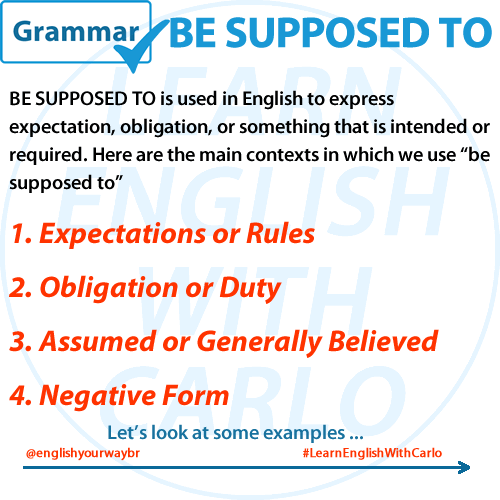
“Be supposed to” is used to express what is expected, required, or assumed in a given situation. Whether you’re talking about rules, responsibilities, or common beliefs, this phrase helps convey those ideas. Here are the key contexts in which we use “be supposed to.”

2. Using “Be Supposed To” for Expectations and Rules

One of the most common uses of “be supposed to” is to indicate what is expected or required based on rules or norms. These can be formal rules, like laws or company policies, or informal expectations, like societal norms.

  • Examples:
    • You’re supposed to wear a uniform to work. (Expectation based on a rule.)
    • We are supposed to bring our own materials to class. (Expectation based on a class rule.)

In both examples, there is a clear expectation or rule that the subject is required to follow.

3. Expressing Obligations or Duties

“Be supposed to” is often used to talk about duties or responsibilities. It indicates something you are required or expected to do, even if you might not always follow through with it.

  • Examples:
    • I’m supposed to clean my room every weekend. (Obligation)
    • He’s supposed to finish the report by Friday. (Responsibility)

In these cases, there is a duty to perform, but it may or may not happen as expected.

4. Assumption or General Belief

“Be supposed to” can also refer to something that is generally believed or assumed to be true, though you might not have direct evidence for it. This use is more about perception than obligation.

  • Examples:
    • That movie is supposed to be really good. (General belief)
    • She’s supposed to be an excellent chef. (Assumed fact)

This use highlights how “be supposed to” can communicate what people think or assume, even if the reality is different.

5. Prohibition or What Shouldn’t Be Done

When used in the negative form (“not supposed to”), it implies that something is prohibited or not allowed. It’s a softer way to say that something is forbidden.

  • Examples:
    • You’re not supposed to eat in the library. (Prohibited action)
    • We’re not supposed to park here. (Breaking a rule if done)

This negative form is very useful in everyday speech to convey what isn’t permitted.

6. How “Be Supposed To” Works in a Sentence

“Be supposed to” follows a simple structure, but it changes based on the subject and tense:

  • Present Tense: [Subject] + am/is/are + supposed to + [base verb].
    • Example: She is supposed to finish her homework.
  • Past Tense: [Subject] + was/were + supposed to + [base verb].
    • Example: They were supposed to meet at 5 PM.

This structure can be used in various tenses, making it flexible for different time frames.

7. Polite Obligation

“Be supposed to” is often softer and more polite than using stronger modal verbs like “must” or “have to.” It expresses obligation or responsibility in a way that feels less strict or forceful.

  • Examples:
    • We’re supposed to leave at noon. (Softer than: We have to leave at noon.)
    • You’re supposed to take your shoes off before entering the house. (Less forceful than: You must take your shoes off.)

This makes “be supposed to” a great choice for giving instructions or expressing duties without sounding too demanding.

8. Future Obligations and Expectations

“Be supposed to” can also refer to future expectations, especially when talking about scheduled or planned events. Even though it’s typically used in the present or past tense, it can hint at future obligations or scheduled activities.

  • Examples:
    • I’m supposed to attend a meeting tomorrow. (Future expectation)
    • We’re supposed to go to the concert next week. (Scheduled plan)

This allows you to talk about upcoming plans in a way that shows expectation or responsibility.

9. Understanding Subject-Verb Agreement

Like many English phrases, the form of “be supposed to” must agree with the subject of the sentence. This means you need to change the verb “to be” (am, is, are, was, were) depending on whether the subject is singular or plural, and based on the tense you’re using.

  • Examples:
    • She is supposed to arrive at 6 PM. (Singular subject)
    • They are supposed to finish the project by Friday. (Plural subject)

Getting this agreement right is crucial for making your sentence grammatically correct.

In Conclusion

“Be supposed to” is an essential phrase in English, offering a polite, flexible, and often indirect way to talk about obligations, expectations, and general beliefs. Whether you’re discussing rules, duties, or assumptions, mastering “be supposed to” can help you express yourself clearly and effectively. Keep practicing, and soon, using “be supposed to” will feel as natural as the expectations you’re describing!

Quick Summary:

  • Expresses expectations: What is required or expected in a situation.
  • Indicates obligation: Duties or responsibilities people are supposed to fulfill.
  • Assumptions or beliefs: Things people generally believe to be true.
  • Negative form: Used to express prohibitions or things not allowed.

If you’re supposed to learn one thing today, it’s how valuable “be supposed to” can be in your English conversations!

Wrong shortcode initialized
GRAMMAR – Another and Other

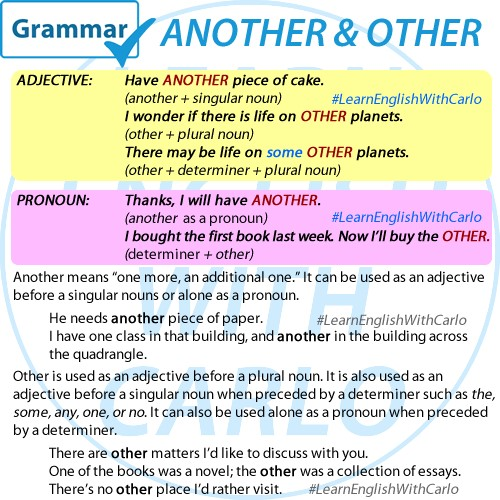
Use of Another and Other
another + singular noun (Have another sandwich.)
another (Thanks. I’ll have another.)
other + plural noun (I wonder if there is life on other planets.)
determiner + other + noun (There may be life on some other planets.)
determiner + other (“I have one book.” “I have the other.”)

Another means “one more, an additional one.” It can be used as an adjective before a singular nouns or alone as a pronoun.
He needs another piece of paper.
I have one class in that building, and another in the building across the street.

Other is used as an adjective before a plural noun. It is also used as an adjective before a singular noun when preceded by a determiner such as the, some, any, one, or no. It can also be used alone as a pronoun when preceded by a determiner.
There are other matters I’d like to discuss with you.
One of the books was a novel; the other was a collection of essays.
There’s no other place I’d rather visit. 

Wrong shortcode initialized

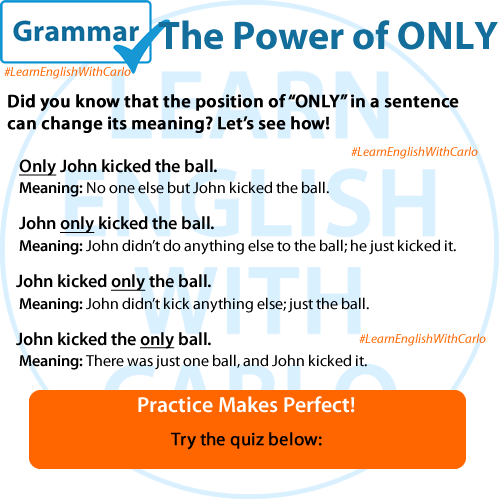
Understanding the Correct Placement of “Only”

Using “only” correctly can make a big difference in the meaning of a sentence. It’s a small word with a powerful impact! Let’s dive into how to place “only” correctly to convey the exact meaning you want.

Understanding the Role of “Only”:

“Only” is a versatile word that can modify different parts of a sentence. Depending on its position, “only” can change the focus and meaning. Here’s a simple guide to help you understand and use “only” effectively.


Examples and Explanations:

  1. She drinks coffee only in the morning.
    • Meaning: She drinks coffee at no other time but in the morning.
    • Explanation: “Only” modifies the time when she drinks coffee.
  2. He speaks only Spanish.
    • Meaning: He doesn’t speak any other language besides Spanish.
    • Explanation: “Only” modifies the language he speaks.
  3. They went only to Paris last summer.
    • Meaning: They didn’t visit any other place last summer.
    • Explanation: “Only” modifies the destination of their trip.
  4. The teacher gave homework only to the students.
    • Meaning: The teacher didn’t give homework to anyone else.
    • Explanation: “Only” modifies the recipients of the homework.
  5. I eat only vegetables for dinner.
    • Meaning: I don’t eat anything else besides vegetables for dinner.
    • Explanation: “Only” modifies the food being eaten.

Conclusion:

Remember, the placement of “only” can change the meaning of a sentence significantly. By practicing and paying attention to its position, you can ensure your sentences convey the exact meaning you intend.


Wrong shortcode initialized

Understanding ABOVE

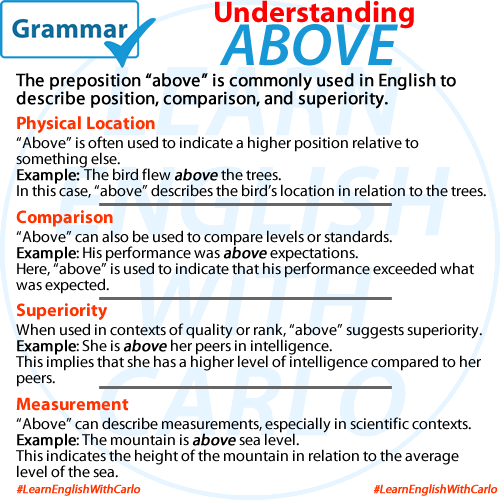
The preposition “above” is commonly used in English to describe position, comparison, and superiority. This post will explore its various uses and provide examples to help you understand how to use “above” correctly.

1. Physical Location

“Above” is often used to indicate a higher position relative to something else.

  • Example: The bird flew above the trees.
  • Explanation: In this case, “above” describes the bird’s location in relation to the trees.

2. Comparison

“Above” can also be used to compare levels or standards.

  • Example: His performance was above expectations.
  • Explanation: Here, “above” is used to indicate that his performance exceeded what was expected.

3. Superiority

When used in contexts of quality or rank, “above” suggests superiority.

  • Example: She is above her peers in intelligence.
  • Explanation: This implies that she has a higher level of intelligence compared to her peers.

4. Measurement

“Above” can describe measurements, especially in scientific contexts.

  • Example: The mountain is above sea level.
  • Explanation: This indicates the height of the mountain in relation to the average level of the sea.

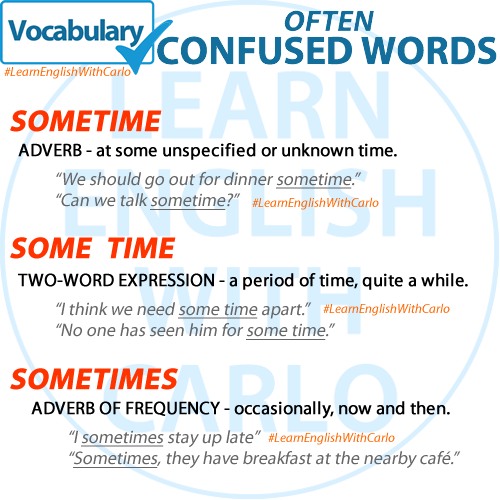
Sometime, Sometimes and Some Time

These three words are often confused. So, here’s an explanation of the differences between “sometime,” “sometimes,” and “some time”:

1. Sometime:

  • “Sometime” is an adverb that refers to an unspecified point in time.
  • Example: “I’ll visit you sometime next week.” (refers to an unspecified time in the future)

2. Sometimes:

  • “Sometimes” is an adverb that indicates frequency, meaning occasionally or at certain times but not always.
  • Example: “Sometimes I go swimming in the afternoon.” (indicates that swimming happens occasionally, not every time)

3. Some time:

  • “Some time” is a phrase that consists of the determiner “some” and the noun “time,” indicating a period of time, either a short or long duration.
  • Example: “We need some time to finish this project.” (refers to a period of time required to complete the project)

Usage Tips:

  • “Sometime” refers to an unspecified point in time, often in the future.
  • “Sometimes” indicates occasional or irregular occurrences.
  • “Some time” refers to a period of time, whether short or long.

Examples:

  • I’ll call you sometime next month. (referring to an unspecified time in the future)
  • Sometimes I feel like going for a run after work. (indicating occasional desire or impulse)
  • Let’s take some time to relax and unwind this weekend. (referring to a period of time for relaxation)

Understanding these differences will help you use these words correctly in various contexts.
Practice using them in sentences with the QUIZ below!

Wrong shortcode initialized
Essential English Grammar Rules for ESL Learners

Mastering English grammar helps you communicate clearly and naturally. Here’s a guide to some fundamental rules, complete with examples and exceptions to be aware of.

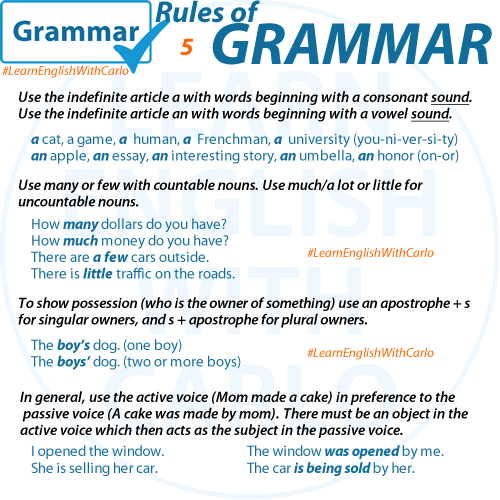
1. Indefinite Articles (A/An)

  • Use a with words that begin with a consonant sound:
    • a cat, a game of golf, a university (you-ni-ver-si-ty)
  • Use an with words that begin with a vowel sound:
    • an apple, an easy job, an honorable man (on-o-ra-ble)
  • Exceptions:
    • Words beginning with silent letters can be tricky. An hour (silent “h”) but a hotel (if “h” is pronounced).

2. Countable and Uncountable Nouns with Quantifiers

  • Use many or few with countable nouns:
    • How many books do you have?
    • There are few seats available.
  • Use much, a lot of, or little with uncountable nouns:
    • How much information do you need?
    • There’s a lot of sugar in this recipe.
  • Exception:
    • Some nouns can be both countable and uncountable, depending on meaning (e.g., I love coffee vs. I had two coffees this morning).

3. Possessive Form with Apostrophes

  • Singular possessive: add ‘s
    • The child’s toy (one child)
    • My friend’s house
  • Plural possessive: add s’
    • The teachers’ lounge (several teachers)
    • My parents’ decision
  • Exception:
    • For plural nouns that don’t end in “s,” add ‘s: The children’s playground, the men’s department.

4. Active vs. Passive Voice

  • Active voice is generally clearer and preferred:
    • Cats eat fish (active) vs. Fish are eaten by cats (passive).
  • Passive is sometimes preferred for focus on the action or when the subject is unknown:
    • The results were published yesterday.

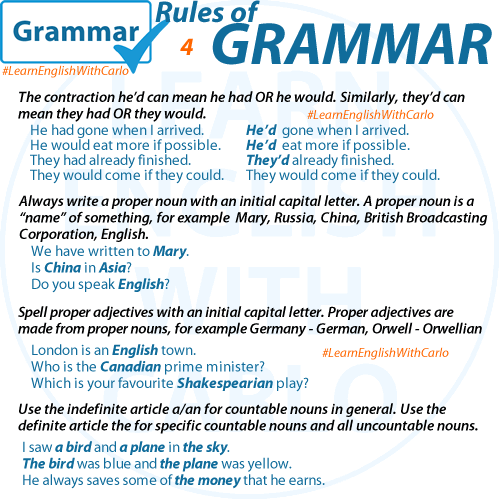
5. Contractions: ‘He’d’, ‘They’d’, and More

  • He’d can mean he had or he would:
    • He had eaten when I arrived.
    • He’d finish if he had time.
  • They’d can mean they had or they would:
    • They had completed the task.
    • They’d like to join if possible.

6. Proper Nouns and Adjectives

  • Proper nouns (names) start with a capital letter:
    • Anna, Tokyo, Brazil
  • Proper adjectives, derived from proper nouns, are also capitalized:
    • Japanese cuisine, Shakespearian play, Mexican culture
  • Exceptions:
    • Some brand names or organizations may stylize their names without capitalization (e.g., iPhone, eBay).

7. Definite and Indefinite Articles (The, A/An)

  • Use a/an for general items:
    • I saw a cat in the garden.
  • Use the for specific items mentioned earlier or known by the listener:
    • The cat was playing with a ball.
  • Use the for uncountable nouns when specific:
    • The water is too cold.

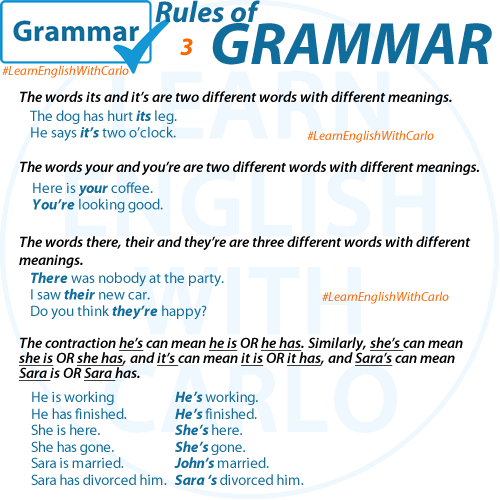
8. Common Confusing Words: It’s vs. Its, Your vs. You’re

  • It’s = it is or it has
    • It’s raining.
    • It’s been a long day.
  • Its = possessive:
    • The company has changed its policy.
  • You’re = you are
    • You’re my best friend.
  • Your = possessive:
    • Is this your book?

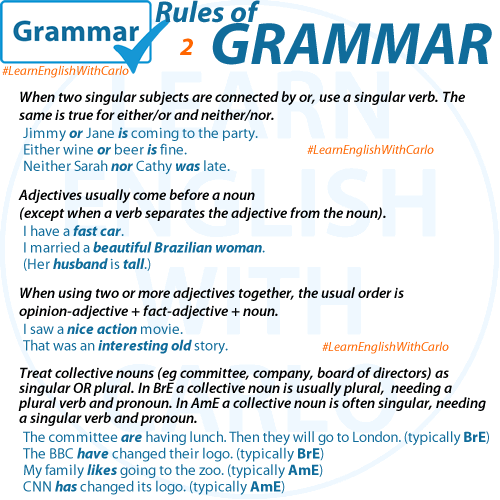
9. Subject-Verb Agreement with Compound Subjects

  • When subjects are connected by or, use a singular verb:
    • Either the teacher or the student is responsible.
  • For either/or and neither/nor:
    • Neither Tom nor Sarah was available.

10. Order of Adjectives

  • Adjectives usually precede a noun. When using multiple adjectives, the order is usually opinion + size + age + color + origin + material + type + purpose:
    • a beautiful small Italian marble table
    • a delicious hot vegetable soup
  • Exceptions:
    • Familiar expressions may not follow these rules, e.g., big bad wolf.

11. Collective Nouns: Singular or Plural?

  • In British English, collective nouns are typically treated as plural:
    • The team are preparing their uniforms.
  • In American English, collective nouns are treated as singular:
    • The team is preparing its uniform.

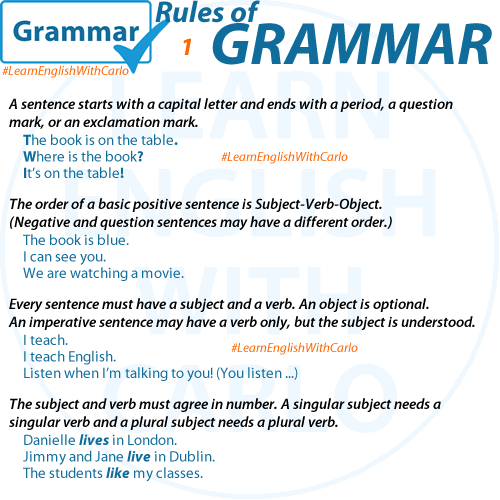
12. Basic Sentence Structure and Capitalization

  • Sentences start with a capital letter and end with a period, question mark, or exclamation mark:
    • What time is it?
    • We’ll see you soon!

13. Subject-Verb-Object Order

  • The standard order in English is Subject-Verb-Object:
    • The dog chased the ball.
  • In questions, the order often changes to Verb-Subject:
    • Is she coming?

14. Every Sentence Needs a Subject and a Verb

  • Each sentence needs a subject and verb, and they must agree in number:
    • Anna reads every day.
    • The children play outside.
  • Exception:
    • Imperative sentences (commands) may only have a verb, with the subject understood: Sit down. (You sit down.)

Wrong shortcode initialized
OTHER PREPOSITIONS


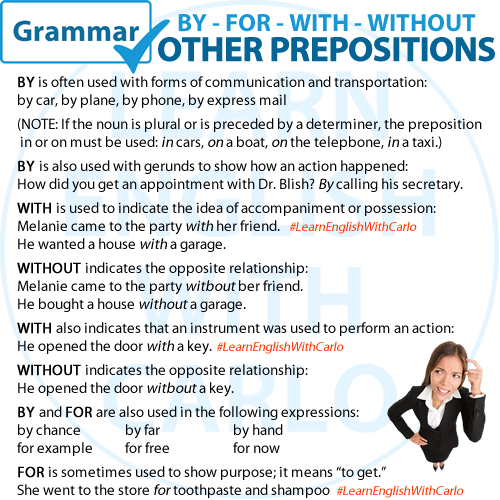
By is often used with forms of communication and transportation:
by car, by plane, by phone, by express mail (‘Note: If the noun is plural or is preceded by a determiner, the preposition in or on must be used: in cars, on a boat, on tbe telepbone, in a taxi.) By is also used with gerunds to show how an action happened:
How did you get an appointment with Dr. Blish? By calling his secretary.

With is used to indicate the idea of accompaniment or possession:
Melanie came to the party with her friend.
He wanted a house with a garage.

Without indicates the opposite relationship:
Melanie came to the party without her friend.
He bought a house without a garage.

With also indicates that an instrument was used to perform an action:
He opened the door with
a key.
Without indicates the opposite relationship:
He opened the door without a key.
By and for are also used in the following expressions:
by chance; by far; by hand.
for example; for free; for now

for is sometimes used to show purpose; it means “to get.”
She went to the store for toothpaste and shampoo

“Because” vs. “Because of”

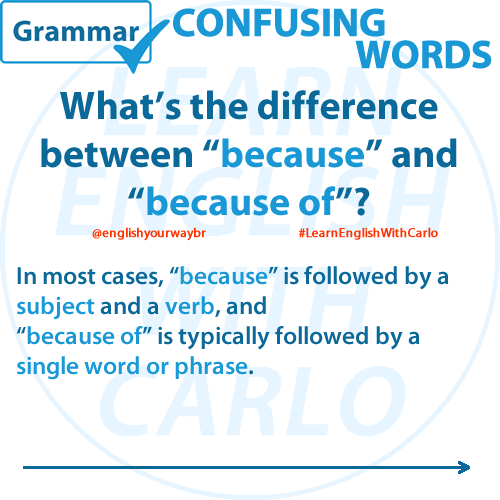
What’s the difference between “because” and “because of”?

In most cases, “because” is followed by a subject and a verb, and “because of” is typically followed by a single word or phrase.

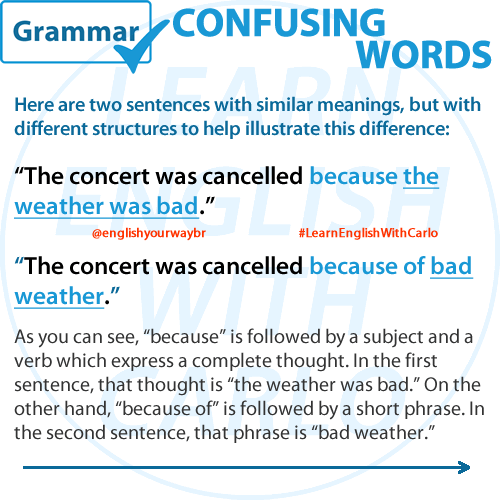
Here are two sentences with similar meanings, but with different structures to help illustrate this difference:

“The concert was canceled because the weather was bad”

“The concert was canceled because of bad weather.”

As you can see, “because” is followed by a subject and a verb which express a complete thought. In the first sentence, that thought is “the weather was bad.” On the other hand, “because of” is followed by a short phrase. In the second sentence, that phrase is “bad weather.”

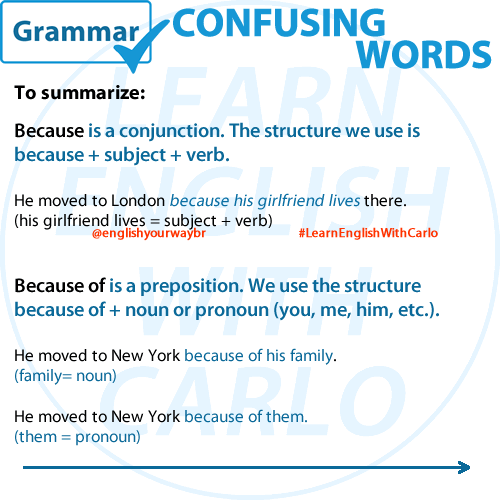
To summarize:

Because is a conjunction. The structure we use is
because + subject + verb.

He moved to London because his girlfriend lives there.
(his girlfriend lives = subject + verb)

Because of is a preposition. We use the structure
because of + noun or pronoun (you, me, him, etc.).

He moved to New York because of his family.
(family = noun)

He moved to New York because of them.
(them = pronoun)

Wrong shortcode initialized
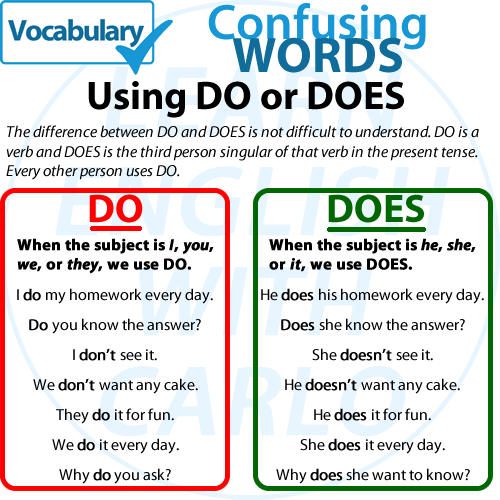
CONFUSING WORDS – DO vs. DOES

The difference between DO and DOES is not difficult to understand.
DO is a verb and DOES is the third person singular of that verb in the present tense. Every other person in the conjugation uses DO.

When the subject is I, you, we, or they, we use DO.

I do my homework every day.
Do you know the answer?
I don’t see it.
We don’t want any cake.
They do it for fun.
We do it every day.
Why do you ask?

When the subject is he, she, or it, we use DOES.

He does his homework every day.
Does she know the answer?
She doesn’t see it.
He doesn’t want any cake.
He does it for fun.
She does it every day.
Why does she want to know?

Wrong shortcode initialized
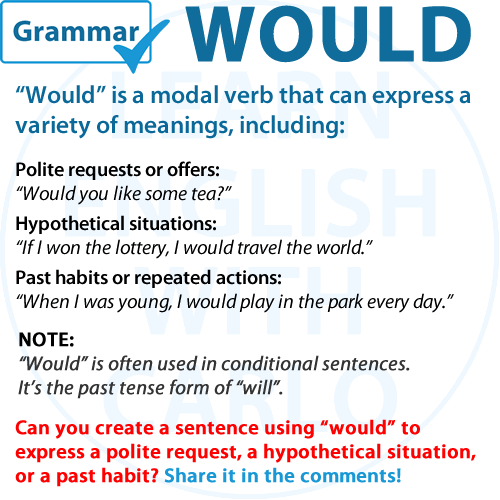
Mastering the Modal: Understanding the Versatility of “Would”

Modal verbs play a crucial role in shaping the meaning and tone of our language. Among these, “would” stands out as a versatile tool with a myriad of uses and implications. In this blog post, we’ll delve into the depths of “would”, exploring its various meanings, functions, and usage in everyday language.

Understanding “Would”:

At its core, “would” is a modal verb with multiple functions, making it an indispensable part of English grammar. Let’s dissect its primary uses:

  1. Polite Requests and Offers: One of the most common roles of “would” is in expressing polite requests or offers. For example, “Would you like some coffee?” or “Would you mind passing the salt?” In these instances, “would” softens the request, adding a layer of politeness and consideration.
  2. Hypothetical Situations: “Would” is also instrumental in discussing hypothetical or imagined scenarios. It’s often used in conditional sentences to express what could happen under certain circumstances. For instance, “If I were president, I would prioritize education reform.” Here, “would” indicates a potential action or outcome based on an imagined condition.
  3. Past Habits or Repeated Actions: In addition to its use in hypothetical situations, “would” can also denote past habits or repeated actions. For example, “When I was a child, I would spend hours reading books.” This usage emphasizes actions that were customary or habitual in the past.

Tips for Using “Would” Effectively:

To wield “would” with precision, consider the following tips:

  • Pay attention to context: The meaning of “would” can vary depending on the context in which it’s used. Whether expressing politeness, hypotheticals, or past habits, ensure that the usage aligns with the intended meaning.
  • Understand conditional structures: “Would” often appears in conditional sentences, where it’s paired with an if-clause to indicate a hypothetical situation and its potential outcome. Familiarize yourself with different conditional structures to use “would” accurately.
  • Practice nuanced usage: Explore various scenarios where “would” might be appropriate, from casual conversations to formal writing. The more you practice, the more confident you’ll become in wielding this versatile modal verb.

Examples of “Would” in Action:

To illustrate the versatility of “would”, consider the following examples:

  • Polite Request: “Would you mind closing the door, please?”
  • Hypothetical Situation: “If I had a time machine, I would visit ancient Rome.”
  • Past Habit: “Every summer, we would go camping in the mountains.”

Conclusion: “Would” may seem like a simple word, but its flexibility and significance in English grammar are undeniable. Whether used to express politeness, imagine alternate realities, or reminisce about the past, “would” enriches our language with depth and nuance. By mastering its usage, we unlock a world of possibilities in communication.

So, the next time you encounter “would” in conversation or writing, remember its multifaceted nature and the myriad ways it shapes our language.

Wrong shortcode initialized