What is a Phrasal Verb?

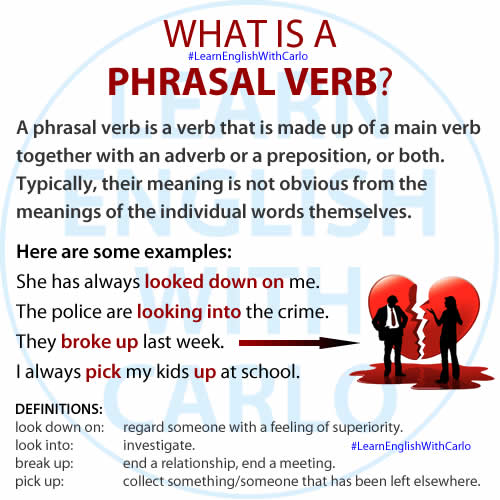
A phrasal verb is a verb that is made up of a main verb together with an adverb or a preposition, or both. Typically, their meaning is not obvious from the meanings of the individual words themselves.
There are many phrasal verbs in English. Here are some examples:

She has always LOOKED DOWN ON me.
(She thought of me with a feeling of superiority)

The police are LOOKING INTO the crime.
(The police are investigating the crime)

They BROKE UP last week.
(They ended their relationship last week)

I always PICK my kids UP at school.
(I always collect my kids from their school)

If you’d like to learn more about Phrasal Verbs, click on the link below to purchase a Self-Study Program.

English for Everyone: Beginner Box Set: Course and Practice Books Four-Book Self-Study Program
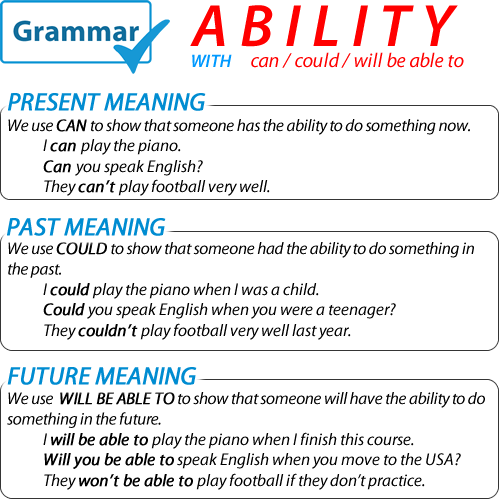
GRAMMAR – ABILITY using CAN, COULD, & WILL BE ABLE TO

We use CAN to show that someone has the ability to do something now.
I can play the piano.
Can you speak English?
They can’t play football very well.

We use COULD to show that someone had the ability to do something in the past.
I could play the piano when I was a child.
Could you speak English when you were a teenager?
They couldn’t play football very well last year.

We use WILL BE ABLE TO to show that someone will have the ability to do something in the future.
I will be able to play the piano when I finish this course.
Will you be able to speak English when you move to the USA?
They won’t be able to play football if they don’t practice.

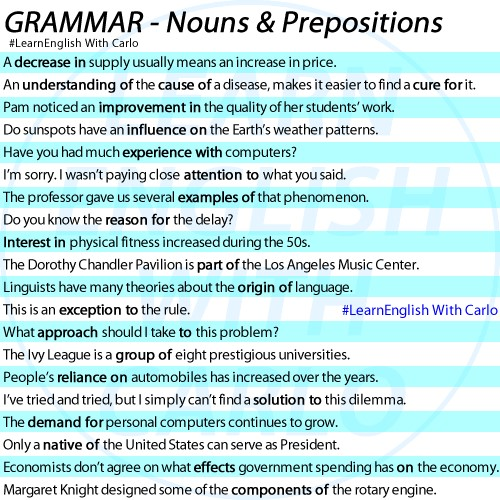
GRAMMAR – Nouns & Prepositions

Some nouns are followed by specific prepositions. For example the noun relationship is always followed by with.

A decrease in supply usually means an increase in price.
Understanding the cause of a disease, makes it easier to find a cure for it.
Pam noticed an improvement in the quality of her students’ work.
Do sunspots have an influence on the Earth’s weather patterns.
Have you had much experience with computers?
I’m sorry. I wasn’t paying close attention to what you said.
The professor gave us several examples of that phenomenon.
Do you know the reason for the delay?
Interest in physical fitness increased in the 50s.
The Dorothy Chandler Pavilion is part of the Los Angeles Music Center.
Linguists have many theories about the origin of language.
This is an exception to the rule.
What approach should I take to this problem?
The Ivy League is a group of eight prestigious universities.
People’s reliance on automobiles has increased over the years.
I’ve tried and tried, but I simply can’t find a solution to this dilemma.
The demand for personal computers continues to grow.
Only a native of the United States can serve as President.
Economists don’t agree on what effects government spending has on the economy.
Margaret Knight designed some of the components of the rotary engine.

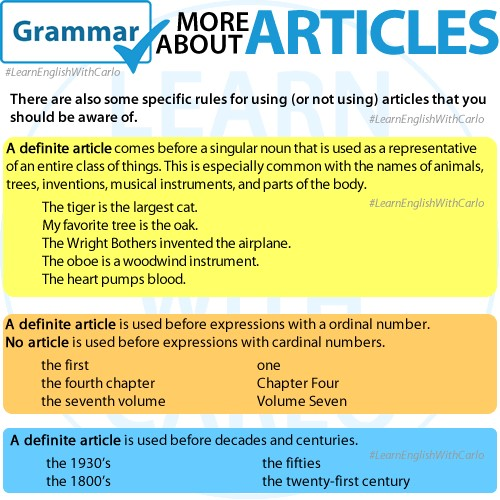
GRAMMAR – More about Articles

A definite article comes before a singular noun that is used as a representative of an entire class of things. This is especially common with the names of animals, trees, inventions, musical instruments, and parts of the body.
The tiger is the largest cat.
My favorite tree is the oak.
The Wright Bothers invented the airplane.
The oboe is a woodwind instrument.
The heart pumps blood.

A definite article is used before expressions with an ordinal number.
No article is used before expressions with cardinal numbers.
the first
one
the fourth chapter
Chapter Four
the seventh volume
Volume Seven

A definite article is used before decades and centuries.
the 1930’s
the fifties
the 1800’s
the twenty-first century

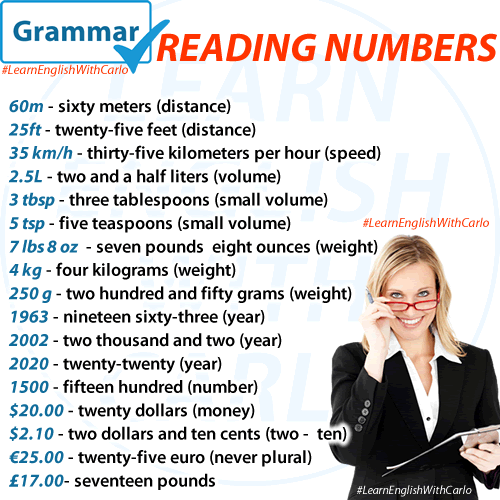
GRAMMAR – How to read numbers

GRAMMAR – How to read numbers

  • 60m – sixty meters (distance)
  • 25ft – twenty-five feet (distance)
  • 35 km/h – thirty-five kilometers per hour (speed)
  • 2.5L – two and a half liters (volume)
  • 3 tbsp – three tablespoons (small volume)
  • 5 tsp – five teaspoons (small volume)
  • 7 lbs 8 oz – seven pounds eight ounces (weight)
  • 4 kg – four kilograms (weight)
  • 250 g – two hundred and fifty grams (weight)
  • 1963 – nineteen sixty-three (year)
  • 2002 – two thousand and two (year)
  • 2020 – twenty-twenty (year)
  • 1500 – fifteen hundred (number)
  • $20.00 – twenty dollars (money)
  • $2.10 – two dollars and ten cents (two – ten)
  • €25.00 – twenty-five euro (never plural)
  • £17.00- seventeen pounds

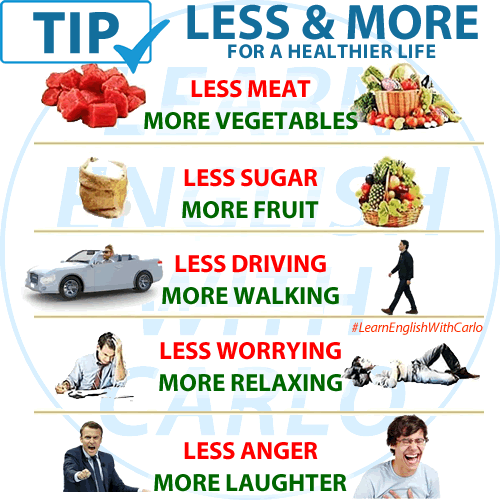
TIP Less & More

TIP Less & More for a HEALTHIER LIFE

Here are some simple things we can do to help us achieve a healthier lifestyle.

  • LESS meat MORE vegetables
  • LESS sugar MORE fruit
  • LESS driving MORE walking
  • LESS worrying MORE relaxing
  • LESS anger MORE laughter

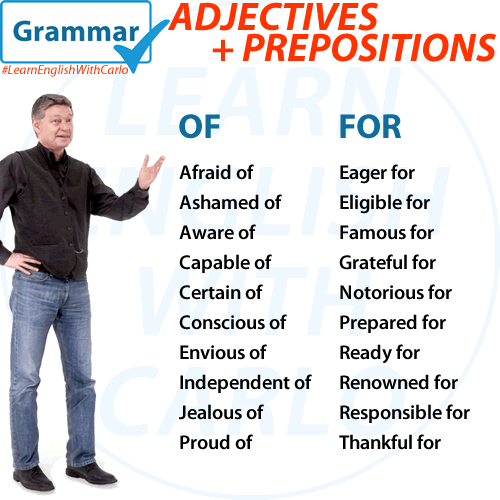
GRAMMAR – Adjectives & Prepositions

GRAMMAR – Adjectives & Prepositions

Some adjectives need a preposition before their object. There doesn’t seem to be a logical rule, I’m afraid! We just need to learn them.

  • Afraid of
  • Ashamed of
  • Aware of
  • Capable of
  • Certain of
  • Conscious of
  • Envious of
  • Independent of
  • Jealous of
  • Proud of
  • Eager for
  • Eligible for
  • Famous for
  • Grateful for
  • Notorious for
  • Prepared for
  • Ready for
  • Renowned for
  • Responsible for
  • Thankful for

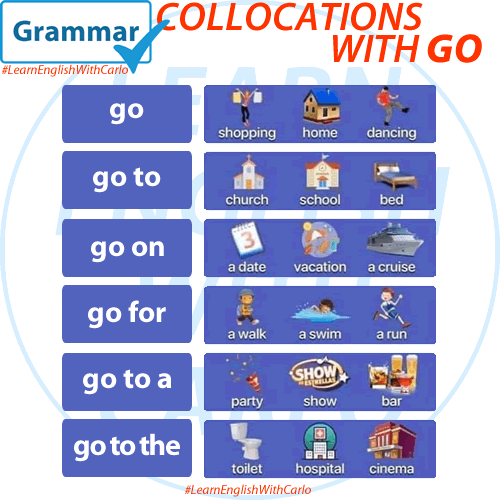
GRAMMAR – Collocations with GO

GRAMMAR – Collocations with GO

Native English speakers use the word GO almost daily. Try using some of these collocations in your everyday speech and learn how it can go into virtually any sentence. Can you think of any other collocations using the word go? Let us know with a comment!

  • GO shopping
  • GO dancing
  • GO home
  • GO TO church
  • GO TO school
  • GO TO bed
  • GO ON vacation
  • GO ON a date
  • GO ON a cruise
  • GO FOR a walk
  • GO FOR a swim
  • GO FOR a run
  • GO TO A party
  • GO TO A show
  • GO TO A bar
  • GO TO THE bathroom (toilet)
  • GO TO THE hospital
  • GO TO THE movies (cinema)

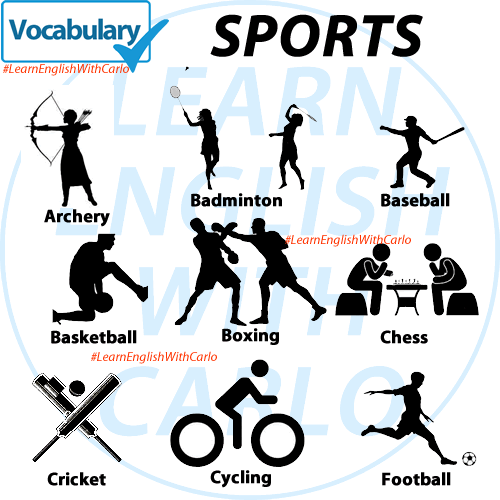
VOCABULARY – Sports

VOCABULARY – Sports

Here are a few popular sports.

  • Archery,
  • Badminton,
  • Baseball,
  • Basketball,
  • Boxing,
  • Chess,
  • Cricket,
  • Cycling,
  • Football

What sports do you play?

What sports do you like to watch?

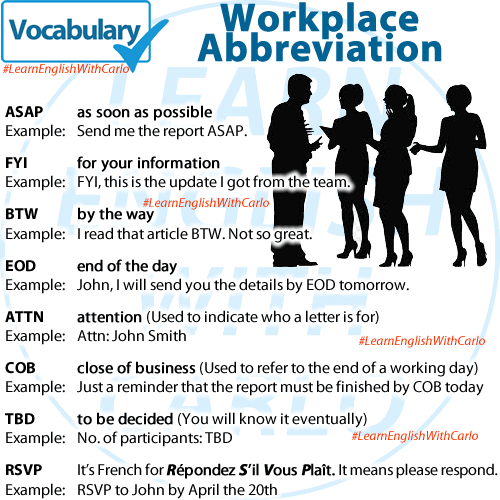
VOCABULARY – Workplace Abbreviation

VOCABULARY – Workplace Abbreviation

  • ASAP as soon as possible
    Send me the report ASAP.
  • FYI for your information
    FYI, this is the update I got from the team.
  • BTW by the way
    I read that article BTW. Not so great.
  • EOD end of the day
    John, I will send you the details by EOD tomorrow.
  • ATTN attention (Used to indicate who a letter is for)
    Attn: John Smith
  • COB close of business (Used to refer to the end of a working day)
    Just a reminder that the report must be finished by COB today
  • TBD to be decided (You will know it eventually)
    No. of participants: TBD
  • RSVP It’s French for Répondez S’il Vous Plaît. It means please respond.
    RSVP to John by April the 20th