
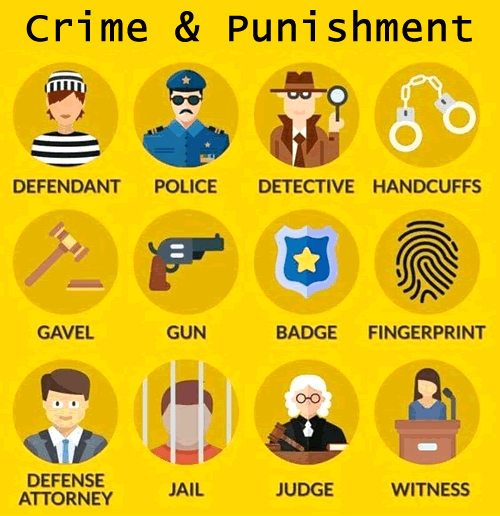
VOCABULARY – Crime & Punishment

The criminal justice system keep us safe from criminals. When a person arrested by a policeman with a badge and is accused of a crime that person becomes a defendant. Police usually carry guns.  A detective usually investigates the crime. Police and detectives usually put handcuffs on the defentant to make sure he cant escape. Later at the station they will take his fingerprints. At the trial, the defendant has a defense attorney to defent him in front of the judge. Both the prosecuter and the defense can call witnesses. If the defendant is found guilty, he will go to jail.

If you have any questions or doubts, please ask in the comments or send me a private message.

Follow me on Instagram: @englishyourwaybr
or look for the hashtag #LearnEnglishWithCarlo
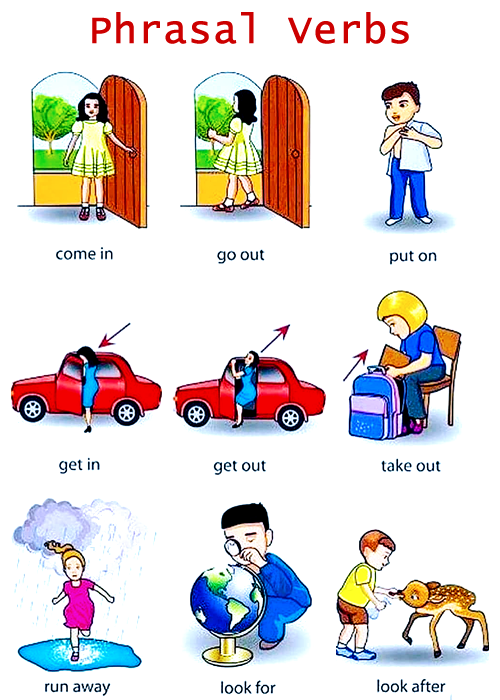
PHRASAL VERBS – mixed

phrasal verb is a combination of a verb and an adverb or preposition, for example ‘look up’ or ‘look after’, which together have a particular meaning which is different from the verb alone.

The following phrasal verbs are featured in this slide.

  • come in
  • go out
  • put on
  • get in
  • get out
  • take out
  • run away
  • look for
  • look after

Do you know how to use phrasal verbs?

If you have any questions or doubts, please ask in the comments or send me a private message.

Follow me on Instagram: @englishyourwaybr
or look for the hashtag #LearnEnglishWithCarlo
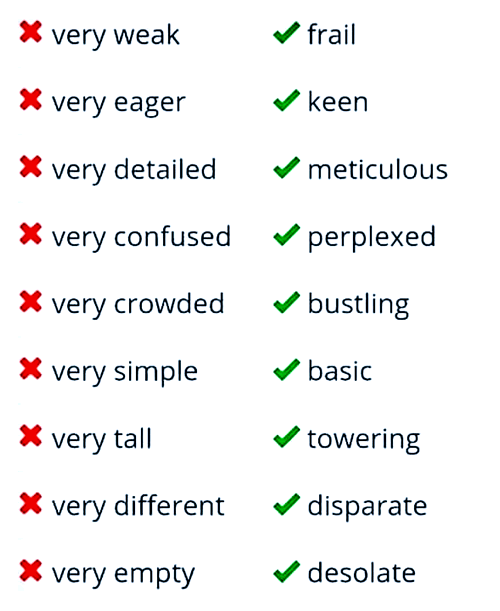
VOCABULARY – Instead of VERY (7)

The word VERY is an adverb and an intensifier – it comes before an adverb or adjective to make it more intense (to a higher degree).

  • Say frail instead of very weak.
  • Say keen instead of very eager.
  • Say meticulous instead of very detailed.
  • Say perplexed instead of very confused.
  • Say bustling instead of very crowded.
  • Say basic instead of very simple.
  • Say towering instead of very tall.
  • Say disparate instead of very different.
  • Say desolate instead of very empty. (for a large space)

If you have any questions or doubts, please ask in the comments or send me a private message.

Follow me on Instagram: @englishyourwaybr
or look for the hashtag #LearnEnglishWithCarlo
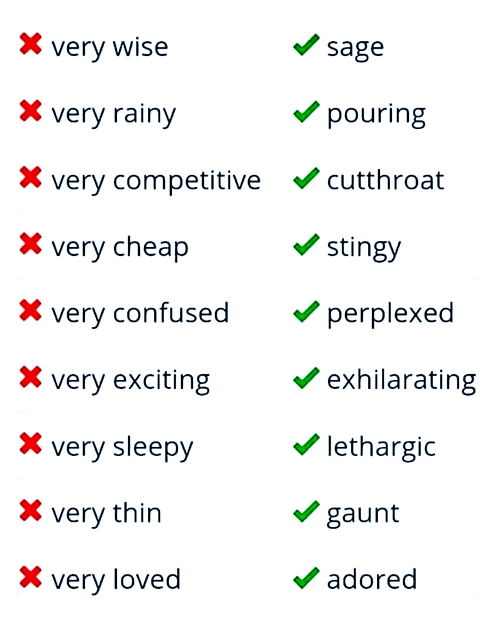
VOCABULARY – Instead of VERY (6)

The word VERY is an adverb and an intensifier – it comes before an adverb or adjective to make it more intense (to a higher degree).

  • Say sage instead of very wise.
  • Say pouring instead of very rainy.
  • Say cutthroat instead of very competetive.
  • Say stingy instead of very cheap.
  • Say perplexed instead of very confused.
  • Say exhiliarating instead of very exciting.
  • Say lethargic instead of very sleepy.
  • Say gaunt instead of very thin.
  • Say adored instead of very loved.

If you have any questions or doubts, please ask in the comments or send me a private message.

Follow me on Instagram: @englishyourwaybr
or look for the hashtag #LearnEnglishWithCarlo
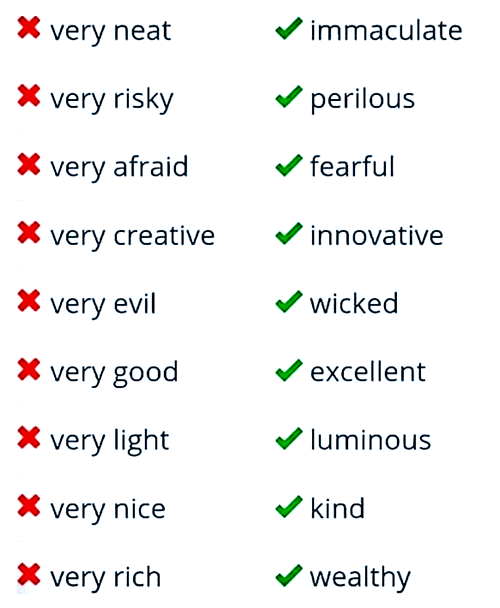
VOCABULARY – Instead of VERY (5)


The word VERY is an adverb and an intensifier – it comes before an adverb or adjective to make it more intense (to a higher degree).

  • Say immaculate instead of very neat.
  • Say perilous instead of very risky.
  • Say fearful instead of very afraid.
  • Say innovative instead of very creative.
  • Say wicked instead of very evil.
  • Say excellent instead of very good.
  • Say luminous instead of very light.
  • Say kind instead of very nice.
  • Say wealthy instead of very rich.

If you have any questions or doubts, please ask in the comments or send me a private message.

Follow me on Instagram: @englishyourwaybr
or look for the hashtag #LearnEnglishWithCarlo
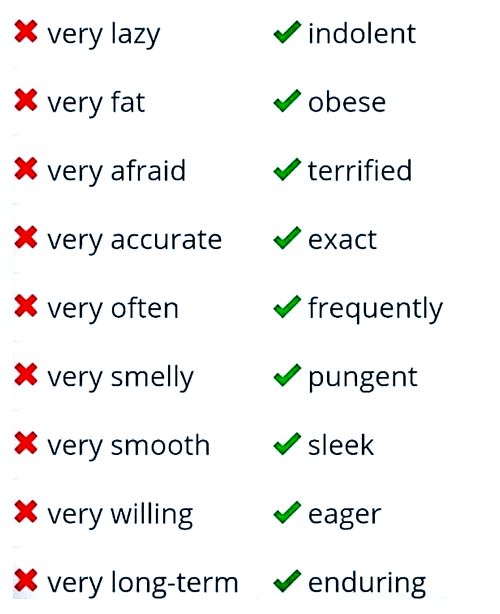
VOCABULARY – Instead of VERY (4)

The word VERY is an adverb and an intensifier – it comes before an adverb or adjective to make it more intense (to a higher degree).

  • Say indolent instead of very lazy.
  • Say obese instead of very fat.
  • Say terrified instead of very afraid.
  • Say exact instead of very accurate.
  • Say frequently instead of very often.
  • Say pungent instead of very smelly.
  • Say sleek instead of very smooth.
  • Say eager instead of very willing.
  • Say enduring instead of very long-term.

If you have any questions or doubts, please ask in the comments or send me a private message.

Follow me on Instagram: @englishyourwaybr
or look for the hashtag #LearnEnglishWithCarlo
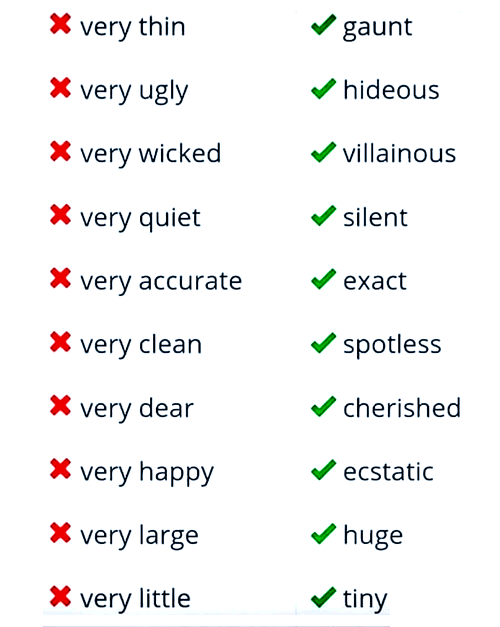
VOCABULARY – Instead of VERY (3)

The word VERY is an adverb and an intensifier – it comes before an adverb or adjective to make it more intense (to a higher degree).

  • Say gaunt instead of very thin.
  • Say hideous instead of very ugly.
  • Say villainous instead of very wicked.
  • Say silent instead of very quiet.
  • Say exact instead of very accurate.
  • Say spotless instead of very clean.
  • Say cherished instead of very dear.
  • Say ecstatic instead of very happy.
  • Say huge instead of very large.
  • Say tiny instead of very little.

If you have any questions or doubts, please ask in the comments or send me a private message.

Follow me on Instagram: @englishyourwaybr
or look for the hashtag #LearnEnglishWithCarlo
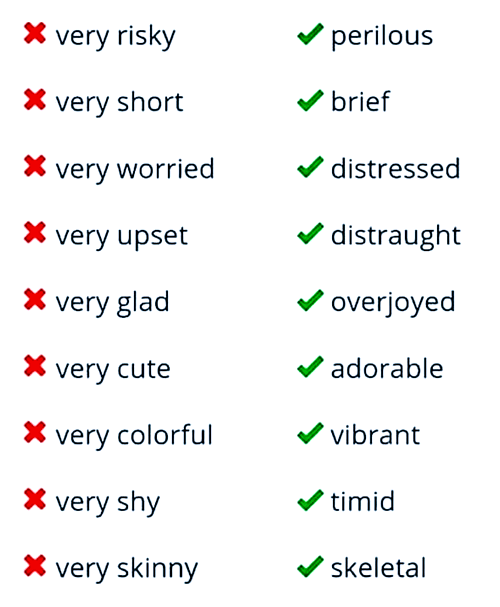
VOCABULARY – Instead of VERY (2)

The word VERY is an adverb and an intensifier – it comes before an adverb or adjective to make it more intense (to a higher degree).

  • Say perelous instead of very risky.
  • Say brief instead of very short.
  • Say distressed instead of very worried.
  • Say distraught instead of very upset.
  • Say overjoyed instead of very glad.
  • Say adorable instead of very cute.
  • Say vibrant instead of very colorful.
  • Say timid instead of very shy.
  • Say skeletal instead of very skinny.

If you have any questions or doubts, please ask in the comments or send me a private message.

Follow me on Instagram: @englishyourwaybr
or look for the hashtag #LearnEnglishWithCarlo
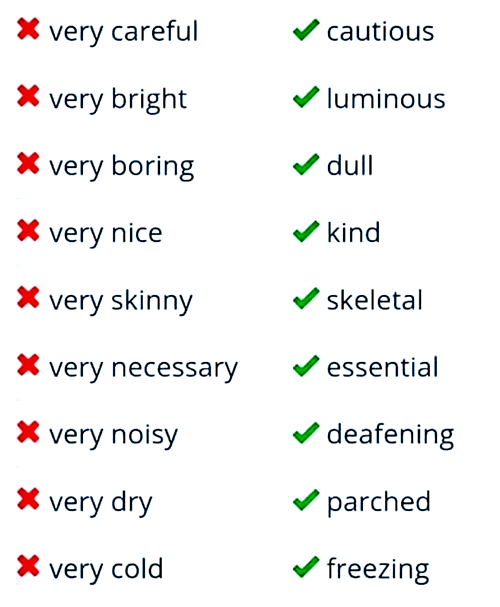
VOCABULARY – Instead of VERY (1)

The word VERY is an adverb and an intensifier – it comes before an adverb or adjective to make it more intense (to a higher degree).

  • Say cautious instead of very careful.
  • Say luminous instead of very bright.
  • Say dull instead of very boring.
  • Say kind instead of very nice. (describing a person)
  • Say skeletal instead of very skinny.
  • Say essential instead of very necessary.
  • Say deafening instead of very noisy.
  • Say parched instead of very dry.
  • Say freezing instead of very cold.

If you have any questions or doubts, please ask in the comments or send me a private message.

Follow me on Instagram: @englishyourwaybr
or look for the hashtag #LearnEnglishWithCarlo
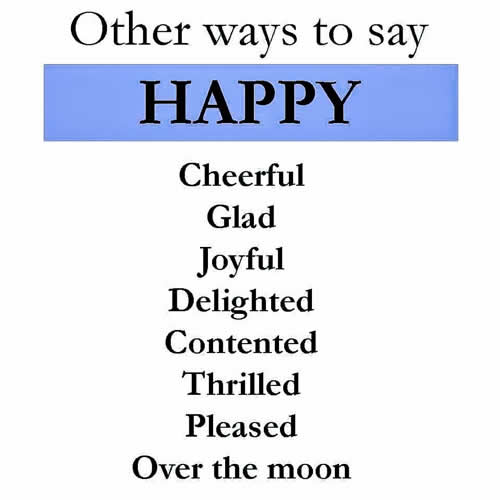
OTHER WAYS TO SAY … Happy

Can you think of any more?

If you have any questions or doubts, please ask in the comments or send me a private message.

Follow me on Instagram: @englishyourwaybr
or look for the hashtag #LearnEnglishWithCarlo