Your Guide to Building Better Sentences When you’re learning English, you might hear a lot about clauses. But what exactly are they, and why are they important? This guide will break down the basics of …
Figures of speech are words or expressions used in a non-literal, creative way to make language more vivid and expressive.Writers and speakers use them to create imagery, add emotion, and make ideas easier to remember. …
QUIT “Quit” is a verb that means to stop or cease doing something. When someone quits an activity, job, or habit, they discontinue or give up that particular action or commitment. “Quit” can also imply …
Countable and uncountable nouns are two categories used to classify nouns based on whether they can be counted or not. Countable Nouns:Countable nouns refer to objects or entities that can be counted as discrete units.They …
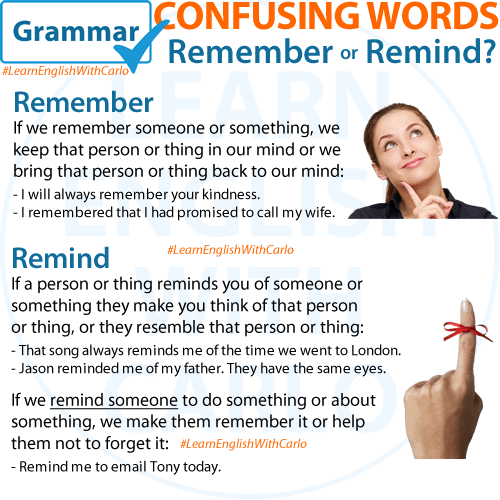
“Remember” is about your own memory, recalling information independently, while “remind” involves assisting or being prompted to recall something. If you remember something, it’s a natural act of memory. If something reminds you, it’s usually a trigger that brings a memory to your mind.
REMEMBER:
“Remember” is a verb that describes the ability to recall or retain information, experiences, or facts in one’s memory. When you “remember” something, it means you can bring to mind something that happened in the past, or you can retain information that you have learned.
Examples:
“I remember my childhood.”
“She remembered to bring her umbrella.”
“Do you remember his name?”
REMIND:
“Remind” is a verb used when you help someone else remember something, or when something cues you to recall a memory. So, if you “remind” someone, you are prompting them to remember something.
Examples:
“Please remind me to call my mother later.” (This means, “Please tell me later so that I don’t forget.”)
“The smell of coffee reminds me of mornings at my grandmother’s house.” (This means, “The smell of coffee makes me think of mornings at my grandmother’s house.”)
Key Differences:
Subject:
Use “remember” when you are talking about your own memory.
Use “remind” when you are helping someone else remember something.
Action:
“Remember” is about recalling or retaining information.
“Remind” is about prompting or triggering someone’s memory.
When learning English, one of the most challenging aspects for students is understanding the difference between the Present Perfect and the Simple Past. Both tenses refer to actions in the past, but they are used in very different ways depending on the context. Let’s break down these differences.
Present Perfect: Unfinished Actions
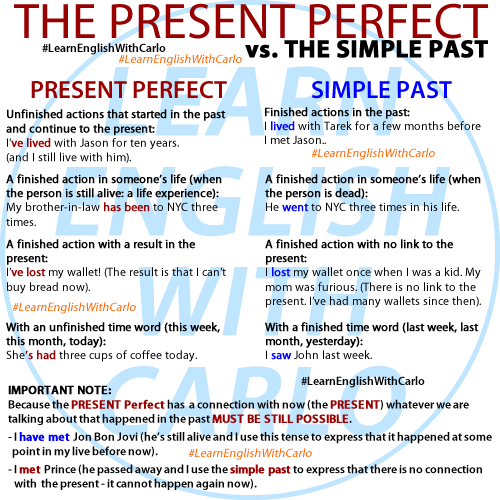
The Present Perfect is used to describe actions that started in the past and continue to the present. The action may not be ongoing, but the impact of the action remains.
Example: I’ve lived with Jason for ten years. (I still live with him.)
In this sentence, the action of living with Jason began in the past and continues to this day.
Simple Past: Finished Actions
The Simple Past is used for completed actions that occurred at a specific point in the past. These actions are not connected to the present moment.
Example: I lived with Tarek for a few months before I met Jason.
In this case, living with Tarek is a finished action with no connection to the present. It occurred before meeting Jason and is no longer relevant.
Present Perfect: Life Experiences (Unfinished Life)
When we talk about life experiences, we often use the Present Perfect, especially if the person is still alive and could possibly repeat the experience.
Example: My brother-in-law has been to NYC three times.
Since the brother-in-law is still alive, he might go to New York City again, making this a relevant life experience.
Simple Past: Life Experiences (Finished Life)
If we are talking about someone who has passed away, or if we are referring to something that can no longer happen, we use the Simple Past.
Example: She went to NYC three times in her life.
Here, the person is no longer alive, so this action belongs to a finished past.
Present Perfect: Actions with Present Results
The Present Perfect is also used when a past action has a result in the present. This emphasizes the connection between the past event and the current situation.
Example: I’ve lost my wallet!
The result of this is that you are still experiencing the consequences in the present, such as being unable to buy something.
Simple Past: No Present Connection
In contrast, the Simple Past is used when a past action has no effect on the present. The action is fully completed, and there is no ongoing relevance.
Example: I lost my wallet once when I was a kid. My mom was furious.
This event happened long ago and has no connection to the present moment.
Present Perfect: Unfinished Time Periods
We use the Present Perfect when the time period being discussed is unfinished or ongoing. Words like “this week,” “this month,” and “today” indicate that the time frame is still open.
Example: She’s had three cups of coffee today.
Since “today” hasn’t ended yet, the Present Perfect is the appropriate tense.
Simple Past: Finished Time Periods
When the time period is finished or clearly in the past, we use the Simple Past. Words like “yesterday,” “last week,” or “last month” signal that the time frame is complete.
Example: She had three cups of coffee yesterday.
“Yesterday” is a finished time period, so we use the Simple Past.
Important Note
The Present Perfect is connected to the present moment because it often describes situations that are still possible or ongoing. This tense suggests that the past event could still have some relevance today.
Example: I have met Jon Bon Jovi. (He’s still alive, so it’s possible that I could meet him again.)
On the other hand, the Simple Past is used for actions that are entirely in the past, with no connection to the present.
Example: I met Prince. (Since Prince has passed away, it’s impossible to meet him again. The action belongs completely to the past.)
Conclusion
Understanding the difference between the Present Perfect and the Simple Past is essential for expressing yourself clearly in English. The Present Perfect links the past to the present, while the Simple Past separates the action from the present. Keep practicing these distinctions, and soon they will become second nature!
While SO-SO and MORE OR LESS are short and simple phrases, they serve entirely different purposes in English. Let’s dive into their meanings, uses, and nuances.
1. SO-SO: The Language of the Average
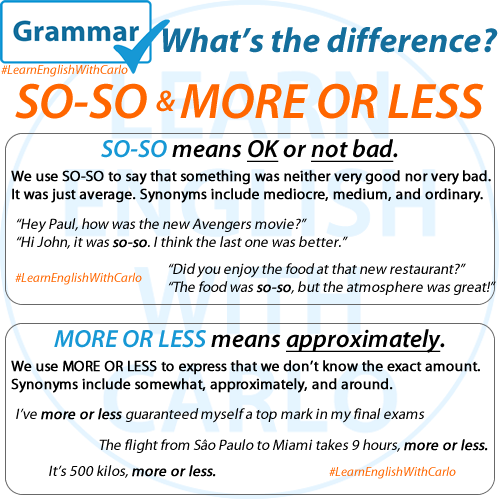
Definition: SO-SO is used to describe something that is average, ordinary, or not impressive. It conveys a neutral feeling—not good, not bad.
When to Use SO-SO:
To express indifference or mild dissatisfaction.
When you want to downplay enthusiasm or expectations.
Examples in Sentences:
“The concert was so-so. The sound system wasn’t great, but the band was okay.”
“I asked Mark about his new job, and he said it’s so-so.”
Note on Usage: While SO-SO is understood worldwide, it might sound old-fashioned to some English speakers. Many prefer alternatives like “meh” (informal) or “it was okay.”
When we want to know the quantity or amount of something, we use HOW MUCH or HOW MANY.
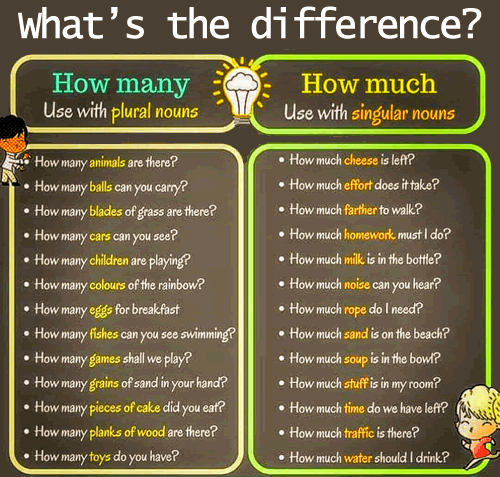
HOW MANY is used with countable nouns, which are objects or entities that can be counted individually. How many animals are there? How many cars can you see? How many slices of pizza did they order?
HOW MUCH is used with uncountable nouns, which are substances, concepts, or things that we cannot count individually. How much cheese is there? How much water should we drink every day? How much coffee is in the pot?
Key Differences:
Nature of Nouns:
Uncountable Nouns: Use “how much” (e.g., water, time, money).
Countable Nouns: Use “how many” (e.g., apples, people, books).
Determining Plurality:
Use “how much” for things that are measured in quantity or volume (water, time).
Use “how many” for things that are counted in numbers (apples, people).
Remembering this distinction will help you use “how much” and “how many” correctly in questions and statements based on whether the noun is countable or uncountable.
Wrong shortcode initialized
If you have any questions or doubts, please ask in the comments or send me a private message.
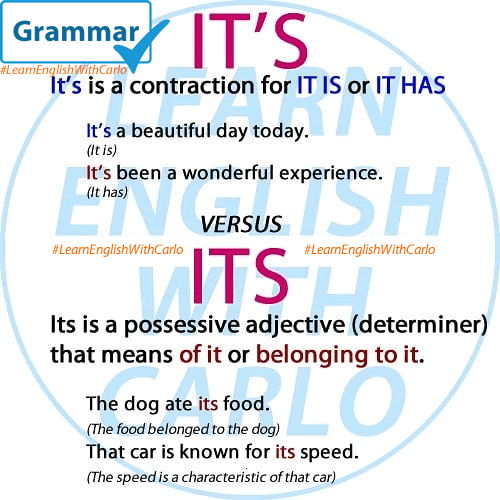
English learners often get confused between “its” and “it’s” — and even native speakers make mistakes with these two! But don’t worry. Once you understand the difference, it’s easy to get it right every time.
🔤 Quick Explanation
✅ It’s = it is or it has
✅ Its = possessive form of “it” (shows that something belongs to “it”)
🔎 When to Use “It’s”
It’s is a contraction (short form) of:
it + is
it + has
📌 Examples with “it is”:
It’s a sunny day. (= It is a sunny day.)
It’s very late. (= It is very late.)
📌 Examples with “it has”:
It’s been a long time. (= It has been a long time.)
It’s got two bedrooms and a balcony. (= It has got…)
TIP: If you can say “it is” or “it has,” use it’s.
🧸 When to Use “Its”
Its is the possessive form of “it.” Use it to show that something belongs to “it.”
📌 Examples:
The cat licked its paw.
The company changed its logo.
This book has lost its cover.
🧠 Think of “its” like “his” or “her” — there’s no apostrophe.
🚫 Common Mistake
Many learners think that “its” should have an apostrophe to show possession. But in English, possessive pronouns (like his, hers, its, yours) don’t use apostrophes.
🔁 WRONG: The dog chased it’s tail. ❌ ✅ RIGHT: The dog chased its tail.
📝 Mini Quiz – Choose “its” or “it’s”
___ raining outside.
The robot lost ___ arm.
___ been a long week.
I love this phone. ___ design is perfect.
___ time to leave!
Answers:
It’s
Its
It’s
Its
It’s
🔁 Quick Recap
Word
Meaning
Example
It’s
It is / It has
It’s cold today. / It’s been great.
Its
Possessive form of “it”
The dog wagged its tail.
💡 Final Tip
If you’re not sure which one to use, try replacing it with “it is” or “it has.” If the sentence still makes sense, use it’s. If not, you probably need its.
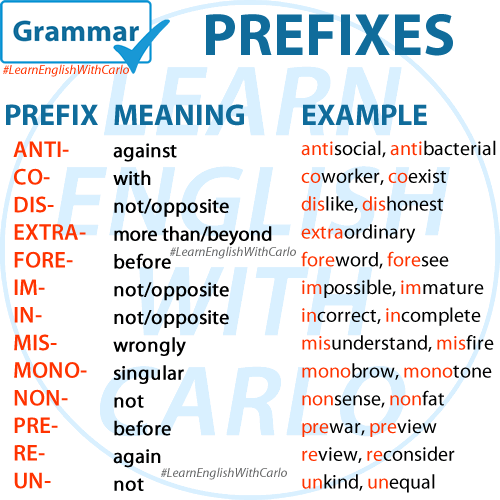
Have you ever wondered how a single word can convey vastly different meanings, just by adding a few letters at the beginning? Enter the fascinating world of prefixes – those tiny yet mighty linguistic tools that shape our language in profound ways.
What are Prefixes?
At their core, prefixes are linguistic building blocks, morphemes attached to the beginning of words to alter their meanings. They serve as the gateway to a universe of nuanced expressions, drawing from a rich tapestry of languages, including Latin, Greek, and Old English.
Understanding prefixes is not just about memorizing a list; it’s about wielding them effectively. Here are some tips to master their usage:
Pay attention to spelling changes: Sometimes, adding a prefix alters the spelling of the word itself (e.g., “in-” becomes “il-” before certain letters).
Consult dictionaries: When in doubt, consult reputable dictionaries to ensure accurate prefix usage.
Benefits of Understanding Prefixes
Embracing prefixes isn’t merely an exercise in linguistic curiosity; it’s a gateway to linguistic empowerment. Here’s why:
Enhanced vocabulary comprehension: Knowing prefixes expands your vocabulary arsenal, enabling you to decipher complex words with ease.
Decoding unfamiliar words: When encountering unfamiliar terms, recognizing their prefixes can provide valuable clues to their meanings.
Building word families: Understanding prefixes allows you to trace the etymology of words and establish connections within word families, fostering a deeper appreciation for language dynamics.
Conclusion
In the vast tapestry of language, prefixes are the humble architects of meaning, imbuing words with depth and versatility. By unraveling their mysteries, we unlock a treasure trove of linguistic possibilities. So, let’s embark on this journey of linguistic discovery, one prefix at a time.
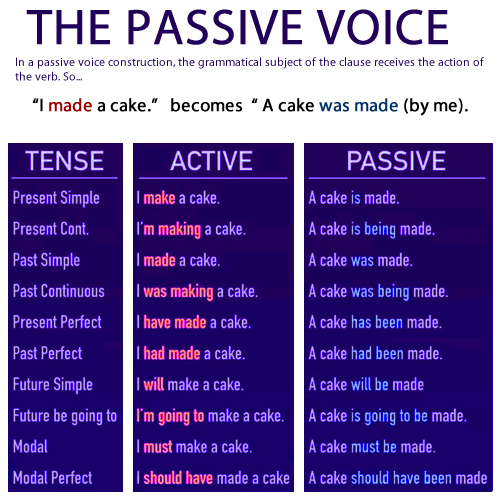
There are two voices in English (and most other languages), ACTIVE and PASSIVE.
ACTIVE: Isabella ate the burrito. In this sentence, the subject, Isabella, performed the action, and the object, the burrito, suffered the action.
To express something in the PASSIVE voice, the idea needs to have an OBJECT. Why? Because in the passive voice, the OBJECT (of the active sentence) occupies the SUBJECT place.
We make the passive by putting the verb ‘to be’ into the tense we need (refer to the active sentence) and then adding the past participle of the action. In our example, The object of the active sentence, the burrito, becomes the SUBJECT of the passive sentence. The active sentence is in the simple past so the verb ‘to be’ must be also in the past and conjugated for our “new” subject, the burrito (third person singular). We then add the past participle of the action (eat/ate/eaten) and then we can complete the idea by adding the prepositional phrase ‘by Isabella.’
PASSIVE: The burrito was eaten (by Isabella).
This is one of the few areas that has logic and NO EXCEPTIONS!
Look at a few more examples in other tenses:
PRESENT: I teach English – English is taught (by me).
PRESENT CONTINUOUS: She is watching TV – TV is being watched (by her)
PRESENT PERFECT: I have visited three museums today – Three museums have been visited by me today.
MODAL: Tom can play the piano – The piano can be played (by Tom)
Wrong shortcode initialized
If you have any questions or doubts, please ask in the comments or send me a private message.
Certain nouns are often accompanied by specific prepositions, creating noun-preposition collocations. For instance, when we use the noun “interest,” it is typically followed by the preposition “in.” Similarly, “contact” pairs with “with,” and “room” with “for.” For example:
“I have no interest in what you are saying.”
“I will be in contact with you soon.”
“We don’t have room for the sofa.”
Recognizing which preposition to use in these collocations can be challenging. One helpful strategy is to consider related adjectives or verbs. If we know the preposition commonly used with an adjective or verb, we can apply the same preposition to the related noun. For example:
Adjective: “Tom had a successful career in movies.”
Verb: “He succeeded in making good movies.”
Noun: “I wished him success in his new movie.”
However, this rule doesn’t always apply universally, and the best way to internalize these combinations is through practice and exposure to English materials. Regular reading and listening will help you become familiar with what sounds natural over time.
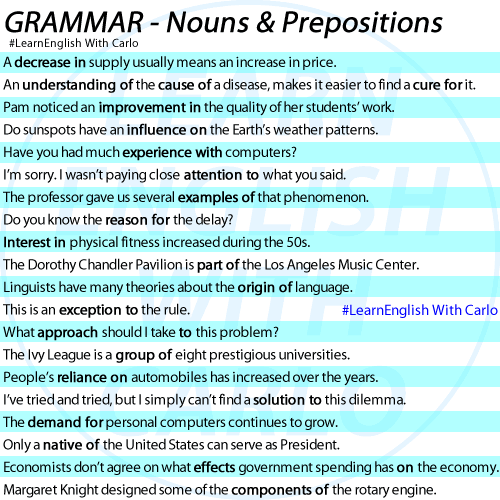
Here are some more example:
A decrease in supply usually means an increase in price.
An understanding of the cause of a disease, makes it easier to find a cure for it.
Pam noticed an improvement in the quality of her students’ work.
Do sunspots have an influence on the Earth’s weather patterns.
Have you had much experience with computers?
I’m sorry. I wasn’t paying close attention to what you said.
The professor gave us several examples of that phenomenon.
Do you know the reason for the delay?
Interest in physical fitness increased in the 50s.
The Dorothy Chandler Pavilion is part of the Los Angeles Music Center.
Linguists have many theories about the origin of language.
This is an exception to the rule.
The Ivy League is a group of eight prestigious universities.
People’s reliance on automobiles has increased over the years.
I’ve tried and tried, but I simply can’t find a solution to this dilemma.
The demand for personal computers continues to grow.
Only a native of the United States can serve as President.
Economists don’t agree on what effects government spending has on the economy.
Margaret Knight designed some of the components of the rotary engine.
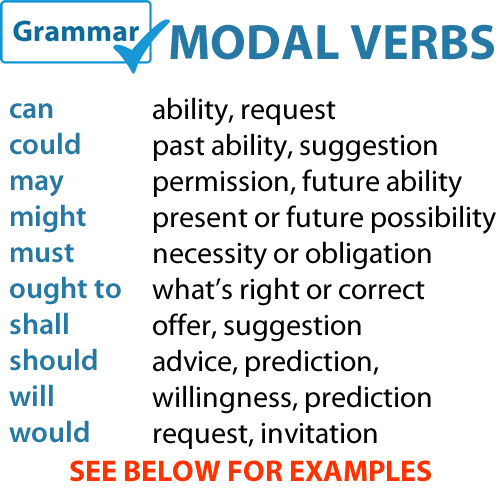
Modal verbs are auxiliary (helping) verbs that express possibility, necessity, ability, permission, and other attitudes toward the action of the main verb. Unlike regular verbs, modal verbs do not change form based on the subject (e.g., “I can,” “he can”). They are always followed by the base form of the main verb.
Common Modal Verbs:
Can:
Ability: Used to express someone’s capability.
Example: She can speak three languages.
Permission: Used to ask for or give permission.
Example: Can I leave early today?
Could:
Past Ability: Used to talk about ability in the past.
Example: When I was younger, I could run fast.
Polite Requests: Used to make polite requests.
Example: Could you help me with this?
May:
Permission: More formal than “can.”
Example: You may leave the room.
Possibility: Indicates a possible situation.
Example: It may rain tomorrow.
Might:
Possibility: Indicates a weaker possibility than “may.”
Example: It might snow later.
Suggestions: Used to make suggestions or give advice.
Example: You might want to try that restaurant.
Must:
Necessity: Indicates a strong obligation or requirement.
Example: You must wear a seatbelt.
Logical Deduction: Used to make logical conclusions.
Example: She must be at work; her car is in the parking lot.
Should:
Advice: Used to give recommendations or advice.
Example: You should see a doctor if you’re feeling unwell.
Expectation: Indicates something that is likely to happen.
Example: The train should arrive by noon.
Ought to:
Advice: Similar to “should,” but slightly stronger.
Example: You ought to apologize for your mistake.
Using Modal Verbs in Different Contexts:
Requests:
Use “can,” “could,” or “may” to make requests.
Example: Can you pass the salt?
Offers:
Use “shall” or “will” for offers.
Example: Shall I help you with that?
Suggestions:
Use “should” or “might” for suggestions.
Example: You should try the new cafe.
Possibility:
Use “may” or “might” to express possibilities.
Example: I might go to the concert if I finish my work.
Tips for Using Modal Verbs:
Remember that modal verbs do not take “to” before the main verb (e.g., “I can swim,” not “I can to swim”).
Modal verbs can change meaning based on context, so pay attention to how they are used in different sentences.
Practice using modal verbs in conversation to improve your fluency and understanding.
Tom can write poetry very well. (Ability)
Lisa can’t speak French. (Lack of ability)
When I was a child I could climb trees. ( Past ability)
Can you lend me ten dollars? (Request, informal)
Could I have your number? (Request, polite)
You may start your exam now. (Permission, formal)
Our company might get the order if the client agrees to the price. (Possibility)
Shall we go for a walk? (Suggestion, polite)
You should check that document before you send it out. (Advice)
You must have a passport to cross the border. (Necessity)
May I sit here? (Request)
Conclusion
Modal verbs are essential in English for expressing various attitudes and functions. By mastering their use, you can communicate more effectively in both spoken and written English.
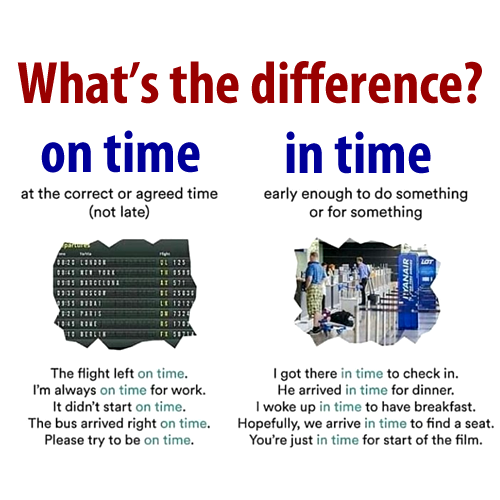
Many people confuse these two expressions. And while they are similar, there is a very important difference.
ON time – This referrs to when you have an appointment or scheduled time to be somewhere or do something.
The meeting starts at 2 pm. I have to be on time. (If I’m late something bad will happen.)
The flight left on time. (It took off at the scheduled time)
TIP: I tell my students to associate the O of ON TIME with the face of a clock to remember that on time has a set time!
IN time – This refers to being early ehough to be able to do something or experience something.
Even though I arrived late for the meeting I was still in time because it hadn’t started.*
I forgot to set my alarm but luckily I woke up in time to have breakfast.
NOTE: It is possible to be late (not on time) for an appointment and still be in time to participate in the experience.
If you have any questions or doubts, please ask in the comments or send me a private message.