HAVE & HAVE GOT

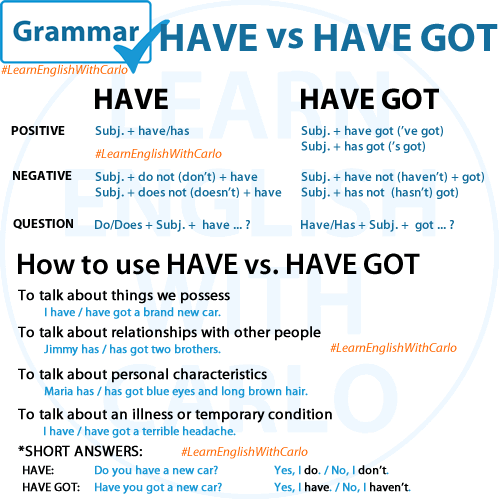
When we talk about possession, relationships, illnesses, or characteristics, English gives us two ways to express the same idea:
👉 HAVE and HAVE GOT

Both mean the same thing, but they’re used slightly differently in everyday English.


🧩 1. Meaning and Usage

Both HAVE and HAVE GOT are used to talk about things we own, relationships, personal characteristics, or temporary states like illnesses.

They mean exactly the same thing.
Both are present tense forms.
HAVE GOT is not the present perfect of “get.”

❌ I have got my keys. → This does not mean “I have obtained my keys.”
✅ It means “I have my keys.” (possession)

💡 Tip:

  • HAVE is used more in American English and formal contexts.
  • HAVE GOT is more common in British English and informal conversation.

💼 2. Talking About Possession

We use have / have got to show ownership or possession.

Examples:

  • I have / have got a brand new car.
  • She has / has got a big house near the beach.
  • They have / have got a lot of free time today.

💬 Both are correct — the difference is mainly in style and formality.


👨‍👩‍👧 3. Talking About Relationships

Use have / have got to describe family members or relationships.

Examples:

  • Jimmy has / has got two brothers.
  • I have / have got a lot of friends at school.
  • We have / have got a great teacher!

Again, both versions are natural and correct.


🌈 4. Talking About Characteristics

We also use have / have got for describing personal features or qualities.

Examples:

  • Maria has / has got blue eyes and long brown hair.
  • My dog has / has got short legs and a loud bark.
  • The house has / has got a big garden.

🤒 5. Talking About Illnesses and Temporary Conditions

We use have / have got to describe feeling sick or having a temporary condition.

Examples:

  • I have / have got a terrible headache.
  • He has / has got a cold.
  • She has / has got the flu this week.

🧠 6. Making Questions and Negatives

Here’s where things get interesting!
The grammar structure changes depending on which one you use.

✅ With HAVE

We use do / does to make questions and negatives.

Questions:

  • Do you have a car?
  • Does she have any siblings?

Negatives:

  • I don’t have a car.
  • She doesn’t have any siblings.

Short answers:

  • Yes, I do. / No, I don’t.

✅ With HAVE GOT

We use have / has directly — no “do” needed.

Questions:

  • Have you got a car?
  • Has she got any siblings?

Negatives:

  • I haven’t got a car.
  • She hasn’t got any siblings.

Short answers:

  • Yes, I have. / No, I haven’t.

⚖️ 7. Quick Comparison Table

FunctionHAVEHAVE GOT
FormalityNeutral / FormalInformal / Conversational
UseAmerican & International EnglishBritish & Informal English
Question FormDo you have…?Have you got…?
Negative FormI don’t have…I haven’t got…
Short AnswerYes, I do. / No, I don’t.Yes, I have. / No, I haven’t.

💬 8. Common Mistakes to Avoid

I’ve got not a car.
I haven’t got a car.

Do you have got a car?
Do you have a car? / Have you got a car?

💡 Remember: never mix “do” with “have got.” Choose one structure and stay consistent.


✍️ 9. Practice Time!

Try completing these sentences with have or have got:

  1. I _______ two sisters.
  2. _______ you _______ a pen I can borrow?
  3. He _______ a terrible headache today.
  4. They _______ a beautiful apartment.

(Answers: 1. have / have got, 2. Have you got / Do you have, 3. has / has got, 4. have / have got)


🎯 In Summary

Both HAVE and HAVE GOT mean the same thing — the difference is style and form.
Use HAVE for more formal or American contexts, and HAVE GOT for more informal or British ones.

With this simple guide, you’ll never mix them up again!
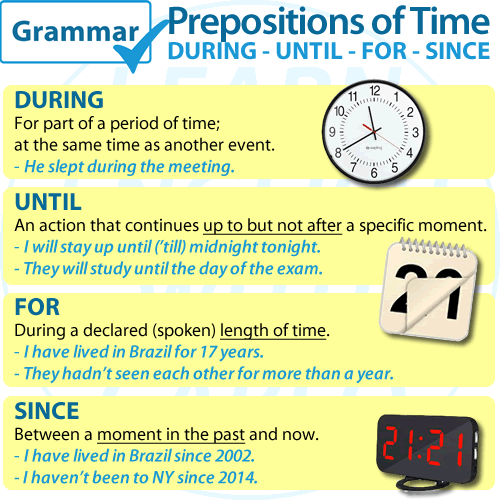
GRAMMAR – Prepositions of Time

DURING, UNTIL, SINCE, and FOR

Prepositions can sometimes be tricky to use correctly, especially when they refer to time. Let’s explore the nuances of DURING, UNTIL, FOR, and SINCE, along with deeper explanations and examples to make their usage clearer.

DURING

Definition: Refers to a specific period of time when something happens, or indicates that one event occurs simultaneously with another.

Key Points:

  1. “During” is used to describe what happens in a particular time frame.
  2. It often answers the question “When?”

Examples:

  • He slept during the meeting. (When did he sleep? During the meeting.)
  • She felt nervous during the interview. (When did she feel nervous? During the interview.)
  • Many animals migrate during the winter. (When do they migrate? During the winter.)

Additional Usage:

  • During the holidays, we visit family and friends.
  • The city was quiet during the storm.

UNTIL

Definition: Refers to an action or state that continues up to a specific time and stops at that point.

Key Points:

  1. “Until” can be used with specific points in time (hours, days, events, etc.).
  2. It indicates the endpoint of an action or state.
  3. “Until” is often shortened to ‘’till’’ in informal writing or speech.

Examples:

  • I will stay up until midnight tonight. (The action of staying up ends at midnight.)
  • They will study until the day of the exam. (The studying continues up to the exam day.)
  • Wait here until I get back. (The waiting ends when I return.)

Additional Usage:

  • The store is open until 10 p.m.
  • He kept working until he finished the project.

FOR

Definition: Refers to a specific length of time, whether in the past, present, or future.

Key Points:

  1. “For” indicates the duration of an activity or state.
  2. It often answers the question “How long?”

Examples:

  • I have lived in Brazil for 17 years. (How long? For 17 years.)
  • They hadn’t seen each other for more than a year. (How long? For more than a year.)
  • We talked on the phone for two hours. (How long? For two hours.)

Additional Usage:

  • He waited for 30 minutes before leaving.
  • She worked on the project for six months.

SINCE

Definition: Refers to a specific point in the past from which an action or state continues up to the present.

Key Points:

  1. “Since” is used with a specific starting point in the past.
  2. It often pairs with the present perfect tense.
  3. It answers the question “From when?”

Examples:

  • I have lived in Brazil since 2002. (From when? Since 2002.)
  • I haven’t been to NY since 2014. (From when? Since 2014.)
  • She’s been working here since March. (From when? Since March.)

Additional Usage:

  • He’s been playing soccer since he was 10 years old.
  • It hasn’t rained here since last summer.

Comparison Chart

PrepositionDescribesKey Question AnsweredExample
DuringPeriod of time when something happensWhen?He laughed during the movie.
UntilTime up to a specific endpointUp to when?Stay here until 5 p.m.
ForLength of timeHow long?She stayed for a week.
SinceFrom a specific time in the pastFrom when?I’ve been here since 2010.

Common Mistakes and Tips

  1. Confusing “for” and “since”:
    • Incorrect: I’ve been living here for 2010.
    • Correct: I’ve been living here since 2010. (Since refers to the starting point.)
  2. Using “until” instead of “during”:
    • Incorrect: He slept until the meeting. (This implies he stopped sleeping when the meeting started.)
    • Correct: He slept during the meeting. (This means he slept while the meeting was happening.)
  3. Forgetting that “since” works with a point in time, not a duration:
    • Incorrect: She’s been studying since two hours.
    • Correct: She’s been studying for two hours.
  4. Shortening “until” inappropriately:
    • Informal: I’ll wait ‘till you get back. (Acceptable in casual speech.)
    • Formal: I’ll wait until you get back. (Better for writing.)

By practicing these prepositions with a variety of examples, you’ll develop a clearer sense of how they function in English. Keep exploring different contexts and applying them to your sentences!

Wrong shortcode initialized

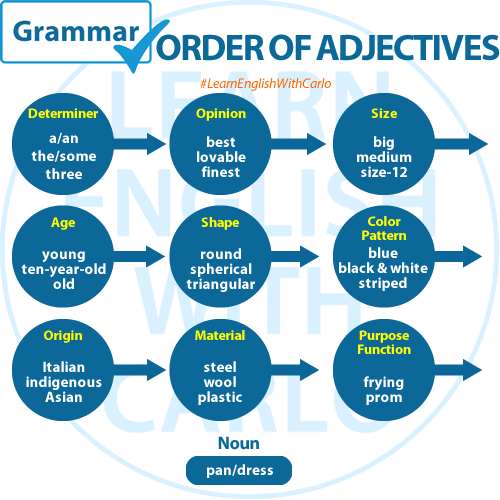
GRAMMAR – Order of Adjectives

In English, when multiple adjectives are used to describe a noun, they typically follow a specific order. This order helps maintain clarity and natural-sounding language. The general order of adjectives is as follows:

  1. Determiner: This includes articles (a, an, the), demonstratives (this, that, these, those), possessives (my, your, his, her, its, our, their), and quantifiers (some, any, many, few, several, etc.). Determiners specify the noun or indicate the amount or quantity.
  2. Observation or opinion: Adjectives expressing opinions or observations about the noun, such as beautiful, lovely, interesting, strange, etc.
  3. Size: Adjectives describing the size of the noun, such as big, small, large, tiny, etc.
  4. Age: Adjectives indicating the age of the noun, such as old, young, new, ancient, etc.
  5. Shape: Adjectives denoting the shape of the noun, such as round, square, rectangular, etc.
  6. Color: Adjectives describing the color of the noun, such as red, blue, green, etc.
  7. Origin: Adjectives indicating the origin or nationality of the noun, such as American, Japanese, French, etc.
  8. Material: Adjectives specifying the material of which the noun is made, such as wooden, metallic, plastic, etc.
  9. Qualifier or purpose: Adjectives that provide further detail or specify the purpose of the noun, such as sleeping (in sleeping bag), cooking (in cooking oil), etc.

Here’s an example sentence using multiple adjectives in their correct order:

“The beautiful small old wooden Italian music box.”

In this sentence:
The” is the determiner.
Beautiful” is an opinion.
Small” describes size.
Old” describes age.
Wooden” describes material.
Italian” indicates origin.
Music” describes purpose.
Box” is the noun being described.

Following this order helps ensure that the adjectives flow naturally and make sense in English sentences.

Wrong shortcode initialized

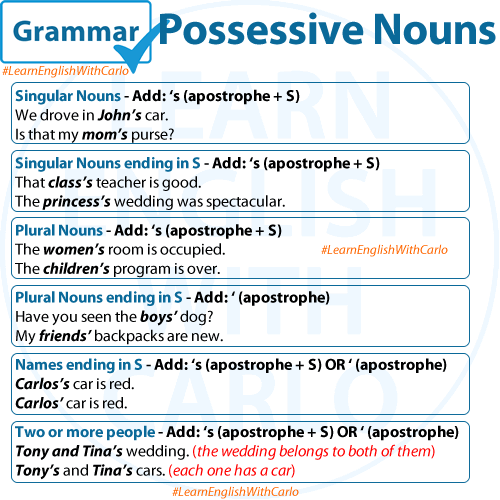
Mastering Possessive Nouns in English: A Complete Guide

Possessive nouns can seem tricky at first, but once you grasp the rules, you’ll find them easy to use. In this post, we’ll explore how to form possessive nouns in different contexts, ensuring that you can confidently show ownership in your writing.

1. Singular Nouns

For most singular nouns, showing possession is straightforward. Simply add an apostrophe followed by the letter “s” (’s).

Examples:

  • We drove in John’s car.
  • That isn’t the dog’s bed.
  • Is that my mom’s purse?

This rule applies to any singular noun, regardless of what letter it ends with.

2. Singular Nouns Ending in S

When a singular noun ends in “s,” you still typically add ’s to show possession. However, in some cases, adding just the apostrophe () is also acceptable, especially in formal writing. Both forms are widely recognized, but consistency is key—stick to one style throughout your writing.

Examples:

  • That class’s teacher is good.
  • Her boss’s secretary is excellent.
  • The princess’s wedding was spectacular.

Alternatively:

  • The princess’ wedding was spectacular.

3. Plural Nouns

For plural nouns that do not end in “s,” you form the possessive by adding ’s.

Examples:

  • He always corrects people’s mistakes.
  • The women’s room is occupied.
  • The children’s program is over.

Notice that “people,” “women,” and “children” are irregular plurals that do not end in “s,” so the possessive is formed in the same way as for singular nouns.

4. Plural Nouns Ending in S

For plural nouns that do end in “s,” you simply add an apostrophe () after the “s.”

Examples:

  • Have you seen the boys’ dog?
  • My friends’ backpacks are new.
  • You don’t need your parents’ permission.

This rule helps to distinguish between the possessive form of singular nouns and plural nouns.

5. Names Ending in S

When it comes to names that end in “s,” you have two options. You can add either ’s or just the apostrophe (). Both are correct, but again, be consistent.

Examples:

  • Carlos’s car is red.
  • Carlos’ car is red.

Whether you choose to add ’s or just the apostrophe may depend on your personal preference, the style guide you’re following, or the sound of the word when spoken aloud.

6. Possession Involving Two or More People

When two or more people share ownership of something, you add ’s (or for plural nouns ending in “s”) to the last person’s name. If each person owns something separately, add ’s to each name.

Examples:

  • Tony and Tina’s wedding. (The wedding belongs to both Tony and Tina.)
  • Tony’s and Tina’s cars. (Tony has one car, and Tina has another.)

This distinction helps clarify whether the possession is joint or separate.

Final Thoughts

Mastering possessive nouns is essential for clear and precise writing. By following these simple rules, you can confidently form possessives in any context. Remember, the key to using possessive nouns correctly is understanding the relationship between the noun and what it owns. Practice these rules, and they’ll soon become second nature!

Now try the quiz!

Wrong shortcode initialized

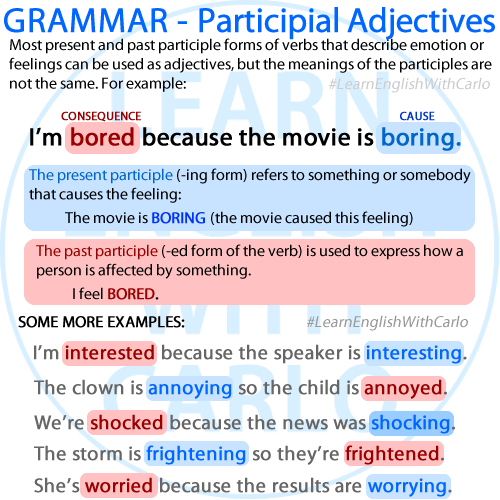
Understanding Participial Adjectives:

The Difference Between -ed and -ing Forms

In English, many verbs that describe emotions or feelings can be transformed into adjectives by using their present or past participle forms. However, it’s important to note that these two forms convey different meanings. Let’s explore how to use these participial adjectives correctly.

Present Participle (-ing Form)

The present participle form of a verb (ending in -ing) is used to describe something or someone that causes a particular feeling. It tells us what effect something has on others.

Example:

  • The movie is boring.
    (The movie causes people to feel bored.)

Past Participle (-ed Form)

The past participle form of a verb (usually ending in -ed) is used to describe how a person feels as a result of something. It reflects the emotion that is experienced.

Example:

  • I feel bored.
    (I am affected by the boring movie.)

More Examples:

  • I’m interested because the speaker is interesting.
    (The speaker causes interest, and I feel interested.)
  • He’s annoyed because the child is annoying.
    (The child causes annoyance, and he feels annoyed.)
  • We’re shocked because the news was shocking.
    (The news caused shock, and we feel shocked.)
  • The storm is frightening, so they’re frightened.
    (The storm causes fear, and they feel frightened.)
  • She’s worried because the results are worrying.
    (The results cause worry, and she feels worried.)

Important Note:

You cannot use the past participle (-ed form) with things because things do not have emotions. The past participle form is only used to describe how people (or sometimes animals) feel.

Common Verbs Used as Participial Adjectives:

Here’s a list of verbs that are commonly used as participial adjectives. Each verb can be turned into both -ing and -ed forms, depending on the context:

  • amaze
  • amuse
  • annoy
  • calm
  • confuse
  • disgust
  • distract
  • disturb
  • embarrass
  • encourage
  • entertain
  • fascinate
  • frighten
  • frustrate
  • infuriate
  • insult
  • please
  • refresh
  • relax
  • sicken
  • stimulate
  • surprise
  • terrify
  • thrill
  • worry

How about a Practice Exercise:

Wrong shortcode initialized

VOCABULARY – Internet Abbreviations (with definitions)

Common Internet Abbreviations in Everyday Use

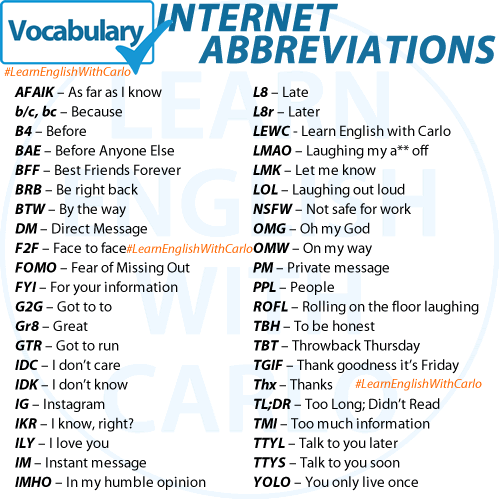
With the rise of online communication, abbreviations have become a fast and convenient way to convey messages. Here are some common internet abbreviations you might come across:

  • SMH – “Shaking My Head”: Used to express disappointment or disbelief.
  • IMO/IMHO – “In My Opinion” or “In My Humble Opinion”: Used to share personal thoughts or beliefs.
  • TBH – “To Be Honest”: When someone is being straightforward or sharing their true feelings.
  • NVM – “Nevermind”: Used to tell someone to disregard a previous statement.

How Abbreviations Change the Way We Communicate

Internet abbreviations not only save time but also add a casual tone to conversations. They help people express emotions and responses quickly, making online chats more dynamic. However, using too many abbreviations can confuse new learners of English, so it’s important to know when to use them.


Tips for Learning and Using Internet Abbreviations

For ESL learners, here are some tips on how to master internet abbreviations:

  • Start small: Learn the most common ones like LOL, BTW, and OMG first. They are widely used and easy to remember.
  • Context is key: Try to use abbreviations in the right context. For example, “LOL” is mostly used for something funny, while “BTW” is more for adding information.
  • Stay updated: New abbreviations pop up frequently, so keep an eye on social media platforms or websites to stay current.

Fun Fact

Did you know? The abbreviation LOL (“Laughing Out Loud”) has been in use since the 1980s, and it’s one of the oldest internet abbreviations still widely used today!

  • AFAIK – As far as I know
  • b/c, bc – Because
  • B4 – Before
  • BAE – Before Anyone Else
  • BFF – Best Friends Forever
  • BRB – Be right back
  • BTW – By the way
  • DM – Direct Message
  • F2F – Face to face
  • FOMO – Fear of Missing Out
  • FYI – For your information
  • G2G – Got to to
  • Gr8 – Great
  • GTR – Got to run
  • IDC – I don’t care
  • IDK – I don’t know
  • IG – Instagram
  • IKR – I know, right?
  • ILY – I love you
  • IM – Instant message
  • IMHO – In my humble opinion
  • IMO – In my opinion
  • L8 – Late
  • L8r – Later
  • LMAO – Laughing my a** off
  • LMK – Let me know
  • LOL – Laughing out loud
  • LOLz – Laughing out loud (plural/sarcastic)
  • NSFW – Not safe for work
  • OMG – Oh my God
  • OMW – On my way
  • PM – Private message
  • PPL – People
  • ROFL – Rolling on the floor laughing
  • ROFLMAO – Rolling on the floor laughing my a** off
  • TBH – To be honest
  • TBT – Throwback Thursday
  • TGIF – Thank goodness it’s Friday
  • Thx – Thanks
  • TL;DR – Too Long; Didn’t Read
  • TMI – Too much information
  • TTYL – Talk to you later
  • TTYS – Talk to you soon
  • YOLO – You only live once

GRAMMAR – Tag Questions

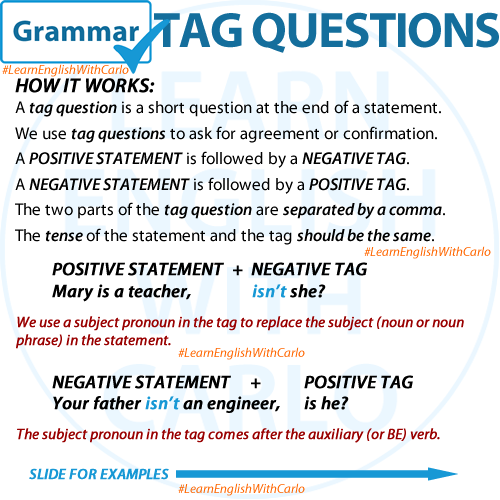
A tag question is a short question added to the end of a statement. They are used to confirm information, seek agreement, or invite a response from the listener. Tag questions are characterized by their structure: they typically consist of an auxiliary verb and a pronoun that matches the subject of the statement.

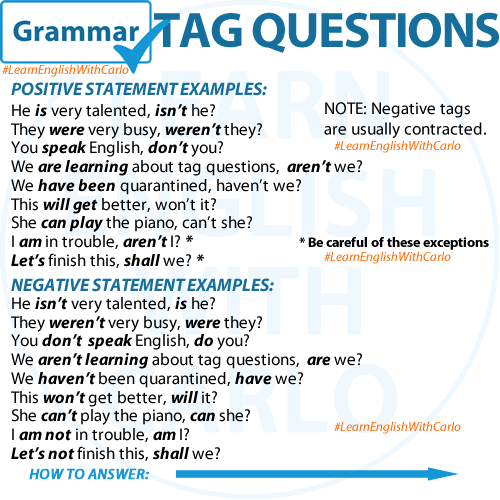
For example:

  • It’s a beautiful day, isn’t it? (Statement: It’s a beautiful day)
  • You like chocolate, don’t you? (Statement: You like chocolate)

How to Form Tag Questions:

  1. Choose the Correct Auxiliary Verb: The auxiliary verb in the tag question should match the tense of the main verb in the statement. Common auxiliary verbs include “is,” “are,” “am,” “do,” “does,” “did,” “have,” “has,” “will,” and “can.”
  2. Match the Pronoun: The pronoun used in the tag question should match the subject of the statement. For example, if the subject is “she,” the tag question should use the pronoun “she” as well.
  3. Add the Negative or Positive Tag: Depending on the statement, the tag question can be positive or negative. If the statement is positive, the tag question is usually negative, and vice versa.

Examples:

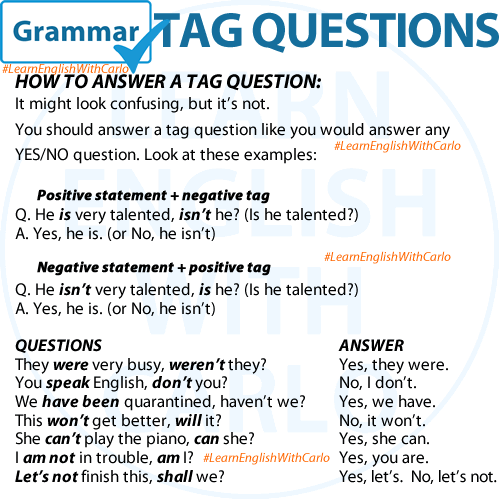
  • He is coming, isn’t he? (Positive statement, negative tag)
  • She doesn’t like coffee, does she? (Negative statement, positive tag)

Common Tag Question Structures:

  1. Positive Statement ➡️ Negative Tag
    • It’s raining, isn’t it?
    • You’re from Italy, aren’t you?
  2. Negative Statement ➡️ Positive Tag
    • They haven’t arrived yet, have they?
    • You don’t speak Spanish, do you?

Using Intonation:

In spoken English, intonation plays a crucial role in conveying meaning. When using tag questions, rising intonation at the end of the statement suggests uncertainty or a genuine question, while falling intonation indicates more of a rhetorical question or an assumption.

For instance:

  • You’ve finished your homework, haven’t you? (Rising intonation – seeking confirmation)
  • She’s your sister, isn’t she? (Falling intonation – assuming agreement)

Wrong shortcode initialized

GRAMMAR – Either & Neither

GRAMMAR – Either & Neither

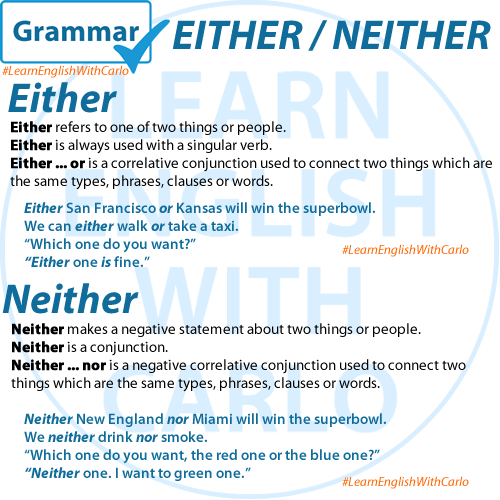
Either refers to one of two things or people. Either is always used with a singular verb. Either … or is a correlative conjunction used to connect two things which are the same types, phrases, clauses or words.

  • Either San Francisco or Kansas will win the Superbowl.
  • We can either walk or take a taxi.
  • “Which one do you want?” “Either one is fine.’


Neither makes a negative statement about two things or people. Neither is a conjunction. Neither … nor is a negative correlative conjunction used to connect two things which are the same types, phrases, clauses or words.

  • Neither New England nor Miami will win the Superbowl.
  • We neither drink nor smoke.
  • “Which one do you want, the red one or the blue one?”
    “Neither one. I want to green one.”

Compound Adjectives

Understanding Compound Adjectives in English

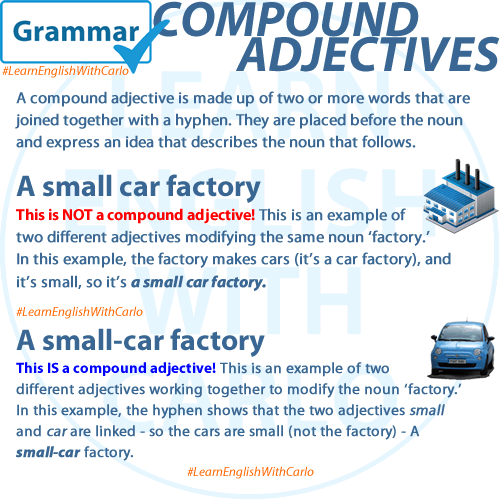
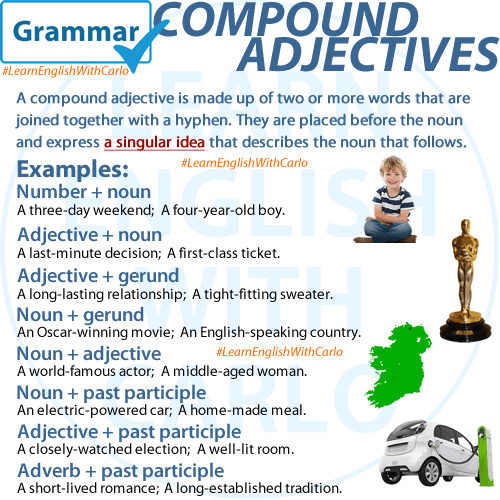
Compound adjectives are a fascinating aspect of English grammar that allow us to express detailed ideas about nouns in a concise and efficient way. As the name suggests, a compound adjective is made up of two or more words that work together as a single unit to describe a noun. These words are typically joined with a hyphen and placed directly before the noun they modify. By doing this, compound adjectives create a singular, unified description of the noun.

How Compound Adjectives Work

Compound adjectives combine words in a variety of patterns to convey specific meanings. Below are common structures of compound adjectives, along with examples to help clarify their usage.

1. Number + Noun

When a number and a noun combine to describe a specific quantity or measurement, they form a compound adjective:

  • A three-day weekend
  • A four-year-old boy
  • A five-star hotel

Note: The noun in the compound adjective is always singular, even if the number indicates plurality.

2. Adjective + Noun

An adjective and a noun can team up to describe a noun:

  • A last-minute decision
  • A first-class ticket
  • A high-speed train

3. Adjective + Gerund (-ing form)

An adjective combined with a gerund often describes the nature or effect of the noun:

  • A long-lasting relationship
  • A tight-fitting sweater
  • A slow-moving vehicle

4. Noun + Gerund (-ing form)

A noun and a gerund together often indicate a function or characteristic:

  • An Oscar-winning movie
  • An English-speaking country
  • A record-breaking performance

5. Noun + Adjective

A noun and an adjective can combine to describe a noun in a unique way:

  • A world-famous actor
  • A thirst-quenching drink
  • A sugar-free dessert

6. Noun + Past Participle

A noun and a past participle often indicate what the noun is made of or its defining characteristic:

  • An electric-powered car
  • A homemade meal
  • A sun-dried tomato

7. Adjective + Past Participle

An adjective combined with a past participle describes the state or condition of the noun:

  • A closely-watched election
  • A well-lit room
  • A highly-respected professor

8. Adverb + Past Participle

When an adverb modifies a past participle, it gives additional nuance to the description:

  • A short-lived romance
  • A long-established tradition
  • A fully-equipped kitchen

Important Notes on Compound Adjectives

  1. Hyphenation Matters: The hyphen is essential in compound adjectives. Without it, the meaning can become unclear or entirely different. For example:
    • A small-business owner (a person who owns a small business)
    • A small business owner (a short person who owns a business)
  2. Placement in a Sentence: Compound adjectives are typically placed before the noun they modify. When placed after the noun, they often lose the hyphenation and become part of a predicate.
    • Before the noun: A well-known artist
    • After the noun: The artist is well known.
  3. Not All Need Hyphens: If the compound adjective uses an adverb ending in -ly, the hyphen is not used:
    • A beautifully designed room
    • A carefully prepared presentation

Additional Examples

  • A cold-blooded animal (Adjective + Past Participle)
  • A two-story house (Number + Noun)
  • A hand-painted vase (Noun + Past Participle)
  • A quick-thinking detective (Adjective + Gerund)

Conclusion

Compound adjectives are a powerful tool for adding precision and variety to your writing. By understanding the structures and rules that govern their formation, you can use them effectively to convey specific and vivid ideas. With practice, you’ll find that compound adjectives are not only practical but also an enjoyable aspect of English to explore and master!

Wrong shortcode initialized

GRAMMAR – Adverbs of frequency

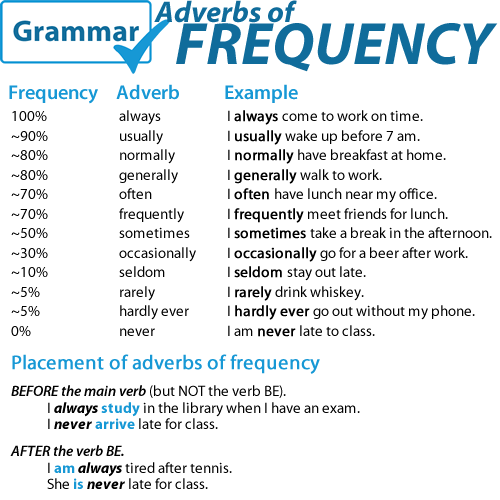
Adverbs of frequency describe how often something occurs

100% – always – I always come to work on time.
~90% – usually – I usually wake up before 7 am.
~80% – normally – I normally have breakfast at home.
~80% – generally – I generally walk to work.
~70% – often – I often have lunch near my office.
~70% – frequently – I frequently meet friends for lunch.
~50% – sometimes – I sometimes take a break in the afternoon.
~30% – occasionally – I occasionally go for a beer after work.
~10% – seldom – I seldom stay out late.
~5% – rarely – I rarely drink whiskey.
~5% – hardly ever – I go out without my phone.
0% – never – I am never late to class.

Placement of adverbs of frequency
BEFORE the main verb (but NOT the verb BE).
I always study in the library when I have an exam.
I never arrive late for class.
AFTER the verb BE.
I am always tired after tennis.
She is never late for class.