GRAMMAR – Conjunctions

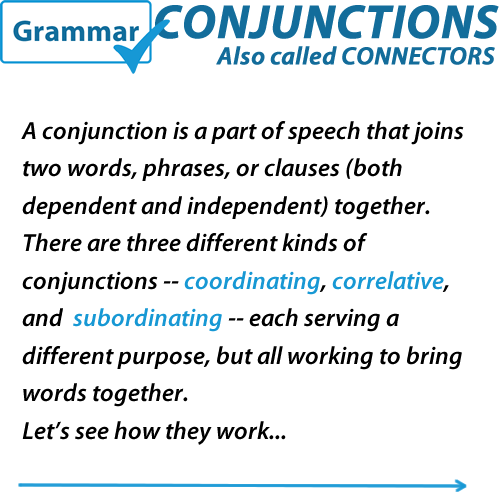
A conjunction is a part of speech that joins two words, phrases, or clauses (both dependent and independent) together. There are three different kinds of conjunctions — coordinating, correlative, and subordinating — each serving a different purpose, but all working to bring words together.
Let’s see how they work…

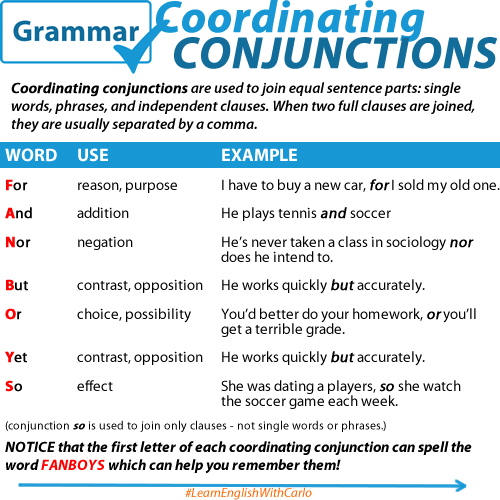
Coordinating conjunctions are used to join equal sentence parts: single words, phrases, and independent clauses. When two full clauses are joined, they are usually separated by a comma.

Here are some:
For; And; Nor; But; Or; Yet; So;
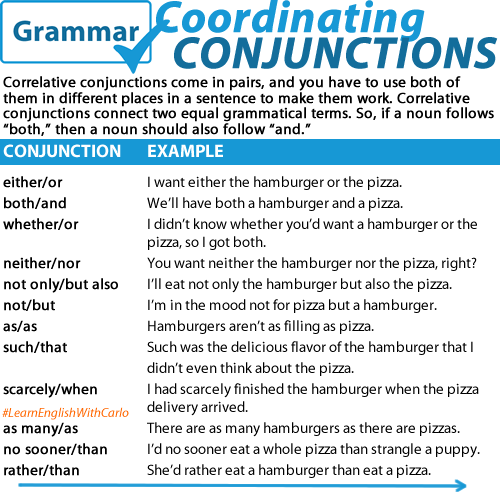
Correlative conjunctions come in pairs, and you have to use both of them in different places in a sentence to make them work. Correlative conjunctions connect two equal grammatical terms. So, if a noun follows “both,” then a noun should also follow “and.”
Here are some: Either/or; Neither/nor; not only/but also; Both/and; Whether/or;
A subordinating conjunction always introduces a dependent clause, tying it to an independent clause. A dependent clause is a group of words that cannot stand alone as a complete sentence. An independent clause, by contrast, can stand alone as a complete sentence.
Unlike coordinating conjunctions, subordinate conjunctions can often come first in a sentence. This is because of the nature of the relationship between the dependent and the independent clause. In English, there are lots of subordinating conjunctions.
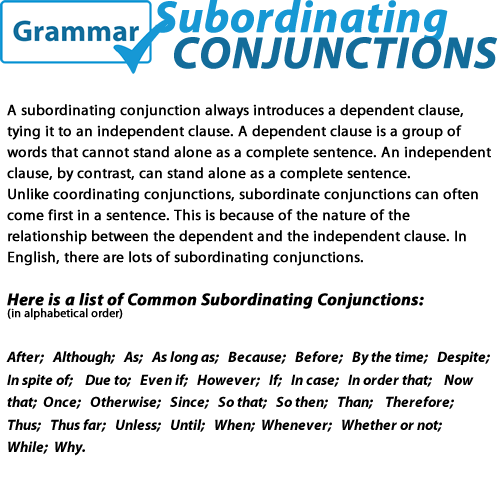
Here are some: after; although; as; as far as; as if; as soon as; because; before; even if; how; if; in case; in that; no matter how; now that; once; provided; since; so that;
supposing; though; unless; until; when; wherever; whether; while; while; 

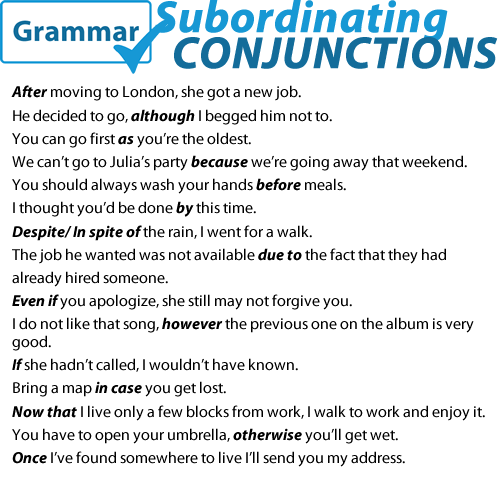
Here are some examples of subordinating conjunctions in use:

  • He decided to go, although I begged him not to.
  • You can go first as you’re the oldest.
  • We can’t go to Julia’s party because we’re going away that weekend.
  • Despite/ In spite of the rain, I went for a walk.
  • Even if you apologize, she still may not forgive you.
  • I do not like that song, however the previous one on the album is very good.
  • If she hadn’t called, I wouldn’t have known.
  • Bring a map in case you get lost.
  • Now that I live only a few blocks from work, I walk to work and enjoy it.
  • You have to open your umbrella, otherwise you’ll get wet.
  • Once I’ve found somewhere to live I’ll send you my address.
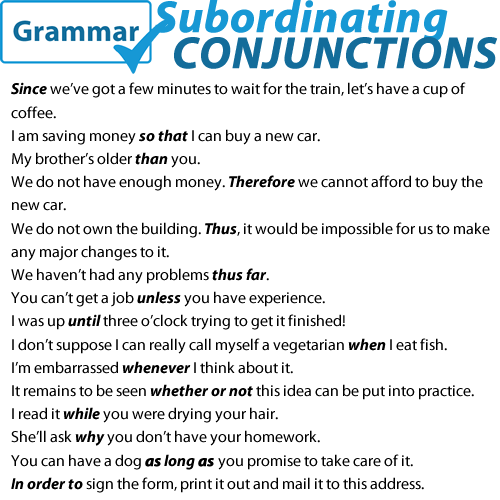
  • Since we’ve got a few minutes to wait for the train, let’s have a cup of coffee.
  • I am saving money so that I can buy a new car.
  • My brother’s older than you.
  • You can’t get a job unless you have experience.
  • I was up until three o’clock trying to get it finished!
  • I don’t suppose I can really call myself a vegetarian when I eat fish.
  • I’m embarrassed whenever I think about it.
  • It remains to be seen whether or not this idea can be put into practice.
  • I read it while you were drying your hair.
  • She’ll ask why you don’t have your homework.
  • You can have a dog as long as you promise to take care of it.
  • In order to sign the form, print it out and mail it to this address.

Wrong shortcode initialized
The Difference Between “Used to” and “Would”

When talking about past habits or repeated actions, learners of English often encounter two phrases: “used to” and “would.” While these two expressions have similarities, they are not interchangeable in every context. Let’s explore their meanings, uses, and differences in detail.

What Does “Used to” Mean?

“Used to” refers to habits, actions, or states that were true in the past but no longer happen or exist. It is particularly useful for emphasizing the contrast between the past and the present. Importantly, “used to” can describe both actions and states.

Examples:

  • Past actions:
    • I used to ride my bike to school every morning. (This was a habit in the past, but I don’t do it anymore.)
  • Past states:
    • She used to live in New York. (This was true in the past, but it’s not anymore.)
    • There used to be a coffee shop here. (The coffee shop existed in the past, but it has since closed.)

What Does “Would” Mean?

“Would” is used to describe repeated actions or routines in the past, often in a storytelling or nostalgic context. Unlike “used to,” it cannot describe states or conditions; it is strictly for actions.

Examples:

  • Past actions:
    • Every summer, we would visit our grandparents in the countryside. (This was a repeated action.)
    • After dinner, my father would read us a bedtime story. (This was a habitual action.)

When “would” is used in this way, it often adds a sense of nostalgia or emotional reflection, especially when recounting memories.

Key Differences Between “Used to” and “Would”

FeatureUsed toWould
Describes actionsYesYes
Describes statesYesNo
Contrast with presentImplies the action/state no longer happensDoes not imply contrast
ToneNeutral, matter-of-factNostalgic or reflective

When to Use “Used to”

Use “used to” when:

  1. You want to emphasize that something happened in the past but does not happen anymore.
  2. You are describing states or conditions that existed in the past.

Examples:

  • I used to have long hair, but now it’s short. (State)
  • He used to work in a factory, but now he’s a teacher. (Action)

When to Use “Would”

Use “would” when:

  1. You are talking about repeated actions or routines in the past.
  2. You want to create a nostalgic or storytelling tone.

Examples:

  • On weekends, we would go to the beach and spend hours swimming. (Action)
  • During the holidays, my grandmother would bake the most delicious cookies. (Action)

Important Note: Avoid using “would” with states or conditions. For instance, you cannot say, “She would live in New York” to mean a past state. Instead, use “used to”:

  • Correct: She used to live in New York.
  • Incorrect: She would live in New York.

Combining “Used to” and “Would”

In some contexts, both “used to” and “would” can be used to describe repeated actions in the past. However, “used to” emphasizes the contrast with the present, while “would” often creates a more reflective tone.

Examples:

  • When I was a child, I used to play in the park every afternoon. (Focus on the change between past and present.)
  • When I was a child, I would play in the park every afternoon. (Focus on the repeated nature of the action, often in a storytelling tone.)

You can even use both in a sentence to provide additional detail:

  • When I was young, I used to have a dog, and we would go for long walks together every evening.

Quick Summary

ExpressionUseExamples
Used toPast actions or states no longer trueI used to live in Paris. She used to love chocolate.
WouldRepeated past actions, storytellingHe would read to us every night. We would swim every summer.

Understanding the subtle differences between “used to” and “would” will help you express yourself more clearly and effectively when talking about the past. Keep practicing, and soon these expressions will become second nature!

GRAMMAR – Prepositions

Types of Prepositions

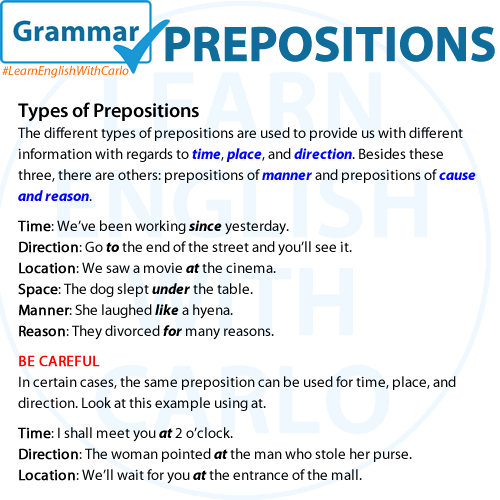
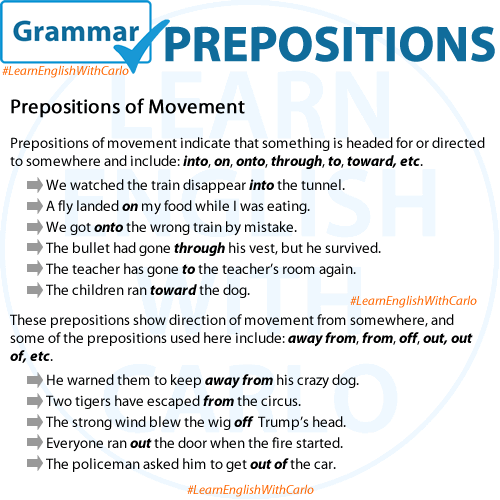
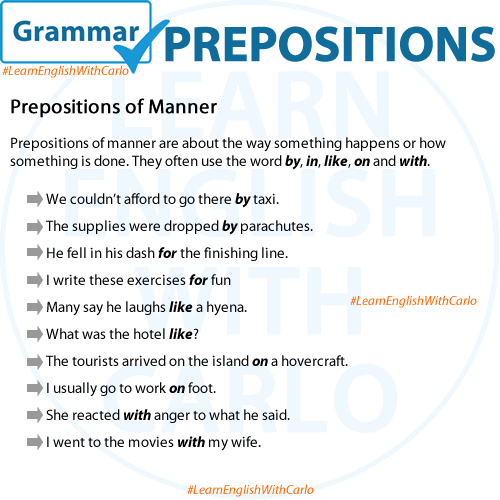
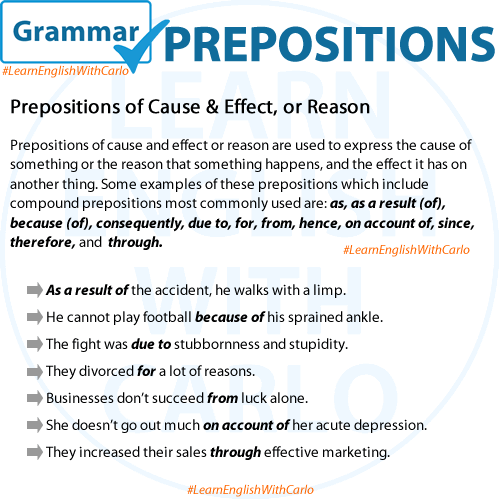
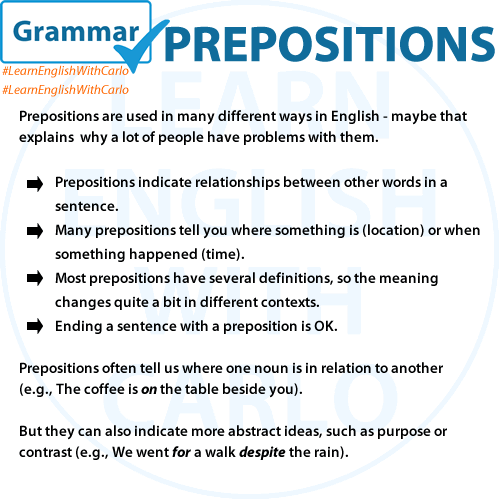
The different types of prepositions are used to provide us with different information with regard to time (prepositions of time), place (prepositions of place), and direction (prepositions of movement). Besides these three, there are others: prepositions of manner and prepositions of cause and reason.

Time: We’ve been working since yesterday.
Direction: Go to the end of the street and you’ll see it.
Location: We saw a movie at the cinema.
Space: The dog slept under the table.
Manner: She laughed like a hyena.
Reason: They divorced for many reasons.

The same preposition, however, can be used for the different divisions into time, place, and direction. Look at this example using at.
Time: I shall meet you at 2 o’clock.
Direction: The woman pointed at the man who stole her purse.
Location: We’ll wait for you at the entrance of the mall.

Wrong shortcode initialized
WORD FORMS

Welcome to our guide on how words can take different forms as nouns, verbs, adjectives, and adverbs! Many words in English change form depending on their role in a sentence, and understanding these transformations is key to mastering grammar and building vocabulary. Here you’ll find tables that show how specific words change across these categories, making it easier to identify and use them correctly. Whether you’re learning how to describe actions, qualities, or ideas, these tables provide a clear and practical reference to help you improve your English. Let’s explore how these forms work and discover their role in communication!

NOUNVERBADJECTIVEADVERB
laughterlaughlaughable laughably
criticismcriticize criticalcritically
griefgrieve grievingN/A
heatheathot hotly
darkness darkendarkdarkly
drama dramatizedramaticdramatically
terror/terrorism/terroristterrorize terrified/terrifyingterrifyingly
varietyvaryvarious variously
advice/advisoradvise advisableadvisably
life livelivingN/A
sharpnesssharpensharp sharply
originoriginate originaloriginally
agreement agreeagreeableagreeably
povertyimpoverishpoorpoorly
numbernumber numerousnumerously
additionadd additional/addedadditionally
weaknessweakenweak weakly
guide guideguidedN/A
mix/mixturemix mixedN/A
congratulation congratulatecongratulatoryN/A
continuationcontinue continued/continuouscontinuously
denialdenydeniable deniably
argument argueargumentative/arguablearguably
failurefail failed/failingN/A
observation/observerobserve observed/observantobservantly
possessionpossesspossessivepossessively
NOUNVERBADJECTIVEADVERB
creation / creativity create creativecreatively
satisfaction satisfy satisfactory / satisfiedsatisfactorily
application apply applicableapplicably
excitement excite excited / excitingexcitedly / excitingly
preparation prepare prepared / preparatorypreparedly
imagination imagine imaginativeimaginatively
pay / payment pay payableN/A
explanation explain explanatoryN/A
industry / industrialisation industrialize industrial industrially
response respond responsiveresponsively
prevention prevent preventive preventively
embarrassment embarrass embarrassing / embarrassed embarrassingly
threat threaten threateningthreateningly
security secure securesecurely
protection protect protectiveprotectively
theory theorize theoreticaltheoretically
completion complete completed completely
symbol symbolize symbolicsymbolically
communication communicate communicative communicatively
appreciation appreciate appreciative appreciatively
end / ending end endlessendlessly
note / notice notice noticeablenoticeably
identification identify identifiableidentifiably
profit profit profitableprofitably
confirmation confirm confirmed / confirmativeN/A
defense defend defensivedefensively
NOUNVERBADJECTIVEADVERB
weaknessweakenweakweakly
descriptiondescribe descriptivedescriptively
competition/competitorcompetecompetitivecompetitively
persuasionpersuadepersuasivepersuasively
appreciationappreciateappreciativeappreciatively
marriagemarrymarriedN/A
reactionreactreactive / reactionaryreactively / reactionarily
strengthstrengthenstrongstrongly
suspicion / suspectsuspectsuspicioussuspiciously
educationeducate educationaleducationally
apologyapologizeapologeticapologetically
sympathy sympathizesympatheticsympathetically
depth deependeepdeeply
conclusionconcludeconclusiveconclusively
warmth warm warmwarmly
sweetnesssweeten sweet sweetly
preferenceprefer(un)preferablepreferably
explosionexplode explosiveexplosively
discouragement discouragediscouragingdiscouragingly
shortage shortenshortshortly
closurecloseclosedclosely
attention / attentiveness attendattentiveattentively
discovery / discoverer discoverdiscoveredN/A
powerempower powerful / powerlesspowerfully/powerlessly
reliabilityrely reliablereliably
speciality specialize specialspecially

Notes:

For terms like congratulatory or grieving, adverbs may exist but are rare and not frequently used in modern English.

Some words do not naturally have a commonly used adverb form (e.g., discover or living).

Wrong shortcode initialized
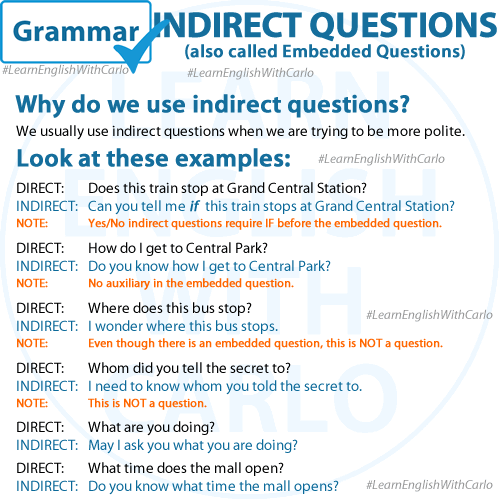
Indirect Questions

Indirect questions are a polite and often more formal way of asking questions. They differ from direct questions in their structure and use. Let’s break down what indirect questions are, how to form them, and provide examples to illustrate their use.

What Are Indirect Questions?

Indirect questions are questions embedded within statements or other questions. They are commonly used to show politeness or to soften the impact of a question. Instead of asking a question directly, you rephrase it in a way that makes it sound less direct and more courteous.

Direct vs. Indirect Questions

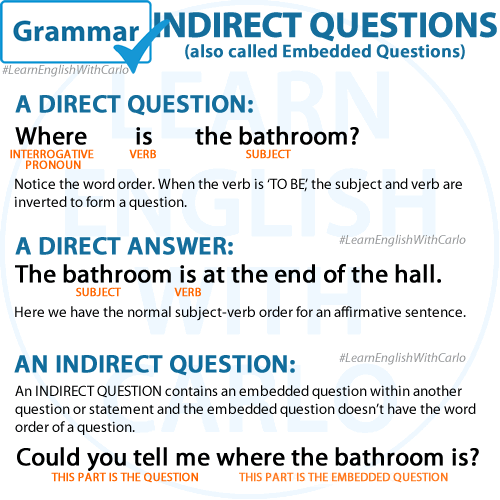
Direct Question: Where is the nearest bank?
Indirect Question: Could you tell me where the nearest bank is?

Notice the difference:

  • The direct question is straightforward and to the point.
  • The indirect question is introduced by a polite phrase and follows a statement structure.

How to Form Indirect Questions

To form an indirect question, follow these steps:

  1. Start with a polite phrase:
    • Could you tell me…
    • Do you know…
    • I wonder…
    • Can you explain…
  2. Follow with the subject and verb, avoiding inversion:
    • Direct: What time is it?
    • Indirect: Do you know what time it is?
  3. Use ‘if’ or ‘whether’ for yes/no questions:
    • Direct: Is it going to rain today?
    • Indirect: Do you know if it is going to rain today?

Examples of Indirect Questions

Here are some examples of how direct questions are transformed into indirect questions:

  1. Direct: Where does she live?
    Indirect: Can you tell me where she lives?
  2. Direct: Why did they leave early?
    Indirect: Do you know why they left early?
  3. Direct: Did he finish the project?
    Indirect: Could you let me know if he finished the project?
  4. Direct: What is your name?
    Indirect: I’d like to know what your name is.
  5. Direct: When is the meeting?
    Indirect: Do you have any idea when the meeting is?

Tips for Using Indirect Questions

  • Maintain Politeness: Use indirect questions to be more polite, especially in formal situations or when speaking to someone you don’t know well.
  • No Auxiliary Verbs in the Question Part: Unlike direct questions, indirect questions do not use auxiliary verbs like ‘do’ or ‘does’ after the polite phrase.
  • Tense Consistency: Ensure that the tense of the question remains consistent. The polite phrase does not change the tense of the question itself.

Wrong shortcode initialized
GRAMMAR – Adjectives that quantify.

GRAMMAR – Adjectives that quantify.

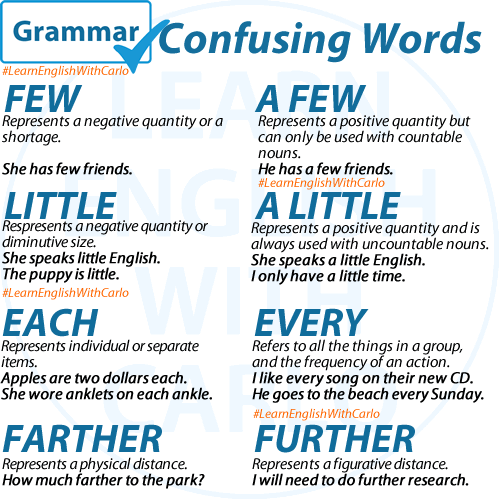
The words in this image can be adjectives, pronouns, or determiners.

  • FEW vs. A FEW
    Few is a quantifier used with plural countable nouns. Without the article “a,” few emphasizes a small number of something. Adding the article removes the emphasis—a few means some.
  • FEWER
    Fewer is a comparative adjective. It is only used with countable nouns and means a smaller quantity (number).
  • LITTLE vs. LITTLE
    The same rule applies to little, which is used with singular uncountable nouns. Without the article “a,” little emphasizes a small quantity of something. Adding the article removes the emphasis—a little means some.
  • EACH vs. EVERY
    Each and every are commonly confused.
    Each is a way to emphasize the individual people or things in a pair or group. We can use each in affirmative sentences, negative sentences, and questions. Each can only be used with countable nouns. When it precedes a subject noun, the noun is singular and it takes a singular verb.
    Every is a way to emphasize all the members of a group. We can use every in affirmative sentences, negative sentences, and questions. Every can only be used with count nouns. When it precedes a subject noun, the noun is singular, and it takes a singular verb. This is very confusing to students because the meaning is always plural (every always means more than one).
  • FARTHER
    Farther is only used for distance. It’s a comparative adjective, so it’s used to compare the distance remaining to the distance already traveled, or when comparing the distances to different places from one point.
  • FURTHER
    Further can be used for distance, but it is more commonly used in a figurative sense. It refers to going “beyond” in degree, time, or progress. It’s a comparative adjective, so it’s used to talk about continuing, extending, or adding to something, such as information, effort, or development.


Simple Past: A Guide to Regular Verb Spelling Rules

Mastering the simple past tense is an essential skill in English grammar. Regular verbs, which form the backbone of everyday communication, follow specific spelling rules when conjugated into the simple past tense. Understanding these rules empowers learners to express past actions accurately and confidently. In this blog post, we’ll explore the key spelling rules governing regular verbs in the simple past tense.

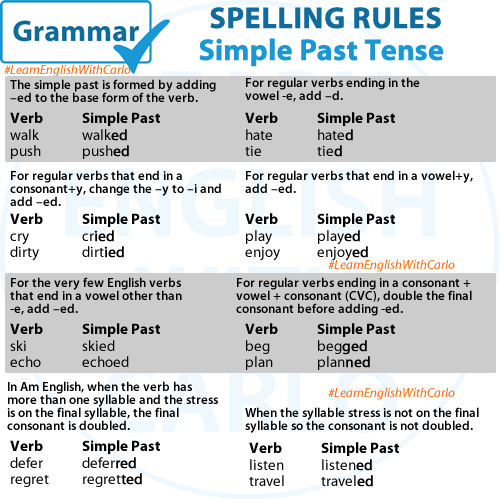
  1. Adding ‘-ed’ to Regular Verbs: The most common way to form the simple past tense of regular verbs is by adding ‘-ed’ to the base form of the verb. For example:
    • Walk (base form) becomes walked (simple past)
    • Talk (base form) becomes talked (simple past)
    • Play (base form) becomes played (simple past)
  2. Spelling Rules for Adding ‘-ed’:
    • Verbs ending in ‘-e’: If a regular verb ends in ‘e,’ simply add ‘-d’ to form the simple past tense.
      • Example: Dance (base form) becomes danced (simple past)
    • Verbs ending in a consonant + ‘y’: Change the ‘y’ to ‘i’ and add ‘-ed.’
      • Example: Study (base form) becomes studied (simple past)
    • Verbs ending in a single vowel + consonant: Double the final consonant before adding ‘-ed’ if the verb is one syllable and ends in a single vowel + consonant.
      • Example: Stop (base form) becomes stopped (simple past)
    • However, if the verb has more than one syllable or the final syllable is stressed, do not double the final consonant.
      • Example: Visit (base form) becomes visited (simple past)
    • Verbs ending in ‘-y’ following a consonant: Simply add ‘-ed’ without any changes.
      • Example: Enjoy (base form) becomes enjoyed (simple past)
  3. Irregularities: While regular verbs generally follow these rules, it’s important to note that some verbs are irregular and do not conform to the standard ‘-ed’ ending. Examples of irregular verbs in the simple past tense include:
    • Go (base form) becomes went (simple past)
    • Eat (base form) becomes ate (simple past)
    • See (base form) becomes saw (simple past)
  4. Practice Makes Perfect: Mastery of the simple past tense and its spelling rules comes with practice. Engage in activities such as reading, writing, and speaking to reinforce your understanding. Additionally, online resources and grammar exercises can provide targeted practice opportunities.

Conclusion: Understanding the spelling rules for regular verbs in the simple past tense is fundamental for effective communication in English. By following these guidelines and practicing regularly, learners can confidently express past actions with accuracy and fluency. Remember, consistency and persistence are key to mastering this essential aspect of English grammar.

Wrong shortcode initialized
Who, Whom, and Whose

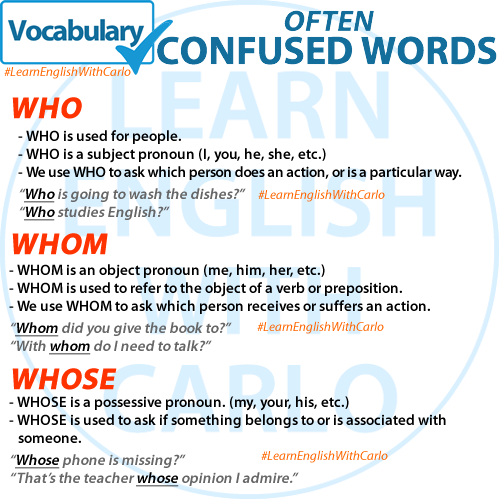
These three words are often confused. Here’s a brief explanation of the differences between “who,” “whom,” and “whose”:

1. Who:

  • “Who” is a subject pronoun used to refer to the subject of a sentence, clause, or phrase.
  • Example: “Who is that girl?”

2. Whom:

  • “Whom” is an object pronoun used to refer to the object of a verb or preposition.
  • Example: “To whom did you lend your book?”

3. Whose:

  • “Whose” is a possessive pronoun used to indicate ownership or possession.
  • Example: “Whose coat is this?”

Usage Tips:

  • When deciding between “who” and “whom,” remember that “who” is used for subjects (the doers of actions) and “whom” is used for objects (the receivers of actions or objects of prepositions).
  • “Whose” indicates possession, similar to “his,” “her,” “their,” etc.

Examples:

  • Who is driving the car? (Who is the subject of the sentence)
  • Whom did you see at the party? (Whom is the object of the verb “see”)
  • Whose bag is this? (Whose indicates possession)

Understanding these differences will help you choose the correct word in various contexts.

Practice using them in sentences with the QUIZ below!

Wrong shortcode initialized
PREPOSITIONS: of Time – In, on, at

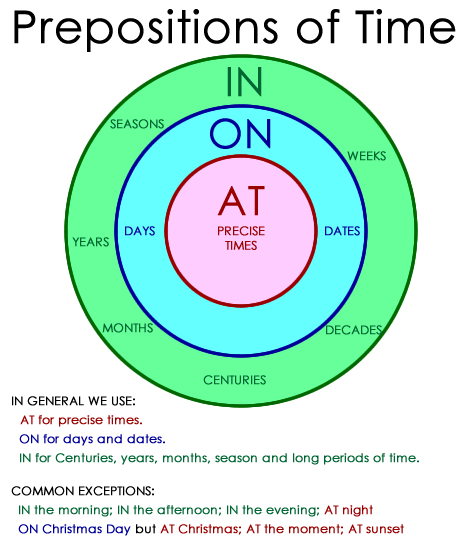
Prepositions of Time IN-ON-AT

Understanding prepositions of time can be tricky, but they’re essential for clear and accurate communication. Let’s break down the use of “in,” “on,” and “at” with examples to make them easier to grasp.

1. IN

Use “in” for longer periods of time, such as months, years, centuries, and long periods:

  • Months:in January, in May
    • Example: I was born in January.
  • Years:in 1995, in 2020
    • Example: We moved to this city in 2020.
  • Centuries:in the 21st century
    • Example: Many technological advancements occurred in the 21st century.
  • Periods of the day:in the morning, in the afternoon, in the evening
    • Example: She likes to jog in the morning.

2. ON

Use “on” for specific days and dates:

  • Days of the week:on Monday, on Friday
    • Example: Let’s meet on Monday.
  • Dates:on July 4th, on December 25th
    • Example: The event is on July 4th.
  • Specific day + part of day:on Monday morning, on Friday night
    • Example: We have a meeting on Tuesday afternoon.

3. AT

Use “at” for precise times and specific points in the day:

  • Clock times:at 5:00 PM, at midnight
    • Example: The movie starts at 7:30 PM.
  • Specific periods:at noon, at night, at dawn
    • Example: He works best at night.

Summary Chart

PrepositionUse ForExamples
INMonths, years, centuries, long periodsin April, in 2021, in the evening
ONDays, dateson Tuesday, on March 3rd
ATPrecise times, specific points of dayat 6 PM, at midnight, at noon

Wrong shortcode initialized

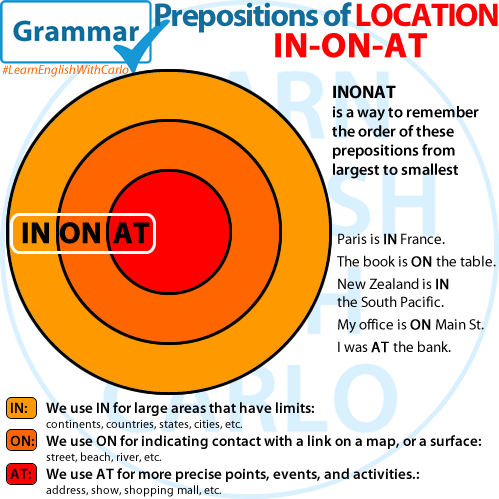
PREPOSITIONS OF LOCATION: in, on, at

Prepositions of location are essential in English as they help us describe where something or someone is located. Among the most commonly used prepositions are IN, ON, and AT. While they may seem similar, they are used in specific contexts to indicate different types of locations. Let’s explore how to use each one correctly.

1. IN

We use IN when referring to large areas that have clear boundaries. These could include countries, cities, regions, or any space enclosed by limits.

  • Examples:
    • Paris is IN France.
    • New Zealand is IN the South Pacific.
    • She lives IN New York City.

2. ON

ON is used to indicate contact with a line on a map or a surface. It’s often used for streets, surfaces like tables or floors, and geographical features like rivers or beaches.

  • Examples:
    • The book is ON the table.
    • My office is ON Main Street.
    • The hotel is ON the beach.

3. AT

AT is used for more precise points or locations. It’s typically used when referring to specific addresses, events, and activities.

  • Examples:
    • I can relax AT home.
    • I was AT the bank.
    • The concert is AT the arena.

Key Points to Remember:

  • Use IN for large areas with limits, like countries and cities.
  • Use ON for surfaces and lines, like streets or tables.
  • Use AT for specific points or events, like addresses or locations.

Understanding these distinctions will help you use prepositions of location accurately and naturally in your conversations. Practice using IN, ON, and AT with different places and situations to become more confident in your English skills.

Wrong shortcode initialized