
While SO-SO and MORE OR LESS are short and simple phrases, they serve entirely different purposes in English. Let’s dive into their meanings, uses, and nuances.
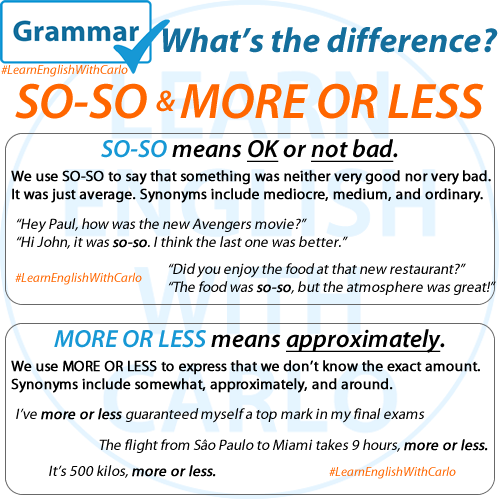
1. SO-SO: The Language of the Average
Definition:
SO-SO is used to describe something that is average, ordinary, or not impressive. It conveys a neutral feeling—not good, not bad.
When to Use SO-SO:
- To express indifference or mild dissatisfaction.
- When you want to downplay enthusiasm or expectations.
Examples in Sentences:
- “The concert was so-so. The sound system wasn’t great, but the band was okay.”
- “I asked Mark about his new job, and he said it’s so-so.”
Note on Usage:
While SO-SO is understood worldwide, it might sound old-fashioned to some English speakers. Many prefer alternatives like “meh” (informal) or “it was okay.”
Synonyms: mediocre, fair, ordinary, nothing special.
2. MORE OR LESS: Talking About Approximation
Definition:
MORE OR LESS means “approximately” or “about.” It’s used to indicate an estimation or a lack of exactness.
When to Use MORE OR LESS:
- To estimate quantities, amounts, or durations.
- To express something figuratively, like “somewhat” or “kind of.”
Examples in Sentences:
- “The meeting lasted two hours, more or less.”
- “We’ve more or less finished the project, but a few tasks remain.”
- “It’s a six-hour drive from here to Toronto, more or less.”
Cultural Tip:
MORE OR LESS can sometimes convey a casual tone. In formal writing, synonyms like approximately or roughly might be more suitable.
Synonyms: around, roughly, somewhat, approximately.
3. Common Mistakes with SO-SO and MORE OR LESS
- Mistake 1: Using SO-SO to mean “more or less.”
❌ “The package weighs so-so 5 kg.”
✅ “The package weighs more or less 5 kg.” - Mistake 2: Using MORE OR LESS to describe quality.
❌ “The movie was more or less.”
✅ “The movie was so-so.”