
Both A and AN are indefinite articles in English, and they mean exactly the same thing. They are used before singular, countable nouns when you are not referring to a specific item. However, the choice between A and AN depends entirely on the sound of the word that follows—not necessarily the first letter of that word. Let’s break this down in detail:
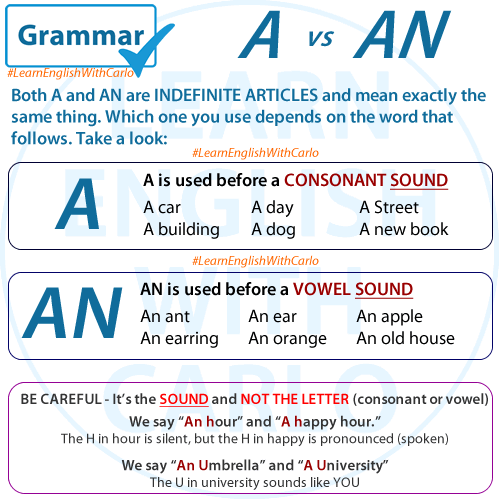
Using A Before Consonant Sounds
The article A is used when the word following it begins with a consonant sound. Here are some examples:
- A car
- A day
- A street
- A building
- A dog
- A new book
These examples demonstrate that A is placed before words that start with a sound produced by consonants such as C, D, S, B, and N.
Using AN Before Vowel Sounds
The article AN is used when the word following it begins with a vowel sound. Examples include:
- An ant
- An ear
- An apple
- An earring
- An orange
- An old house
Here, AN precedes words that start with vowel sounds like A, E, I, O, and U.
The Key Rule: It’s About the Sound, Not the Letter
One of the most important things to remember is that the choice between A and AN depends on the sound of the word, not its spelling. Sometimes, words begin with a silent consonant or an unusual vowel sound. Let’s look at some examples:
Words with Silent Consonants:
- An hour — The “H” in hour is silent, so the word starts with a vowel sound.
- A happy hour — The “H” in happy is pronounced, so the word starts with a consonant sound.
Words with Unusual Vowel Sounds:
- An umbrella — The “U” in umbrella sounds like the vowel uh, so AN is used.
- A university — The “U” in university sounds like the consonant you, so A is used.
More Examples:
- An honest mistake (silent “H”)
- A house (pronounced “H”)
- An hourglass (silent “H”)
- A unicorn (“U” sounds like “you”)
Practice with A vs. AN
Here are some sentences to test your understanding:
- I bought ___ orange from the market. (AN)
- She is looking for ___ unique gift. (A)
- He waited for ___ hour before leaving. (AN)
- They stayed at ___ hotel near the beach. (A)
- We saw ___ eagle flying in the sky. (AN)
Tips to Remember
- Always say the word out loud to identify whether it begins with a vowel or consonant sound.
- Focus on pronunciation, not spelling.
- Remember that exceptions often occur with silent letters or unique vowel sounds.
By mastering this simple rule, you’ll sound more natural and confident when using English articles!