
ADVERBS
An adverb describes a verb, an adjective or another adverb. Look at this table to see all the things an adverb can tell us.
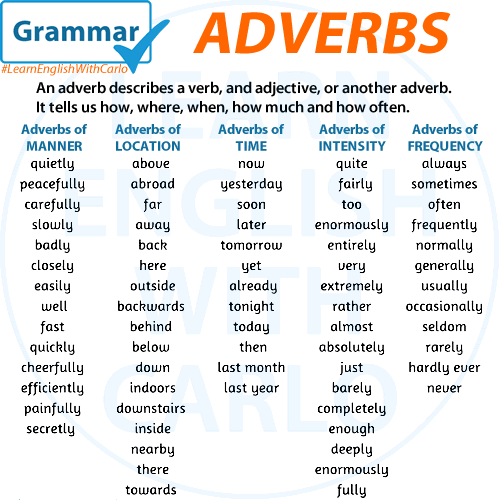
Adverbs are essential parts of speech that modify verbs, adjectives, or other adverbs, giving us more information about how, where, when, how much, or how often something happens. Let’s explore the different types of adverbs and see how they work with examples.
1. Adverbs of Manner
Adverbs of manner describe how an action is performed. They often end in “-ly.”
- Examples: quickly, slowly, carefully, badly
- She sings beautifully.
- He drove slowly in the rain.
2. Adverbs of Location
Adverbs of location (or place) indicate where an action takes place.
- Examples: here, there, everywhere, outside, upstairs
- The kids are playing outside.
- She looked everywhere for her keys.
3. Adverbs of Time
Adverbs of time tell us when an action occurs.
- Examples: now, later, soon, yesterday, tomorrow
- We will start the meeting now.
- He will arrive tomorrow.
4. Adverbs of Intensity
Adverbs of intensity (or degree) describe how much or to what extent something happens.
- Examples: very, quite, almost, too, extremely
- She was very happy with the results.
- The coffee is too hot to drink.
5. Adverbs of Frequency
Adverbs of frequency explain how often an action occurs.
- Examples: always, often, sometimes, rarely, never
- He always wakes up early.
- They rarely go out for dinner.
Summary Chart
| Adverb Type | Describes | Examples |
|---|---|---|
| Manner | How | quickly, carefully, badly |
| Location | Where | here, outside, upstairs |
| Time | When | now, yesterday, tomorrow |
| Intensity | How much/to what extent | very, too, extremely |
| Frequency | How often | always, sometimes, never |