Most commented posts
- PRONUNCIATION – the ED sound — 4 comments
- GRAMMAR – The Passive Voice — 3 comments
- Adjectives + Prepositions (OF) — 2 comments
- Mastering the Modal: Understanding the Versatility of “Would” — 2 comments
- TOO vs. ENOUGH — 1 comment


Aug 12
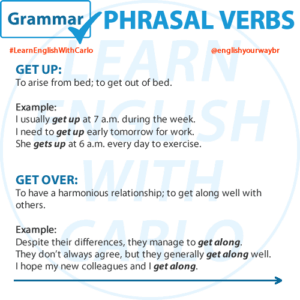
Phrasal verbs with “get” are versatile and widely used in English. They combine with prepositions or adverbs to convey various meanings, making them essential for both casual and formal communication. Here’s a closer look at some common phrasal verbs with “get,” their meanings, and examples to help you understand them better. GET UP Meaning: To …
Permanent link to this article: https://learnenglishwithcarlo.com/phrasal-verbs-with-get/
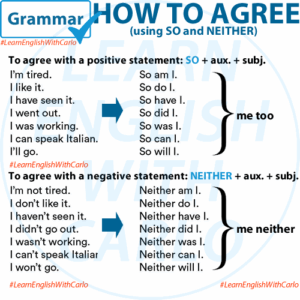
Agreeing in English can be simple and natural once you know the key structures. Whether the statement is positive or negative, these phrases will help you respond appropriately. Agreeing with Positive Statements Agreeing with Negative Statements A: I haven’t read that book.B: I haven’t either. Using “Neither + auxiliary verb + subject”: A: I didn’t …
Permanent link to this article: https://learnenglishwithcarlo.com/grammar-how-to-agree/
Aug 09
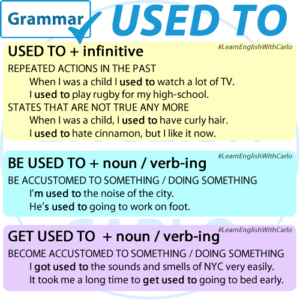
In English, expressions like “used to” and “be used to” can be confusing because they look similar but have distinct meanings and uses. This guide will help you understand the difference and use them correctly. What Does “Used To” Mean? “Used to” is used to talk about habits, actions, or states that were true in …
Permanent link to this article: https://learnenglishwithcarlo.com/grammar-be-used-to/
Aug 08
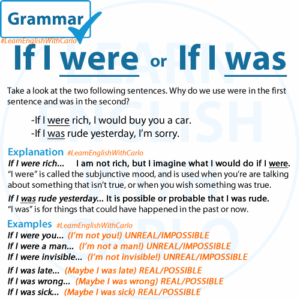
Take a look at the two following sentences. Why do weuse were in the first sentence and was in the second? In the first sentence, “If I were rich”, “were” is used because it’s a hypothetical or unreal condition, which requires the subjunctive mood (used for unreal or imagined situations). In the second sentence, “If …
Permanent link to this article: https://learnenglishwithcarlo.com/if-i-was-vs-if-i-were/
Jul 31
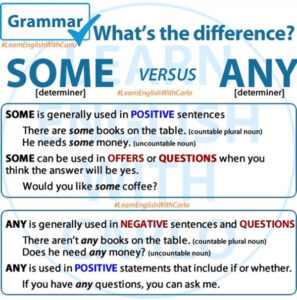
As an English learner, you’ve probably come across some and any and wondered why we use one instead of the other. These two words have very similar meanings—they both refer to an unspecified amount or number—but their usage depends on the context. Let’s explore the differences with simple rules, examples, and tips. Key Differences Between …
Permanent link to this article: https://learnenglishwithcarlo.com/difference-between-some-and-any/
Jul 30
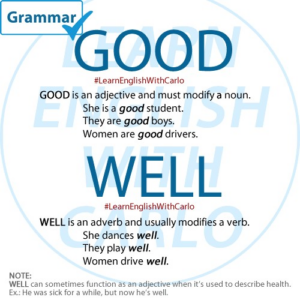
Good is an adjective and must modify a noun. Well is usually an adverb. Well is occasionally used as an adjective but only when referring to someone’s health. “Good” as an Adjective: “Well” as an Adverb: “Well” as an Adjective (Health): Here are some common mistakes to avoid when using “good” and “well”: These points …
Permanent link to this article: https://learnenglishwithcarlo.com/good-vs-well/
Jul 27
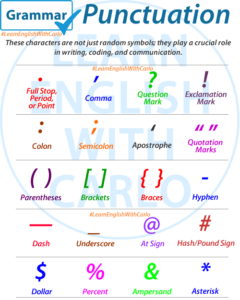
These characters are not just random symbols; they play a crucial role in writing, coding, and communication. You will learn their names, definitions, and multiple uses with practical examples. Whether you’re writing an email, composing a document, or exploring programming, knowing how to use these symbols correctly will enhance your efficiency and effectiveness.
Permanent link to this article: https://learnenglishwithcarlo.com/keyboard-characters-and-punctuation-marks/
Jul 25
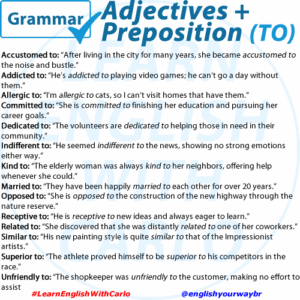
Let’s dive into the fascinating world of adjectives paired with prepositions! In English, certain adjectives are commonly followed by specific prepositions to express various relationships, attitudes, and qualities. Understanding these combinations can greatly enhance our language skills and enrich our expressions. Join me as we explore some examples of adjectives paired with prepositions and discover …
Permanent link to this article: https://learnenglishwithcarlo.com/adjectives-prepositions-to/
Jul 25
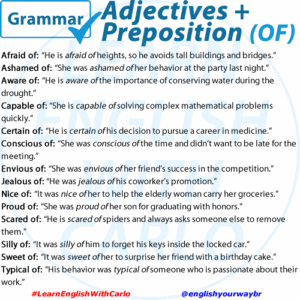
We are continuing our dive into the fascinating world of adjectives paired with prepositions! In English, certain adjectives are commonly followed by specific prepositions to express various relationships, attitudes, and qualities. Understanding these combinations can greatly enhance our language skills and enrich our expressions. Join me as we explore examples of adjectives paired with prepositions …
Permanent link to this article: https://learnenglishwithcarlo.com/adjectives-prepositions-of/
Jul 24
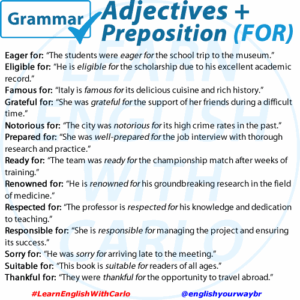
We are continuing our dive into the fascinating world of adjectives paired with prepositions! In English, certain adjectives are commonly followed by specific prepositions to express various relationships, attitudes, and qualities. Understanding these combinations can greatly enhance our language skills and enrich our expressions. Join me as we explore examples of adjectives paired with prepositions …
Permanent link to this article: https://learnenglishwithcarlo.com/adjectives-prepositions-for/