Most commented posts
- PRONUNCIATION – the ED sound — 4 comments
- GRAMMAR – The Passive Voice — 3 comments
- Adjectives + Prepositions (OF) — 2 comments
- Mastering the Modal: Understanding the Versatility of “Would” — 2 comments
- TOO vs. ENOUGH — 1 comment


Dec 13
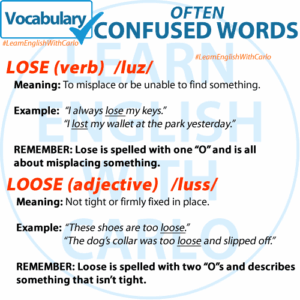
Hey everyone! Today, let’s clear up the confusion between two commonly mixed-up words: lose and loose. LOSE (verb) /lu:z/ LOOSE (adjective) /lu:s/ Quick Tip:
Dec 12
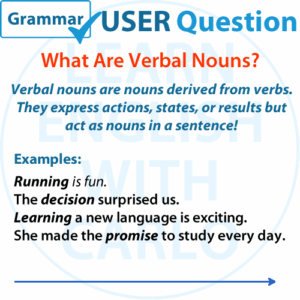
What Are Verbal Nouns and How Are They Constructed? If you’ve ever encountered words like running, development, or decision, you’ve seen verbal nouns in action! Verbal nouns are a fascinating aspect of English grammar, as they combine the essence of an action (from verbs) with the grammatical function of a noun. Let’s dive into what …
Dec 11
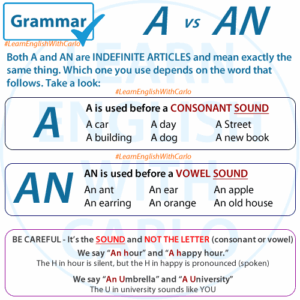
Both A and AN are indefinite articles in English, and they mean exactly the same thing. They are used before singular, countable nouns when you are not referring to a specific item. However, the choice between A and AN depends entirely on the sound of the word that follows—not necessarily the first letter of that …
Dec 09
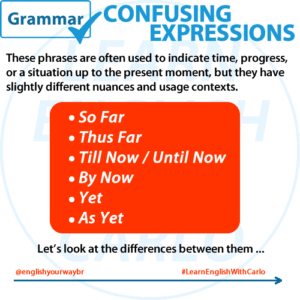
So far, thus far, till now, until now, by now, yet, as yet These phrases are often used to indicate time, progress, or a situation up to the present moment, but they have slightly different nuances and usage contexts. 1. So Far 2. Thus Far 3. Till Now / Until Now 4. By Now 5. …
Dec 05
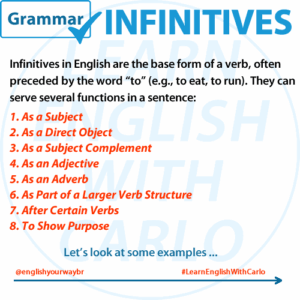
Infinitives are the base form of a verb, usually preceded by “to” (e.g., to learn, to explore, to be). They’re incredibly versatile and are used in many ways to express purpose, intention, emotion, and more. In this guide, we’ll break down the main uses of infinitives in English grammar, with examples that will make it …
Dec 04
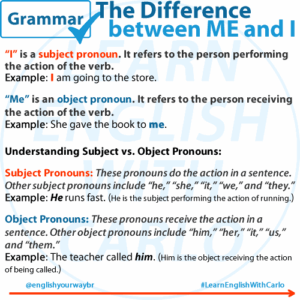
One of the most common mistakes English learners (and even native speakers!) make is using “I” and “me” incorrectly. While they both refer to the same person — the speaker — they are used in different parts of a sentence. In this post, we’ll explain the difference and give you lots of examples so you …
Dec 02
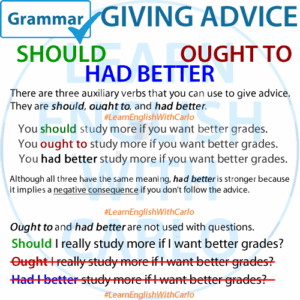
When giving advice in English, we often use the modal verbs “should,” “ought to,” and “had better.” Each of these has its nuances and specific contexts where they are more appropriate. Let’s explore how to use them, their differences, and how they work in questions and negative sentences. Using SHOULD “Should” is the most common …
Dec 01
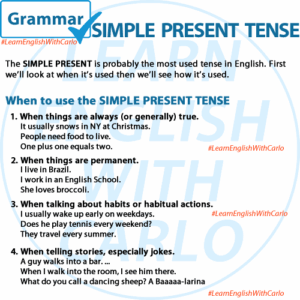
The SIMPLE PRESENT is probably the most used tense in English. First, we’ll look at when it’s used then we’ll see how it’s used. When to use the SIMPLE PRESENT TENSE 1. When things are always (or generally) true.It usually snows in NY at Christmas.People need food to live.One plus one equals two. 2. When …
Nov 30
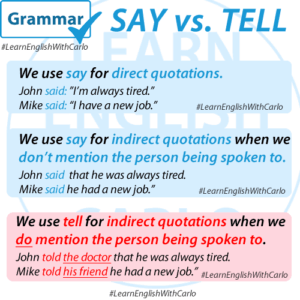
SAY and TELL have similar meanings. They both mean to communicate verbally with someone. But we often use them differently. The best way to remember say and tell is: SAY is immediately followed by a noun clause (He said (that) he was right) or, if it is followed by a personal object, we include the …
Nov 29
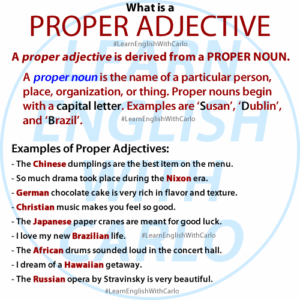
In English, proper adjectives are derived from proper nouns, which name specific people, places, organizations, or things. What makes proper adjectives unique is that they always begin with a capital letter, just like the proper nouns they come from. These adjectives allow us to describe things with precision, linking the characteristics of a person, country, …