Most commented posts
- PRONUNCIATION – the ED sound — 4 comments
- GRAMMAR – The Passive Voice — 3 comments
- Adjectives + Prepositions (OF) — 2 comments
- Mastering the Modal: Understanding the Versatility of “Would” — 2 comments
- TOO vs. ENOUGH — 1 comment


Aug 31
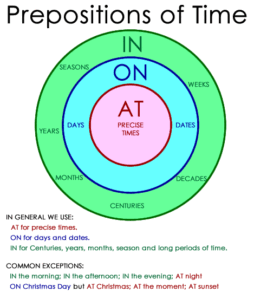
Understanding prepositions of time can be tricky, but they’re essential for clear and accurate communication. Let’s break down the use of “in,” “on,” and “at” with examples to make them easier to grasp. 1. IN Use “in” for longer periods of time, such as months, years, centuries, and long periods: 2. ON Use “on” for …
Permanent link to this article: https://learnenglishwithcarlo.com/prepositions-of-time-in-on-at/
Aug 31
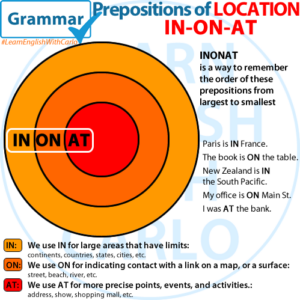
Prepositions of location are essential in English as they help us describe where something or someone is located. Among the most commonly used prepositions are IN, ON, and AT. While they may seem similar, they are used in specific contexts to indicate different types of locations. Let’s explore how to use each one correctly. 1. …
Permanent link to this article: https://learnenglishwithcarlo.com/prepositions-of-location-in-on-at/
Aug 30
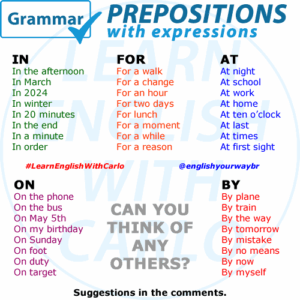
Here are some common prepositional phrases, also known as Collocations with prepositions. Prepositional Phrases for Time: Prepositional Phrases for Location or Movement: Prepositional Phrases for Cause or Reason: Prepositional Phrases for State or Condition: Prepositional Phrases for Manner or Degree: PREPOSITIONS with expressions INIn the afternoonIn MarchIn 2024In winterIn 20 minutesIn the endIn a minuteIn …
Permanent link to this article: https://learnenglishwithcarlo.com/grammar-prepositional-phrases-2/
Aug 29
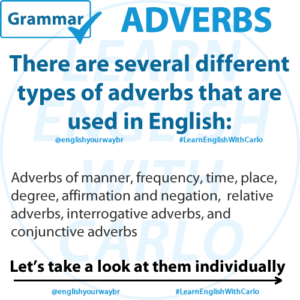
An adverb is a word that modifies or describes a verb, adjective, or other adverb. It provides additional information about how, when, where, or to what extent an action or quality is performed. Several different types of adverbs are used in English:
Permanent link to this article: https://learnenglishwithcarlo.com/grammar-adverbs/
Aug 26
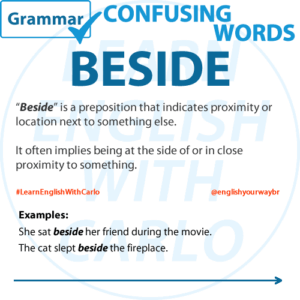
Beside:“Beside” is a preposition that indicates proximity or location next to something else.It often implies being at the side of or in close proximity to something. Examples:She sat beside her friend during the movie.The cat slept beside the fireplace. Besides:“Besides” is an adverb or a preposition that has several meanings:In addition to or apart from.Moreover …
Permanent link to this article: https://learnenglishwithcarlo.com/confusing-words-beside-vs-besides/
Aug 25
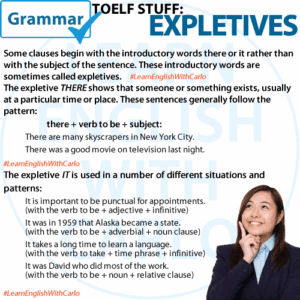
Some clauses begin with the introductory words THERE or IT rather than with the subject of the sentence. These introductory words are sometimes called expletives. The expletive THERE shows that someone or something exists, usually at a particular time or place. These sentences generally follow the pattern there + verb to be + subject: There …
Permanent link to this article: https://learnenglishwithcarlo.com/grammar-expletives/
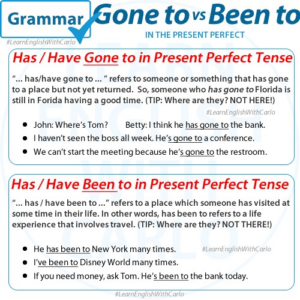
The present perfect forms have gone to and have been to are often confused in English. However, there areclear differences between the two forms. The present perfect forms have gone to and have been to are commonly used to refer to movement to another place. Notice the differences in the examples below. Has / Have …
Permanent link to this article: https://learnenglishwithcarlo.com/grammar-has-gone-to-vs-has-been-to/
Aug 18

A lot of my students ask me for tips on ways they can improve their English outside the classroom. Here are a few that Ilike to pass along. Listen to songs in English and try to identify and understand the words and the meaning. Watch TV series, movies and the news. Use English subtitles if …
Permanent link to this article: https://learnenglishwithcarlo.com/ways-to-improve-your-english/
Aug 14
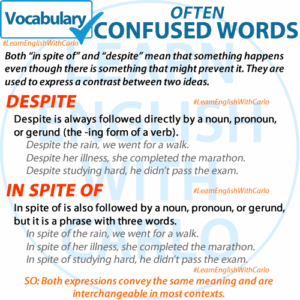
Both “in spite of” and “despite” mean that something happens even though there is something that might prevent it. They are used to express a contrast between two ideas. Structure Key Points to Remember Examples with Explanations Practice Exercise Ask your students to rewrite sentences using “in spite of” and “despite”: Visual Aid Create a …
Permanent link to this article: https://learnenglishwithcarlo.com/despite-vs-in-spite-of/
Aug 13
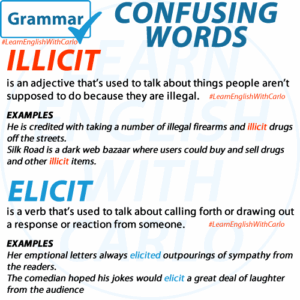
GRAMMAR -ILLICIT vs ELICIT ILLICIT is an adjective that’s used to talk about things people aren’t supposed to do because they are illegal. EXAMPLES He is credited with taking a number of illegal firearms and illicit drugs off the streets. Silk Road is a dark web bazaar where users could buy and sell drugs and …
Permanent link to this article: https://learnenglishwithcarlo.com/grammar-illicit-vs-elicit/