Understanding Mixed Conditionals Mixed Conditionals are a combination of two different types of conditionals, typically mixing the second and third conditionals. They are used to express situations where the time in the “if” clause is different from the time in the main clause. This allows for a more nuanced expression of hypothetical situations that may …
Category: GRAMMAR
Permanent link to this article: https://learnenglishwithcarlo.com/conditionals-mixed-conditionals/
Jan 16
Personal Pronouns & Adjectives
1. Subject Pronouns: Subject pronouns are used when the pronoun is the subject of the sentence, meaning it performs the action of the verb. They replace nouns as the doers of the action. Here are the subject pronouns in English: For example: 2. Possessive Adjectives: Possessive adjectives show ownership or possession. They come before a …
Permanent link to this article: https://learnenglishwithcarlo.com/pronouns/
Jan 15
GRAMMAR – Still vs. Yet vs. Already
“Still,” “yet,” and “already” are commonly used adverbs in English that can sometimes be confusing. They help indicate time and the progression of events, but each has its own specific use and nuance. This guide will explain the differences between these three words, complete with definitions and examples to clarify their correct usage. STILL Definition: …
Permanent link to this article: https://learnenglishwithcarlo.com/grammar-still-vs-yes-vs-already/
Jan 15
Grammar – ENOUGH
Permanent link to this article: https://learnenglishwithcarlo.com/grammar-enough/
Jan 14
GRAMMAR – Figures of Speech
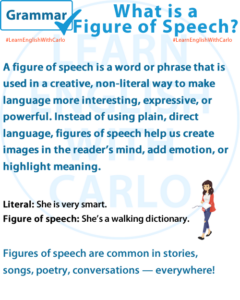
Figures of speech are words or expressions used in a non-literal, creative way to make language more vivid and expressive.Writers and speakers use them to create imagery, add emotion, and make ideas easier to remember. They’re common in stories, songs, poetry, and everyday conversation. Literal: She is very smart.Figure of speech: She’s a walking dictionary. …
Permanent link to this article: https://learnenglishwithcarlo.com/figures-of-speech-in-english/
Jan 10
CONFUSING WORDS – Quit – Quiet – Quite
QUIT “Quit” is a verb that means to stop or cease doing something. When someone quits an activity, job, or habit, they discontinue or give up that particular action or commitment. “Quit” can also imply resignation or abandonment of a task or responsibility. It is often used in contexts related to work, sports, studies, or …
Permanent link to this article: https://learnenglishwithcarlo.com/confusing-words-quit-quiet-quite/
Jan 09
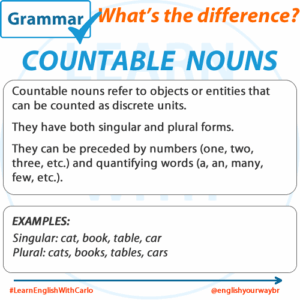
GRAMMAR – Countable and Uncountable Nouns
Countable and uncountable nouns are two categories used to classify nouns based on whether they can be counted or not. Countable Nouns:Countable nouns refer to objects or entities that can be counted as discrete units.They have both singular and plural forms.They can be preceded by numbers (one, two, three, etc.) and quantifying words (a, an, …
Permanent link to this article: https://learnenglishwithcarlo.com/grammar-countable-and-uncountable-nouns/
Jan 08
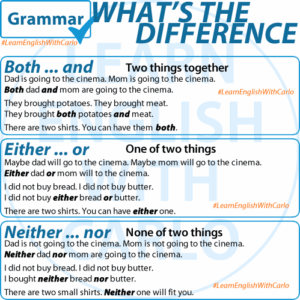
GRAMMAR – Both – Either – Neither
Both … andTwo things togetherMom is going to the cinema. Dad is going to the cinema.Both Mom and Dad are going to the cinema.They bought potatoes. They bought meat.They bought both potatoes and meat.There are two shirts. You can have both this one and that one.. Either … orOne of two thingsMom and Dad have …
Permanent link to this article: https://learnenglishwithcarlo.com/grammar-both-either-neither/
Jan 05
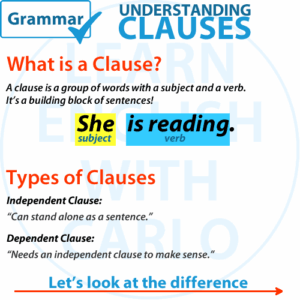
Understanding Clauses in English Grammar
A clause is a group of words that contains a subject and a verb. Clauses are essential building blocks of sentences, and understanding them can help you improve your writing and speaking skills. Types of Clauses Clauses can be divided into two main types: What is an Independent Clause? An independent clause expresses a complete …
Permanent link to this article: https://learnenglishwithcarlo.com/clauses-in-english-grammar/
Jan 03
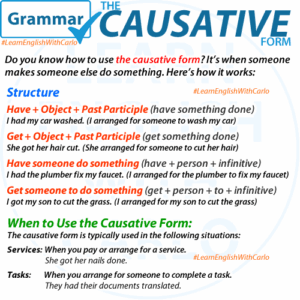
The Causative Form
The causative form is a grammatical structure used when one person causes another person to do something. It’s a common form in English and is often used to indicate that someone has arranged for an action to be done by someone else. Structure of the Causative Form There are two main ways to form the …
Permanent link to this article: https://learnenglishwithcarlo.com/the-causative-form/