Category: GRAMMAR

Understanding “Be Supposed To” in English

English learners often encounter the phrase “be supposed to” in everyday conversations. It’s a common expression used to talk about expectations, obligations, rules, and assumptions. In this post, we’ll explore what “be supposed to” means, how it’s used, and the grammatical rules that guide its usage. 1. What Does “Be Supposed To” Mean? “Be supposed …

Continue reading

Permanent link to this article: https://learnenglishwithcarlo.com/be-supposed-to-usage-in-english/

GRAMMAR – Another and Other

Use of Another and Otheranother + singular noun (Have another sandwich.) another (Thanks. I’ll have another.) other + plural noun (I wonder if there is life on other planets.) determiner + other + noun (There may be life on some other planets.) determiner + other (“I have one book.” “I have the other.”) Another means …

Continue reading

Permanent link to this article: https://learnenglishwithcarlo.com/grammar-another-and-other/

Understanding the Correct Placement of “Only”

Using “only” correctly can make a big difference in the meaning of a sentence. It’s a small word with a powerful impact! Let’s dive into how to place “only” correctly to convey the exact meaning you want. Understanding the Role of “Only”: “Only” is a versatile word that can modify different parts of a sentence. …

Continue reading

Permanent link to this article: https://learnenglishwithcarlo.com/correct-placement-of-only-in-sentences/

Sometime, Sometimes and Some Time

These three words are often confused. So, here’s an explanation of the differences between “sometime,” “sometimes,” and “some time”: 1. Sometime: 2. Sometimes: 3. Some time: Usage Tips: Examples: Understanding these differences will help you use these words correctly in various contexts. Practice using them in sentences with the QUIZ below!

Permanent link to this article: https://learnenglishwithcarlo.com/sometime-sometimes-and-some-time/

Essential English Grammar Rules for ESL Learners

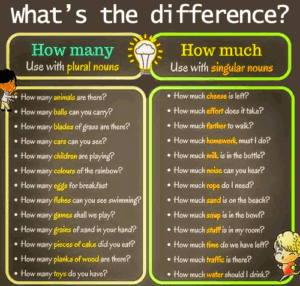
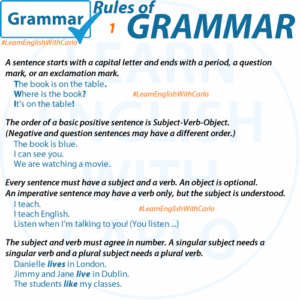
Mastering English grammar helps you communicate clearly and naturally. Here’s a guide to some fundamental rules, complete with examples and exceptions to be aware of. 1. Indefinite Articles (A/An) 2. Countable and Uncountable Nouns with Quantifiers 3. Possessive Form with Apostrophes 4. Active vs. Passive Voice 5. Contractions: ‘He’d’, ‘They’d’, and More 6. Proper Nouns …
Continue reading

Permanent link to this article: https://learnenglishwithcarlo.com/essential-english-grammar-rules-for-esl-learners/

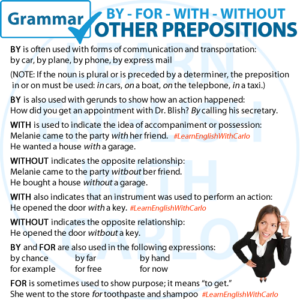
OTHER PREPOSITIONS

By is often used with forms of communication and transportation:by car, by plane, by phone, by express mail (‘Note: If the noun is plural or is preceded by a determiner, the preposition in or on must be used: in cars, on a boat, on tbe telepbone, in a taxi.) By is also used with gerunds …

Continue reading

Permanent link to this article: https://learnenglishwithcarlo.com/other-prepositions/

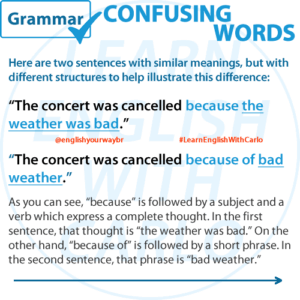
“Because” vs. “Because of”

What’s the difference between “because” and “because of”? In most cases, “because” is followed by a subject and a verb, and “because of” is typically followed by a single word or phrase. Here are two sentences with similar meanings, but with different structures to help illustrate this difference: “The concert was canceled because the weather …

Continue reading

Permanent link to this article: https://learnenglishwithcarlo.com/because-vs-because-of/

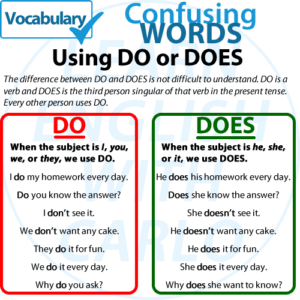
CONFUSING WORDS – DO vs. DOES

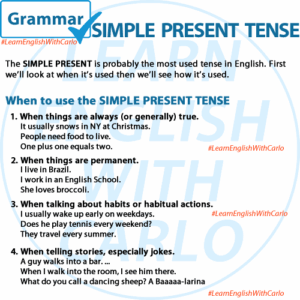
The difference between DO and DOES is not difficult to understand.DO is a verb and DOES is the third person singular of that verb in the present tense. Every other person in the conjugation uses DO. When the subject is I, you, we, or they, we use DO. I do my homework every day.Do you …

Continue reading

Permanent link to this article: https://learnenglishwithcarlo.com/confusing-words-do-vs-does/

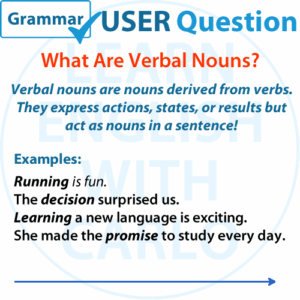
GRAMMAR – Verbal Nouns

What Are Verbal Nouns and How Are They Constructed? If you’ve ever encountered words like running, development, or decision, you’ve seen verbal nouns in action! Verbal nouns are a fascinating aspect of English grammar, as they combine the essence of an action (from verbs) with the grammatical function of a noun. Let’s dive into what …

Continue reading

Permanent link to this article: https://learnenglishwithcarlo.com/grammar-verbal-nouns/

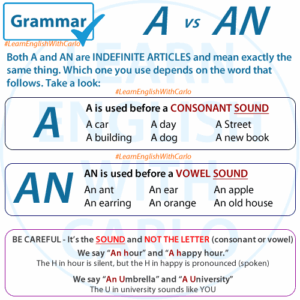
A vs. AN: Indefinite Articles

Both A and AN are indefinite articles in English, and they mean exactly the same thing. They are used before singular, countable nouns when you are not referring to a specific item. However, the choice between A and AN depends entirely on the sound of the word that follows—not necessarily the first letter of that …

Continue reading

Permanent link to this article: https://learnenglishwithcarlo.com/a-vs-an-indefinite-articles/

Load more