When giving advice in English, we often use the modal verbs “should,” “ought to,” and “had better.” Each of these has its nuances and specific contexts where they are more appropriate. Let’s explore how to use them, their differences, and how they work in questions and negative sentences. Using SHOULD “Should” is the most common …
Category: GRAMMAR
Permanent link to this article: https://learnenglishwithcarlo.com/giving-advice-using-should-ought-to-had-better/
Dec 01
GRAMMAR – SIMPLE PRESENT TENSE
The SIMPLE PRESENT is probably the most used tense in English. First, we’ll look at when it’s used then we’ll see how it’s used. When to use the SIMPLE PRESENT TENSE 1. When things are always (or generally) true.It usually snows in NY at Christmas.People need food to live.One plus one equals two. 2. When …
Permanent link to this article: https://learnenglishwithcarlo.com/grammar-simple-present-tense-2/
Nov 23
SO-SO and MORE OR LESS: What’s the Difference
While SO-SO and MORE OR LESS are short and simple phrases, they serve entirely different purposes in English. Let’s dive into their meanings, uses, and nuances. 1. SO-SO: The Language of the Average Definition:SO-SO is used to describe something that is average, ordinary, or not impressive. It conveys a neutral feeling—not good, not bad. When …
Permanent link to this article: https://learnenglishwithcarlo.com/difference-between-so-so-and-more-or-less/
Nov 20
GRAMMAR – How Much vs. How Many
When we want to know the quantity or amount of something, we use HOW MUCH or HOW MANY. Key Differences: Remembering this distinction will help you use “how much” and “how many” correctly in questions and statements based on whether the noun is countable or uncountable. If you have any questions or doubts, please ask …
Permanent link to this article: https://learnenglishwithcarlo.com/difference-between-how-much-and-how-many/
Nov 18
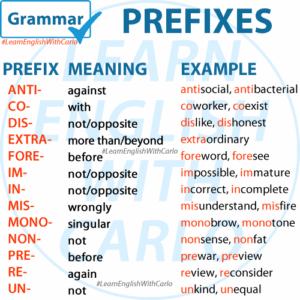
Prefixes: Unlocking the Power of Word Beginnings
Have you ever wondered how a single word can convey vastly different meanings, just by adding a few letters at the beginning? Enter the fascinating world of prefixes – those tiny yet mighty linguistic tools that shape our language in profound ways. What are Prefixes? At their core, prefixes are linguistic building blocks, morphemes attached …
Permanent link to this article: https://learnenglishwithcarlo.com/prefixes-unlocking-the-power-of-word-beginnings/
Nov 17
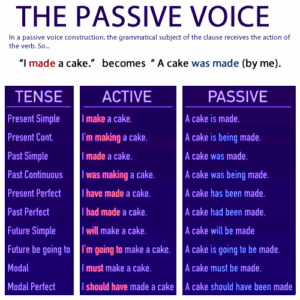
GRAMMAR – The Passive Voice
There are two voices in English (and most other languages), ACTIVE and PASSIVE. ACTIVE: Isabella ate the burrito.In this sentence, the subject, Isabella, performed the action, and the object, the burrito, suffered the action. To express something in the PASSIVE voice, the idea needs to have an OBJECT.Why? Because in the passive voice, the OBJECT …
Permanent link to this article: https://learnenglishwithcarlo.com/grammar-the-passive-voice/
Nov 15
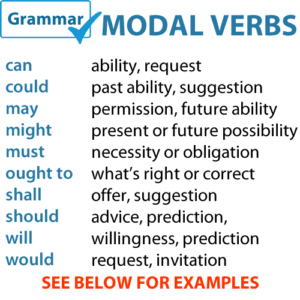
GRAMMAR – Modal Verbs
What Are Modal Verbs? Modal verbs are auxiliary (helping) verbs that express possibility, necessity, ability, permission, and other attitudes toward the action of the main verb. Unlike regular verbs, modal verbs do not change form based on the subject (e.g., “I can,” “he can”). They are always followed by the base form of the main …
Permanent link to this article: https://learnenglishwithcarlo.com/grammar-modal-verbs/
Nov 14
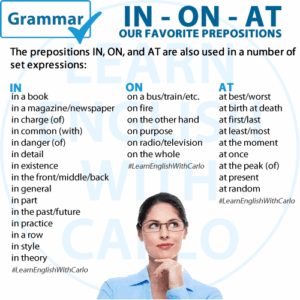
What’s the difference? IN TIME vs. ON TIME
Many people confuse these two expressions. And while they are similar, there is a very important difference. ON time – This referrs to when you have an appointment or scheduled time to be somewhere or do something. The meeting starts at 2 pm. I have to be on time. (If I’m late something bad will …
Permanent link to this article: https://learnenglishwithcarlo.com/whats-the-difference-in-time-vs-on-time/
Nov 12
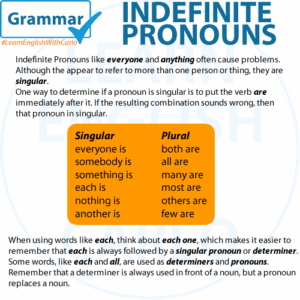
GRAMMAR – Indefinite Pronouns
GRAMMAR – Indefinite Pronouns Indefinite Pronouns like everyone and anything often cause problems. Although the appear to refer to more than one person or thing, they are SINGULAR. One way to determine if a pronoun is singular is to put the verb are immediately after it. If the resulting combination sounds wrong, then that pronoun …
Permanent link to this article: https://learnenglishwithcarlo.com/grammar-indefinite-pronouns/
Nov 09
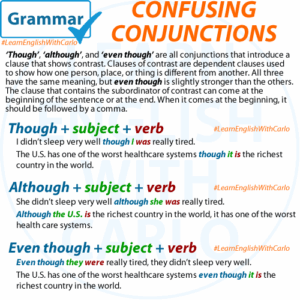
Understanding Conjunctions for Contrast
Though, Although, and Even Though Conjunctions play a crucial role in connecting ideas within sentences, and when it comes to expressing contrast, three common ones stand out: “though,” “although,” and “even though.” Let’s delve deeper into how these conjunctions function and how they can elevate your writing! 1. Though 2. Although 3. Even Though Placement …
Permanent link to this article: https://learnenglishwithcarlo.com/understanding-conjunctions-for-contrast/