Category: GRAMMAR
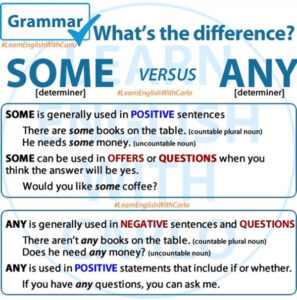
As an English learner, you’ve probably come across some and any and wondered why we use one instead of the other. These two words have very similar meanings—they both refer to an unspecified amount or number—but their usage depends on the context. Let’s explore the differences with simple rules, examples, and tips. Key Differences Between …
Continue reading
Permanent link to this article: https://learnenglishwithcarlo.com/difference-between-some-and-any/
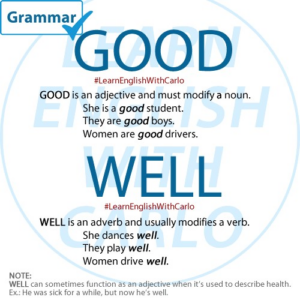
Good is an adjective and must modify a noun. Well is usually an adverb. Well is occasionally used as an adjective but only when referring to someone’s health. “Good” as an Adjective: “Well” as an Adverb: “Well” as an Adjective (Health): Here are some common mistakes to avoid when using “good” and “well”: These points …
Continue reading
Permanent link to this article: https://learnenglishwithcarlo.com/good-vs-well/
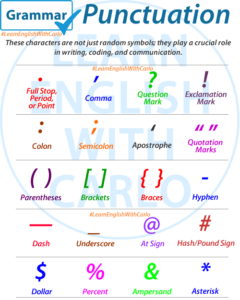
These characters are not just random symbols; they play a crucial role in writing, coding, and communication. You will learn their names, definitions, and multiple uses with practical examples. Whether you’re writing an email, composing a document, or exploring programming, knowing how to use these symbols correctly will enhance your efficiency and effectiveness.
Permanent link to this article: https://learnenglishwithcarlo.com/keyboard-characters-and-punctuation-marks/
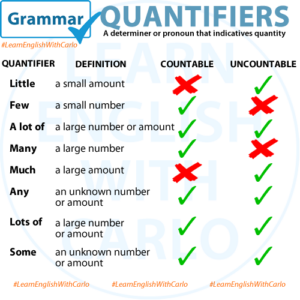
Countable or Uncountable? We use different quantifiers in English depending on whether the noun is countable (things we can count like apples 🍏) or uncountable (things we can’t count like water 💧). Here’s a quick guide to help you out: 🔹 For Countable Nouns: 🔹 For Uncountable Nouns: 🔹 For Both: Remember, countable nouns are …
Continue reading
Permanent link to this article: https://learnenglishwithcarlo.com/countable-or-uncountable-quantifiers/
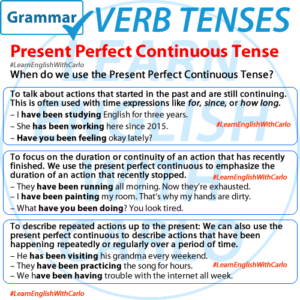
The Present Perfect and Present Perfect Continuous tenses can sometimes be used interchangeably, but they often emphasize different aspects of an action. Here’s a breakdown of when they are the same and when they are different: When the Present Perfect and Present Perfect Continuous Are the Same: Both tenses can be used to talk about …
Continue reading
Permanent link to this article: https://learnenglishwithcarlo.com/present-perfect-vs-present-perfect-continuous/
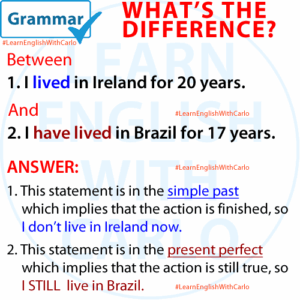
What’s the difference between these two sentences:1. I lived in Ireland for 20 years.2. I have lived in Brazil for 17 years. ANSWER:1. This statement is in the simple past which implies that the action is finished,so…I don’t live in Ireland now. 2. This statement is in the present perfect which implies that the action …
Continue reading
Permanent link to this article: https://learnenglishwithcarlo.com/simple-past-and-present-perfect/
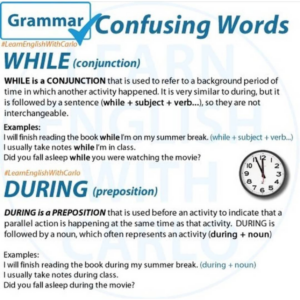
As an English learner, you may have noticed that both “while” and “during” are used to talk about time. However, they are used differently in sentences, and understanding how to use them correctly can make your English more accurate and natural. Let’s break down the key differences between these two words. 1. “WHILE” Usage:“While” is …
Continue reading
Permanent link to this article: https://learnenglishwithcarlo.com/difference-between-while-and-during-esl/
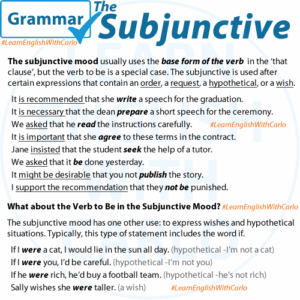
The subjunctive mood in English is used to express wishes, suggestions, demands, or hypothetical situations. It often appears after certain verbs (like “suggest” or “recommend”) and is characterized by using the base form of the verb, even with singular subjects (e.g., “I suggest that he go“). It can also express unreal or hypothetical situations, particularly …
Continue reading
Permanent link to this article: https://learnenglishwithcarlo.com/grammar-subjunctive/
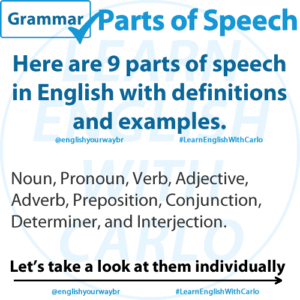
Here are 9 parts of speech in English with definitions and examples. NOUN A noun is a word used to identify a person, place, thing, or idea. Nouns are the basic building blocks of sentences and are essential for communication in any language. Examples of nouns include “dog,” “car,” “teacher,” “city,” and “happiness.” Nouns can …
Continue reading
Permanent link to this article: https://learnenglishwithcarlo.com/partsofspeech/
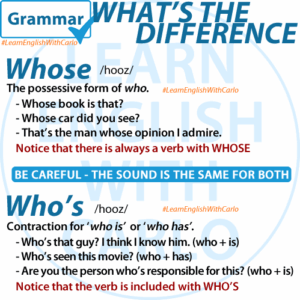
The words WHOSE and WHO’S may sound the same when spoken (both pronounced /ho͞oz/), but they have very different meanings and uses in English. Learning to use them correctly will help you avoid common mistakes in writing and speaking. WHOSE: Possessive Pronoun WHOSE is a possessive pronoun used to ask or talk about ownership or …
Continue reading
Permanent link to this article: https://learnenglishwithcarlo.com/whats-the-difference-between-whose-and-whos/
Load more