Category: INSTAGRAM
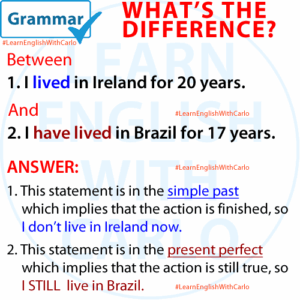
What’s the difference between these two sentences:1. I lived in Ireland for 20 years.2. I have lived in Brazil for 17 years. ANSWER:1. This statement is in the simple past which implies that the action is finished,so…I don’t live in Ireland now. 2. This statement is in the present perfect which implies that the action …
Continue reading
Permanent link to this article: https://learnenglishwithcarlo.com/simple-past-and-present-perfect/
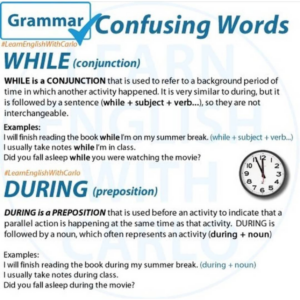
As an English learner, you may have noticed that both “while” and “during” are used to talk about time. However, they are used differently in sentences, and understanding how to use them correctly can make your English more accurate and natural. Let’s break down the key differences between these two words. 1. “WHILE” Usage:“While” is …
Continue reading
Permanent link to this article: https://learnenglishwithcarlo.com/difference-between-while-and-during-esl/
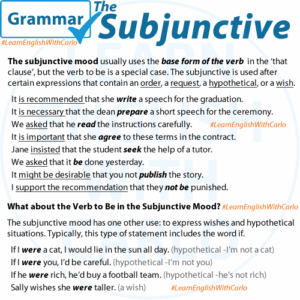
The subjunctive mood in English is used to express wishes, suggestions, demands, or hypothetical situations. It often appears after certain verbs (like “suggest” or “recommend”) and is characterized by using the base form of the verb, even with singular subjects (e.g., “I suggest that he go“). It can also express unreal or hypothetical situations, particularly …
Continue reading
Permanent link to this article: https://learnenglishwithcarlo.com/grammar-subjunctive/
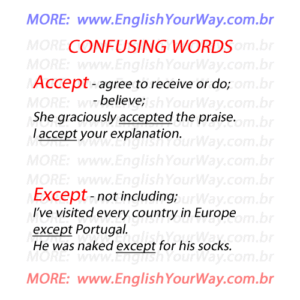
“Accept” and “except” are two commonly confused words in English due to their similar pronunciation, but they have different meanings and uses. Accept Definition: To receive or agree to something willingly. Part of Speech: Verb Examples: Usage: Use “accept” when talking about agreeing to take something that is offered or recognizing something as true. Except …
Continue reading
Permanent link to this article: https://learnenglishwithcarlo.com/accept-vs-except/
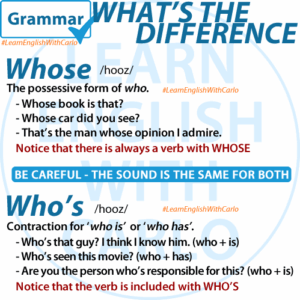
The words WHOSE and WHO’S may sound the same when spoken (both pronounced /ho͞oz/), but they have very different meanings and uses in English. Learning to use them correctly will help you avoid common mistakes in writing and speaking. WHOSE: Possessive Pronoun WHOSE is a possessive pronoun used to ask or talk about ownership or …
Continue reading
Permanent link to this article: https://learnenglishwithcarlo.com/whats-the-difference-between-whose-and-whos/
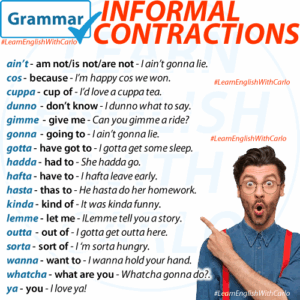
VOCABULARY – Informal (spoken) Contractions In English, as in most other languages, there are ways to shorten groups of words that commonly go together. We don’t do this in writing, just when we speak. They are called informal or spoken, contractions. ain’t – am not/is not/are not – I ain’t gonna lie. cos – because …
Continue reading
Permanent link to this article: https://learnenglishwithcarlo.com/vocabulary-informal-contractions/
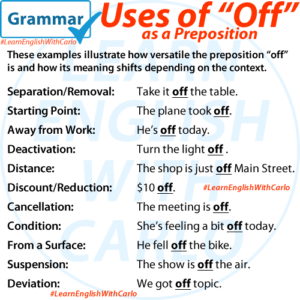
The preposition “off” has many different uses in English, depending on the context. Here’s a breakdown of its main uses: 1. Separation or Removal 2. Starting Point (in Time or Space) 3. Away from Work or Duty 4. Deactivation or Disconnection 5. Distance or Separation 6. Reduced or Discounted 7. Cancellation or Suspension 8. Condition …
Continue reading
Permanent link to this article: https://learnenglishwithcarlo.com/uses-of-off-preposition/
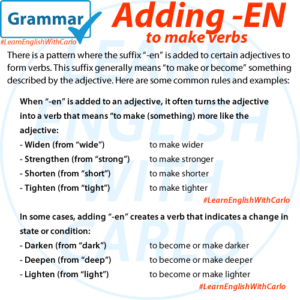
Turn Adjectives & Nouns into Verbs! Did you know you can add -EN to some adjectives and nouns to create verbs? This is a powerful and useful suffix in English. It often means “to make” or “to become” something. In this post, we’ll look at how this suffix works and give you plenty of examples …
Continue reading
Permanent link to this article: https://learnenglishwithcarlo.com/verb-suffix-en/
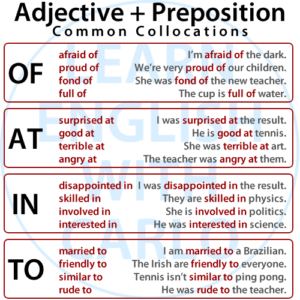
Adjectives are words used to describe a person, place, or thing, for example, The tall man in the red shirt is a friend of mine. We drove along a quiet road until reaching a small town. I’m reading an interesting book. Prepositions are words used to connect two ideas or to demonstrate the relationship between …
Continue reading
Permanent link to this article: https://learnenglishwithcarlo.com/grammar-adjective-preposition-2/
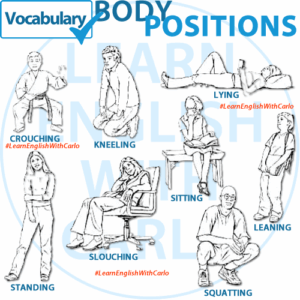
We place our bodies in different positions depending on what we are doing. Do you know the names of the different positions? One of my INSTAGRAM followers asked to use each one in a sentence, so here you go: Can you think of any other positions? If you have any questions or doubts, please ask …
Continue reading
Permanent link to this article: https://learnenglishwithcarlo.com/body-positions-vocabulary/
Load more