Category: INSTAGRAM
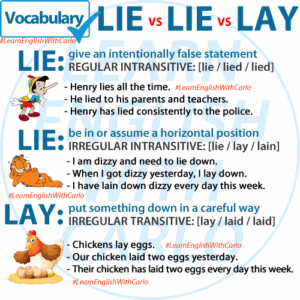
English can be tricky, especially when it comes to words that sound the same but have different meanings and uses. A common source of confusion is the difference between “lie,” “lie,” and “lay.” These three words are often mixed up, but understanding their meanings and how they are used can help you use them correctly. …
Continue reading
Permanent link to this article: https://learnenglishwithcarlo.com/lie-vs-lie-vs-lay-understanding-the-differences/
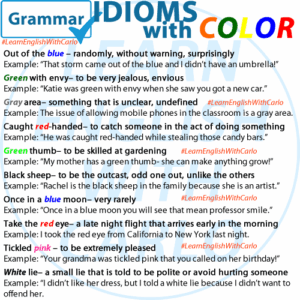
Out of the blue – randomly, without warning, surprisinglyExample: “That storm came out of the blue and I didn’t have an umbrella!” Green with envy– to be very jealous, enviousExample: “Katie was green with envy when she saw you got a new car for your birthday.” Gray area – something that is unclear, undefinedExample: The …
Continue reading
Permanent link to this article: https://learnenglishwithcarlo.com/grammar-idioms-with-color/
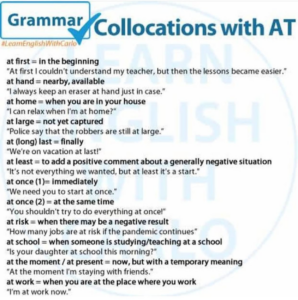
The preposition “at” is used in many common expressions in English, each with unique meanings. Below, you’ll find clear explanations and examples to help you understand and use these expressions confidently. Let’s explore! 1. At First = In the beginning This expression describes the initial phase of something, often followed by a change. Examples: 2. …
Continue reading
Permanent link to this article: https://learnenglishwithcarlo.com/grammar-collocations-with-at/
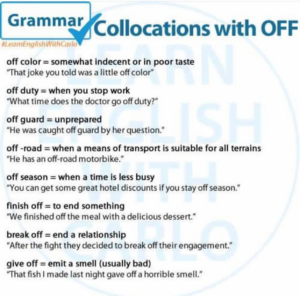
The English preposition “off” has a variety of meanings and uses, often forming part of idiomatic expressions and collocations. In this blog post, we’ll explore some common expressions with “off,” provide clear definitions, and share examples for each. Let’s dive in! 1. Off Color Definition: Something that is somewhat indecent, inappropriate, or in poor taste.Examples: …
Continue reading
Permanent link to this article: https://learnenglishwithcarlo.com/grammar-collocations-with-off/
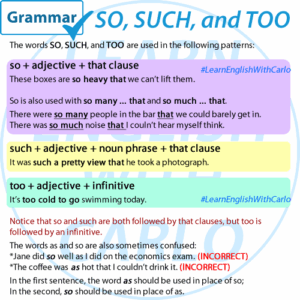
The words so, such, and too are often confused by English learners because they all express emphasis or intensity. However, they follow different grammatical patterns and are used in distinct ways. Let’s break it down with examples and explanations. 1. SO So is used with adjectives and adverbs to indicate a high degree, often followed …
Continue reading
Permanent link to this article: https://learnenglishwithcarlo.com/using-so-such-too-in-english/
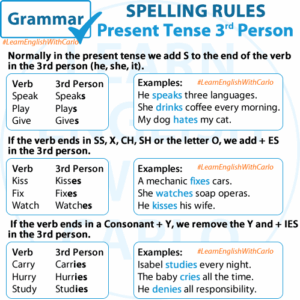
In English, when using the present simple tense, verbs often change slightly in the third person singular (when the subject is he, she, or it). These changes depend on the spelling of the verb. Let’s break it down! 1. The Basic Rule: Add “S” For most verbs, simply add S to the base form: Verb …
Continue reading
Permanent link to this article: https://learnenglishwithcarlo.com/adding-s-to-the-third-person-singular/
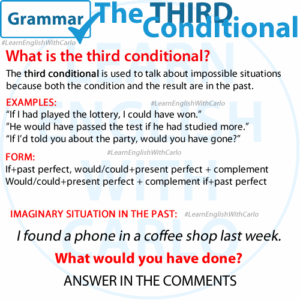
What is the third conditional? The Third Conditional is used to talk about hypothetical or unreal situations in the past and their imagined outcomes. It’s commonly used to express regrets, wishes, or events that didn’t happen. Examples: In each case, the situation is impossible to change because it’s already in the past. Forming the Third …
Continue reading
Permanent link to this article: https://learnenglishwithcarlo.com/conditionals-the-third-conditional/
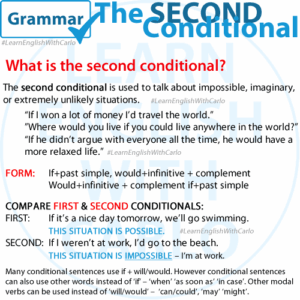
What is the Second Conditional? The Second Conditional is a grammatical structure used to talk about hypothetical, imaginary, or extremely unlikely situations. It allows us to express dreams, wishes, and scenarios that are not based in reality. Structure The Second Conditional follows this structure: Examples: Compare First & Second Conditionals It’s important to distinguish between …
Continue reading
Permanent link to this article: https://learnenglishwithcarlo.com/conditionals-the-second-conditional/
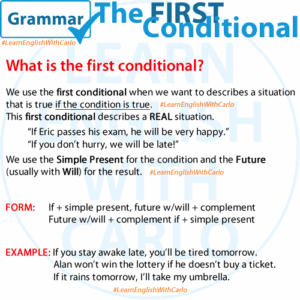
What is the first conditional? The First Conditional is used to talk about situations that are likely or possible in the future. It describes a real, specific outcome that will happen if a condition is met. Example Sentences: This conditional structure helps us talk about things that are realistic or likely in the future as …
Continue reading
Permanent link to this article: https://learnenglishwithcarlo.com/conditionals-the-first-conditional/
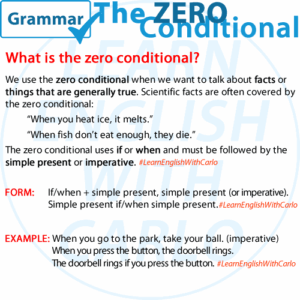
What is the zero conditional? The Zero Conditional is used to talk about general truths, scientific facts, and situations that are always true when the condition is met. This conditional helps us discuss facts that remain the same, regardless of time. Example Sentences: The outcomes are universally true in these cases, making the Zero Conditional …
Continue reading
Permanent link to this article: https://learnenglishwithcarlo.com/grammar-the-zero-conditional/
Load more