Category: INSTAGRAM
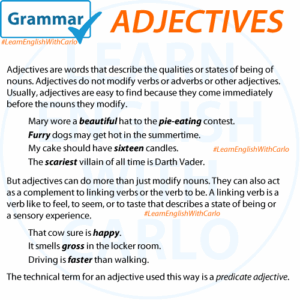
Adjectives are words that describe the quality or state of being of nouns. Adjectives do not modify verbs, adverbs, or other adjectives. Usually, adjectives are easy to find because they come immediately before the nouns they modify. Adjectives can do more than just modify nouns. They can also act as a complement to linking verbs …
Continue reading
Permanent link to this article: https://learnenglishwithcarlo.com/adjectives/
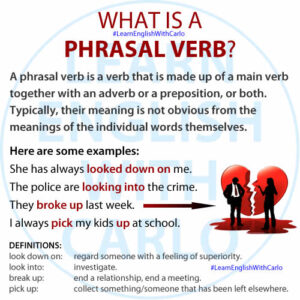
A phrasal verb is a verb that is made up of a main verb together with an adverb or a preposition, or both. Typically, their meaning is not obvious from the meanings of the individual words themselves.There are many phrasal verbs in English. Here are some examples: She has always LOOKED DOWN ON me.(She thought …
Continue reading
Permanent link to this article: https://learnenglishwithcarlo.com/what-is-a-phrasal-verb/
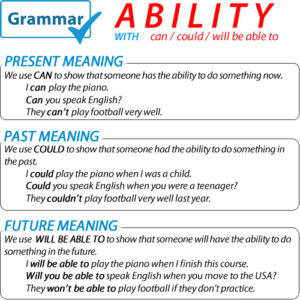
We use CAN to show that someone has the ability to do something now.I can play the piano.Can you speak English?They can’t play football very well. We use COULD to show that someone had the ability to do something in the past.I could play the piano when I was a child.Could you speak English when …
Continue reading
Permanent link to this article: https://learnenglishwithcarlo.com/grammar-ability-using-can-could-will-be-able-to/
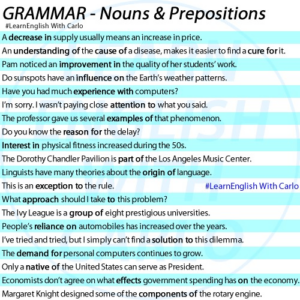
Some nouns are followed by specific prepositions. For example the noun relationship is always followed by with. A decrease in supply usually means an increase in price.Understanding the cause of a disease, makes it easier to find a cure for it.Pam noticed an improvement in the quality of her students’ work.Do sunspots have an influence …
Continue reading
Permanent link to this article: https://learnenglishwithcarlo.com/grammar-nouns-prepositions/
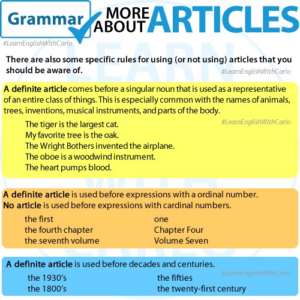
A definite article comes before a singular noun that is used as a representative of an entire class of things. This is especially common with the names of animals, trees, inventions, musical instruments, and parts of the body.The tiger is the largest cat.My favorite tree is the oak.The Wright Bothers invented the airplane.The oboe is …
Continue reading
Permanent link to this article: https://learnenglishwithcarlo.com/grammar-more-about-articles/
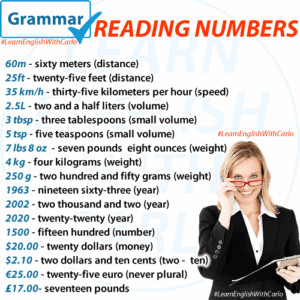
GRAMMAR – How to read numbers 60m – sixty meters (distance) 25ft – twenty-five feet (distance) 35 km/h – thirty-five kilometers per hour (speed) 2.5L – two and a half liters (volume) 3 tbsp – three tablespoons (small volume) 5 tsp – five teaspoons (small volume) 7 lbs 8 oz – seven pounds eight ounces …
Continue reading
Permanent link to this article: https://learnenglishwithcarlo.com/grammar-how-to-read-numbers/
TIP Less & More for a HEALTHIER LIFE Here are some simple things we can do to help us achieve a healthier lifestyle. LESS meat MORE vegetables LESS sugar MORE fruit LESS driving MORE walking LESS worrying MORE relaxing LESS anger MORE laughter
Permanent link to this article: https://learnenglishwithcarlo.com/tip-less-more/
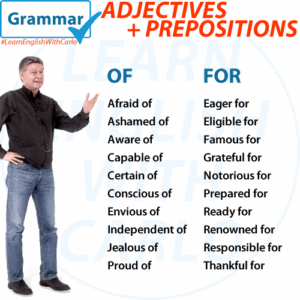
GRAMMAR – Adjectives & Prepositions Some adjectives need a preposition before their object. There doesn’t seem to be a logical rule, I’m afraid! We just need to learn them. Afraid of Ashamed of Aware of Capable of Certain of Conscious of Envious of Independent of Jealous of Proud of Eager for Eligible for Famous for …
Continue reading
Permanent link to this article: https://learnenglishwithcarlo.com/grammar-adjectives-prepositions-2/
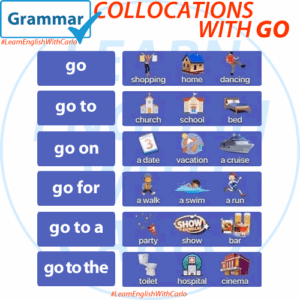
GRAMMAR – Collocations with GO Native English speakers use the word GO almost daily. Try using some of these collocations in your everyday speech and learn how it can go into virtually any sentence. Can you think of any other collocations using the word go? Let us know with a comment! GO shopping GO dancing …
Continue reading
Permanent link to this article: https://learnenglishwithcarlo.com/grammar-collocations-with-go/
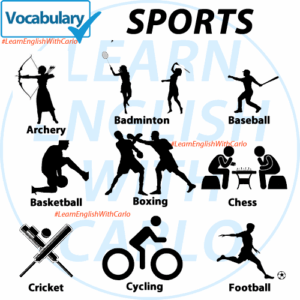
VOCABULARY – Sports Here are a few popular sports. Archery, Badminton, Baseball, Basketball, Boxing, Chess, Cricket, Cycling, Football What sports do you play? What sports do you like to watch?
Permanent link to this article: https://learnenglishwithcarlo.com/vocabulary-sports-3/
Load more