Category: INSTAGRAM

GRAMMAR – The Passive Voice

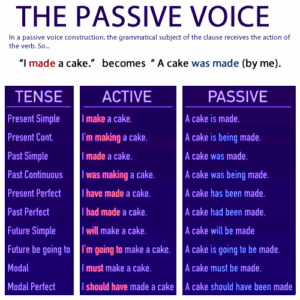
There are two voices in English (and most other languages), ACTIVE and PASSIVE. ACTIVE: Isabella ate the burrito.In this sentence, the subject, Isabella, performed the action, and the object, the burrito, suffered the action. To express something in the PASSIVE voice, the idea needs to have an OBJECT.Why? Because in the passive voice, the OBJECT …

Continue reading

Collocations – Nouns + Prepositions

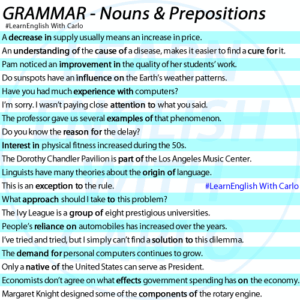
Certain nouns are often accompanied by specific prepositions, creating noun-preposition collocations. For instance, when we use the noun “interest,” it is typically followed by the preposition “in.” Similarly, “contact” pairs with “with,” and “room” with “for.” For example: Recognizing which preposition to use in these collocations can be challenging. One helpful strategy is to consider …

Continue reading

What’s the difference? IN TIME vs. ON TIME

Many people confuse these two expressions. And while they are similar, there is a very important difference. ON time – This referrs to when you have an appointment or scheduled time to be somewhere or do something. The meeting starts at 2 pm. I have to be on time. (If I’m late something bad will …

Continue reading

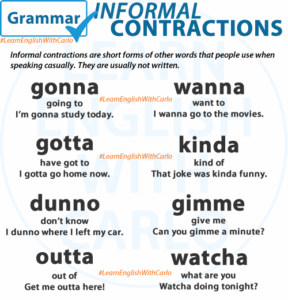
VOCABULARY – Informal (spoken) Contractions

VOCABULARY – Informal (spoken) Contractions In English, as in most other languages, there are ways to shorten groups of words that commonly go together. We don’t do this in writing, just when we speak. They are called informal or spoken contractions. Here are some examples: I’ve got to go soon – I’ve gotta go soon. …

Continue reading

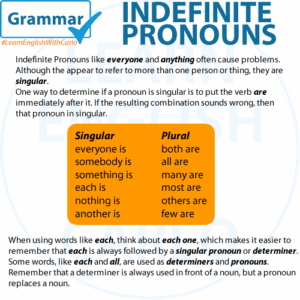
GRAMMAR – Indefinite Pronouns

GRAMMAR – Indefinite Pronouns Indefinite Pronouns like everyone and anything often cause problems. Although the appear to refer to more than one person or thing, they are SINGULAR. One way to determine if a pronoun is singular is to put the verb are immediately after it. If the resulting combination sounds wrong, then that pronoun …

Continue reading

Conjunctions

Conjunctions are essential parts of speech in English, connecting words, phrases, or clauses within a sentence. For ESL learners, understanding conjunctions is crucial for constructing clear and cohesive sentences. Conjunctions can be categorized into different types, each serving a specific purpose in expressing relationships between ideas. 1. Coordinating Conjunctions: These conjunctions connect words, phrases, or …

Continue reading

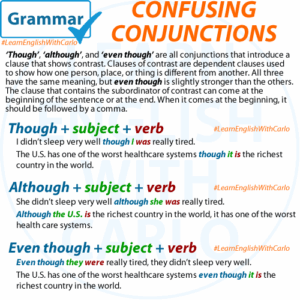
Understanding Conjunctions for Contrast

Though, Although, and Even Though Conjunctions play a crucial role in connecting ideas within sentences, and when it comes to expressing contrast, three common ones stand out: “though,” “although,” and “even though.” Let’s delve deeper into how these conjunctions function and how they can elevate your writing! 1. Though 2. Although 3. Even Though Placement …

Continue reading

GRAMMAR – IN – ON – AT

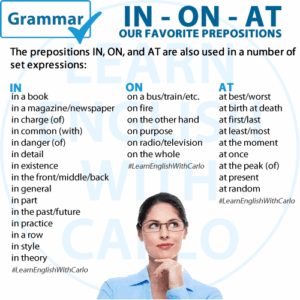
The prepositions IN, ON, and AT are also used in a number of set expressions:in a book/magazine newspaperin charge (of)in common (with)in danger (of)in detailin existencein the front/middle/backin generalin partin the past/futurein practicein a rowin stylein theoryon a bus/train/etc.on fireon the other handon purposeon radio/televisionon the wholeat best/worstat birth at deathat first/lastat least/mostat the momentat …

Continue reading

VOCABULARY – Irregular Plural Nouns

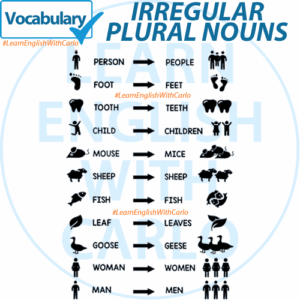
VOCABULARY – Irregular Plural Nouns Most nouns in English are made plural by adding an ‘s’ to the singular form. But there are some exceptions. Here are a few of the more common ones. REMEMBER: Always use the plural verb form with plural noun subjects. FOR MORE INFORMATION ABOUT IRREGULAR PLURAL NOUNS, CLICK HERE.

GRAMMAR – Interrogative Pronouns (question words)

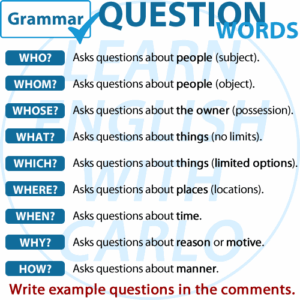
An Interrogative Pronoun (question word) is a word we use in an information question (as opposed to a yes/no questions). The most common question words in English are: WHO is only used when referring to people, when we want to know the person. WHERE is used when asking about a place or location, when we want to know the …

Continue reading