Category: INSTAGRAM
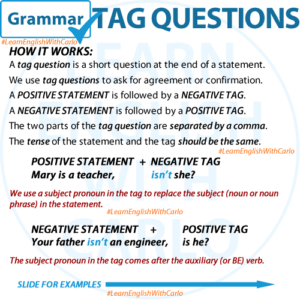
A tag question is a short question added to the end of a statement. They are used to confirm information, seek agreement, or invite a response from the listener. Tag questions are characterized by their structure: they typically consist of an auxiliary verb and a pronoun that matches the subject of the statement. For example: …
Continue reading
Permanent link to this article: https://learnenglishwithcarlo.com/grammar-tag-questions/
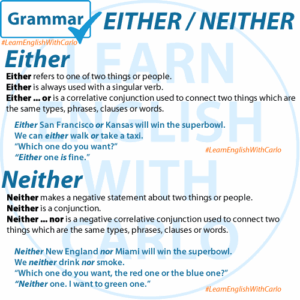
GRAMMAR – Either & Neither Either refers to one of two things or people. Either is always used with a singular verb. Either … or is a correlative conjunction used to connect two things which are the same types, phrases, clauses or words. Neither makes a negative statement about two things or people. Neither …
Continue reading
Permanent link to this article: https://learnenglishwithcarlo.com/grammar-either-neither/
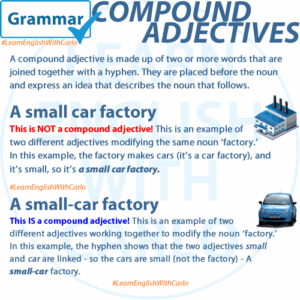
Understanding Compound Adjectives in English Compound adjectives are a fascinating aspect of English grammar that allow us to express detailed ideas about nouns in a concise and efficient way. As the name suggests, a compound adjective is made up of two or more words that work together as a single unit to describe a noun. …
Continue reading
Permanent link to this article: https://learnenglishwithcarlo.com/compound-adjectives-examples-and-rules/
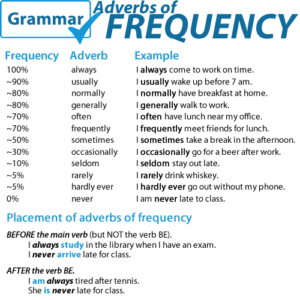
Adverbs of frequency describe how often something occurs 100% – always – I always come to work on time.~90% – usually – I usually wake up before 7 am.~80% – normally – I normally have breakfast at home.~80% – generally – I generally walk to work.~70% – often – I often have lunch near my …
Continue reading
Permanent link to this article: https://learnenglishwithcarlo.com/grammar-adverbs-of-frequency/
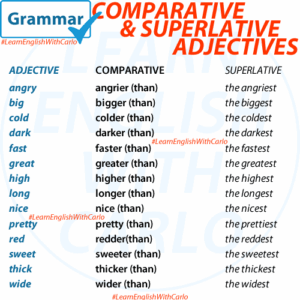
Comparative and superlative adjectives are essential tools in English grammar for comparing and expressing degrees of qualities or characteristics. This post will clarify these concepts with clear definitions, examples, and practical applications. GRAMMAR – Comparatives & Superlatives Comparative Adjectives Definition: Comparative adjectives are used to compare two things or people and indicate which has a …
Continue reading
Permanent link to this article: https://learnenglishwithcarlo.com/comparative-and-superlative-adjectives/
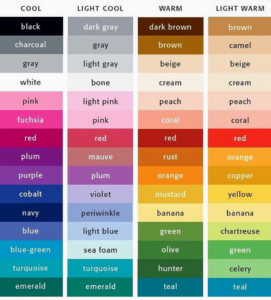
What’s your favorite color? Who knew there were so many colors? And this is only a small sample. Here is a list of the colors shown in the image: If you have any questions or doubts, please ask in the comments or send me a private message. Follow me on Instagram: @englishyourwaybror look for the hashtag …
Continue reading
Permanent link to this article: https://learnenglishwithcarlo.com/colors/
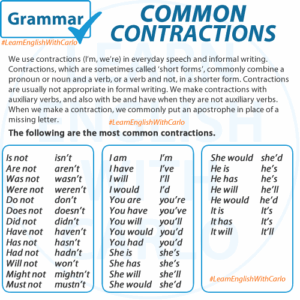
GRAMMAR – COMMON CONTRACTIONS We use contractions (I’m, we’re) in everyday speech and informal writing. Contractions, which are sometimes called ‘short forms’, commonly combine a pronoun or noun and a verb, or a verb and not, in a shorter form. Contractions are usually not appropriate in formal writing. We make contractions with auxiliary verbs, and …
Continue reading
Permanent link to this article: https://learnenglishwithcarlo.com/grammar-common-contractions/
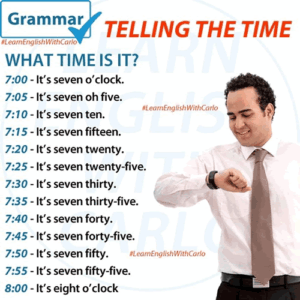
GRAMMAR – Telling the Time There are two ways to tell the time in English. The TRADITIONAL British way and the NEWER American way. In the traditional British way, we say the minutes, or portion of an hour (quarter or half), followed by a preposition (past, or to) and then the hour. The US method …
Continue reading
Permanent link to this article: https://learnenglishwithcarlo.com/grammar-telling-the-time/
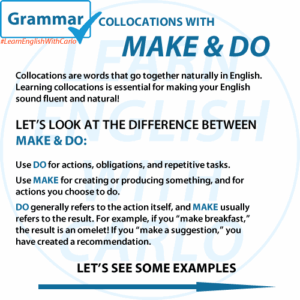
Collocations are words that go together naturally in English.Learning collocations is essential for making your English sound fluent and natural! LET’S LOOK AT THE DIFFERENCE BETWEEN MAKE & DO:Use DO for actions, obligations, and repetitive tasks.Use MAKE for creating or producing something, and for actions you choose to do. DO generally refers to the action …
Continue reading
Permanent link to this article: https://learnenglishwithcarlo.com/grammar-collocations-with-make-do/
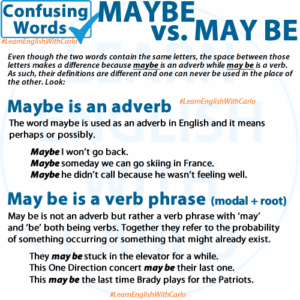
MAYBE vs MAY BE Even though the two words contain the same letters, the space between those letters makes a difference because maybe is an adverb while may be is a verb. As such, their definitions are different and one can never be used in the place of the other. Look: MAY BE (Verb Phrase) …
Continue reading
Permanent link to this article: https://learnenglishwithcarlo.com/grammar-maybe-vs-may-be/
Load more