Category: INSTAGRAM
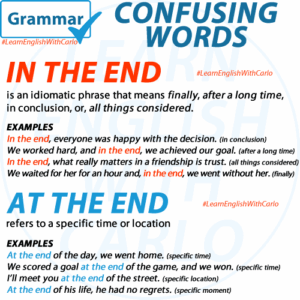
GRAMMAR – AT THE END vs IN THE END English learners often confuse the phrases at the end and in the end because they sound similar. However, their meanings and usage are distinct. Let’s break them down and look at some examples to help you use these phrases correctly. What Does AT THE END Mean? …
Continue reading
Permanent link to this article: https://learnenglishwithcarlo.com/grammar-at-the-end-vs-in-the-end/
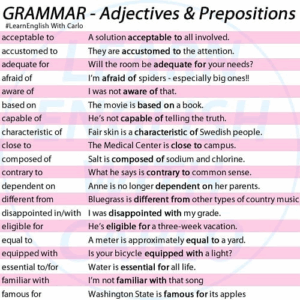
Some adjectives need a preposition before their object. There doesn’t seem to be a logical rule, I’m afraid! We just need to learn them.
Permanent link to this article: https://learnenglishwithcarlo.com/adjectives-with-prepositions/
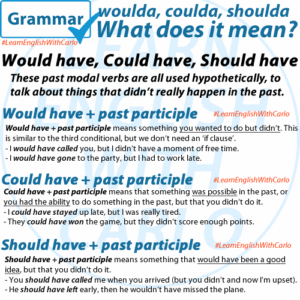
You may have heard native English speakers use phrases like woulda, coulda, or shoulda. But what do they mean? These are informal, spoken forms of would have, could have, and should have. These past modal verbs are used to talk about things that didn’t happen, but that we imagine or wish had been different. Let’s …
Continue reading
Permanent link to this article: https://learnenglishwithcarlo.com/woulda-coulda-shoulda/
When talking about past habits or repeated actions, learners of English often encounter two phrases: “used to” and “would.” While these two expressions have similarities, they are not interchangeable in every context. Let’s explore their meanings, uses, and differences in detail. What Does “Used to” Mean? “Used to” refers to habits, actions, or states that …
Continue reading
Permanent link to this article: https://learnenglishwithcarlo.com/used-to-vs-would/
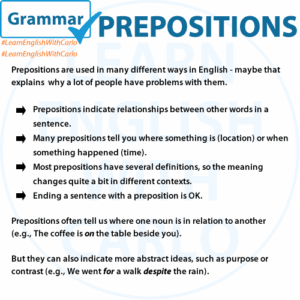
Types of Prepositions The different types of prepositions are used to provide us with different information with regard to time (prepositions of time), place (prepositions of place), and direction (prepositions of movement). Besides these three, there are others: prepositions of manner and prepositions of cause and reason. Time: We’ve been working since yesterday.Direction: Go to …
Continue reading
Permanent link to this article: https://learnenglishwithcarlo.com/grammar-prepositions-2/
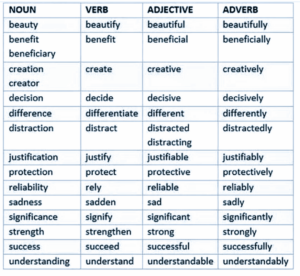
Welcome to our guide on how words can take different forms as nouns, verbs, adjectives, and adverbs! Many words in English change form depending on their role in a sentence, and understanding these transformations is key to mastering grammar and building vocabulary. Here you’ll find tables that show how specific words change across these categories, …
Continue reading
Permanent link to this article: https://learnenglishwithcarlo.com/noun-verb-adjective-adverb/
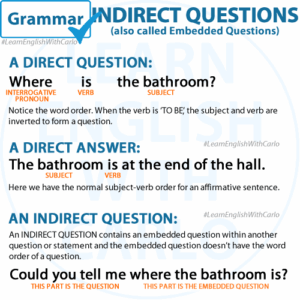
Indirect questions are a polite and often more formal way of asking questions. They differ from direct questions in their structure and use. Let’s break down what indirect questions are, how to form them, and provide examples to illustrate their use. What Are Indirect Questions? Indirect questions are questions embedded within statements or other questions. …
Continue reading
Permanent link to this article: https://learnenglishwithcarlo.com/indirect-questions/
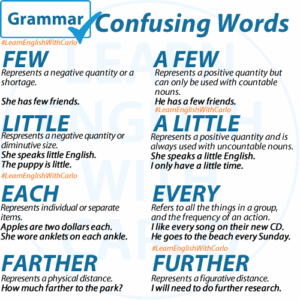
GRAMMAR – Adjectives that quantify. The words in this image can be adjectives, pronouns, or determiners.
Permanent link to this article: https://learnenglishwithcarlo.com/grammar-adjectives-that-quantify/
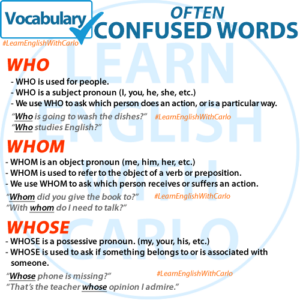
These three words are often confused. Here’s a brief explanation of the differences between “who,” “whom,” and “whose”: 1. Who: 2. Whom: 3. Whose: Usage Tips: Examples: Understanding these differences will help you choose the correct word in various contexts. Practice using them in sentences with the QUIZ below!
Permanent link to this article: https://learnenglishwithcarlo.com/who-whom-and-whose/
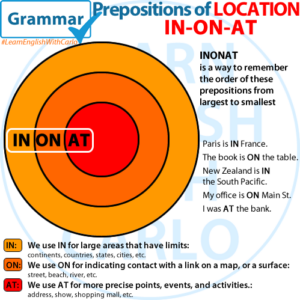
Prepositions of location are essential in English as they help us describe where something or someone is located. Among the most commonly used prepositions are IN, ON, and AT. While they may seem similar, they are used in specific contexts to indicate different types of locations. Let’s explore how to use each one correctly. 1. …
Continue reading
Permanent link to this article: https://learnenglishwithcarlo.com/prepositions-of-location-in-on-at/
Load more