Category: VERBS
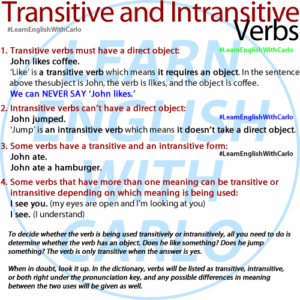
Verbs are the heart of every sentence. They tell us what’s happening — what the subject does or is. But did you know that some verbs need an object, while others stand alone? That’s where transitive and intransitive verbs come in. Understanding the difference between them helps you build clear, grammatically correct sentences — and …
Continue reading
Permanent link to this article: https://learnenglishwithcarlo.com/transitive-and-intransitive-verbs-in-english-grammar/
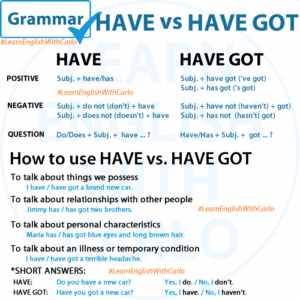
When we talk about possession, relationships, illnesses, or characteristics, English gives us two ways to express the same idea:👉 HAVE and HAVE GOT Both mean the same thing, but they’re used slightly differently in everyday English. 🧩 1. Meaning and Usage Both HAVE and HAVE GOT are used to talk about things we own, relationships, …
Continue reading
Permanent link to this article: https://learnenglishwithcarlo.com/have-vs-have-got-in-english-grammar/
When talking about past habits or repeated actions, learners of English often encounter two phrases: “used to” and “would.” While these two expressions have similarities, they are not interchangeable in every context. Let’s explore their meanings, uses, and differences in detail. What Does “Used to” Mean? “Used to” refers to habits, actions, or states that …
Continue reading
Permanent link to this article: https://learnenglishwithcarlo.com/used-to-vs-would/
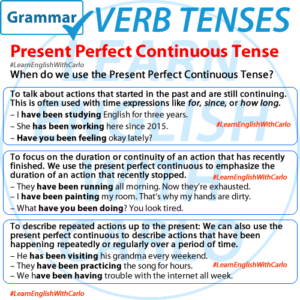
The Present Perfect and Present Perfect Continuous tenses can sometimes be used interchangeably, but they often emphasize different aspects of an action. Here’s a breakdown of when they are the same and when they are different: When the Present Perfect and Present Perfect Continuous Are the Same: Both tenses can be used to talk about …
Continue reading
Permanent link to this article: https://learnenglishwithcarlo.com/present-perfect-vs-present-perfect-continuous/
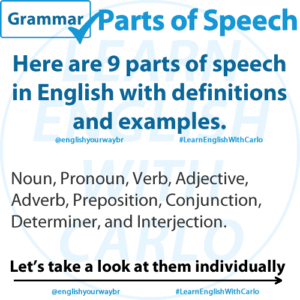
Here are 9 parts of speech in English with definitions and examples. NOUN A noun is a word used to identify a person, place, thing, or idea. Nouns are the basic building blocks of sentences and are essential for communication in any language. Examples of nouns include “dog,” “car,” “teacher,” “city,” and “happiness.” Nouns can …
Continue reading
Permanent link to this article: https://learnenglishwithcarlo.com/partsofspeech/
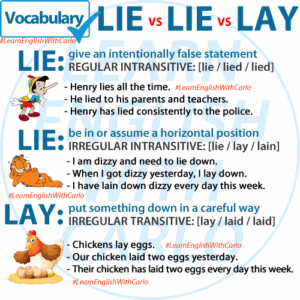
English can be tricky, especially when it comes to words that sound the same but have different meanings and uses. A common source of confusion is the difference between “lie,” “lie,” and “lay.” These three words are often mixed up, but understanding their meanings and how they are used can help you use them correctly. …
Continue reading
Permanent link to this article: https://learnenglishwithcarlo.com/lie-vs-lie-vs-lay-understanding-the-differences/
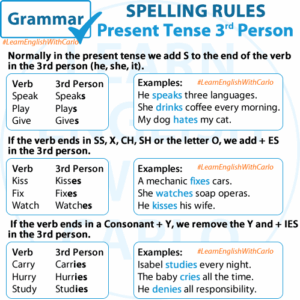
In English, when using the present simple tense, verbs often change slightly in the third person singular (when the subject is he, she, or it). These changes depend on the spelling of the verb. Let’s break it down! 1. The Basic Rule: Add “S” For most verbs, simply add S to the base form: Verb …
Continue reading
Permanent link to this article: https://learnenglishwithcarlo.com/adding-s-to-the-third-person-singular/
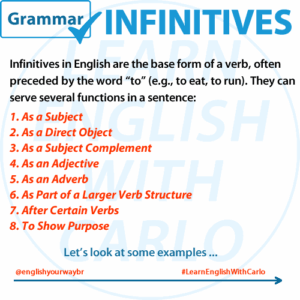
Infinitives in English are the base form of a verb, often preceded by the word “to” (e.g., to eat, to run). They can serve several functions in a sentence: 1. As a Subject: 2. As a Direct Object: 3. As a Subject Complement: 4. As an Adjective: 5. As an Adverb: 6. As Part of …
Continue reading
Permanent link to this article: https://learnenglishwithcarlo.com/infinitives/
The Verb “To Do” The verb to do is another common verb in English. It can be used as an auxiliary and a main verb. It is often used in questions. Affirmative Negative Interrogative Short answers Short answers I do I don’t .. Do I .. ? Yes, I do. No, I don’t. You do …
Continue reading
Permanent link to this article: https://learnenglishwithcarlo.com/verbs-to-do/
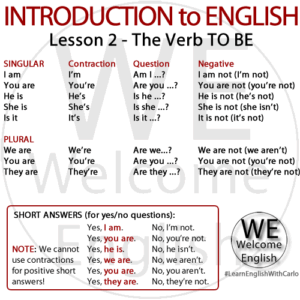
The Verb “to be” Affirmative Contracted Question Negative I Negative II Short answers I am .. I’m .. Am I …? I’m not …. I’m not… Yes, I am. No, I’m not. You are .. You’re.. Are you..? You’re not .. You aren’t .. Yes, you are. No, you aren’t. He is …
Continue reading
Permanent link to this article: https://learnenglishwithcarlo.com/verbs-to-be-or-not-to-be/
Load more