Grammar: A Guide for ESL Students
Are you an ESL (English as a Second Language) student struggling to grasp the intricacies of English grammar? You’re not alone. Grammar can be a daunting aspect of learning any language, but with the right approach and guidance, you can conquer it. In this comprehensive guide, we’ll break down the essentials of English grammar and provide you with tips and resources to help you become a grammar pro.
Understanding the Basics
Before diving into the complexities of grammar, it’s essential to understand its fundamental components. English grammar primarily consists of syntax (sentence structure), morphology (word forms), and semantics (meaning). By mastering these elements, you’ll develop a solid foundation for effective communication.
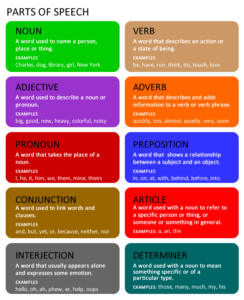
One of the building blocks of grammar is understanding the different parts of speech. Here’s a brief overview:
- Nouns: These are words that represent people, places, things, or ideas. They can be concrete (e.g., book, cat) or abstract (e.g., love, freedom).
- Verbs: Verbs denote actions (e.g., run, eat) or states of being (e.g., is, are). They are crucial for constructing sentences.
- Adjectives: Adjectives modify nouns or pronouns, providing more information about their qualities (e.g., beautiful, tall).
- Adverbs: Adverbs modify verbs, adjectives, or other adverbs, often indicating manner, time, place, or degree (e.g., quickly, there, very).
- Pronouns: Pronouns replace nouns in sentences to avoid repetition (e.g., he, she, they).
- Prepositions: Prepositions show the relationship between nouns or pronouns and other words in a sentence (e.g., in, on, at).
- Determiners: A word used before a noun to indicate something specific or of a particular type. (those, many, his, my, much).
- Conjunctions: Conjunctions connect words, phrases, or clauses within a sentence (e.g., and, but, or).
- Interjections: Interjections express emotions or sentiments (e.g., wow, ouch, bravo).
Permanent link to this article: https://learnenglishwithcarlo.com/esl-grammar-guide/
Have you ever marveled at how the addition of a few letters at the end of a word can completely alter its meaning? Enter the world of suffixes – those small yet powerful linguistic components that play a crucial role in shaping our language. What are Suffixes? At their core, suffixes are linguistic elements appended …
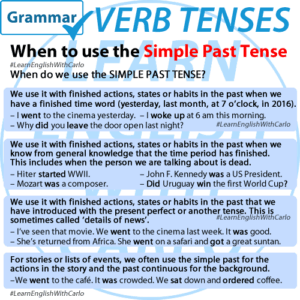
When to Use the Simple Past Tense The Simple Past is used to talk about actions, events, or states that were completed in the past. Here are the main situations when we use the Simple Past: How to Form the Simple Past Tense The formation of the Simple Past depends on whether the verb is …
English is made up of many different types of words. We refer to these types of words as parts of speech. Some words can be used in more than one way depending on the sentence they are in. The main parts of speech are nouns, verbs, adjectives, adverbs, pronouns, prepositions and conjunctions. Look at the …
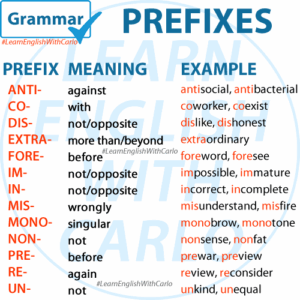
Have you ever wondered how a single word can convey vastly different meanings, just by adding a few letters at the beginning? Enter the fascinating world of prefixes – those tiny yet mighty linguistic tools that shape our language in profound ways. What are Prefixes? At their core, prefixes are linguistic building blocks, morphemes attached …
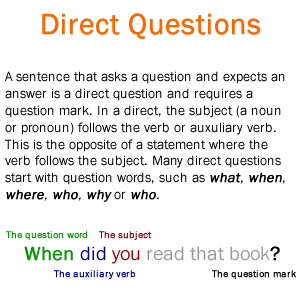
In English there are two types of questions: Yes/No questions, and Question-word questions. Yes/No questions Yes/No questions always starts with a verb. If the verb is ‘to be’, we invert the subject and verb to make the question: He is a teacher. – Is he teacher? – Yes, he is. They are from Ireland. – …
The Zero Conditional Situations that are always true if something happens. Forms: If + present simple, present simple. Present simple if + present simple. Examples: If I am late, my father takes me to school. She doesn’t worry if Jack stays out after school. For more about the Zero Conditional, see the Zero Conditional Page …
Reported Statements When do we use reported speech? Sometimes someone says a sentence, for example “I’m going to the cinema tonight”. Later, maybe we want to tell someone else what the first person said. Here’s how it works: We use a ‘reporting verb’ like ‘say’ or ‘tell’. If this verb is in the present …
What is a relative clause? We can use relative clauses to join two English sentences, or to give more information about something. I bought a new car. It is very fast. I bought a new car that is very fast. She lives in New York. She likes living in New York. She lives in New …