
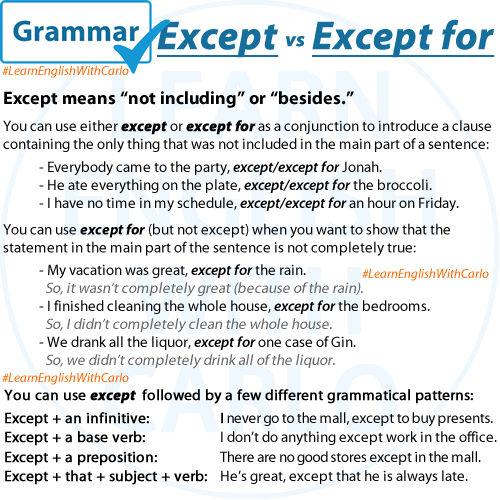
EXCEPT means “not including” or “besides.” You can use either EXCEPT or EXCEPT FOR as a conjunction to introduce a clause containing the only thing that was not included in the main part of a sentence:
Everybody came to the party, EXCEPT/EXCEPT FOR Jonah.
He ate everything on the plate, EXCEPT/EXCEPT FOR the broccoli.
I have no time in my schedule, EXCEPT/EXCEPT FOR an hour on Friday.
You can use EXCEPT FOR when you want to show that the statement in the main part of the sentence is not completely true:
My vacation was great, EXCEPT FOR the rain. (So, not completely great because of the rain).
I finished cleaning the whole house, EXCEPT FOR the bedrooms. (So, I didn’t completely clean.)
We drank all the liquor, EXCEPT FOR one case of Gin. (So, we didn’t completely drunk.)
You can use EXCEPT followed by a few different grammatical patterns:
EXCEPT + AN INFINITIVE:
I never go to the mall, except to buy presents.
EXCEPT + A BASE VERB:
I don’t do anything except work in the office.
EXCEPT + A PREPOSITION:
There are no good stores except in the mall.
EXCEPT + THAT + SUBJECT + VERB
He’s great, except that he is always late.
1 comment
Excellent ! I was looking for a simple explanation but I good one and found it here.