
Modal verbs play a crucial role in shaping the meaning and tone of our language. Among these, “would” stands out as a versatile tool with a myriad of uses and implications. In this blog post, we’ll delve into the depths of “would”, exploring its various meanings, functions, and usage in everyday language.
Understanding “Would”:
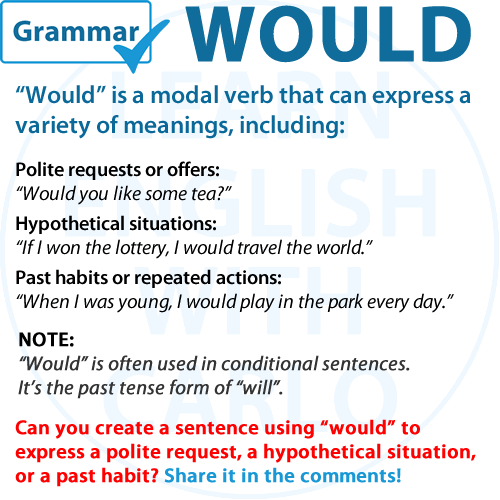
At its core, “would” is a modal verb with multiple functions, making it an indispensable part of English grammar. Let’s dissect its primary uses:
- Polite Requests and Offers: One of the most common roles of “would” is in expressing polite requests or offers. For example, “Would you like some coffee?” or “Would you mind passing the salt?” In these instances, “would” softens the request, adding a layer of politeness and consideration.
- Hypothetical Situations: “Would” is also instrumental in discussing hypothetical or imagined scenarios. It’s often used in conditional sentences to express what could happen under certain circumstances. For instance, “If I were president, I would prioritize education reform.” Here, “would” indicates a potential action or outcome based on an imagined condition.
- Past Habits or Repeated Actions: In addition to its use in hypothetical situations, “would” can also denote past habits or repeated actions. For example, “When I was a child, I would spend hours reading books.” This usage emphasizes actions that were customary or habitual in the past.
Tips for Using “Would” Effectively:
To wield “would” with precision, consider the following tips:
- Pay attention to context: The meaning of “would” can vary depending on the context in which it’s used. Whether expressing politeness, hypotheticals, or past habits, ensure that the usage aligns with the intended meaning.
- Understand conditional structures: “Would” often appears in conditional sentences, where it’s paired with an if-clause to indicate a hypothetical situation and its potential outcome. Familiarize yourself with different conditional structures to use “would” accurately.
- Practice nuanced usage: Explore various scenarios where “would” might be appropriate, from casual conversations to formal writing. The more you practice, the more confident you’ll become in wielding this versatile modal verb.
Examples of “Would” in Action:
To illustrate the versatility of “would”, consider the following examples:
- Polite Request: “Would you mind closing the door, please?”
- Hypothetical Situation: “If I had a time machine, I would visit ancient Rome.”
- Past Habit: “Every summer, we would go camping in the mountains.”
Conclusion: “Would” may seem like a simple word, but its flexibility and significance in English grammar are undeniable. Whether used to express politeness, imagine alternate realities, or reminisce about the past, “would” enriches our language with depth and nuance. By mastering its usage, we unlock a world of possibilities in communication.
So, the next time you encounter “would” in conversation or writing, remember its multifaceted nature and the myriad ways it shapes our language.
2 comments
What are some practical examples provided in the article to illustrate the diverse functions and nuances of “would” in English language communication?
Author
Here is an overview of the various functions and nuances of the modal verb “would” in English communication, along with practical examples:
Polite Requests: “Would” is often used to make polite requests.
Example: “Would you mind closing the window?”
Offers and Invitations: It can extend offers or invitations in a courteous manner.
Example: “Would you like a cup of tea?”
Hypothetical Situations: “Would” describes imagined or unreal scenarios, often in conditional sentences.
Example: “If I had a million dollars, I would travel the world.”
Past Habits: It indicates actions that were regularly performed in the past.
Example: “Every summer, we would visit our grandparents.”
Reported Speech: When reporting someone’s words, “would” is the past tense of “will.”
Example: Direct speech: “I will call you tomorrow.” Reported speech: “He said he would call me tomorrow.”
Expressing Desires or Preferences: “Would” conveys wishes or preferences.
Example: “I would love to see that movie.”
Softening Statements: It makes statements sound less direct or assertive.
Example: “I would think that’s not the best idea.”
Future in the Past: “Would” describes a future action from a past perspective.
Example: “She knew he would arrive late.”
Expressing Uncertainty or Tentativeness: It indicates that something is probable but not certain.
Example: “I would imagine the meeting will be postponed.”
These examples illustrate the versatility of “would” in conveying different meanings and nuances in English communication.