Your Guide to Building Better Sentences When you’re learning English, you might hear a lot about clauses. But what exactly are they, and why are they important? This guide will break down the basics of …
Figures of speech are words or expressions used in a non-literal, creative way to make language more vivid and expressive.Writers and speakers use them to create imagery, add emotion, and make ideas easier to remember. …
QUIT “Quit” is a verb that means to stop or cease doing something. When someone quits an activity, job, or habit, they discontinue or give up that particular action or commitment. “Quit” can also imply …
Countable and uncountable nouns are two categories used to classify nouns based on whether they can be counted or not. Countable Nouns:Countable nouns refer to objects or entities that can be counted as discrete units.They …
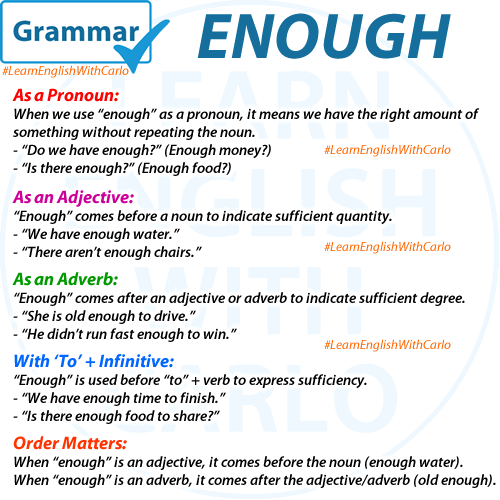
“Enough” means having as much or as many as needed. It’s not too little, not too much, but just right!
How to Use “Enough”:
As a Pronoun:
When we use “enough” as a pronoun, it means we have the right amount of something without repeating the noun.
Examples:
“Do we have enough?” 💰 (Enough money?)
“Is there enough?” 🍕 (Enough food?)
As an Adjective:
“Enough” comes before a noun to indicate sufficient quantity.
Examples:
“We have enough water.” 🚰
“There aren’t enough chairs.” 🪑
As an Adverb:
“Enough” comes after an adjective or adverb to indicate sufficient degree.
Examples:
“She is old enough to drive.” 🚗
“He didn’t run fast enough to win.” 🏃♂️
With ‘To’ + Infinitive:
“Enough” is used before “to” + verb to express sufficiency.
Examples:
“We have enough time to finish.” ⏰
“Is there enough food to share?” 🍲
Key Points to Remember:
Order Matters: When “enough” is an adjective, it comes before the noun (enough water). When “enough” is an adverb, it comes after the adjective/adverb (old enough).
Questions and Negatives: “Enough” is often used in questions and negative sentences.
“Do you have enough?”
“We don’t have enough.”
Practice Time! 📝
Try using “enough” in different ways:
“I have enough books.” 📚 (Adjective)
“Is there enough?” ❓ (Pronoun)
“She didn’t speak loudly enough.” 🔊 (Adverb)
“We have enough money to buy tickets.” 🎟️ (With ‘to’ + infinitive)
Keep practicing, and you’ll master “enough” in no time! 🌟
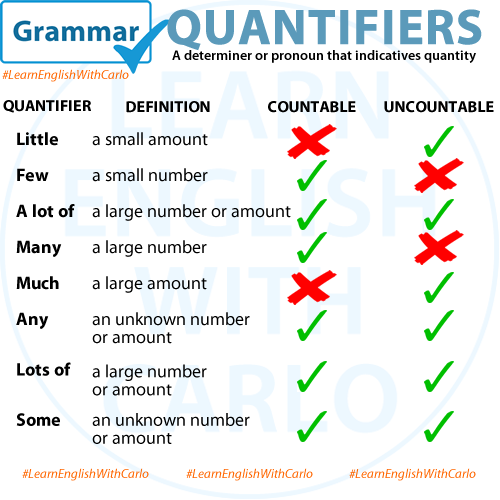
We use different quantifiers in English depending on whether the noun is countable (things we can count like apples 🍏) or uncountable (things we can’t count like water 💧). Here’s a quick guide to help you out:
🔹 For Countable Nouns:
Few: “There are few chairs left.”
Many: “How many books do you have?”
A lot of/Lots of: “We have a lot of friends.”
🔹 For Uncountable Nouns:
Little: “I have little time to spare.”
Much: “How much money do you need?”
A lot of/Lots of: “We have a lot of milk.”
🔹 For Both:
Some: “I’d like some apples and some juice.”
Any: “Do you have any questions?”
Remember, countable nouns are things we can count individually, while uncountable nouns are treated as whole masses. Simple, right?
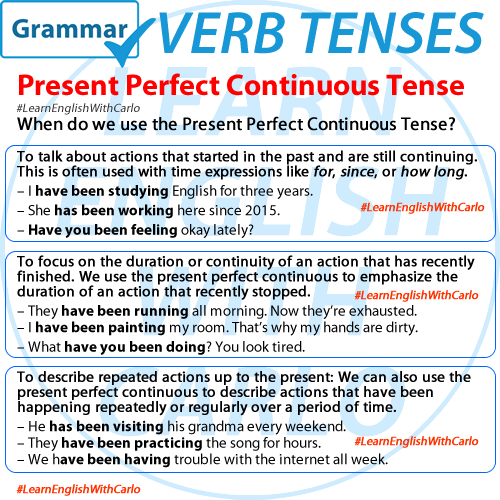
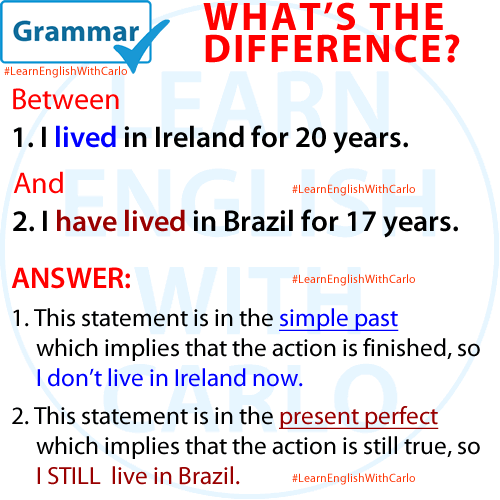
The Present Perfect and Present Perfect Continuous tenses can sometimes be used interchangeably, but they often emphasize different aspects of an action. Here’s a breakdown of when they are the same and when they are different:
When the Present Perfect and Present Perfect Continuous Are the Same:
Both tenses can be used to talk about actions that started in the past and continue into the present. In these cases, they emphasize the duration of an action or its result, and the difference in meaning is minimal.
Examples:
Present Perfect: I have lived here for 10 years.
Present Perfect Continuous: I have been living here for 10 years.
In both examples, the speaker has lived in the same place for 10 years, and the action is ongoing. The meaning is nearly the same, although the continuous form emphasizes the duration more strongly.
When the Present Perfect and Present Perfect Continuous Are Different:
Focus on Result vs. Duration:
Present Perfect emphasizes the result of the action.
Example: I have written three emails today. (Focus is on the completed action—three emails are done.)
Present Perfect Continuous emphasizes the duration or ongoing nature of the action.
Example: I have been writing emails all morning. (Focus is on the activity itself, not necessarily completion.)
Completed vs. Ongoing Actions:
Present Perfect is used for actions that are completed or when the number of actions matters.
Example: He has visited Japan three times. (Focus on how many times, the visits are complete.)
Present Perfect Continuous is used for ongoing actions or ones that have recently finished and have visible results.
Example: He has been visiting Japan for work. (The visits are ongoing or frequent but not finished.)
State Verbs:
With state verbs (e.g., know, like, believe), only the Present Perfect is used because these verbs don’t typically take continuous forms.
Example: I have known her for five years. (NOT: I have been knowing her.)
Summary:
Use the Present Perfect when you want to emphasize the result or completion of an action.
Use the Present Perfect Continuous when you want to emphasize the duration or ongoing nature of an action.
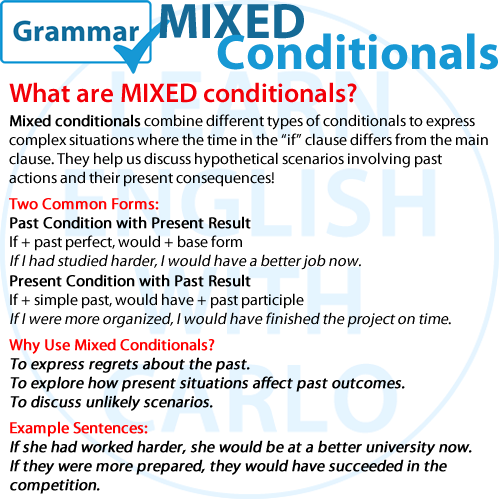
Mixed Conditionals are a combination of two different types of conditionals, typically mixing the second and third conditionals. They are used to express situations where the time in the “if” clause is different from the time in the main clause. This allows for a more nuanced expression of hypothetical situations that may involve past actions and present consequences or vice versa.
What Are Mixed Conditionals?
Mixed conditionals allow speakers to convey complex relationships between conditions and results that are not strictly tied to a single timeframe. Here are the most common forms of mixed conditionals:
Past Condition with Present Result
This structure expresses a hypothetical past situation and its present consequence.
Form: If + past perfect, would + base form of the verb
Example: If I had studied harder, I would have a better job now.
Explanation: The speaker didn’t study hard in the past, and as a result, they have a lesser job in the present.
Present Condition with Past Result
This structure reflects a present situation that results in a hypothetical past consequence.
Form: If + simple past, would have + past participle
Example: If I were more organized, I would have finished the project on time.
Explanation: The speaker is not organized in the present, which resulted in not finishing the project on time in the past.
Usage of Mixed Conditionals
Mixed conditionals are particularly useful when you want to explore complex ideas about regret, consequences, and the interplay between different timeframes. Here are some situations where mixed conditionals can be effectively used:
Expressing Regret About the Past: To show how a past action affects the present.
If I had taken that job offer, I would be living in New York now.
Hypothetical Present Affecting the Past: To illustrate how a current state could have changed a past outcome.
If he were more attentive, he wouldn’t have missed the deadline last week.
Discussing Unlikely Scenarios: To express unlikely present conditions leading to past outcomes.
If I had known you were in town, I would have invited you to the party.
Example Sentences
If she had worked harder in school (past), she would be at a better university now (present).
If they were better prepared (present), they would have succeeded in the competition (past).
If I had learned Spanish (past), I could communicate better with my friends now (present).
Conclusion
Mixed conditionals provide a versatile way to express complex hypothetical situations where the timing of actions and their consequences differ. Understanding how to use mixed conditionals can enhance your fluency in English, allowing for more sophisticated expressions of regret, possibilities, and hypothetical scenarios.
FAQs About Mixed Conditionals
1. What are mixed conditionals? Mixed conditionals combine different conditional forms to express relationships between past actions and present consequences or vice versa.
2. How do I know when to use a mixed conditional? Use mixed conditionals when discussing situations where the time in the “if” clause differs from the time in the main clause, especially to express regrets or unlikely scenarios.
3. Can I use “could” instead of “would” in mixed conditionals? Yes! You can use “could” to express a possibility or ability:
If I had known about the meeting, I could have prepared better.
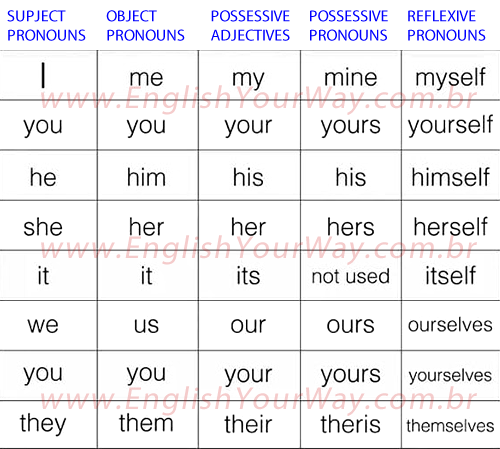
1. Subject Pronouns: Subject pronouns are used when the pronoun is the subject of the sentence, meaning it performs the action of the verb. They replace nouns as the doers of the action. Here are the subject pronouns in English:
I
You
He
She
It
We
They
For example:
“She runs every morning.” (The subject pronoun “she” replaces the noun that would be the person running.)
2. Possessive Adjectives: Possessive adjectives show ownership or possession. They come before a noun to indicate that the noun belongs to someone or something. Here are the possessive adjectives in English:
My
Your
His
Her
Its
Our
Their
For example:
“This is my book.” (The possessive adjective “my” shows that the book belongs to me.)
3. Object Pronouns: Object pronouns are used when the pronoun is the object of the verb or preposition, meaning it receives the action of the verb or follows a preposition. They replace nouns as the receivers of the action. Here are the object pronouns in English:
Me
You
Him
Her
It
Us
Them
For example:
“He gave the book to me.” (The object pronoun “me” receives the action of the verb “gave.”)
4. Possessive Pronouns: Possessive pronouns also show ownership or possession, but they stand alone and do not need to be followed by a noun. They indicate that something belongs to someone or something. Here are the possessive pronouns in English:
Mine
Yours
His
Hers
Its
Ours
Theirs
For example:
“The red car is hers.” (The possessive pronoun “hers” stands alone and shows that the red car belongs to her.)
5. Reflexive Pronouns: Reflexive pronouns are used when the subject and object of the verb are the same person or thing. They reflect back to the subject of the sentence. Here are the reflexive pronouns in English:
Myself
Yourself
Himself
Herself
Itself
Ourselves
Yourselves
Themselves
For example:
“She hurt herself.” (The reflexive pronoun “herself” reflects back to the subject “she,” indicating that she hurt herself.)
Understanding the differences between these pronouns and adjectives can help clarify their usage in sentences. The table below lists subject pronouns, object pronouns, possessive adjectives, possessive pronouns, and reflexive pronouns.
Here’s a multiple-choice exercise to reinforce the understanding of subject pronouns, possessive adjectives, object pronouns, possessive pronouns, and reflexive pronouns:
Wrong shortcode initialized
If you have any questions or doubts, please ask in the comments or send me a private message.
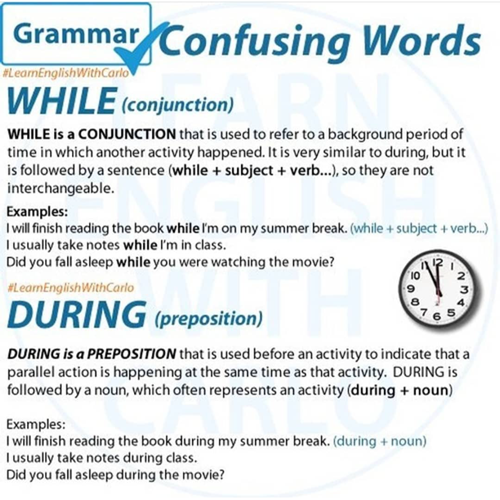
As an English learner, you may have noticed that both “while” and “during” are used to talk about time. However, they are used differently in sentences, and understanding how to use them correctly can make your English more accurate and natural. Let’s break down the key differences between these two words.
1. “WHILE”
Usage: “While” is a conjunction that connects two actions happening at the same time. It introduces a clause (a part of a sentence that has a subject and a verb).
Structure:
While + subject + verb
Examples:
I listened to music while I was studying. (Here, “I was studying” is the action that happens at the same time as “I listened to music.”)
She cooked dinner while he set the table. (Here, two actions happen at the same time: “She cooked dinner” and “he set the table.”)
Note: “While” is often used with continuous tenses (like “was studying” or “was cooking”) because these tenses express ongoing actions.
2. “DURING”
Usage: “During” is a preposition that is used to indicate when something happens. It refers to a specific period of time or an event.
Structure:
During + noun (period of time/event)
Examples:
I took notes during the lecture. (“The lecture” is the event that took place, and “I took notes” is what happened at that time.)
She stayed quiet during the movie. (“The movie” is the event, and “She stayed quiet” is what happened at that time.)
Note: “During” is not followed by a clause (a subject and a verb). Instead, it is followed by a noun or a noun phrase.
3. Quick Tips to Remember
Use “during” to refer to a specific period or event when something happens.
Use “while” when you want to talk about two actions happening at the same time.
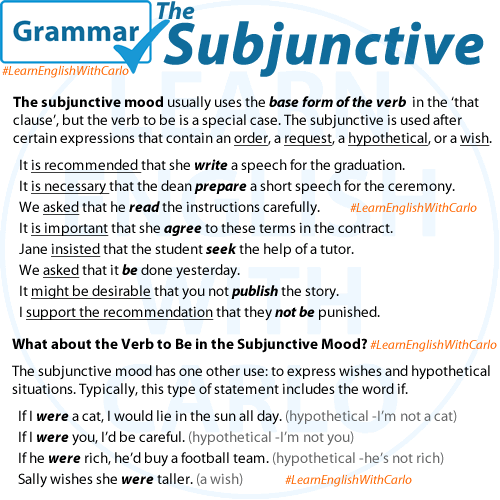
The subjunctive mood in English is used to express wishes, suggestions, demands, or hypothetical situations. It often appears after certain verbs (like “suggest” or “recommend”) and is characterized by using the base form of the verb, even with singular subjects (e.g., “I suggest that he go“). It can also express unreal or hypothetical situations, particularly with “were” (e.g., “If I were you…”).
The subjunctive mood usually uses the base form of the verb in the ‘that clause’, but the verb to be is a special case. The subjunctive is used after certain expressions that contain an order, a request, a hypothetical, or a wish.
It is recommended that she write a speech for the graduation.
It is necessary that the dean prepare a short speech for the ceremony.
We asked that he read the instructions carefully.
It is important that she agree to these terms in the contract.
Jane insisted that the student seek the help of a tutor.
We asked that it be done yesterday.
It might be desirable that you not publish the story.
I support the recommendation that they not be punished.
What about the Verb to Be in the Subjunctive Mood?
The subjunctive mood has one other use: to express wishes and hypothetical situations. Typically, this type of statement includes the word if.
If I were a cat, I would lie in the sun all day. (hypothetical because I’m not a cat)
If I were you, I’d be careful. (hypothetical because I’m not you)
If he were rich, he’d buy a football team. (hypothetical because he’s not rich)
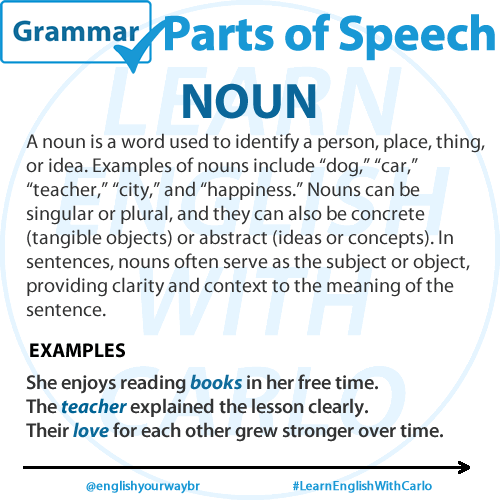
A noun is a word used to identify a person, place, thing, or idea. Nouns are the basic building blocks of sentences and are essential for communication in any language. Examples of nouns include “dog,” “car,” “teacher,” “city,” and “happiness.” Nouns can be singular or plural, and they can also be concrete (tangible objects) or abstract (ideas or concepts). In sentences, nouns often serve as the subject or object, providing clarity and context to the meaning of the sentence.
Examples:
Book (thing) – “She enjoys reading books in her free time.”
Teacher (person) – “The teacher explained the lesson clearly.”
Love (idea) – “Their love for each other grew stronger over time.”
PRONOUN
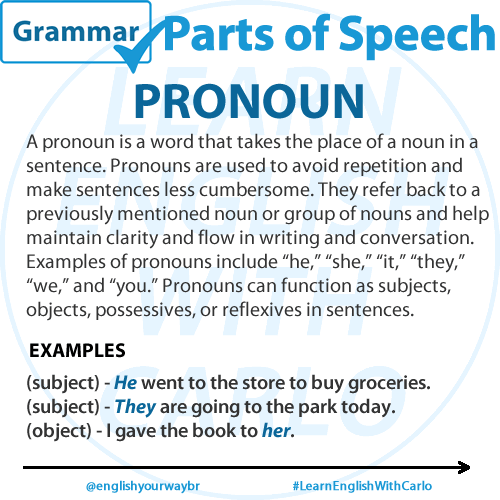
A pronoun is a word that takes the place of a noun in a sentence. Pronouns are used to avoid repetition and make sentences less cumbersome. They refer back to a previously mentioned noun or group of nouns and help maintain clarity and flow in writing and conversation. Examples of pronouns include “he,” “she,” “it,” “they,” “we,” and “you.” Pronouns can function as subjects, objects, possessives, or reflexives in sentences.
Examples:
He (subject pronoun) – “He went to the store to buy groceries.”
They (subject pronoun) – “They are going to the park this afternoon.”
I (subject pronoun); Her (object pronoun) – “I gave the book to her.”
VERB
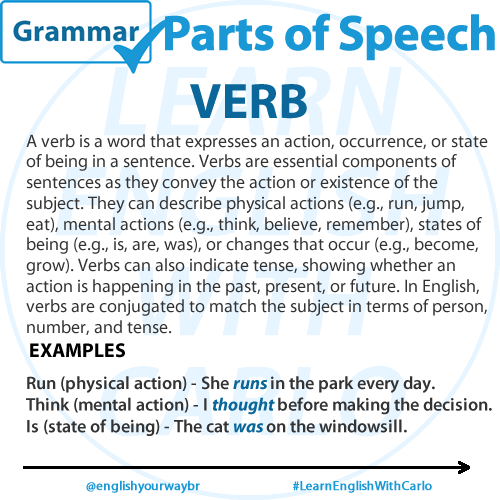
A verb is a word that expresses an action, occurrence, or state of being in a sentence. Verbs are essential components of sentences as they convey the action or existence of the subject. They can describe physical actions (e.g., run, jump, eat), mental actions (e.g., think, believe, remember), states of being (e.g., is, are, was), or changes that occur (e.g., become, grow). Verbs can also indicate tense, showing whether an action is happening in the past, present, or future. In English, verbs are conjugated to match the subject in terms of person, number, and tense.
Examples: Run (physical action) – “She runs in the park every morning.”
Think (mental action) – “He thinks before making a decision.”
Is (state of being) – “The cat is sleeping on the windowsill.”
ADJECTIVE
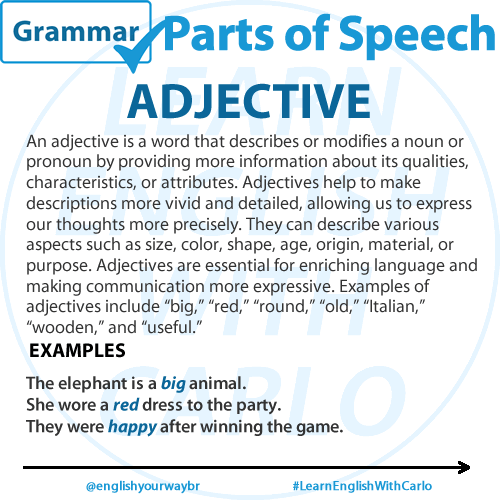
An adjective is a word that describes or modifies a noun or pronoun by providing more information about its qualities, characteristics, or attributes. Adjectives help to make descriptions more vivid and detailed, allowing us to express our thoughts more precisely. They can describe various aspects such as size, color, shape, age, origin, material, or purpose. Adjectives are essential for enriching language and making communication more expressive. Examples of adjectives include “big,” “red,” “round,” “old,” “Italian,” “wooden,” and “useful.”
Examples:
Big (describing size) – “The elephant is a big animal.”
Red (describing color) – “She wore a red dress to the party.”
Happy (describing emotion) – “They felt happy after winning the game.”
ADVERB
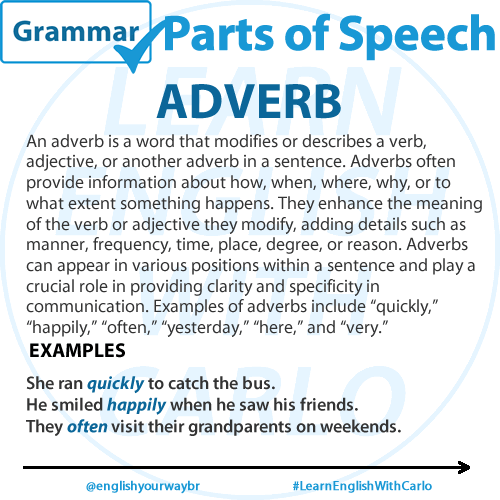
An adverb is a word that modifies or describes a verb, adjective, or another adverb in a sentence. Adverbs often provide information about how, when, where, why, or to what extent something happens. They enhance the meaning of the verb or adjective they modify, adding details such as manner, frequency, time, place, degree, or reason. Adverbs can appear in various positions within a sentence and play a crucial role in providing clarity and specificity in communication. Examples of adverbs include “quickly,” “happily,” “often,” “yesterday,” “here,” and “very.”
Examples:
Quickly (modifying the verb “ran”) – “She ran quickly to catch the bus.”
Happily (modifying the verb “smiled”) – “He smiled happily when he saw his friends.”
Often (modifying the verb “visit”) – “They often visit their grandparents on weekends.”
PREPOSITION
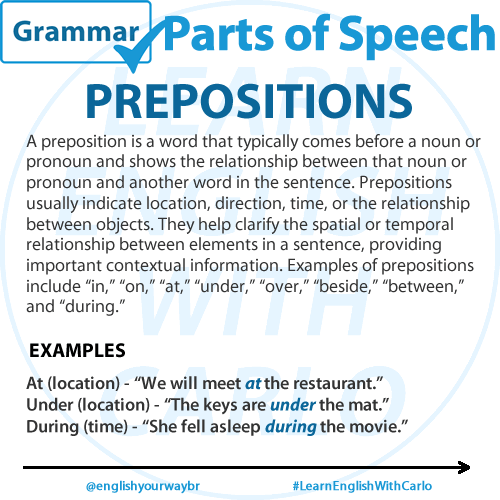
A preposition is a word that typically comes before a noun or pronoun and shows the relationship between that noun or pronoun and another word in the sentence. Prepositions usually indicate location, direction, time, or the relationship between objects. They help clarify the spatial or temporal relationship between elements in a sentence, providing important contextual information. Examples of prepositions include “in,” “on,” “at,” “under,” “over,” “beside,” “between,” and “during.”
Examples:
On (location) – “The book is on the table.”
Between (location) – “She stood between her two friends.”
At (location) – “We will meet at the restaurant.”
Under (location) – “The keys are under the mat.”
During (time) – “She fell asleep during the movie.”
CONJUNCTION
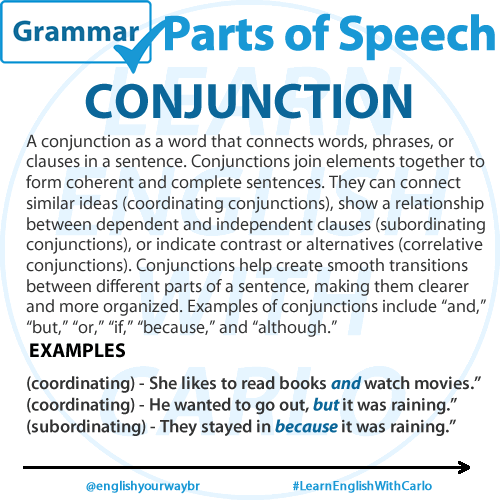
A conjunction is a word that connects words, phrases, or clauses in a sentence. Conjunctions are important for joining elements together to form coherent and complete sentences. They can connect similar ideas (coordinating conjunctions), show a relationship between dependent and independent clauses (subordinating conjunctions), or indicate contrast or alternatives (correlative conjunctions). Conjunctions help create smooth transitions between different parts of a sentence, making the overall meaning clearer and more organized. Examples of conjunctions include “and,” “but,” “or,” “if,” “because,” and “although.”
Examples:
And (coordinating) – “She likes to read books and watch movies.”
But (coordinating) – “He wanted to go to the park, but it started raining.”
Because (subordinating) – “They stayed indoors because it was raining heavily.”
DETERMINER
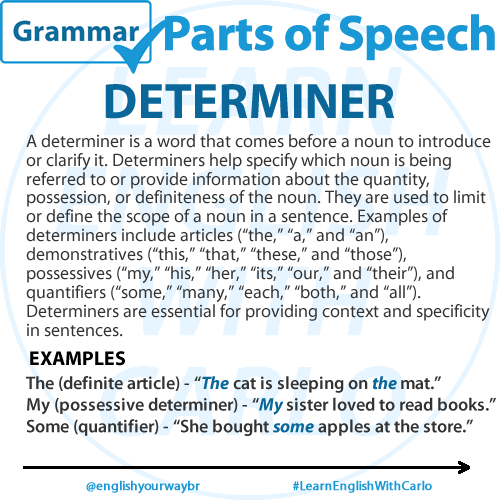
A determiner is a word that comes before a noun to introduce or clarify it. Determiners help specify which noun is being referred to or provide information about the quantity, possession, or definiteness of the noun. They are used to limit or define the scope of a noun in a sentence. Examples of determiners include articles (such as “the,” “a,” and “an”), demonstratives (such as “this,” “that,” “these,” and “those”), possessives (such as “my,” “your,” “his,” “her,” “its,” “our,” and “their”), and quantifiers (such as “some,” “many,” “few,” “several,” “each,” “every,” “both,” “neither,” and “all”). Determiners are essential for providing context and specificity in sentences.
Examples:
The (definite article) – “The cat is sleeping on the mat.”
My (possessive determiner) – “My sister loves to read books.”
Some (quantifier) – “She bought some apples at the store.”
INTERJECTION
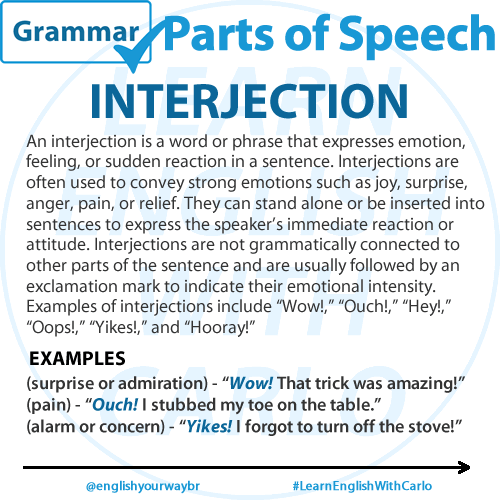
An interjection is a word or phrase that expresses emotion, feeling, or sudden reaction in a sentence. Interjections are often used to convey strong emotions such as joy, surprise, anger, pain, or relief. They can stand alone or be inserted into sentences to express the speaker’s immediate reaction or attitude. Interjections are not grammatically connected to other parts of the sentence and are usually followed by an exclamation mark to indicate their emotional intensity. Examples of interjections include “Wow!,” “Ouch!,” “Hey!,” “Oops!,” “Yikes!,” and “Hooray!” Interjections add color and expressiveness to language, allowing speakers to convey their emotions more vividly.
Examples:
Wow! (surprise or admiration) – “Wow! That magic trick was amazing!”
Ouch! (pain) – “Ouch! I stubbed my toe on the table.”
Yikes! (alarm or concern) – “Yikes! I forgot to turn off the stove!”