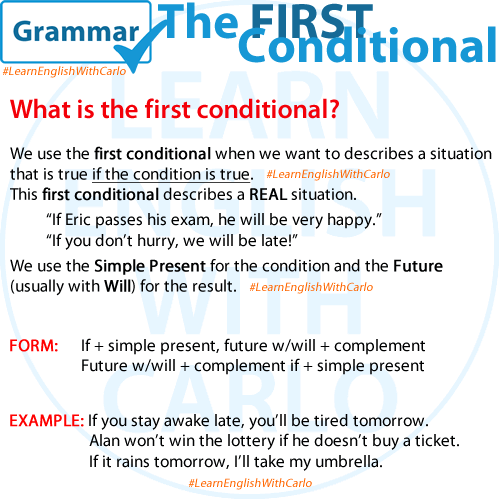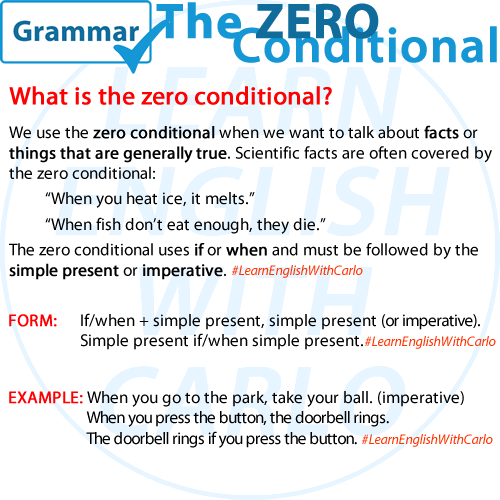
Understanding SO, SUCH, and TOO in English

The words so, such, and too are often confused by English learners because they all express emphasis or intensity. However, they follow different grammatical patterns and are used in distinct ways. Let’s break it down with examples and explanations.

1. SO

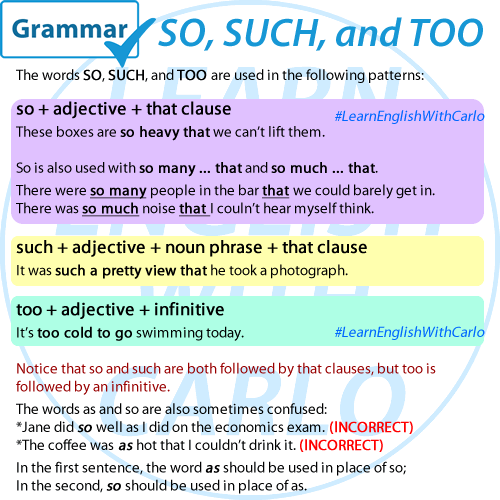
So is used with adjectives and adverbs to indicate a high degree, often followed by a that clause to explain the result.

Pattern

  • so + adjective/adverb + that clause

Examples

  • These boxes are so heavy that we can’t lift them.
  • He ran so quickly that nobody could catch him.

So can also be used with many or much to emphasize quantity:

  • so many + plural noun + that clause
  • so much + uncountable noun + that clause

Examples

  • There were so many people in the auditorium that we could barely get in the front door.
  • She drank so much coffee that she couldn’t sleep all night.

2. SUCH

Such is used to emphasize a noun or noun phrase. It is typically followed by an adjective + noun and often connects to a that clause to show the outcome.

Pattern

  • such + adjective + noun phrase + that clause

Examples

  • It was such a pretty view that he took a photograph.
  • They were such good friends that they couldn’t stop talking.

3. TOO

Too expresses an excessive degree and is typically followed by an adjective + infinitive to explain why something cannot or should not happen.

Pattern

  • too + adjective + infinitive

Examples

  • It’s too cold to go swimming today.
  • She’s too tired to finish her homework.

Common Mistakes with SO, SUCH, TOO, and AS

English learners sometimes confuse these words, especially so and as. Let’s look at some common errors:

Incorrect: Jane did so well as I did on the economics exam.

  • Correct: Jane did as well as I did on the economics exam.
  • Why?: Use as in comparisons to show equality (as + adjective/adverb + as).

Incorrect: The coffee was as hot that I couldn’t drink it.

  • Correct: The coffee was so hot that I couldn’t drink it.
  • Why?: Use so to indicate intensity followed by a result (so + adjective + that clause).

Quick Summary

WordPatternExample
Soso + adjective/adverb + that clauseShe was so tired that she fell asleep instantly.
so + many/much + noun + that clauseHe has so much work that he can’t take a break.
Suchsuch + adjective + noun + that clauseIt was such a boring movie that we left halfway through.
Tootoo + adjective + infinitiveThe bag is too heavy to carry alone.

By mastering these words and their patterns, you can use them correctly and make your English sound more natural and precise. Remember to practice with examples to solidify your understanding!
“Used to” vs. “Be used to”

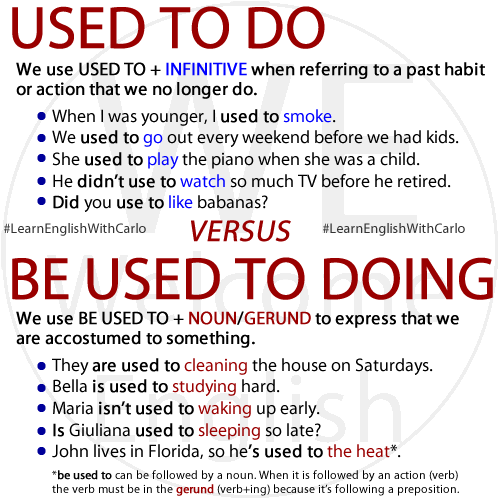
Used to” refers to past habits or situations that are no longer true in the present.
Be used to” refers to the state of being familiar or accustomed to something in the present.

Used to:

Used to” is a phrase used to describe past habits or situations that were true in the past but are no longer true in the present. It is used to talk about repeated actions or states in the past that are not happening now. It is followed by the base form of the verb.

Examples:

  1. I used to play the guitar when I was younger. (I played the guitar regularly in the past, but I don’t anymore.)
  2. She used to live in New York. (She lived in New York in the past, but she doesn’t live there anymore.)

Be Used to:

Be used to” is a phrase used to indicate familiarity or being accustomed to something.

It describes a state or condition of being accustomed to a particular situation, action, or environment. It is followed by a noun or gerund (-ing form of the verb).

Examples:

  • He is used to the cold weather. (He is familiar with or accustomed to cold weather.)
  • She is used to driving on the left side of the road. (She is accustomed to driving on the left side because that’s the norm in her country.)

Additional Notes:

Both “used to” and “be used to” are followed by the base form of the verb, but “be used to” can also be followed by a noun or gerund.

Get used to” is similar in meaning to “be used to” and refers to the process of becoming accustomed to something.

It’s important to note that “used to” can also be used in questions and negative sentences, whereas “be used to” follows the standard rules for forming questions and negatives in English.

Understanding the nuances between “used to” and “be used to” is essential for expressing past habits and describing familiarity or adaptation to situations in English.

Wrong shortcode initialized

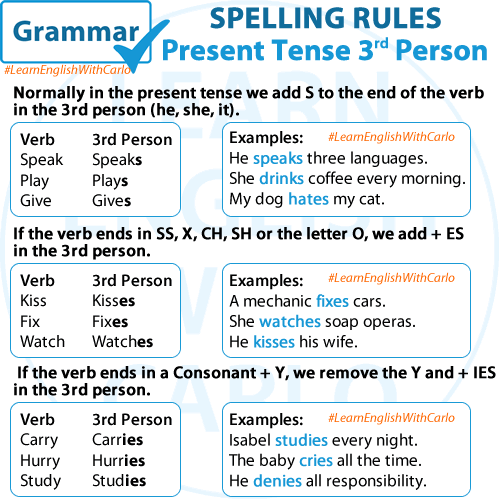
Grammar Guide: Adding S to the Third Person Singular in Present Simple

In English, when using the present simple tense, verbs often change slightly in the third person singular (when the subject is he, she, or it). These changes depend on the spelling of the verb. Let’s break it down!

1. The Basic Rule: Add “S”

For most verbs, simply add S to the base form:

VerbThird Person Singular
SpeakSpeaks
PlayPlays
GiveGives
MakeMakes

Examples:

  • He speaks three languages fluently.
  • She drinks coffee every morning.
  • My dog hates my cat.

Tip: This rule applies to most regular verbs that don’t have special endings.

2. Add “ES” After Certain Endings

If a verb ends in -ss, -x, -ch, -sh, or -o, add ES to the base form.

VerbThird Person Singular
KissKisses
FixFixes
WatchWatches
CrashCrashes
GoGoes

Examples:

  • A mechanic fixes cars.
  • She watches soap operas every afternoon.
  • He kisses his wife before he goes to work.

Why “ES”?
This extra syllable makes the verb easier to pronounce. For example, kiss + s would sound awkward without the E.

3. Replace “Y” with “IES”

If a verb ends in a consonant + Y, change the Y to IES:

VerbThird Person Singular
CarryCarries
HurryHurries
StudyStudies
DenyDenies

Examples:

  • Isabel studies every night.
  • The baby cries all the time.
  • He denies all responsibility.

Exception: If the verb ends in a vowel + Y (e.g., play or buy), just add S:

  • She plays the piano.
  • He buys groceries every Sunday.

Why Are These Rules Important?

In English, the third person singular form is unique and shows grammatical agreement with the subject. Using the correct form improves fluency and helps avoid confusion.

Practice Makes Perfect!

Here are some practice exercises to test your knowledge:

Exercise 1: Complete the Sentences

  1. She _____ (watch) TV every evening.
  2. He _____ (go) to the gym twice a week.
  3. My mom _____ (carry) the groceries.
  4. The cat _____ (hurry) to catch the bird.
  5. John _____ (fix) his bike on weekends.

Exercise 2: Correct the Mistakes

  1. He go to school by bus.
  2. She plays the guitar beautifully. (Correct!)
  3. The dog barkes at strangers.
  4. Maria cry at sad movies.
  5. He washes his car every Saturday. (Correct!)

Key Takeaways

  • Add S for most verbs in the third person singular.
  • Add ES if the verb ends in -ss, -x, -ch, -sh, or -o.
  • Change Y to IES if it follows a consonant.

By mastering these simple rules, you’ll sound more natural when speaking and writing in English.

Wrong shortcode initialized

WHY LEARN ENGLISH?

Here are 10 reasons why someone should learn English:

  1. Global Communication – English is the most widely spoken language in the world, making it easier to communicate with people from different countries.
  2. Career Opportunities – Many international companies require employees to speak English, giving English speakers a competitive edge in the job market.
  3. Travel Convenience – English is commonly used in airports, hotels, and tourist attractions, making travel much easier.
  4. Access to Knowledge – A large percentage of books, academic papers, and online content are in English, allowing learners access to valuable information.
  5. Entertainment & Media – Many popular movies, TV shows, and songs are in English, helping learners enjoy them in their original language without subtitles.
  6. Higher Education – Many top universities and study programs require English proficiency, opening doors to better educational opportunities.
  7. Networking & Socializing – Knowing English allows people to connect with others worldwide, make friends, and build international relationships.
  8. Technology & the Internet – English is the dominant language in tech, coding, and online platforms, helping learners stay updated with digital trends.
  9. Self-Improvement – Learning a new language improves memory, problem-solving skills, and creativity, making it a great mental exercise.
  10. Cultural Understanding – English provides insight into different cultures, customs, and perspectives, fostering global awareness and appreciation.

Summary:

Learning English opens doors to global communication, career growth, and educational opportunities. It makes travel easier, provides access to vast knowledge, and allows you to enjoy entertainment in its original form. English is essential in technology, networking, and cultural understanding, while also sharpening cognitive skills. Whether for personal or professional growth, mastering English is a valuable investment in your future.

CONFUSING WORDS: Speak vs. Talk

SPEAK and TALK are almost synonymous and are generally interchangeable except in fixed expressions.

Remember that the verb speak tends to be used in more formal or one-sided situations. Unfortunately, there is no simple or easy rule to follow. But there are a number of fixed expressions for both verbs.

Always use SPEAK in these fixed expressions:

  •     Speak a language—(e.g. French, English, etc.)
  •     Speak for someone—voice what another person thinks
  •     Speak now or forever hold your peace—this is your last chance to say something
  •     Speak your mind—say what you really think
  •     Speak out (about something)—voice your opinion (on a subject)
  •     Speak up—raise your voice
  •     Speak up for someone—voice support for a person
  •     Speak volumes—convey lots of information
  •     Speak well of someone—say only positive things about that person
  •     this Speak for itself—requires no explanation

Always use TALK in these fixed expressions:

  •     Money talks—money can get things done
  •     Talk away—talk a great deal
  •     Talk back—answer rudely or disrespectfully
  •     Talk down to someone—be condescending towards a person
  •     Talk shop—talk about your job, using jargon
  •     Talk the talk—say things and make promises to please others
  •     Talk things over—discuss something
  •     Talk tough—speak in a brash or threatening manner
  •     Talk through your hat (or talk nonsense)—say things that make no sense
  •     Talk turkey—speak frankly

GRAMMAR – PHRASAL VERBS with TAKE

Phrasal verbs are special phrases in English made up of a verb (like “take”) and another word (like “off” or “out”). Together, they create a new meaning that might not be obvious from the individual words. They’re really common in English and are used in all kinds of conversations. Learning phrasal verbs helps you understand and speak English better.

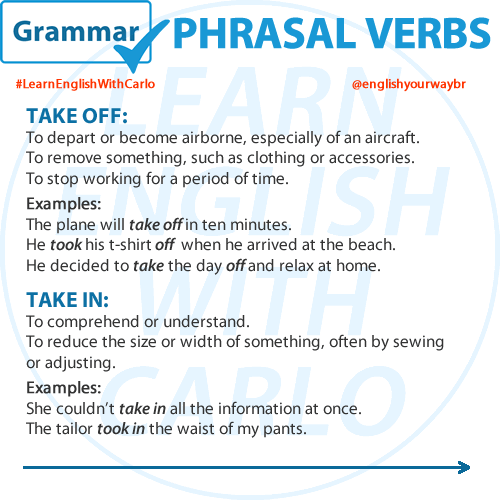
Take off:
To depart or become airborne, especially of an aircraft.
To remove something, such as clothing or accessories.
To stop working for a period of time.

Examples:
The plane will take off in ten minutes.
He took off his t-shirt when he arrived at the beach.
He decided to take the day off and relax at home.

Take in:
To comprehend or understand.
To reduce the size or width of something, often by sewing or adjusting.

Examples:
She couldn’t take in all the information at once.
The tailor took in the waist of my pants.

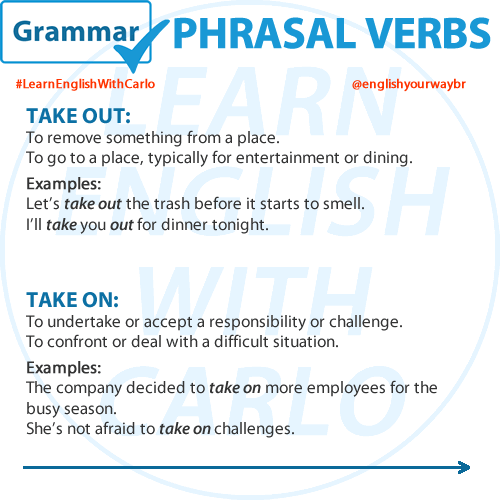
Take out:
To remove something from a place.
To go to a place, typically for entertainment or dining.

Examples:
Let’s take out the trash before it starts to smell.
I’ll take you out for dinner tonight.

Take on:
To undertake or accept a responsibility or challenge.
To confront or deal with a difficult situation.

Examples:
The company decided to take on more employees for the busy season.
She’s not afraid to take on challenges.

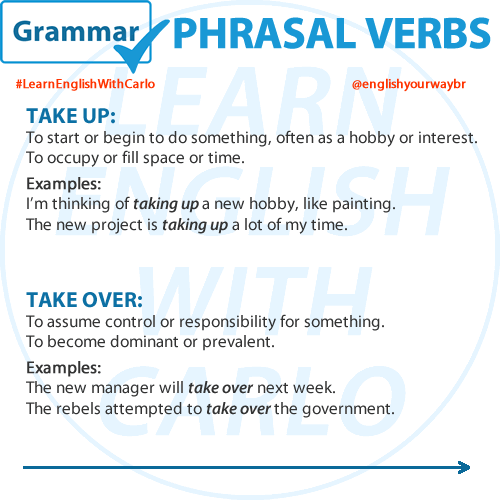
Take up:
To start or begin to do something, often as a hobby or interest.
To occupy or fill space or time.

Examples:
I’m thinking of taking up a new hobby, like painting.
The new project is taking up a lot of my time.

Take over:
To assume control or responsibility for something.
To become dominant or prevalent.

Examples:
The new manager will take over next week.
The rebels attempted to take over the government.

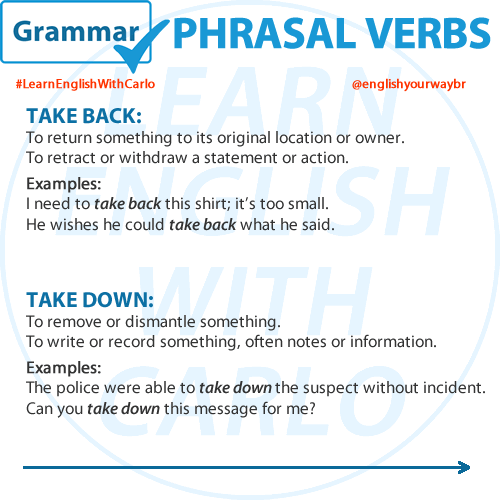
Take back:
To return something to its original location or owner.
To retract or withdraw a statement or action.

Examples:
I need to take back this shirt; it’s too small.
He wishes he could take back what he said.

Take down:
To remove or dismantle something.
To write or record something, often notes or information.

Examples:
The police were able to take down the suspect without incident.
Can you take down this message for me?

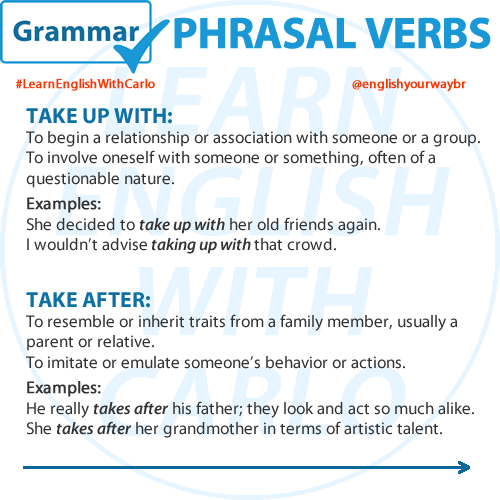
Take up with:
To begin a relationship or association with someone or a group.
To involve oneself with someone or something, often of a questionable nature.

Examples:
She decided to take up with her old friends again.
I wouldn’t advise taking up with that crowd.

Take after:
To resemble or inherit traits from a family member, usually a parent or relative.
To imitate or emulate someone’s behavior or actions.

Examples:
He really takes after his father; they look and act so much alike.
She takes after her mother in terms of artistic talent.

Wrong shortcode initialized

Conditionals – The THIRD Conditional

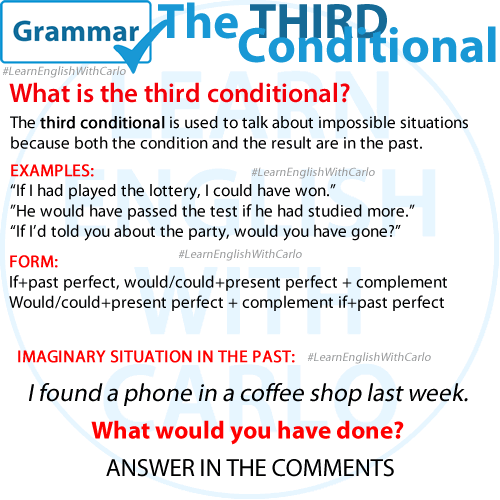
What is the third conditional?

The Third Conditional is used to talk about hypothetical or unreal situations in the past and their imagined outcomes. It’s commonly used to express regrets, wishes, or events that didn’t happen.

Examples:

  • If I had played the lottery, I could have won.
  • He would have passed the test if he had studied more.
  • If I’d told you about the party, would you have gone?

In each case, the situation is impossible to change because it’s already in the past.

Forming the Third Conditional

The Third Conditional has a specific structure:

  • If-clause (Past Perfect): This describes the unreal condition in the past that didn’t happen.
    • Form: If + past perfect tense (had + past participle)
  • Main clause (Would Have + Past Participle): This describes the hypothetical result.
    • Form: Would have + past participle

Examples:

Explanation: If I had studied harder is the condition in the past, and I would have passed the exam is the hypothetical result.

If I had studied harder, I would have passed the exam.

MORE EXAMPLES

  • If she had known about the traffic, she wouldn’t have been late.
  • If they had invited us, we would have gone to the party.
  • If I had saved more money, I would have bought a new car last year.

Uses of the Third Conditional in Everyday English

The Third Conditional is especially useful for:

  • Expressing regret: If I had left earlier, I wouldn’t have missed the train.
  • Discussing missed opportunities: If you had come to the concert, you would have loved it.
  • Pondering “what if” scenarios: If we had taken the other route, we could have avoided the traffic.

Common Alternatives for Expressing Hypotheticals

In the main clause, would have can be replaced with could have (to indicate ability) or might have (to show possibility).

  • If I had known, I could have helped.
  • If he had left earlier, he might have arrived on time.

Practice Sentences

Try to create sentences with the Third Conditional to describe hypothetical past events. Here are some prompts:

  1. If I had gone to bed earlier, ___________.
  2. If she hadn’t forgotten her keys, ___________.
  3. If they had planned their trip better, ___________.

Summary

The Third Conditional helps us talk about past possibilities that didn’t happen, allowing us to reflect on hypothetical outcomes. Remember, it always uses the Past Perfect for the condition and would have (or could have/might have) for the result.

FAQs About the Third Conditional

1. Can I use “could have” or “might have” instead of “would have” in the main clause?
Yes, absolutely! While “would have” is the most common form, using “could have” or “might have” changes the meaning slightly:

  • Would have implies a certain result (e.g., If I had studied, I would have passed).
  • Could have suggests ability (e.g., If I had saved more, I could have bought a new car).
  • Might have shows possibility or uncertainty (e.g., If he had asked, I might have agreed).

2. Can I reverse the clauses in a Third Conditional sentence?
Yes, you can. The order of clauses doesn’t change the meaning. Just remember to omit the comma when the main clause comes first.

  • If I had left earlier, I would have caught the train.
  • I would have caught the train if I had left earlier.

3. How is the Third Conditional different from the Second Conditional?
The Second Conditional talks about hypothetical situations in the present or future, while the Third Conditional focuses on unreal situations in the past.

  • Second Conditional: If I won the lottery, I would buy a house (present/future possibility).
  • Third Conditional: If I had won the lottery, I would have bought a house (past possibility that didn’t happen).

4. Can I use contractions in the Third Conditional?
Yes! Contractions are common in everyday English and make sentences sound more natural.

  • If I’d known earlier, I wouldn’t have missed it.
  • If he’d told you, you could’ve made different plans.

5. Why do we use the Past Perfect in the if-clause?
The Past Perfect in the if-clause indicates that the action or condition is unreal and belongs entirely to the past. This helps show that the event didn’t happen and can no longer happen.


6. Is it okay to use the Third Conditional to talk about emotions?
Definitely. The Third Conditional is often used to express regret or disappointment about the past.

  • If I had called her, she wouldn’t have been upset.
  • If they had told me earlier, I wouldn’t have felt so anxious.

Wrong shortcode initialized

Conditionals – The SECOND Conditional

What is the Second Conditional?

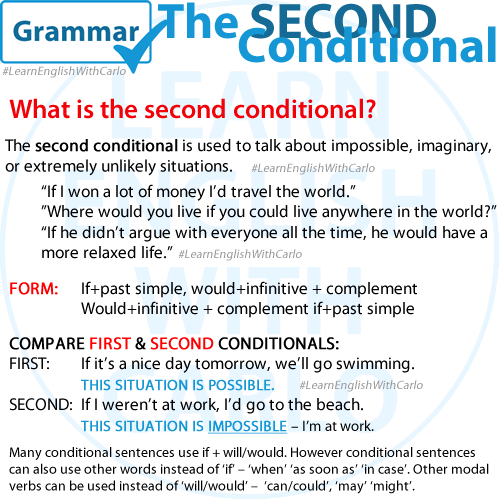
The Second Conditional is a grammatical structure used to talk about hypothetical, imaginary, or extremely unlikely situations. It allows us to express dreams, wishes, and scenarios that are not based in reality.

Structure

The Second Conditional follows this structure:

  • If + past simple, would + base form of the verb
  • Would + base form of the verb + if + past simple

Examples:

  • If I won a lot of money, I’d travel the world. (Imagining winning a large sum of money)
  • Where would you live if you could live anywhere in the world? (Imagining living in any location)
  • If he didn’t argue with everyone all the time, he would have a more relaxed life. (Imagining a more peaceful existence)

Compare First & Second Conditionals

It’s important to distinguish between the First and Second Conditionals:

  • First Conditional: Used for real and possible situations.
    If it’s a nice day tomorrow, we’ll go swimming. (This situation is possible.)
  • Second Conditional: Used for unreal or impossible situations.
    If I weren’t at work, I’d go to the beach. (This situation is impossible since I am at work.)

Using Other Words

Many conditional sentences use “if,” but other words can also be used to express conditions, such as:

  • When
  • As soon as
  • In case

Additionally, other modal verbs can be used instead of “would” to express different meanings:

  • Can/Could: If I could travel anywhere, I would visit Japan.
  • May/Might: If I had more time, I might learn a new language.

Common Uses of the Second Conditional

  1. Dreams and Wishes: To express desires that are unlikely to happen.
    • I wish I could fly. (Imagining the ability to fly)
  2. Advice: To give suggestions for hypothetical situations.
    • If I were you, I’d take that job. (Imagining being in someone else’s position)
  3. Polite Requests: To make polite requests or offers.
    • I would appreciate it if you could help me with this project. (Making a polite request)

Example Sentences

  • If I were rich, I would donate to charity. (Imagining having wealth)
  • You would have more friends if you were friendlier. (Imagining a different social outcome)
  • If she knew his number, she would call him. (Imagining knowledge of his contact information)

Conclusion

The Second Conditional is a powerful tool for expressing our imaginations, dreams, and hypothetical situations. By mastering its structure and usage, you can enhance your conversational skills and express your thoughts more effectively in English.


FAQs About the Second Conditional

1. Can I use “were” instead of “was” in the Second Conditional?
Yes! In the Second Conditional, we typically use “were” for all subjects to express unreal situations:

  • If I were you, I’d study harder.

2. Is it correct to say “If I was you”?
While some speakers use “was,” the standard form is “If I were you” when talking about hypothetical situations.

3. Can I use “might” in the Second Conditional?
Yes! You can use “might” to express a possibility instead of “would”:

  • If I had more time, I might travel to Europe.

Wrong shortcode initialized

Conditionals – The FIRST Conditional

What is the first conditional?

The First Conditional is used to talk about situations that are likely or possible in the future. It describes a real, specific outcome that will happen if a condition is met.

Example Sentences:

  • If Eric passes his exam, he will be very happy.
  • If you don’t hurry, we will be late!

This conditional structure helps us talk about things that are realistic or likely in the future as long as the condition in the sentence is fulfilled.

We use the Simple Present for the condition and the Future (usually with will) for the result.

FORM:
If + simple present, future w/will + complement
Future w/will + complement if + simple present

NOTE: When the condition clause comes first, we use a comma before the result.

EXAMPLE:
If you stay awake late, you’ll be tired tomorrow.
Alan won’t win the lottery if he doesn’t buy a ticket.
If it rains tomorrow, I’ll take my umbrella.

How to Use the First Conditional in Everyday Situations

The First Conditional is often used to:

  • Give warnings or advice: If you don’t bring a coat, you’ll be cold.
  • Discuss plans or intentions: If I finish work early, I’ll meet you at the café.
  • Talk about cause-and-effect relationships: If you water the plants, they’ll grow faster.

Practice Exercises

Try to make your own sentences using the First Conditional to talk about possible future outcomes. Examples of prompts could include:

  1. If I find extra time this weekend, I ___________.
  2. You’ll miss the bus if ___________.
  3. If it gets too hot tomorrow, ___________.

Summary

The First Conditional is a powerful tool for expressing future plans, possibilities, and outcomes that are likely to happen if certain conditions are met. Remember to use the Simple Present for the condition and will for the result.

FAQs About the First Conditional

1. When do we use the First Conditional?
We use the First Conditional to talk about real or possible situations in the future that depend on a specific condition. It’s often used for warnings, promises, offers, and advice about likely future events.


2. What is the structure of the First Conditional?
The structure is:

  • If + simple present, will + base form of the verb

Examples:

  • If you study, you will pass the test.
  • I’ll call you if I finish early.

3. Can I reverse the clauses in the First Conditional?
Yes, you can. The meaning doesn’t change, but remember to omit the comma when the main clause comes first.

  • If it rains, we’ll stay inside.
  • We’ll stay inside if it rains.

4. Can I use “when” instead of “if” in the First Conditional?
Yes, but only if the event is certain to happen. “If” suggests a possibility, while “when” implies that the action will definitely occur.

  • If it rains, I’ll take an umbrella. (It might rain.)
  • When I finish work, I’ll call you. (I will definitely finish work.)

5. Are there alternatives to “will” in the main clause?
Yes. Instead of “will,” you can use modals like “can,” “might,” or “should” to express different meanings:

  • If you finish early, you can join us. (permission)
  • If he works hard, he might get a promotion. (possibility)
  • If you’re tired, you should rest. (advice)

6. What’s the difference between the First and Zero Conditionals?
The Zero Conditional discusses general truths or facts that are always true, while the First Conditional talks about specific future situations that are likely to happen if the condition is met.

  • Zero Conditional: If water reaches 100°C, it boils. (always true)
  • First Conditional: If it rains tomorrow, we’ll stay home. (specific future possibility)

7. Can I use contractions in the First Conditional?
Yes! Contractions are common and make sentences sound more natural.

  • If it doesn’t rain, we’ll go hiking.
  • I’ll be happy if you come to the party.

Wrong shortcode initialized

Conditionals – The ZERO Conditional

What is the zero conditional?

The Zero Conditional is used to talk about general truths, scientific facts, and situations that are always true when the condition is met. This conditional helps us discuss facts that remain the same, regardless of time.

Example Sentences:

  • If water reaches 100°C, it boils.
  • If you mix red and blue, you get purple.

The outcomes are universally true in these cases, making the Zero Conditional ideal for describing rules and certainties. The zero conditional uses if or when and must be followed by the simple present or imperative.

Forming the Zero Conditional

The structure of the Zero Conditional is simple and consistent. Here’s the formula:

Alternative Form: Simple Present + if + Simple Present

Form: If + Simple Present, Simple Present

EXAMPLE:
When you go to the park, take your ball. (imperative)
When you press the button, the doorbell rings.
The doorbell rings if you press the button.

Using the Zero Conditional in Everyday Language

Here’s how we commonly use the Zero Conditional:

  • To state facts and rules: If you touch fire, it burns.
  • To explain habits: If I don’t set an alarm, I oversleep.
  • To describe scientific truths: If iron rusts, it turns brown.

Practice Exercises

Try to create sentences using the Zero Conditional to talk about everyday truths and routines:

  1. If I drink coffee at night, I ___________.
  2. Ice ___________ if you leave it in the sun.
  3. If the phone battery dies, it ___________.

Summary

The Zero Conditional is essential for talking about things that are generally or always true. With its simple form and straightforward usage, it’s an easy and practical way to express known facts and reliable outcomes.

FAQs About the Zero Conditional

1. When do we use the Zero Conditional?
We use the Zero Conditional to talk about general truths, scientific facts, habits, and situations that are always true when a specific condition is met. It’s perfect for explaining things that don’t change over time.


2. What is the structure of the Zero Conditional?
The structure is straightforward:

  • If + simple present, simple present

For example: If it rains, the ground gets wet.


3. Can I reverse the clauses in the Zero Conditional?
Yes, you can! Reversing the clauses does not change the meaning. However, remember to drop the comma if the “if” clause comes second.

  • If water reaches 100°C, it boils.
  • Water boils if it reaches 100°C.

4. Can I use “when” instead of “if” in the Zero Conditional?
Yes, “when” is often interchangeable with “if” in the Zero Conditional, especially when talking about something that always happens.

  • If you heat ice, it melts.
  • When you heat ice, it melts.

5. What’s the difference between the Zero and First Conditionals?
The Zero Conditional talks about general truths or predictable results (e.g., If you mix red and blue, you get purple). The First Conditional discusses specific future possibilities or likely events (e.g., If it rains tomorrow, we will cancel the picnic).


6. Can I use the Zero Conditional for advice?
Not usually. The Zero Conditional is more suited to general truths or scientific facts. For advice, the First Conditional is often more appropriate (e.g., If you study, you will pass the test).

Wrong shortcode initialized