GRAMMAR – MIGRATE vs EMIGRATE vs IMMIGRATE

GRAMMAR – MIGRATE vs EMIGRATE vs IMMIGRATE

Migrate

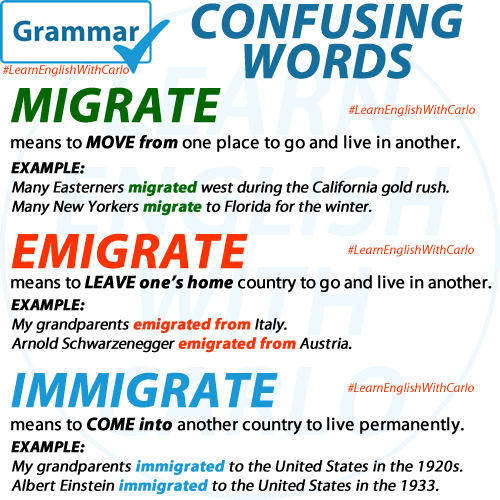
  • Definition: To move from one place to another, often temporarily or seasonally.
  • Usage: “Migrate” refers to movement in general and doesn’t specify whether the move is permanent or where it’s going to or from. Animals, for example, often migrate.
  • Grammar: Used without a specific direction (no “from” or “to” is needed), and it can apply to both people and animals.
    • Birds migrate south in the winter. (general movement)
    • Many Easterners migrated west during the California gold rush.
    • Many New Yorkers migrate to Florida for the winter.

Emigrate

  • Definition: To leave one’s country or region to live in another.
  • Usage: “Emigrate” focuses on the act of leaving a place. When someone emigrates, they move away from their home country.
  • Grammar: Usually followed by “from” to indicate the place the person is leaving.
    • She emigrated from Brazil last year. (left Brazil)
    • My grandparents emigrated from Italy.
    • Arnold Schwarzenegger emigrated from Austria.

Immigrate

  • Definition: To move into a new country or region to live there permanently.
  • Usage: “Immigrate” focuses on the act of entering and settling in a new country. It emphasizes the arrival.
  • Grammar: Usually followed by “to” or “into” to indicate the destination country.
    • They immigrated to Canada in 2010. (moved into Canada)
    • My grandparents immigrated to the United States in the 1920s.
    • Albert Einstein immigrated to the United States in 1933.

Key Differences:

  • Migrate refers to movement in general, without specifying direction or permanency.
  • Emigrate emphasizes leaving a country or region.
  • Immigrate emphasizes entering a new country or region.

In simpler terms:

Immigrate = Entering a new country. 

Migrate = Moving, not necessarily to or from a specific country.

Emigrate = Leaving a country.

Wrong shortcode initialized
May vs. Might: Understanding the Difference

In English, both may and might are modal verbs used to indicate possibility. However, they aren’t interchangeable in all situations. Knowing when to use each one can improve the accuracy and clarity of your communication.

May: A Stronger Possibility

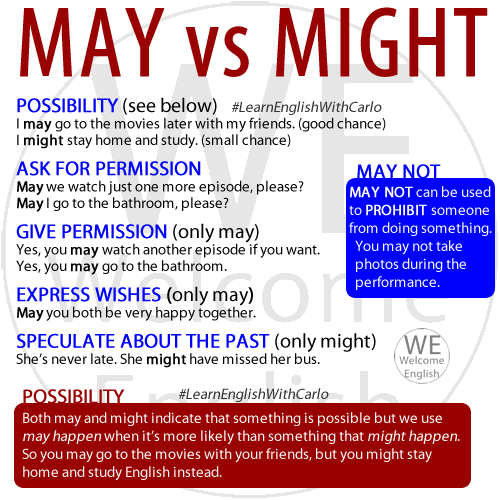
May is often used when something is more likely to happen. When we say something may happen, we suggest that the chances of it occurring are reasonably high. For example:

  • “You may go to the movies with your friends.”

In this case, there is a good chance that you will go to the movies. The outcome is likely.

Might: A Weaker Possibility or Uncertainty

Might is used when the possibility is less certain, or when we want to express doubt about whether something will happen. For example:

  • “You might stay home and study English instead.”

Here, the chance of staying home is less certain or unlikely compared to going out with friends. Might often carries an undertone of uncertainty or a weaker possibility.

Might as the Past Tense of May

When referring to past events, might is used as the past tense of may. For example:

  • “She might have gone to the movies yesterday.”

In this context, we are talking about a possible event that could have happened in the past.

Might for Negative Outcomes

It’s also important to use might when discussing negative outcomes, even if they seem likely. This is because using may in these cases can be confusing—it might sound like you’re giving permission rather than talking about a possibility. For example:

  • “You might fail the test if you don’t study.”

Using may in this context would sound odd, as it could imply you’re allowing or permitting failure. Using might ensures the sentence focuses on possibility, not permission.

Quick Recap:

  • Use may when the outcome is likely.
  • Use might when the outcome is less likely or uncertain.
  • Use might for past possibilities.
  • Use might when referring to negative possibilities to avoid confusion with permission.

Mastering these subtle differences will help make your English sound more natural and precise.

Wrong shortcode initialized

PRONUNCIATION – the ED sound

PRONUNCIATION – the ED sound

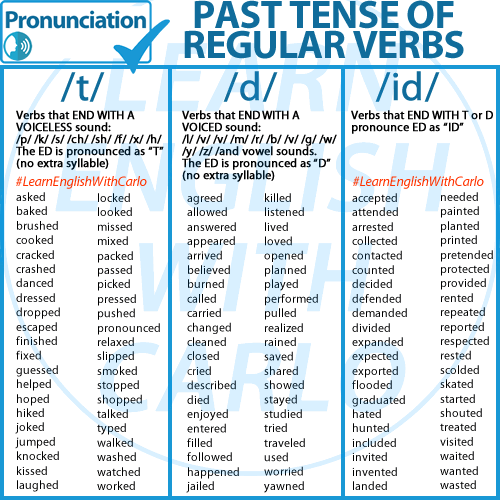
There are three different ways to pronounce the ‘ED’ ending of regular verbs in the simple past tense: / t/ , / d / or / id /. The pronunciation depends on the sound at the end of the infinitive of the main verb and whether it is voiced or not. A voiced sound is one that vibrates in your throat when you say it.

T – For verbs ending in a voiceless sound (sounds made in the mouth, not the throat) we add a T sound when adding ED.

  • ask – asked (askt);
  • kiss – kissed (kist);
  • relax – relaxed (relakst)

D – For verbs ending in a voiced sound (sounds made in the voicebox, vibrating the throat) we add a D sound when adding ED.

  • call – called (calld);
  • love – loved (lovd);
  • earn – earned (earned)

ID – For verbs ending in T or D, we cannot add the same sound again so we add ID and a syllable when adding ED.

  • want – wanted (wantid);
  • wait – waited (waitid)
  • need – needed (needid);
  • end – ended (endid)

Wrong shortcode initialized

SEE ALSO: https://learnenglishwithcarlo.com/pronunciation-2/pronunciation-the-ed-sound/

VOCABULARY – Family Members

Now with PRONUNCIATION GUIDE

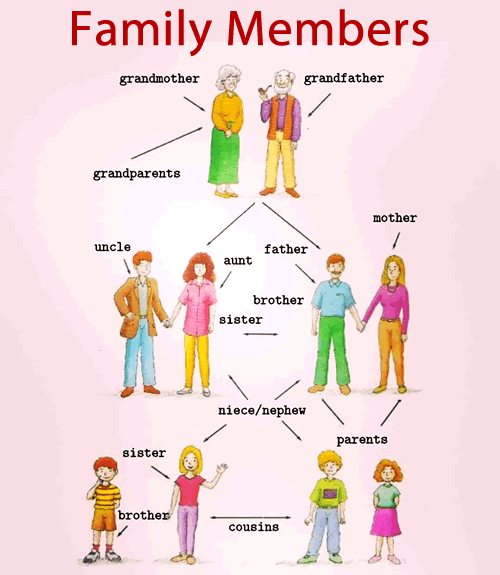
Grandmother, Grandfather, Grandparents
Mother, Father, Wife, Husband, Parents
Children, Son, Daughter, Brother, Sister, Siblings, Brothers and Sisters.
Uncle, Aunt, Niece, Nephew.


Pronunciation for the list below

Here are a couple of confusing definitions explained:

  • NephewThe son of your brother or sister, your husband’s brother or sister, and your wife’s brother or sister.
  • NieceThe daughter of your brother or sister, your husband’s brother or sister, and your wife’s brother or sister.
  • Half-brother: A brother who is the son of either your mother or your father.
  • Half-sister: A sister who is the daughter of either your mother or your father.
  • Stepbrother: The son of your stepparent or the person who is married to your parent (not a blood relative).
  • Stepsister: The daughter of your stepparent or the person who is married to your parent (not a blood relative).
  • Widow: A woman whose husband has died and who has not married again.
  • Widower: A man whose wife has died and who has not married again.
  • Fiancé: The man to whom a woman is engaged. (
  • Fiancée: The woman to whom a man is engaged.

How many of the above do you have in your family?

VOCABULARY – Fast Food

Popular Fast Food Dishes

In addition to burgers and fries, fast food offers a variety of dishes depending on where you are in the world. Some popular fast food items include:

  • Pizza: Often served with different toppings like pepperoni, mushrooms, or cheese.
  • Tacos: Mexican-inspired fast food made with a tortilla and filled with meat, cheese, and veggies.
  • Chicken Nuggets: Small, bite-sized pieces of breaded and fried chicken.
  • Hot Dogs: Sausages served in a bun with toppings like ketchup, mustard, and onions.

Fast Food Vocabulary in Context

Here are some common phrases you might hear when ordering fast food:

  • “Can I take your order?” – This is what a cashier will ask when they are ready to help you.
  • “Would you like that as a combo?” – A combo usually includes a main item (like a burger), a side (like fries), and a drink.
  • “For here or to go?” – They will ask if you want to eat at the restaurant or take the food with you.

Healthier Fast Food Options

Fast food doesn’t always have to be unhealthy. Many fast food chains are offering healthier choices now:

  • Grilled chicken instead of fried chicken.
  • Salads as an alternative to fries.
  • Fruit as a dessert or snack option.

Memory updated

Sure! Here are a few filler content ideas to enhance your fast food vocabulary page:


Popular Fast Food Dishes

In addition to burgers and fries, fast food offers a variety of dishes depending on where you are in the world. Some popular fast food items include:

  • Pizza: Often served with different toppings like pepperoni, mushrooms, or cheese.
  • Tacos: Mexican-inspired fast food made with a tortilla and filled with meat, cheese, and veggies.
  • Chicken Nuggets: Small, bite-sized pieces of breaded and fried chicken.
  • Hot Dogs: Sausages served in a bun with toppings like ketchup, mustard, and onions.

Fast Food Vocabulary in Context

Here are some common phrases you might hear when ordering fast food:

  • “Can I take your order?” – This is what a cashier will ask when they are ready to help you.
  • “Would you like that as a combo?” – A combo usually includes a main item (like a burger), a side (like fries), and a drink.
  • “For here or to go?” – They will ask if you want to eat at the restaurant or take the food with you.

Healthier Fast Food Options

Fast food doesn’t always have to be unhealthy. Many fast food chains are offering healthier choices now:

  • Grilled chicken instead of fried chicken.
  • Salads as an alternative to fries.
  • Fruit as a dessert or snack option.

Idioms and Expressions Related to Fast Food

  • “Fast food nation”: Refers to countries where fast food is very popular.
  • “Drive-thru mentality”: Describes a situation where people expect everything to be done quickly, like in a fast food drive-thru.

If you’re anything like me, you like fast food.
I LOVE fast food. It’s my vice.
What’s your favorite fast food?

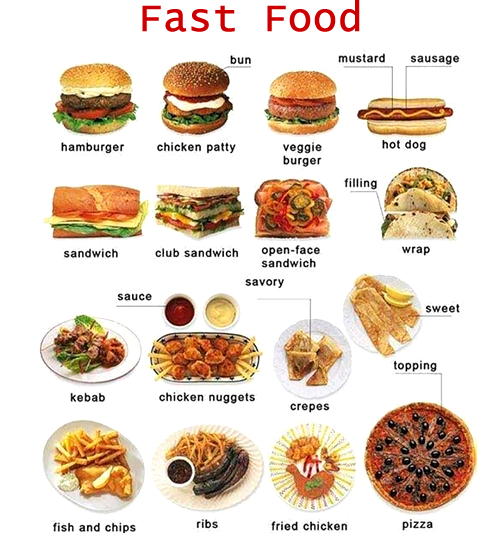
  • Hamburger (or cheesburger)
  • Chicken Patty
  • Veggie burger
  • Hot dog
  • Sandwich, club sandwich (double-decker), open-faced sandwich
  • Wrap
  • Kebab
  • Chicken nuggets
  • Crepes
  • Pancakes
  • Fish ‘n’ chios
  • Ribs
  • Fried chicken
  • Pizza

I LOVE THEM ALL!!!!

If you have any questions or doubts, please ask in the comments or send me a private message.

Follow me on Instagram: @englishyourwaybr
or look for the hashtag #LearnEnglishWithCarlo

VOCABULARY – Expressions of Time

Do you know how to use phrases like “in the morning,” “next week,” or “a long time ago”? Expressions of time help you give more details when you’re talking about when things happen.

Days/Weeks/Months/Years: Use on for days (“on Monday”), in for months/years (“in July”, “in 2022”), and at for specific times (“at 5 o’clock”).

Talking about the past: Phrases like last night, yesterday, or a week ago tell you something happened before now.

Talking about the future: Phrases like next week, in two hours, or soon tell you when something will happen later!

VOCABULARY – Expressions of Time

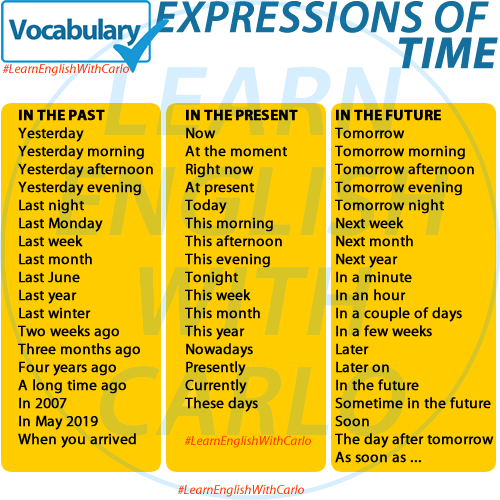
IN THE PAST

  • Yesterday
  • Yesterday morning
  • Yesterday afternoon
  • Yesterday evening
  • Last night
  • Last Monday
  • Last week
  • Last month
  • Last year
  • Two weeks ago
  • Three months ago
  • Four years ago
  • A long time ago
  • In June
  • In 2007
  • In winter
  • In May 2019
  • When you arrived


IN THE PRESENT

  • Now
  • At the moment
  • Right now
  • At present
  • Today
  • This morning
  • This afternoon
  • This evening
  • Tonight
  • This week
  • This month
  • This year
  • Nowadays
  • Presently
  • Currently
  • These days


IN THE FUTURE

  • Tomorrow
  • Tomorrow morning
  • Tomorrow afternoon
  • Tomorrow evening
  • Tomorrow night
  • Next week
  • Next month
  • Next year
  • In a minute
  • In an hour
  • In a couple fo days
  • In a few weeks
  • Later
  • Later on
  • In the future
  • Sometime in the future
  • Soon
  • The day after tomorrow
  • As soon as

Wrong shortcode initialized

TOO vs. ENOUGH

TOO:

  • Use “too” to describe something that is more than what is needed or wanted. It often implies a negative result.
  • Example: “It’s too hot.” (It’s more hot than comfortable.)

ENOUGH:

  • Use “enough” to show that something is the right amount or level. It often suggests satisfaction or adequacy.
  • Example: “It’s hot enough.” (It’s sufficiently hot, just right.)

Quick Tip:

  • “TOO” often comes before an adjective (too hot).
  • “ENOUGH” comes after an adjective (hot enough) or before a noun (enough water).

Here are examples for each of the patterns:

TOO + Adjective

  • Example: “The bag is too heavy.”
  • Meaning: The bag is heavier than what is manageable or comfortable.

TOO + Adverb

  • Example: “She talks too quickly.”
  • Meaning: She speaks at a speed faster than what can be easily understood.

TOO MANY + Noun (Countable)

  • Example: “There are too many cars on the road.”
  • Meaning: The number of cars is more than what is desirable or safe.

TOO MUCH + Noun (Uncountable)

  • Example: “He added too much sugar to the coffee.”
  • Meaning: The amount of sugar is more than what is needed or preferred.

Adverb + ENOUGH

  • Example: “She runs fast enough to win the race.”
  • Meaning: Her speed is sufficient to win.

Adjective + ENOUGH

  • Example: “The soup is hot enough.”
  • Meaning: The temperature of the soup is just right.

ENOUGH + Noun

  • Example: “We have enough chairs for everyone.”
  • Meaning: The number of chairs is sufficient for all the people.

These examples should clarify how to use “too” and “enough” in different contexts!

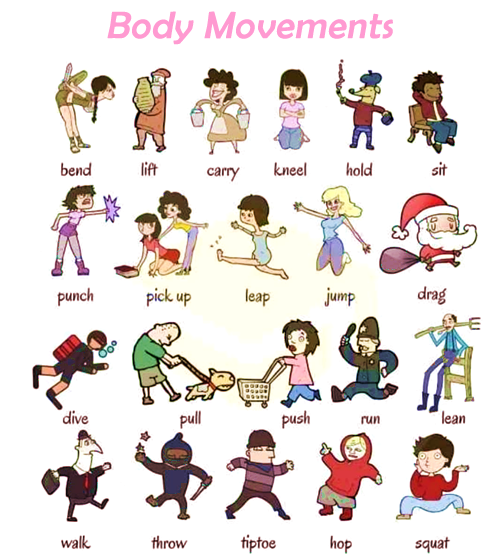
VOCABULARY – Body Movements

Here are some examples to better illustrate these verbs of movement:

  • BEND – incline the body downward from the vertical.
    “I bent over to give my little sister a kiss.”

  • LIFT – raise to a higher position or level.
    “He lifted his trophy over his head”

  • CARRY – support and move (someone or something) from one place to another.
    “She is carrying two buckets of water”

  • KNEEL – be in a position in which the body is supported the knees.
    “They knelt down and prayed.

  • HOLD – grasp, carry, or support with one’s arms or hands.
    “He was holding a stick in one hand and a leather suitcase in the other.”

  • SIT – be in a position in which one’s weight is supported by one’s buttocks.
    “You’d better sit down.

  • PUNCH – strike with the fist.
    “She punched him in the face and ran off”

  • PICK UP – collect something that has been left elsewhere.
    “Wanda picked up the book from the floor.”

  • LEAP – jump or spring a long way, to a great height, or with great force.
    “I leaped across the threshold.”

  • JUMP – push oneself off a surface and into the air by using the muscles in one’s legs and feet.
    “She jumped as high as she could.”

  • DRAG – pull (someone or something) along forcefully, roughly, or with difficulty.
    “He dragged the heavy bag behind him.”

  • DIVE  – swim underwater using breathing equipment.
    “He has been diving since he was young.”

  • PULL – exert force on (someone or something) so as to cause movement toward oneself.
    “He pulled the dog but she wouldn’t move.”

  • PUSH – exert force on (someone or something), typically with one’s hand, in order to move them away from oneself or the origin of the force.
    “She pushed the shopping cart in front of her.”

  • RUN – move at a speed faster than a walk, never having both feet on the ground at the same time.
    “The policeman ran across the road after the thief.”

  • LEAN – be in or move into a sloping position.
    “He leaned back against the fence.”

  • WALK  – move at a regular pace by lifting and setting down each foot in turn.
    “I walked to work every day”

  • THROW – propel (something) with force through the air by a movement of the arm and hand.
    “The Ninja threw his star at the killer.”

  • TIP-TOE – walk quietly and carefully with one’s heels raised and one’s weight on the balls of the feet.
    “The thief tiptoed out of the room so as not to be heard.”

  • HOP – move by jumping up and down on one foor.
    “He hopped along beside her”
  • SQUAT – crouch or sit with one’s knees bent.
    “I squatted down in front of him”


If you have any questions or doubts, please ask in the comments or send me a private message.

Follow me on Instagram: @englishyourwaybr
or look for the hashtag #LearnEnglishWithCarlo

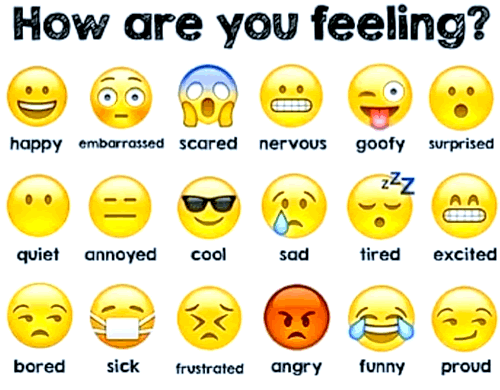
VOCABULARY – Emojis

If you use social media at all, you should be very familiar with emojis – those cute little digital images or icons used to express an idea, emotion, etc.

Here are a few of the emotions that they represent:

  • happy
  • embarrassed
  • scared
  • nervous
  • goofy
  • surpised
  • quiet
  • annoyed
  • cool
  • sad
  • tired
  • excited
  • bored
  • sick
  • frustrated
  • angry
  • funny
  • proud

Which one’s do you use most?
Which one is your favorite?

If you have any questions or doubts, please ask in the comments or send me a private message.

Follow me on Instagram: @englishyourwaybr
or look for the hashtag #LearnEnglishWithCarlo

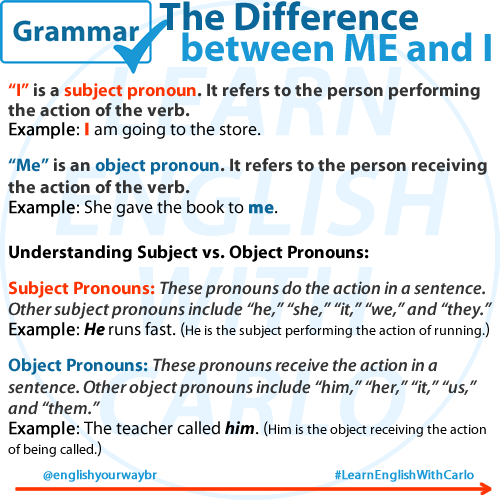
The Difference Between “Me” and “I”

“I” is a subject pronoun. It refers to the person performing the action of the verb.

  • Example: I am going to the store.
  • Tip: If you can replace the pronoun with “we,” and it still makes sense, use “I.”

“Me” is an object pronoun. It refers to the person receiving the action of the verb.

  • Example: She gave the book to me.
  • Tip: If you can replace the pronoun with “us,” and it still makes sense, use “me.”

Remember: When talking about yourself and another person, always put the other person first.

  • Example: My friend and I went to the park. (subject)
  • Example: She invited my friend and me to the party. (object)

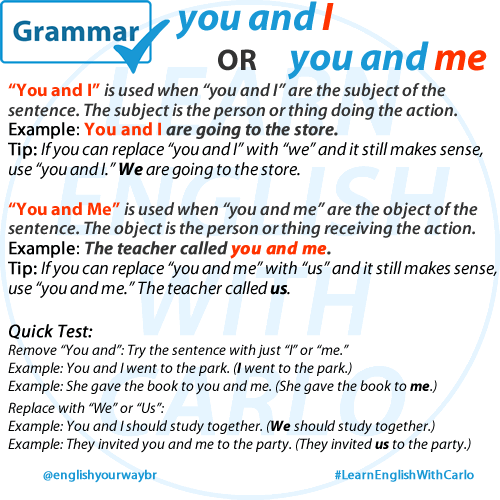
The Difference Between “You and Me” vs. “You and I”

“You and I” is used when “you and I” are the subject of the sentence. The subject is the person or thing doing the action.

  • Example: You and I are going to the store.
  • Tip: If you can replace “you and I” with “we” and it still makes sense, use “you and I.”
    • Example: We are going to the store.

“You and Me” is used when “you and me” are the object of the sentence. The object is the person or thing receiving the action.

  • Example: The teacher called you and me.
  • Tip: If you can replace “you and me” with “us” and it still makes sense, use “you and me.”
    • Example: The teacher called us.

Quick Test:

  1. Remove “You and”: Try the sentence with just “I” or “me.”
    • Example: You and I went to the park. (I went to the park.)
    • Example: She gave the book to you and me. (She gave the book to me.)
  2. Replace with “We” or “Us”:
    • Example: You and I should study together. (We should study together.)
    • Example: They invited you and me to the party. (They invited us to the party.)

Wrong shortcode initialized