GRAMMAR – Adjective + Preposition

Adjectives are words used to describe a person, place, or thing.
For example:

The tall man in the red shirt is a friend of mine.
We drove along a quiet road until we reached a small town.
I’m reading an interesting book.

Prepositions are words used to connect two ideas or to demonstrate the relationship between two concepts.
Examples of prepositions in English include at, in, on, for, to, with, and from.

Adjective + Preposition Combinations

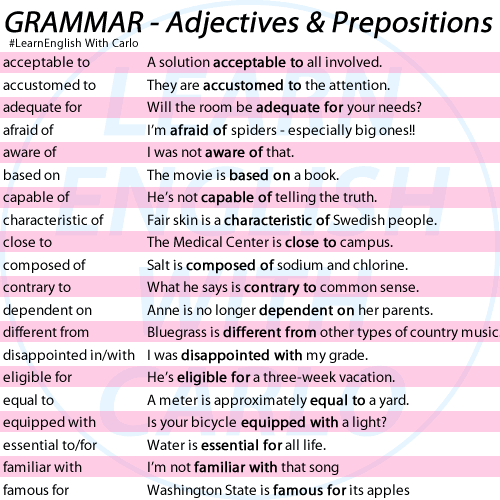
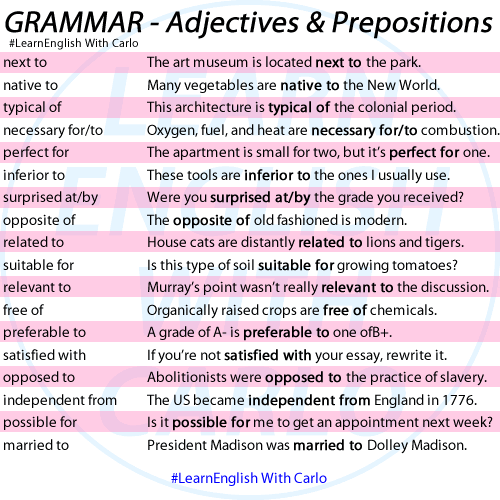
There are many cases in which adjectives are combined with prepositions – but there is no rule stating when to use which combination.
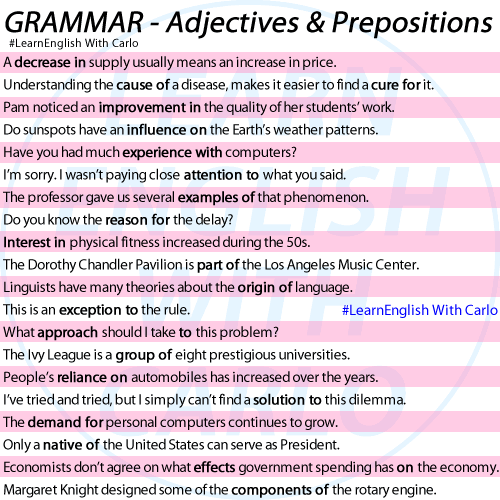
As you read and listen to more English, you will become more and more familiar with how these adjective-prepositions combinations are used. Here are a few of the more common combinations of adjectives and prepositions in English.
VOCABULARY – Beside/Besides

These two words look very similar but are quite different.
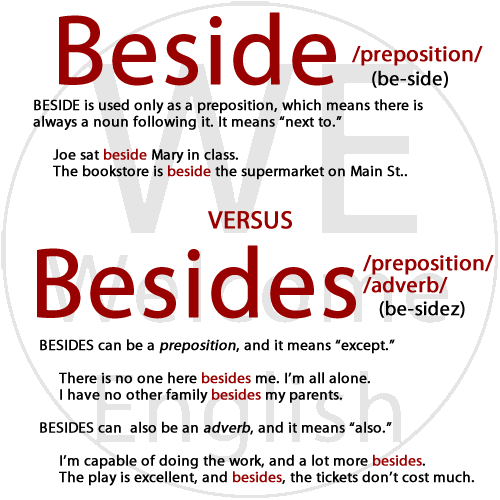
BESIDE – is a preposition and means ‘next to.’ BESIDES – as a preposition means ‘except.’ BESIDES – as an adverb means ‘also.’

GRAMMAR – Prepositions of Time

BETWEEN…AND – AFTER – TO/PAST – WITHIN

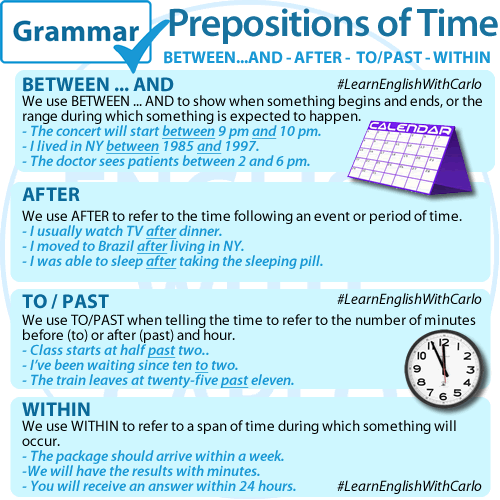
We use BETWEEN … AND to show when something begins and ends, or the range during which something is expected to happen.
– The concert will start between 9 pm and 10 pm.
– I lived in NY between 1985 and 1997.
– The doctor sees patients between 2 and 6 pm.

We use AFTER to refer to the time following an event or period of time.
– I usually watch TV after dinner.
– I moved to Brazil after living in NY.
– I was able to sleep after taking the sleeping pill.

We use TO/PAST when telling the time to refer to the number of minutes before (to) or after (past) and hour.
– Class starts at half past two..
– I’ve been waiting since ten to two.
– The train leaves at twenty-five past eleven.

We use WITHIN to refer to a span of time during which something will occur.
– The package should arrive within a week.
– We will have the results within minutes.
– You will receive an answer within 24 hours.

GRAMMAR – Prepositions of Time

FROM … TO – AGO – BEFORE – BY

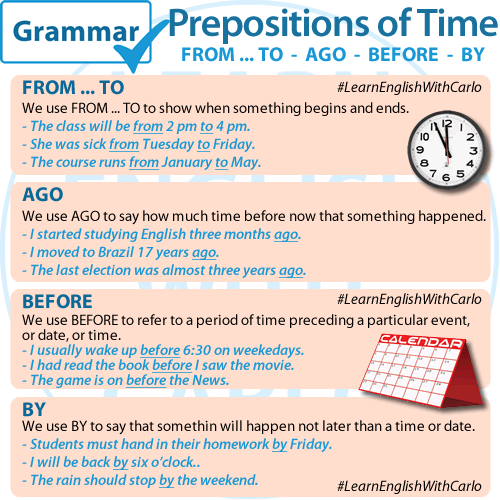
We use FROM … TO to show when something begins and ends.
– The class will be from 2 pm to 4 pm.
– She was sick from Tuesday to Friday.
– The course runs from January to May.

We use AGO to say how much time before now that something happened.
– I started studying English three months ago.
– I moved to Brazil 17 years ago.
– The last election was almost three years ago.

We use BEFORE to refer to a period of time preceding a particular event, date, or time.
– I usually wake up before 6:30 on weekedays.
– I had read the book before I saw the movie.
– The game is on before the News.

We use BY to say that something will happen no later than a time or date.
– Students must hand in their homework by Friday.
– I will be back by six o’clock..
– The rain should stop by the weekend.

GRAMMAR – Confusing Words

WHILE and DURING

WHILE is a CONJUNCTION that is used to refer to a background period of time in which another activity happened. It is very similar to during, but it is followed by a sentence (while + subject + verb…), so they are not interchangeable.

DURING is a PREPOSITION that is used before an activity to indicate that a parallel action is happening at the same time as that activity. DURING is followed by a noun, which often represents an activity (during + noun)

Examples:
I will finish reading the book while I’m on my summer break. (while + subject + verb…)
I usually take notes while I’m in class.
Did you fall asleep while you were watching the movie?

To use during in the above sentences, we have to change the structure of the sentence.

Examples:
I will finish reading the book during my summer break.(during + noun)
I usually take notes during class.
Did you fall asleep during the movie?

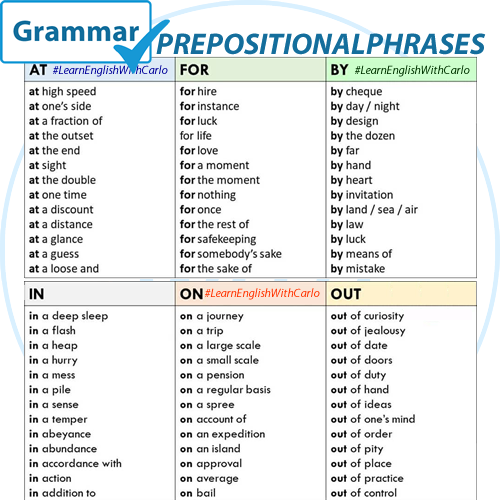
GRAMMAR – PREPOSITIONAL PHRASES

Here are some common prepositional phrases, also known as Collocations with prepositions.

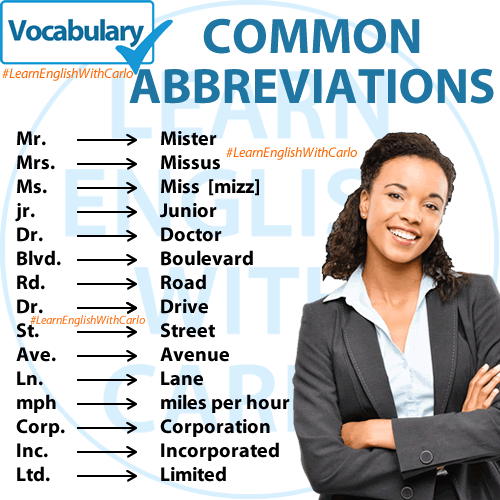
VOCABULARY – Common Abbreviations

An abbreviation is a shortened form of a word or phrase.

Here are some of the more common ones:

Mr. – Mister
Mrs. – Missus
Ms. – Miss [mizz]
jr. – Junior
Dr. – Doctor
Blvd. – Boulevard
Rd. – Road
Dr. – Drive
St. – Street
Ave. – Avenue
Ln. – Lane
mph – miles per hour
Corp. – Corporation
Inc. – Incorporated
Ltd. – Limited

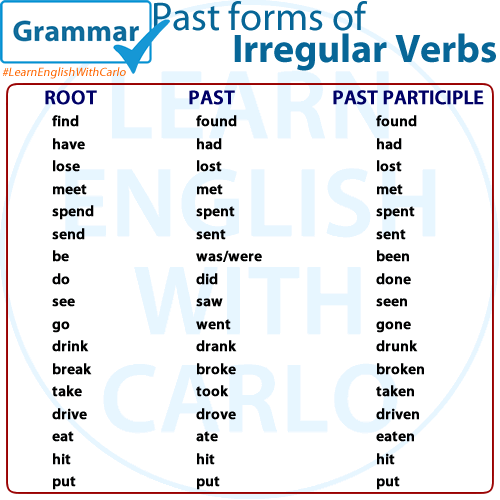
GRAMMAR – Past forms of Irregular Verbs

The difference between a regular and an irregular verb is the formation of the simple past and past participle. Regular verbs are consistent—the simple past ends in ed as does the past participle.

BUT, the simple past and past participle of irregular verbs can end in a variety of ways, with no consistent pattern.

Here are some of the more common IRREGULAR VERBS.

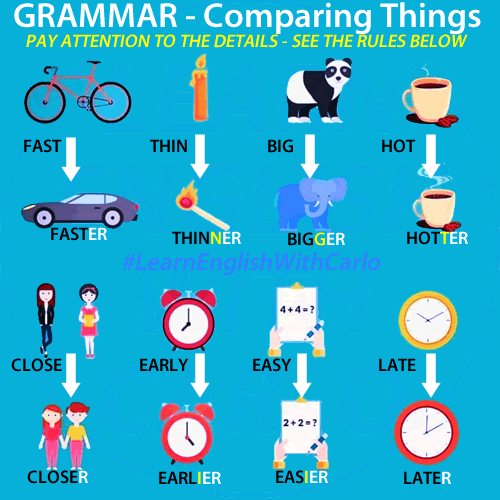
GRAMMAR – Comparing Things

To compare two things, we use what is called a COMPARATIVE ADJECTIVE to what is different between the two things. We do this by modifying the adjective of the characteristic that is different. Here are the rules for this:
For adjectives of one syllable:
You add ‘ER’
Examples:
smart – smartER
young – youngER
fast – fastER

For adjectives of one syllable that end with Consonant-Vowel-Consonant (C-V-C):
You double the last consonant and add ‘ER’
Examples:
wet = wetter
big = bigger
sad = sadder

For adjectives of two syllables that end with a Y
You remove the Y and add ‘IER’
Examples:
pretty – prettIER
happy – happIER
lucky – luckIER

For adjectives with two or more syllables (not ending in Y)
You add MORE before the adjective.
Examples:
famous – MORE famous
interesting – MORE interesting
careful – MORE careful

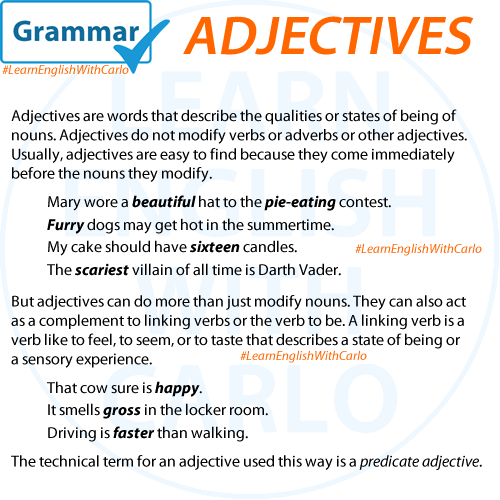
Adjectives

Adjectives are words that describe the quality or state of being of nouns. Adjectives do not modify verbs, adverbs, or other adjectives. Usually, adjectives are easy to find because they come immediately before the nouns they modify.

Adjectives can do more than just modify nouns. They can also act as a complement to linking verbs or the verb to be. A linking verb is a verb like feel, seem, or taste that describes a state of being or a sensory experience.