Your Guide to Building Better Sentences When you’re learning English, you might hear a lot about clauses. But what exactly are they, and why are they important? This guide will break down the basics of …
Figures of speech are words or expressions used in a non-literal, creative way to make language more vivid and expressive.Writers and speakers use them to create imagery, add emotion, and make ideas easier to remember. …
QUIT “Quit” is a verb that means to stop or cease doing something. When someone quits an activity, job, or habit, they discontinue or give up that particular action or commitment. “Quit” can also imply …
Countable and uncountable nouns are two categories used to classify nouns based on whether they can be counted or not. Countable Nouns:Countable nouns refer to objects or entities that can be counted as discrete units.They …
What Are Verbal Nouns and How Are They Constructed?
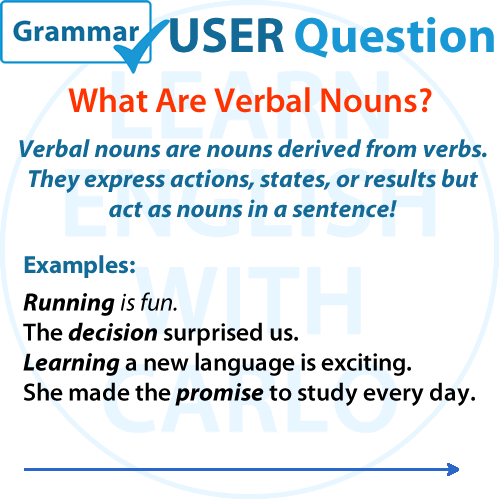
If you’ve ever encountered words like running, development, or decision, you’ve seen verbal nouns in action! Verbal nouns are a fascinating aspect of English grammar, as they combine the essence of an action (from verbs) with the grammatical function of a noun. Let’s dive into what verbal nouns are, how they’re formed, and some common examples to help you master this concept.
What Is a Verbal Noun?
A verbal noun is a noun that originates from a verb. While it retains the meaning of the verb—expressing an action, state, or result—it functions solely as a noun in a sentence. Verbal nouns do not act as verbs and cannot take subjects, objects, or show tense. Instead, they take on roles such as subject, object, or complement within a sentence.
For example:
Swimming is a great form of exercise. (Here, swimming acts as the subject, not the verb.)
His decision to leave surprised everyone. (The word decision comes from the verb decide but acts as a noun.)
How Are Verbal Nouns Formed?
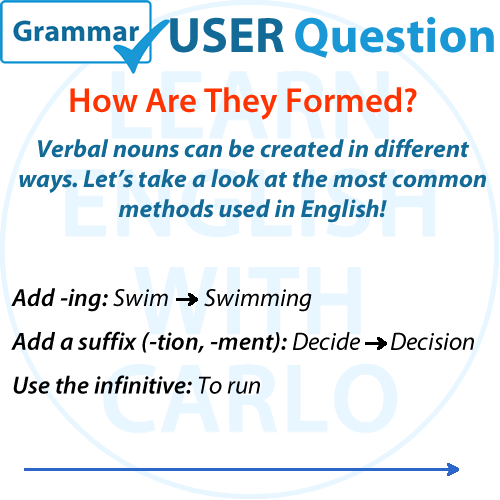
Verbal nouns can be constructed in various ways. Below are the most common methods used in English:
1. Adding the Suffix -ing (Gerunds)
One of the most common forms of verbal nouns is the gerund. To form a gerund, simply add -ing to the base form of a verb.
Run → Running
Write → Writing
Swim → Swimming
Examples in sentences:
Running is my favorite way to relax.
She loves writing in her journal.
Swimming every morning helps her stay healthy.
Note: Gerunds sometimes behave like nouns but retain certain “verb-like” qualities, such as the ability to take objects. For instance:
I enjoy reading books.
In this case, “books” is the object of the gerund “reading.”
2. Using the Infinitive Form (To + Verb)
Another way to create a verbal noun is to use the infinitive form of the verb, typically beginning with to.
To run → as a noun: To run is exhilarating.
To learn → as a noun: To learn a new skill takes time.
Examples in sentences:
To succeed requires hard work.
To forgive can be difficult but rewarding.
This form is more common in formal or philosophical writing.
3. Adding Specific Suffixes to Create Derived Nouns
In many cases, verbal nouns are formed by adding specific suffixes to the base verb. These nouns are often used in academic, professional, or formal contexts. Some of the most common suffixes include:
-tion/-sion:
Inform → Information
Decide → Decision
Conclude → Conclusion
-ment:
Develop → Development
Punish → Punishment
-ance/-ence:
Perform → Performance
Persist → Persistence
Examples in sentences:
The information provided was extremely helpful.
Her decision to leave the company was unexpected.
Hard work leads to success, but persistence ensures it lasts.
4. Irregular or Unique Forms
Some verbal nouns have irregular forms that don’t follow predictable patterns. These nouns often appear in everyday English and must be memorized individually.
Speak → Speech
Die → Death
Choose → Choice
Examples in sentences:
His speech was inspiring.
The death of the character shocked the audience.
Her choice to study abroad changed her life.
Key Differences Between Verbal Nouns and Other Verb Forms
While verbal nouns look like verbs in some ways, they function very differently:
Feature
Verbal Noun
Verb
Role in the sentence
Acts as a noun (subject, object, etc.)
Acts as the main verb
Tense
No tense
Shows tense (past, present, future)
Takes objects
Rarely (except gerunds)
Can take direct or indirect objects
Why Are Verbal Nouns Important?
Understanding verbal nouns can help you:
Expand your vocabulary: Many academic and professional terms are verbal nouns (e.g., agreement, analysis, development).
Write better sentences: Verbal nouns add variety and sophistication to your writing.
Identify grammatical structures: Recognizing verbal nouns can improve your reading comprehension and grammar skills.
Conclusion
Verbal nouns are a versatile part of the English language that allow us to turn actions into ideas. Whether you’re using gerunds, infinitives, or suffix-derived nouns, understanding how to form and use verbal nouns will elevate your English skills. Keep practicing, and soon you’ll recognize and use verbal nouns like a pro!
Have questions about verbal nouns or other grammar topics? Leave a comment below!
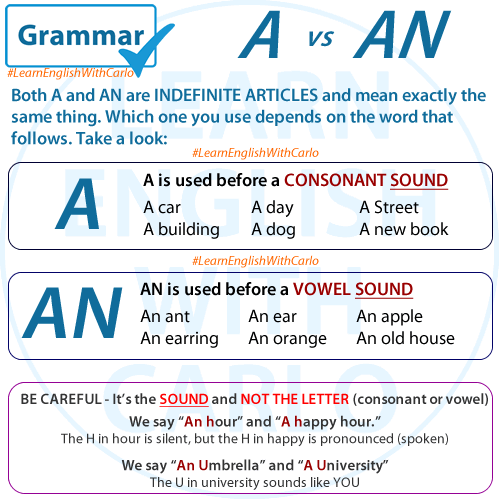
Both A and AN are indefinite articles in English, and they mean exactly the same thing. They are used before singular, countable nouns when you are not referring to a specific item. However, the choice between A and AN depends entirely on the sound of the word that follows—not necessarily the first letter of that word. Let’s break this down in detail:
Using A Before Consonant Sounds
The article A is used when the word following it begins with a consonant sound. Here are some examples:
A car
A day
A street
A building
A dog
A new book
These examples demonstrate that A is placed before words that start with a sound produced by consonants such as C, D, S, B, and N.
Using AN Before Vowel Sounds
The article AN is used when the word following it begins with a vowel sound. Examples include:
An ant
An ear
An apple
An earring
An orange
An old house
Here, AN precedes words that start with vowel sounds like A, E, I, O, and U.
The Key Rule: It’s About the Sound, Not the Letter
One of the most important things to remember is that the choice between A and AN depends on the sound of the word, not its spelling. Sometimes, words begin with a silent consonant or an unusual vowel sound. Let’s look at some examples:
Words with Silent Consonants:
An hour — The “H” in hour is silent, so the word starts with a vowel sound.
A happy hour — The “H” in happy is pronounced, so the word starts with a consonant sound.
Words with Unusual Vowel Sounds:
An umbrella — The “U” in umbrella sounds like the vowel uh, so AN is used.
A university — The “U” in university sounds like the consonant you, so A is used.
More Examples:
An honest mistake (silent “H”)
A house (pronounced “H”)
An hourglass (silent “H”)
A unicorn (“U” sounds like “you”)
Practice with A vs. AN
Here are some sentences to test your understanding:
I bought ___ orange from the market. (AN)
She is looking for ___ unique gift. (A)
He waited for ___ hour before leaving. (AN)
They stayed at ___ hotel near the beach. (A)
We saw ___ eagle flying in the sky. (AN)
Tips to Remember
Always say the word out loud to identify whether it begins with a vowel or consonant sound.
Focus on pronunciation, not spelling.
Remember that exceptions often occur with silent letters or unique vowel sounds.
By mastering this simple rule, you’ll sound more natural and confident when using English articles!
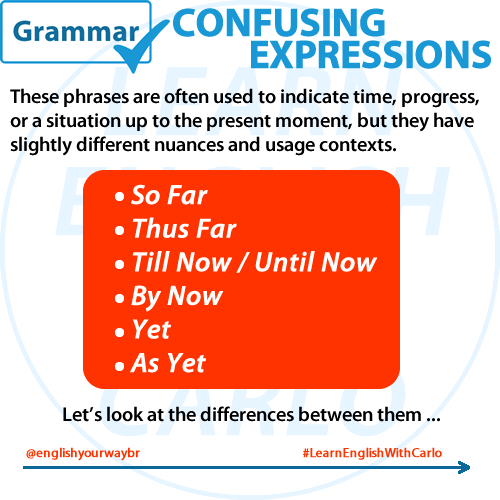
So far, thus far, till now, until now, by now, yet, as yet
These phrases are often used to indicate time, progress, or a situation up to the present moment, but they have slightly different nuances and usage contexts.
1. So Far
Meaning: Up to this point in time.
Usage: Commonly used to talk about progress or results. It suggests that the situation may continue.
Example: “So far, we’ve raised $500 for charity.”
2. Thus Far
Meaning: Similar to “so far,” but slightly more formal or literary.
Usage: Used in a more formal context, but it also indicates progress up to the present moment.
Example: “Thus far, the project has been a success.”
3. Till Now / Until Now
Meaning: Up to the present moment, often implying that a change has occurred or is about to occur.
Usage: Can suggest a contrast between the past and present.
Example: “Until now, I had never considered a career in teaching.”
4. By Now
Meaning: Refers to a point in time that has passed, indicating that something should have happened or been completed.
Usage: Often used when there is an expectation of completion.
Example: “By now, you should have received the package.”
5. Yet
Meaning: Used to describe something that hasn’t happened by a certain time, but is expected to happen.
Usage: Often used in questions and negative sentences.
Example: “I haven’t finished the report yet.”
6. As Yet
Meaning: Similar to “yet,” but slightly more formal.
Usage: Often used in negative contexts to indicate something hasn’t happened up to the current moment.
Example: “As yet, no one has claimed the lost item.”
Summary:
So Far / Thus Far: Progress or situation up to now, with potential to continue.
Till Now / Until Now: Situation up to the present, often implying change.
By Now: Expectation of something having happened by this time.
Yet / As Yet: Indicates something expected has not happened yet.
Each phrase has its context, with some being more formal or implying expectation or change.
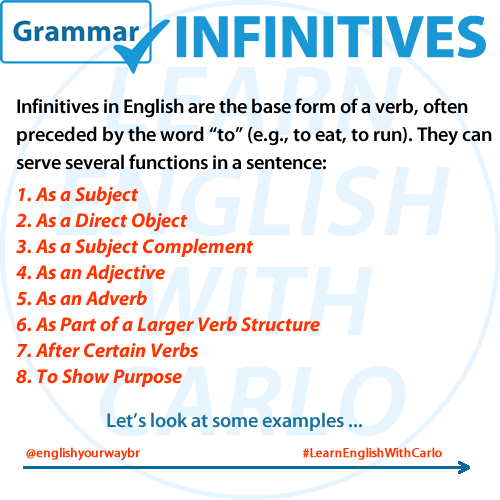
Infinitives are the base form of a verb, usually preceded by “to” (e.g., to learn, to explore, to be). They’re incredibly versatile and are used in many ways to express purpose, intention, emotion, and more.
In this guide, we’ll break down the main uses of infinitives in English grammar, with examples that will make it easy to understand and use them in everyday situations.
🔤 What Is an Infinitive?
An infinitive is the base form of a verb, often introduced by the word “to.” Examples:
to run
to eat
to understand
to be
Infinitives can act as nouns, adjectives, or adverbs, depending on how they’re used in a sentence.
🧩 1. Infinitive as a Subject
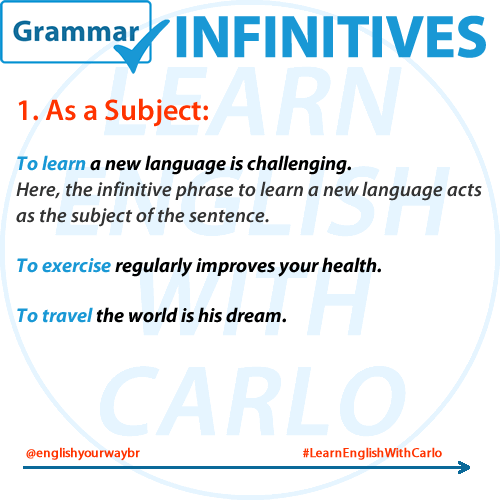
When an infinitive begins the sentence, it acts as the subject of the verb.
📌 Examples:
To read is to open your mind.
To travel broadens your perspective.
🧠 Tip: If you can replace the phrase with “something,” it’s probably a subject. (E.g., Something broadens your perspective.)
🎯 2. Infinitive as a Direct Object
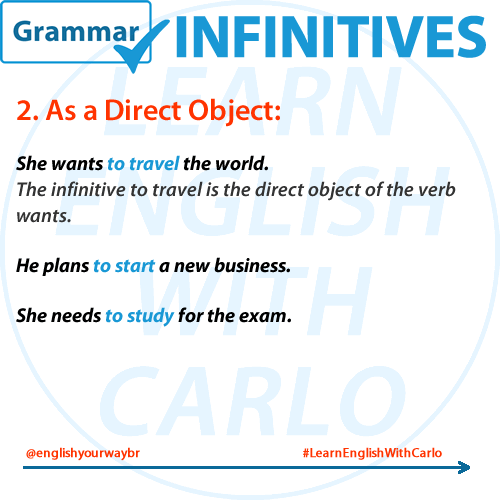
After some verbs, the infinitive functions as the direct object — the thing being acted upon.
📌 Examples:
She loves to dance.
He plans to study abroad.
Common verbs that are followed by infinitives include: want, hope, decide, learn, agree, need, promise, plan, expect.
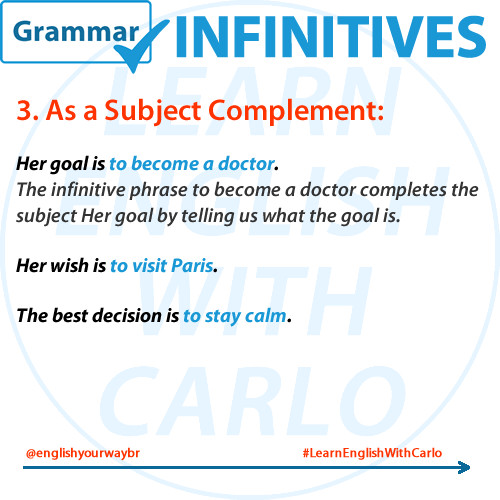
💬 3. Infinitive as a Subject Complement
When used after a linking verb (like is, was, seems), the infinitive completes or renames the subject.
📌 Examples:
Her dream is to write a novel.
The goal is to finish on time.
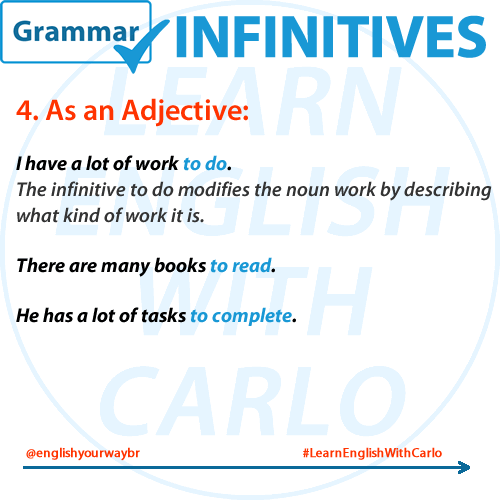
🧱 4. Infinitive as an Adjective
Infinitives can describe a noun, acting like adjectives that give more information.
📌 Examples:
I have a lot of things to do.
There’s a book to read on the table.
Here, the infinitive tells us which things or book.
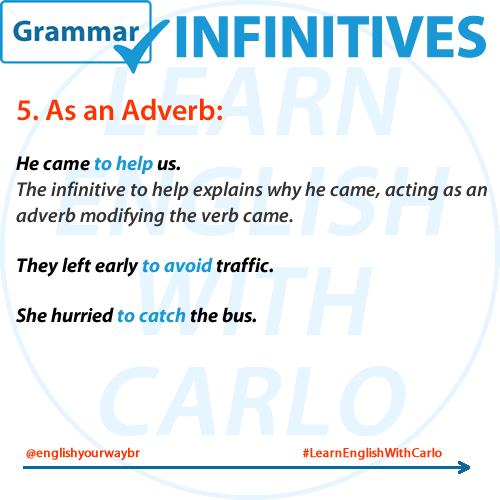
⏱️ 5. Infinitive as an Adverb
Infinitives can also describe why something is done — modifying a verb, adjective, or another adverb.
📌 Examples:
They left early to catch the train.
She studies hard to succeed.
These infinitives answer “Why?”.
🔗 6. Infinitive After Certain Verbs
Some verbs are always followed by infinitives (never gerunds). These include: hope, decide, want, promise, agree, learn, need, refuse, plan.
📌 Examples:
He promised to help with the project.
They decided to join the class.
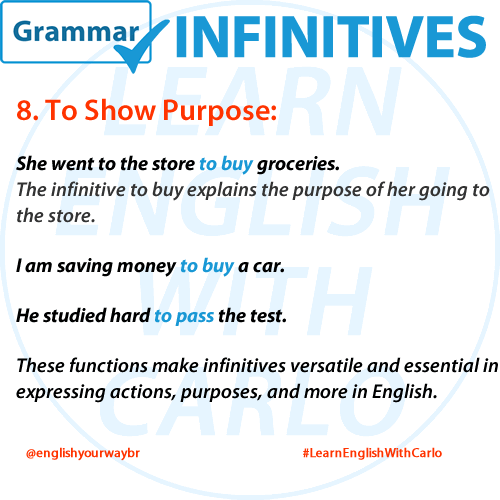
🛠️ 7. Infinitive to Show Purpose
This is one of the most common and useful uses of infinitives — to express purpose or reason for an action.
📌 Examples:
She saved money to buy a new laptop.
He practices daily to improve his skills.
🧠 Why did she save money? To buy something. Why does he practice? To improve.
📝 Practice: Fill in the Blank with an Infinitive
I want ___ a new language. (learn)
She left work early ___ her child. (pick up)
Their goal is ___ the tournament. (win)
We need ___ harder next time. (try)
This is a problem ___ quickly. (solve)
Answers:
to learn
to pick up
to win
to try
to solve
📌 Summary Chart: Uses of Infinitives
Use
Example
Subject
To learn English is important.
Direct Object
He wants to travel.
Subject Complement
The goal is to win.
Adjective
I have homework to finish.
Adverb
She runs to stay healthy.
After Certain Verbs
They agreed to help.
To Show Purpose
He studies to pass the test.
✅ Conclusion
Infinitives are essential tools in English grammar. They help you express actions, goals, purposes, and feelings clearly and effectively. With a bit of practice, you’ll be using infinitives like a pro!
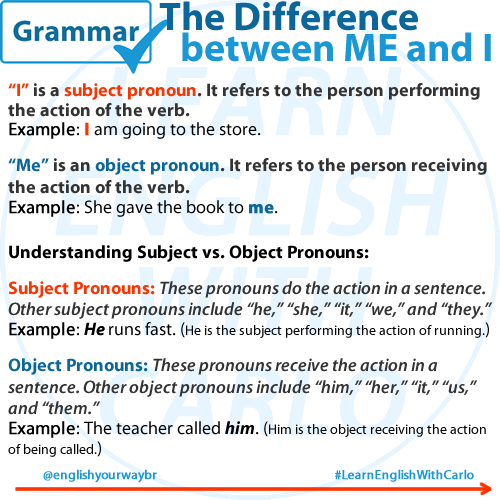
One of the most common mistakes English learners (and even native speakers!) make is using “I” and “me” incorrectly. While they both refer to the same person — the speaker — they are used in different parts of a sentence. In this post, we’ll explain the difference and give you lots of examples so you can feel confident using them correctly.
🔤 The Quick Answer
✅ Use “I” when you are the subject of a sentence.
✅ Use “me” when you are the object of a sentence.
🔍 What is a Subject? What is an Object?
The subject does the action.
Example: 🧍♂️ I like pizza. → I am doing the action (liking).
The object receives the action.
Example: 🍕 My friend invited me to dinner. → Me is receiving the action (being invited).
📚 More Examples
Sentence
Correct or Incorrect?
Why?
I went to the store.
✅ Correct
“I” is the subject.
She saw me at the park.
✅ Correct
“Me” is the object.
Me went to the store.
❌ Incorrect
You need “I” as the subject.
She saw I at the park.
❌ Incorrect
“Me” should be the object.
🤝 When There Are Two People
Many mistakes happen when there’s more than one person in the sentence.
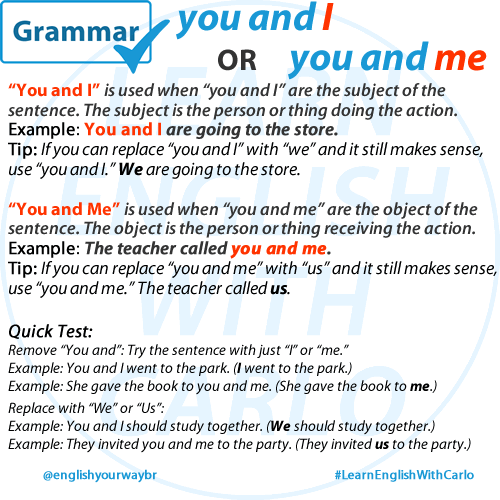
🧍♂️🧍♀️ Example: My brother and I went to the concert. ✅ My brother and me went to the concert. ❌
💡 Tip: Remove the other person and test the sentence.
“I went to the concert.” ✅
“Me went to the concert.” ❌
So, “My brother and I” is correct.
Another example: She gave the tickets to my brother and me. ✅ She gave the tickets to my brother and I. ❌
Again, remove the other person:
“She gave the tickets to me.” ✅
“She gave the tickets to I.” ❌
So, “my brother and me” is correct here.
✅ A Quick Rule of Thumb
🔄 When in doubt, try the sentence with just “I” or “me” and see what sounds correct.
🧠 Mini Quiz
Choose the correct word: I or me
Sarah and ___ are going to the beach.
Can you help John and ___?
___ love watching movies on weekends.
They invited Alex and __ to the party.
___ don’t like spicy food.
Answers:
I
me
I
me
I
📝 Summary
Use
Pronoun
Example
Subject of the sentence
I
I am learning English.
Object of the sentence
Me
She called me yesterday.
🌟 Final Tip
Don’t feel bad if you get confused sometimes — even native speakers make this mistake in casual speech. But now that you know the rules, you’re one step ahead!
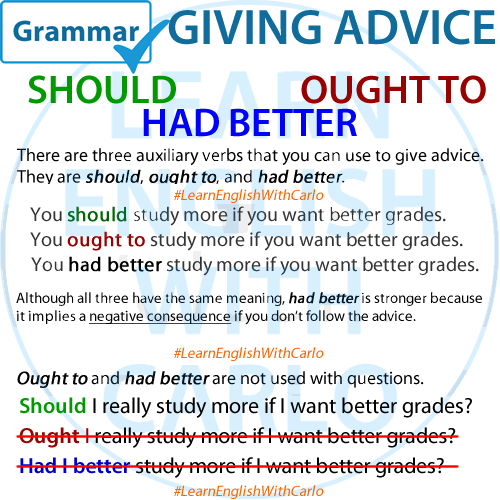
When giving advice in English, we often use the modal verbs “should,” “ought to,” and “had better.” Each of these has its nuances and specific contexts where they are more appropriate. Let’s explore how to use them, their differences, and how they work in questions and negative sentences.
Using SHOULD
“Should” is the most common modal verb for giving advice. It is used to suggest that something is a good idea or the right thing to do.
Positive Sentences:
You should eat more vegetables.
She should call her parents more often.
Negative Sentences:
You shouldn’t eat too much sugar.
He shouldn’t skip his classes.
Questions:
Should I bring an umbrella?
Should we invite them to the party?
Using OUGHT TO
“Ought to” is very similar to “should” and can often be used interchangeably. However, “ought to” can sound slightly more formal or emphatic.
Positive Sentences:
You ought to see a doctor.
They ought to apologize for their mistake.
Negative Sentences:
You ought not to (oughtn’t to) smoke so much. (Note: “ought not to” is less common and can sound a bit formal or old-fashioned)
She ought not to lie to her friends.
Questions:
Ought I to finish this report today? (Less common and sounds formal)
Ought we to help them with their project?
Using HAD BETTER
“Had better” is used to give strong advice or warnings. It implies that there will be negative consequences if the advice is not followed.
Positive Sentences:
You had better finish your homework before going out.
He had better take an umbrella; it looks like rain.
Negative Sentences:
You had better not be late for the meeting.
She had better not forget to call her mom.
Questions:(Not commonly used in questions)
Hadn’t you better go now? (This form is quite rare and sounds old-fashioned)
Differences Between SHOULD, OUGHT TO, and HAD BETTER
Formality and Emphasis:
“Should” is neutral and commonly used in everyday conversation.
“Ought to” is slightly more formal and emphatic.
“Had better” is used for strong advice or warnings, indicating possible negative consequences.
Usage in Negative Sentences:
“Should” and “shouldn’t” are commonly used.
“Ought not to” is grammatically correct but less commonly used.
“Had better not” is the standard form for negative sentences with “had better.”
Usage in Questions:
“Should” is commonly used in questions.
“Ought to” can be used in questions but sounds formal.
“Had better” is rarely used in questions and sounds old-fashioned when it is.
Examples in Context
Should:
Positive: “You should read this book; it’s really good.”
Negative: “You shouldn’t stay up too late.”
Question: “Should I wear this dress to the party?”
Ought to:
Positive: “You ought to respect your elders.”
Negative: “You ought not to interrupt when someone is speaking.”
Question: “Ought we to check the weather before leaving?”
Had Better:
Positive: “You had better lock the door when you leave.”
Negative: “You had better not forget your passport.”
Question: “Hadn’t you better get started on your assignment?” (Rare and old-fashioned)
Conclusion
Using “should,” “ought to,” and “had better” correctly can help you give advice more effectively in English. Remember that “should” is the most versatile and commonly used, “ought to” is slightly more formal, and “had better” is used for strong advice or warnings. Practice using them in different contexts to become more comfortable with their nuances!
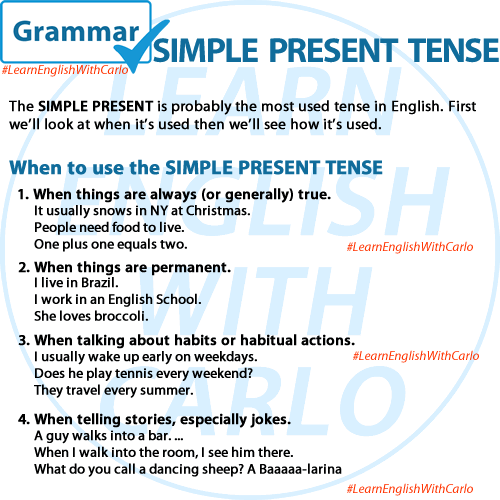
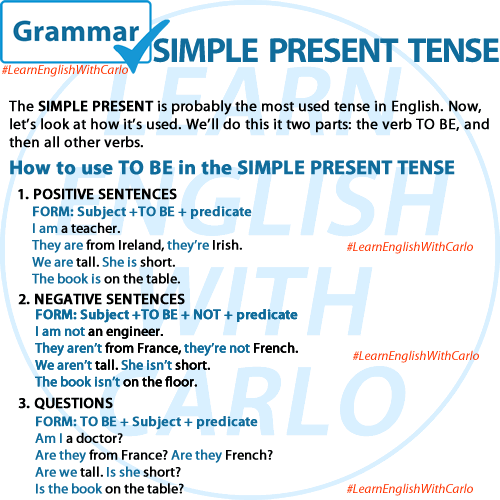
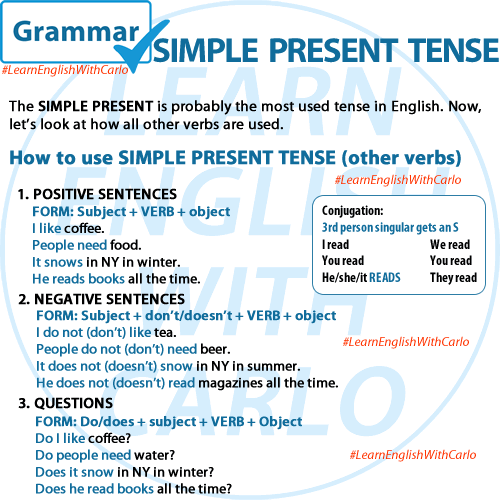
The SIMPLE PRESENT is probably the most used tense in English. First, we’ll look at when it’s used then we’ll see how it’s used.
When to use the SIMPLE PRESENT TENSE
1. When things are always (or generally) true. It usually snows in NY at Christmas. People need food to live. One plus one equals two.
2. When things are permanent. I live in Brazil. I work in an English School. She loves broccoli.
3. When talking about habits or habitual actions. I usually wake up early on weekdays. Does he play tennis every weekend? They travel every summer.
4. When telling stories, especially jokes. A guy walks into a bar. … When I walk into the room, I see him there. What do you call a dancing sheep? A Baaaaa-larina
I like coffee. People need food. It snows in NY in winter. He reads books all the time.
Conjugation:
3rd person singular gets an S
I read You read He/she/it READS We read You read They read
2. NEGATIVE SENTENCES
FORM: Subject + don’t/doesn’t + VERB + object
I do not (don’t) like tea. People do not (don’t) need beer. It does not (doesn’t) snow in NY in summer. He does not (doesn’t) read magazines all the time.
3. QUESTIONS
FORM: Do/does + subject + VERB + Object
Do I like coffee? Do people need water? Does it snow in NY in winter? Does he read books all the time?
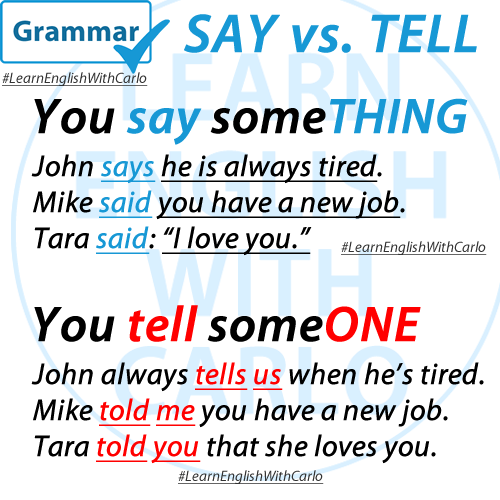
SAY and TELL have similar meanings. They both mean to communicate verbally with someone. But we often use them differently.
The best way to remember say and tell is:
You say something to someone
You tell someone something
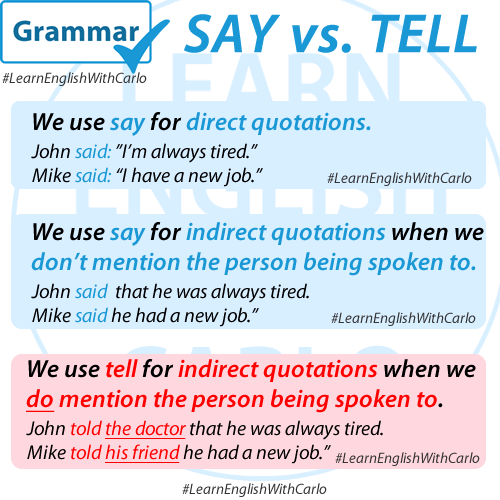
SAY is immediately followed by a noun clause (He said (that) he was right) or, if it is followed by a personal object, we include the preposition to (He said to his father that he was right).
TELL is followed by an object noun or pronoun (Can you tell me who is right?)
SAY
We sometimes use “to someone” after we use say, for example:
He said to me that he was tired.
Janet said to John that he had done very well.
We use say with direct speech, for example:
Paul said, “Hi Julia! How are you?” Julia said, “Well, I’m having a birthday party tomorrow, would you like to come?” Paul said, “I’m working tomorrow” Julia said, “Oh, well you can come later if you want to”
More examples with say:
Susan said (that) she was tired.
Anthony says you found a new job. Congratulations!
James said he loved her.
TELL
We follow tell with a personal object, for example:
I told everyone it was time to go home.
We use tell for orders and advice using the structure: tell + object + infinitive, for example:
She told him to sit down.
There are some fixed phrases we always use tell with, not say.
tell (someone) a story
tell (someone) a lie
tell (someone) the truth
tell the future
tell the time
tell a joke
More examples with tell:
Tania told Charlie, “Turn off the TV now, I have to study”
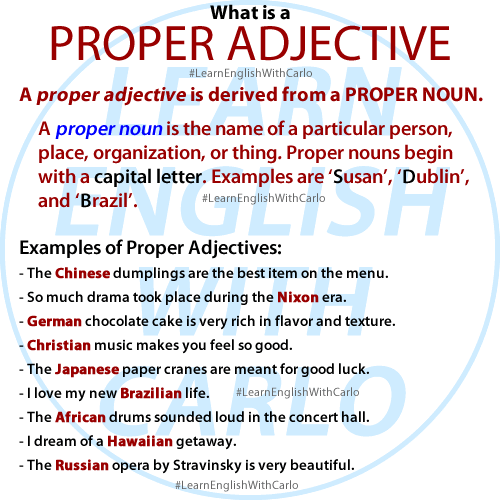
In English, proper adjectives are derived from proper nouns, which name specific people, places, organizations, or things. What makes proper adjectives unique is that they always begin with a capital letter, just like the proper nouns they come from. These adjectives allow us to describe things with precision, linking the characteristics of a person, country, or culture to the noun being modified.
What is a Proper Noun?
A proper noun is the specific name of a person, place, or thing. It distinguishes one person, place, or thing from others in the same category. Proper nouns are always capitalized, regardless of where they appear in a sentence. Some examples include:
Susan (a person’s name)
Dublin (a city)
Brazil (a country)
Apple (a company)
Now, when we take these proper nouns and turn them into adjectives, we create proper adjectives.
What is a Proper Adjective?
A proper adjective is formed from a proper noun and is used to describe something by linking it to the noun it originates from. Proper adjectives must also be capitalized. Let’s look at some examples:
The CHINESE dumplings are the best item on the menu.
Here, Chinese is a proper adjective derived from the proper noun China.
So much drama took place during the NIXON era.
The proper adjective Nixon refers to the U.S. President Richard Nixon, giving the era a specific historical reference.
GERMAN chocolate cake is very rich in flavor and texture.
German comes from Germany, connecting the cake to its origin or style.
CHRISTIAN music makes you feel so good.
Christian is derived from the religion Christianity, describing a particular style of music.
The JAPANESE paper cranes are meant for good luck.
Japanese relates to the country Japan, referencing the cultural significance of paper cranes in Japan.
I love my new BRAZILIAN life.
Brazilian is a proper adjective based on Brazil, highlighting a lifestyle connected to the country.
The AFRICAN drums sounded loud in the concert hall.
African comes from Africa and refers to a style of drums typical in that region.
I dream of a HAWAIIAN getaway.
Hawaiian is derived from Hawaii, implying a vacation destination connected to the islands.
The RUSSIAN opera by Stravinsky is very beautiful.
Russian refers to Russia, indicating the origin of the opera.
Why Use Proper Adjectives?
Proper adjectives add specificity and cultural or geographical context to what you’re describing. Instead of saying “a type of dumplings,” you can specify Chinese dumplings, bringing in associations with a particular cuisine. It gives the sentence more flavor and helps the reader visualize or understand what you’re referring to.
Common Proper Adjectives in Use
Proper adjectives are commonly used in everyday language without us realizing it. Here are a few more examples:
Mexican cuisine is full of rich flavors.
She loves watching French films.
The Victorian era was a time of great change.
My favorite holiday is Italian Christmas.
In each of these examples, the proper adjective provides clarity and context, whether about food, movies, or historical periods.
Tips for Using Proper Adjectives
Always capitalize proper adjectives, just like you would with proper nouns.
Don’t overuse proper adjectives in writing; they should add specific context but not overwhelm the sentence.
Check the correct form of the proper adjective as some can have slightly irregular formations. For instance, France becomes French, not Francian.
By understanding and correctly using proper adjectives, you can enrich your writing and speak with greater precision.