Your Guide to Building Better Sentences When you’re learning English, you might hear a lot about clauses. But what exactly are they, and why are they important? This guide will break down the basics of …
Figures of speech are words or expressions used in a non-literal, creative way to make language more vivid and expressive.Writers and speakers use them to create imagery, add emotion, and make ideas easier to remember. …
QUIT “Quit” is a verb that means to stop or cease doing something. When someone quits an activity, job, or habit, they discontinue or give up that particular action or commitment. “Quit” can also imply …
Countable and uncountable nouns are two categories used to classify nouns based on whether they can be counted or not. Countable Nouns:Countable nouns refer to objects or entities that can be counted as discrete units.They …
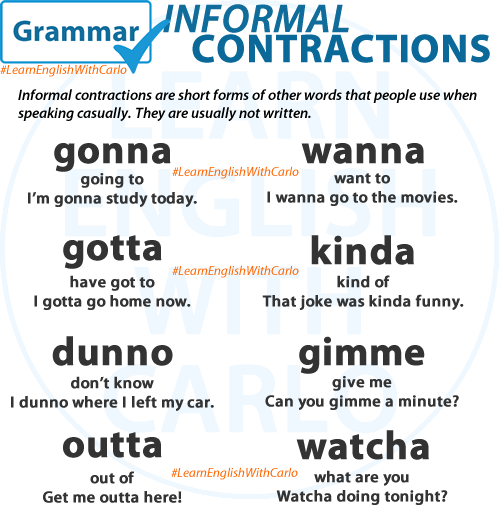
In English, as in most other languages, there are ways to shorten groups of words that commonly go together. We don’t do this in writing, just when we speak. They are called informal or spoken contractions.
Here are some examples:
I’ve got to go soon – I’ve gotta go soon.
I’m going to play tennis – I’m gonna play tennis.
I need to talk to you – I needa talk to you.
I want to say something – I wanna say something.
I have to leave early – I hafta leave early.
He has to leave early, too – He hasta leave early, too.
I had to do it – I hadda do it.
Can you give me a ride? – Can you gimme a ride?
Let me in, I forgot my key – Lemme in, I forgot my key.
The movie was kind of sad – The movie was kinda sad.
Let’s get out of here – Let’s get outta here.
I’d love a cup of coffee I’d love a cuppa coffee.
Tell them what you told me – Tellem what you told me.
I don’t know – I Dunno
I sort of wish I hadn’t gone -I sorta wish I hadn’t gone.
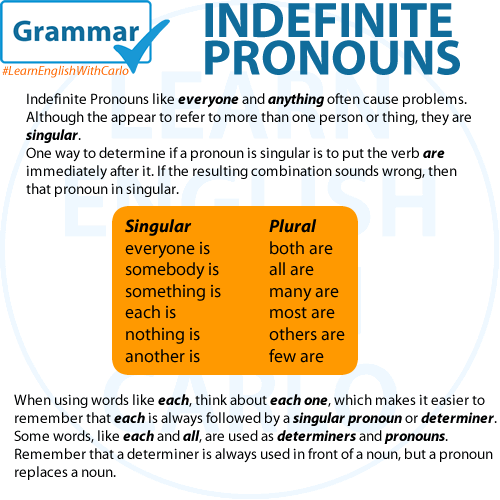
Indefinite Pronouns like everyoneand anythingoften cause problems. Although the appear to refer to more than one person or thing, they are SINGULAR. One way to determine if a pronoun is singular is to put the verb are immediately after it. If the resulting combination sounds wrong, then that pronoun is singular.
Singular
everyone is
somebody is
something is
each is
nothing is
another is
Plural
both are
all are
many are
most are
others are
few are
When using words like each, think about each one, which makes it easier to remember that each is always followed by a singular pronoun or determiner.
Some words like each and all are used as determiners and pronouns.
Remember that a determiner is always used in front of a noun, but a pronoun replaces a noun.
Conjunctions are essential parts of speech in English, connecting words, phrases, or clauses within a sentence. For ESL learners, understanding conjunctions is crucial for constructing clear and cohesive sentences. Conjunctions can be categorized into different types, each serving a specific purpose in expressing relationships between ideas.
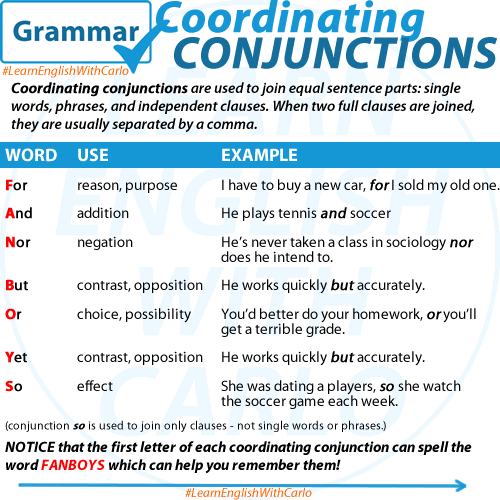
1. Coordinating Conjunctions: These conjunctions connect words, phrases, or clauses that are grammatically equal. The common coordinating conjunctions are “and,” “but,” “or,” “nor,” “for,” “yet,” and “so.” For example, “I like tea, but she prefers coffee.” Here, “but” connects two contrasting ideas.
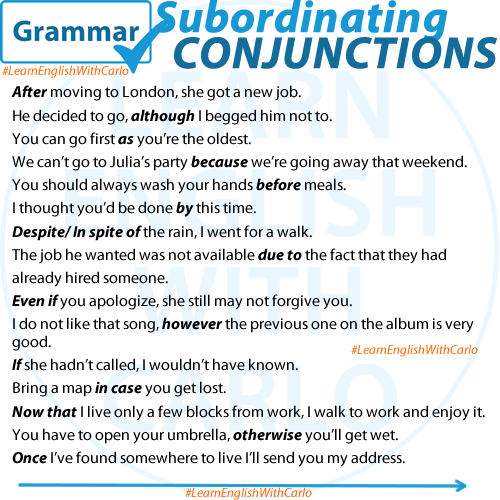
2. Subordinating Conjunctions: These conjunctions introduce subordinate clauses, which cannot stand alone as complete sentences. Subordinating conjunctions indicate relationships such as time, cause and effect, contrast, and condition. Examples include “although,” “because,” “when,” “while,” “if,” and “since.” For instance, “I’ll go for a walk if the weather improves.”
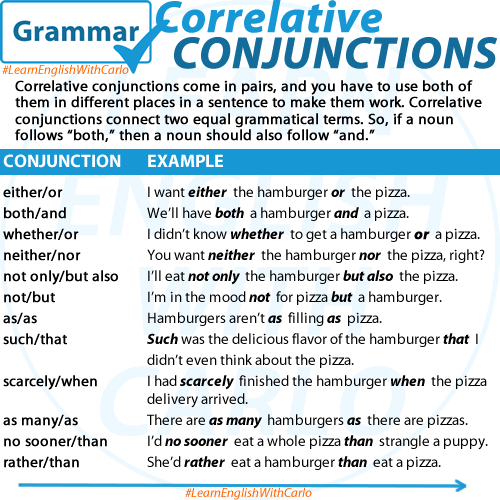
3. Correlative Conjunctions: These conjunctions work in pairs to join similar sentence elements. Common correlative conjunction pairs include “either…or,” “neither…nor,” “both…and,” “not only…but also,” and “whether…or.” For example, “He can either come now or call later.”
Tips for ESL Learners:
Learn the common conjunctions and their functions.
Pay attention to the context in which conjunctions are used to understand their meaning better.
Practice using conjunctions in sentences to express relationships between ideas effectively.
Be aware of the difference between coordinating, subordinating, and correlative conjunctions and their appropriate usage in sentences.
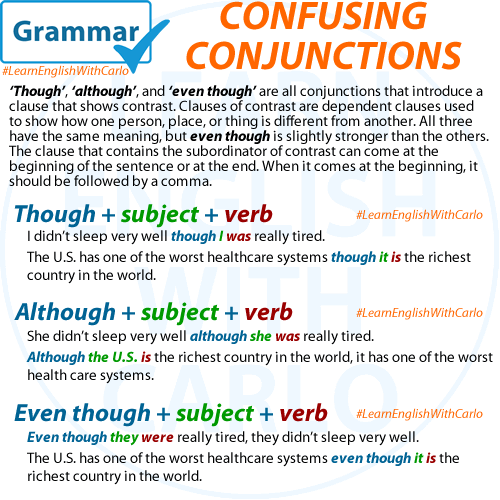
Conjunctions play a crucial role in connecting ideas within sentences, and when it comes to expressing contrast, three common ones stand out: “though,” “although,” and “even though.” Let’s delve deeper into how these conjunctions function and how they can elevate your writing!
1. Though
Usage: “Though” introduces a clause that presents a contrast to the main idea of the sentence.
Example: “I didn’t sleep very well though I was really tired.”
Explanation: Here, “though” sets up a contrast between the speaker being tired and not sleeping well.
2. Although
Usage: Similar to “though,” “although” also introduces a contrasting clause.
Example: “She didn’t sleep very well although she was really tired.”
Explanation: Despite being tired, the subject experiences difficulty sleeping, highlighting the contrast.
3. Even Though
Usage: “Even though” intensifies the contrast and emphasizes the unexpectedness of the outcome.
Example: “Even though they were really tired, they didn’t sleep very well.”
Explanation: This construction underscores the surprising fact that despite extreme tiredness, the subjects still struggle to sleep.
Placement of Contrasting Clauses:
These contrasting clauses can be positioned either at the beginning or end of a sentence.
When at the beginning: Remember to use a comma after the clause.
Example: “Though it is the richest country in the world, the U.S. has one of the worst healthcare systems.”
When at the end: No additional punctuation is needed.
Example: “The U.S. has one of the worst healthcare systems even though it is the richest country in the world.”
Understanding the nuances of these conjunctions empowers you to express contrasting ideas effectively in your writing. Practice using them to add depth and clarity to your sentences!
Tip: Experiment with different placements and conjunctions to find the most impactful way to convey contrast in your writing.
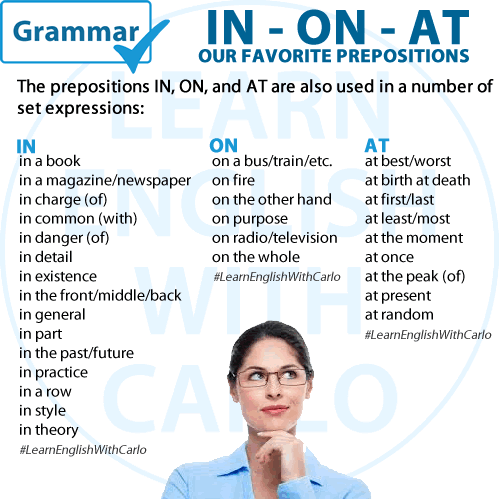
The prepositions IN, ON, and AT are also used in a number of set expressions: in a book/magazine newspaper in charge (of) in common (with) in danger (of) in detail in existence in the front/middle/back in general in part in the past/future in practice in a row in style in theory on a bus/train/etc. on fire on the other hand on purpose on radio/television on the whole at best/worst at birth at death at first/last at least/most at the moment at once at the peak (of) at present at random
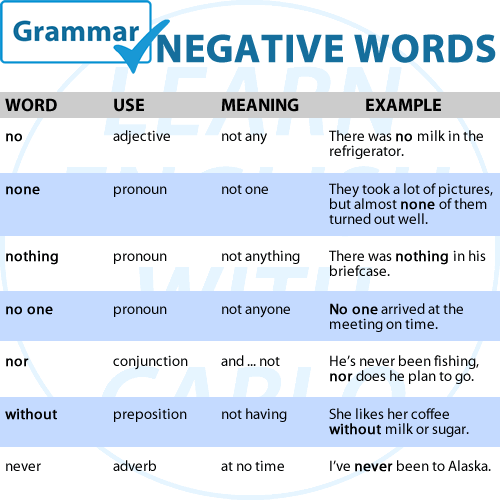
🚫 No, none, nothing, no one, nor, without, never… So many ways to say no! 😅
At first glance, these little words seem almost the same — they all express the idea of negation or absence. But in English, each one has its own special job in a sentence. Understanding how to use them correctly can make your speech and writing sound much more natural.
Let’s break them down one by one 👇
1. “No” – Means Zero of Something
We use no before a noun to mean not any or zero. It’s often used to emphasize the complete absence of something.
✅ Examples:
There’s no milk in the fridge.
I have no idea what you mean.
She has no friends in this city.
💡 Tip: You can often replace “no” with “not any.”
There’s not any milk in the fridge. → Same meaning!
2. “None” – Replaces a Noun
When you don’t want to repeat the noun, use none. It stands alone and means not any or zero amount.
✅ Examples:
How many apples are left? → None.
I looked for my keys, but found none.
💡 Tip: “None” is used without a noun after it — it replaces the noun.
3. “Nothing” – Zero Things
Use nothing to mean “not anything.” It’s a pronoun that refers to things — not people.
✅ Examples:
There’s nothing in the box.
He said nothing during the meeting.
🚫 Common mistake:
❌ I didn’t say anything. ✅ Correct. ❌ I didn’t say nothing. (double negative ❌)
4. “No One” – Zero People
When you want to talk about people, use no one (or “nobody”). It means “not a single person.”
✅ Examples:
No one called me last night.
No one knows the answer.
💡 “No one” = “Nobody” = “Not anyone.” But remember — “no one” is two words, not “noone”.
5. “Nor” – Connects Two Negative Ideas
Nor is often used after neither or another negative phrase. It connects two negative ideas in a sentence.
✅ Examples:
I don’t like tea, nor do I drink coffee.
She’s neither angry nor disappointed.
💡 Think of “nor” as the negative partner of “or.”
6. “Without” – Absence of Something
Without is a preposition. It means “not having” or “in the absence of.”
✅ Examples:
I can’t live without music.
He left without saying goodbye.
💡 It’s often followed by a noun or -ing verb.
without sugar, without saying, without sleeping…
7. “Never” – Not at Any Time
Never means not ever. It shows that something hasn’t happened — and usually won’t.
✅ Examples:
I’ve never been to Japan.
He never listens to me.
💡 You can think of “never” as a stronger version of “not ever.”
Common Mistake: Double Negatives
In English, we don’t usually use two negatives together in one clause. They cancel each other out or sound nonstandard.
❌ Incorrect: I don’t have no money. ✅ Correct: I don’t have any money. ✅ Also correct: I have no money.
✅ Quick Summary
Word
Meaning
Example
No
Zero of something
No sugar in my coffee.
None
Not any (replaces noun)
None of the answers are correct.
Nothing
Not anything
There’s nothing to do here.
No one
Not a single person
No one came to the party.
Nor
Connects negatives
She doesn’t smoke, nor does she drink.
Without
Lacking something
I can’t live without you.
Never
Not at any time
I’ve never tried sushi.
Final Tip
Practice these words in real sentences! Try writing examples about your daily life — for instance:
“I can’t start my day without coffee.”
“No one understands Mondays.”
“There’s nothing better than a good nap.”
The more you use them, the more natural they’ll feel. 💬
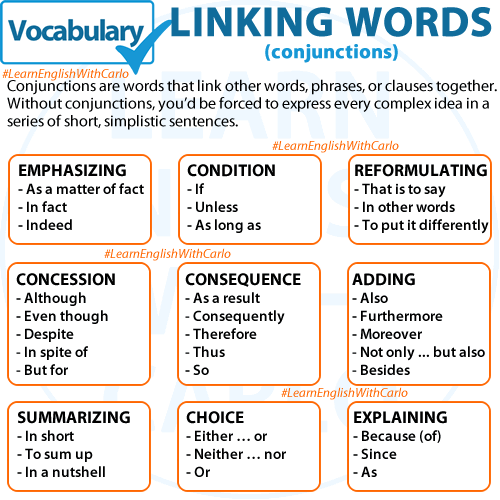
Conjunctions are words used to connect ideas within the same sentence. Depending on the relationship between ideas, we use different conjunctions. Here are some common types, their meanings, and examples:
Emphasizing
Definition: Highlighting the importance of an idea.
Indeed: Reinforces a statement. Example: This is a challenging project indeed.
As a matter of fact: Adds a surprising or clarifying fact. Example: She’s not just talented; as a matter of fact, she’s a prodigy.
In fact: Provides evidence to support an idea. Example: He looks young. In fact, he’s over 50.
Reformulating
Definition: Restating an idea for clarity.
To put it differently: Simplifies a statement. Example: The project is delayed. To put it differently, we need more time.
That is to say: Clarifies or specifies a point. Example: The car is electric, that is to say, it runs on batteries.
In other words: Explains an idea differently. Example: He’s economical; in other words, he doesn’t like to spend money.
Summarizing
Definition: Condensing multiple ideas into a brief statement.
In a nutshell: Expresses the main idea concisely. Example: In a nutshell, the movie was amazing.
In short: Summarizes key points. Example: The meeting was long. In short, we decided to postpone the launch.
To sum up: Highlights conclusions. Example: To sum up, teamwork is essential.
Condition
Definition: Indicates a requirement for something to happen.
As long as: Implies a condition is met. Example: You can borrow the book as long as you return it tomorrow.
If: Introduces a condition. Example: If it rains, we’ll stay indoors.
Unless: Suggests an exception. Example: I won’t go unless you come with me.
Consequence
Definition: Shows the result of an action or event.
So: Simplifies cause and effect. Example: I was tired, so I went to bed.
As a result: Indicates an effect. Example: The roads were icy; as a result, the game was canceled.
Therefore: Highlights a logical conclusion. Example: He was late; therefore, he missed the train.
Choice
Definition: Expresses alternatives.
Or: Presents options. Example: Do you want tea or coffee?
Either … or: Indicates two possibilities. Example: You can either walk or take the bus.
Neither … nor: Denies both options. Example: He’s neither a doctor nor a lawyer.
Concession
Definition: Admits something unexpected.
Despite: Expresses contrast succinctly. Example: We won the match despite our injuries.
Although: Contrasts ideas. Example: Although it was raining, we went hiking.
Even though: Strengthens contrast. Example: Even though she was tired, she stayed late to help.
Adding
Definition: Combines ideas for emphasis.
Moreover: Adds importance. Example: The plan is practical. Moreover, it’s cost-effective.
Also: Adds information. Example: She sings beautifully and also dances well.
Furthermore: Strengthens a point. Example: The book is well-written. Furthermore, it’s inspiring.
Explaining
Definition: Provides reasons or causes.
As: Explains why something happens. Example: I didn’t attend as I was feeling unwell.
Because (of): Shows the reason for something. Example: We canceled the trip because of bad weather.
Since: Introduces a reason. Example: Since it’s late, let’s go home.
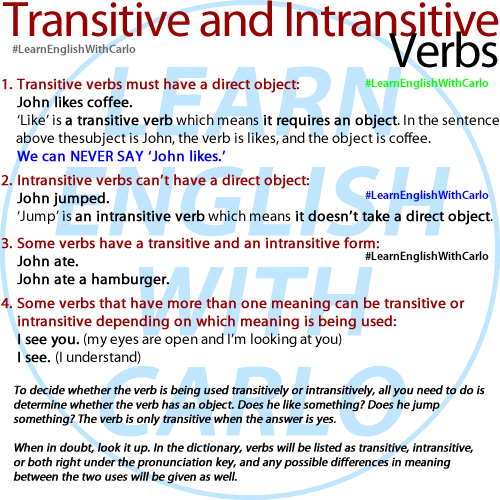
Verbs are the heart of every sentence. They tell us what’s happening — what the subject does or is. But did you know that some verbs need an object, while others stand alone?
That’s where transitive and intransitive verbs come in. Understanding the difference between them helps you build clear, grammatically correct sentences — and avoid mistakes like “John likes.”
1. What Are Transitive Verbs?
A transitive verb is a verb that needs a direct object to complete its meaning.
The object answers the question “What?” or “Whom?” after the verb.
Example:
John likes coffee.
Subject: John
Verb: likes
Object: coffee
The verb like is transitive because it requires an object. You can’t just say “John likes” — it sounds incomplete!
Think of it this way: If the action “goes to” or “affects” something, the verb is transitive.
More examples:
She opened the door.
They watched a movie.
I bought a car.
Each of these verbs (opened, watched, bought) needs an object to make sense.
2. What Are Intransitive Verbs?
An intransitive verb is a verb that does not take a direct object. It expresses a complete action by itself.
Example:
John jumped.
There’s no object after jumped — and that’s perfectly fine! The verb jump is intransitive here because the action doesn’t affect anything directly.
Other examples:
The baby cried.
We arrived late.
She slept all day.
Tip: You can’t ask “cried what?” or “slept what?” — those sentences don’t make sense because these verbs don’t take objects.
3. Verbs That Can Be Both Transitive and Intransitive
Some verbs can be both transitive and intransitive depending on how they’re used.
Example:
John ate. John ate a hamburger.
In the first sentence, ate has no object, so it’s intransitive. In the second, ate has the object a hamburger, so it’s transitive.
Same verb — different function depending on whether it has an object!
More examples:
She reads before bed. (intransitive)
She reads the newspaper. (transitive)
They run every morning. (intransitive)
They run a small café. (transitive — meaning “manage”)
4. When a Verb’s Meaning Changes
Some verbs have different meanings depending on whether they are used transitively or intransitively.
Example:
I see you. → (My eyes are looking at you.) → Transitive I see. → (I understand.) → Intransitive
Same verb, different meaning!
Other examples:
Run
Transitive: They run a business.
Intransitive: They run every day.
Change
Transitive: She changed her clothes.
Intransitive: The weather changed.
5. How to Identify Whether a Verb Is Transitive or Intransitive
Here’s a simple way to test it:
Ask “What?” or “Whom?” after the verb.
Does the sentence make sense if you add an object?
Does the action affect something directly?
If yes, the verb is transitive. If no, it’s intransitive.
Examples:
Does he like something? → Yes → Transitive
Does he jump something? → No → Intransitive
6. Check the Dictionary
When in doubt, look it up!
In a good English dictionary, you’ll see abbreviations right under the pronunciation guide:
[T] = Transitive
[I] = Intransitive
[T/I] = Both
You’ll also see examples for each use and, sometimes, different meanings depending on whether the verb takes an object.
Example (from a dictionary): run [I/T] — to move quickly on foot / to manage something
🧾 7. Quick Summary
Type
Definition
Example
Has Object?
Transitive Verb
Needs a direct object
She opened the door.
Yes
Intransitive Verb
No object needed
She arrived late.
No
Both
Can be either, depending on use
He runs every day. / He runs a company.
Sometimes
8. Practice Time
Try identifying whether the verbs below are transitive (T) or intransitive (I):
The sun rose at 6 a.m.
She plays the piano beautifully.
They laughed loudly.
He wrote a letter.
We slept for hours.
Answers:
I, 2. T, 3. I, 4. T, 5. I
In Summary
Understanding the difference between transitive and intransitive verbs helps you form complete and natural sentences.
Transitive verbs → need an object.
Intransitive verbs → stand alone.
Some verbs → can be both, depending on meaning.
Whenever you’re unsure, just check if the action affects something — or look it up in a dictionary. You’ll quickly see which type it is.