GRAMMAR – Comparatives & Superlatives

Comparative and superlative adjectives are essential tools in English grammar for comparing and expressing degrees of qualities or characteristics. This post will clarify these concepts with clear definitions, examples, and practical applications.
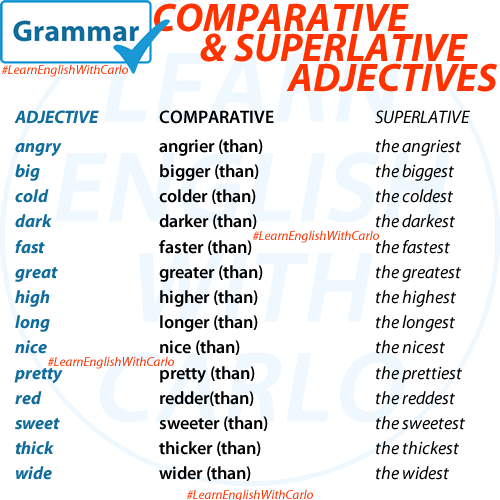
GRAMMAR – Comparatives & Superlatives

Comparative Adjectives

Definition: Comparative adjectives are used to compare two things or people and indicate which has a higher degree of a particular quality.

Formation:

  • For most adjectives: add “-er” to the adjective (for short adjectives) or use “more” before the adjective (for longer adjectives).
  • For adjectives ending in “y”: change the “y” to “i” and add “-er” (e.g., happy → happier).
  • For irregular adjectives: use completely different words (e.g., good → better, bad → worse).

Examples:

  1. Short adjective: fast → faster
    • The cheetah is faster than the lion.
  2. Long adjective: beautiful → more beautiful
    • Paris is more beautiful than London.
  3. Adjective ending in “y”: happy → happier
    • She seems happier today.
  4. Irregular adjectives: good → better, bad → worse
    • Her performance was better than expected.
    • The weather today is worse than yesterday.

Superlative Adjectives

Definition: Superlative adjectives are used to compare three or more things or people and indicate which has the highest degree of a particular quality.

Formation:

  • For most adjectives: add “-est” to the adjective (for short adjectives) or use “most” before the adjective (for longer adjectives).
  • For adjectives ending in “y”: change the “y” to “i” and add “-est” (e.g., happy → happiest).
  • For irregular adjectives: use completely different words (e.g., good → best, bad → worst).

Examples:

  1. Short adjective: fast → fastest
    • The cheetah is the fastest animal on land.
  2. Long adjective: beautiful → most beautiful
    • Venice is one of the most beautiful cities in the world.
  3. Adjective ending in “y”: happy → happiest
    • She is the happiest person I know.
  4. Irregular adjectives: good → best, bad → worst
    • This is the best restaurant in town.
    • That was the worst movie I’ve ever seen.

Key Differences

  • Comparative: Used to compare two things or people.
  • Superlative: Used to compare three or more things or people.
  • Formation: Follow specific rules based on adjective length and irregular forms.

Practical Applications

  • Use comparative adjectives to indicate differences between two items.
  • Use superlative adjectives to highlight the highest degree of a quality among a group.

Conclusion: Understanding how to use comparative and superlative adjectives effectively allows you to express comparisons clearly and accurately in English. Practice using these forms in sentences to improve your language skills and communicate with precision.
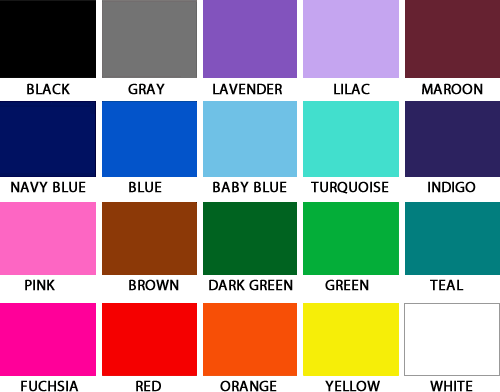
COLORS

What’s your favorite color? Who knew there were so many colors? And this is only a small sample.

Here is a list of the colors shown in the image:

  1. Black
  2. Gray
  3. Lavender
  4. Lilac
  5. Maroon
  6. Navy Blue
  7. Blue
  8. Baby Blue
  9. Turquoise
  10. Indigo
  11. Pink
  12. Brown
  13. Dark Green
  14. Green
  15. Teal
  16. Fuchsia
  17. Red
  18. Orange
  19. Yellow
  20. White

If you have any questions or doubts, please ask in the comments or send me a private message.

Follow me on Instagram: @englishyourwaybr
or look for the hashtag #LearnEnglishWithCarlo

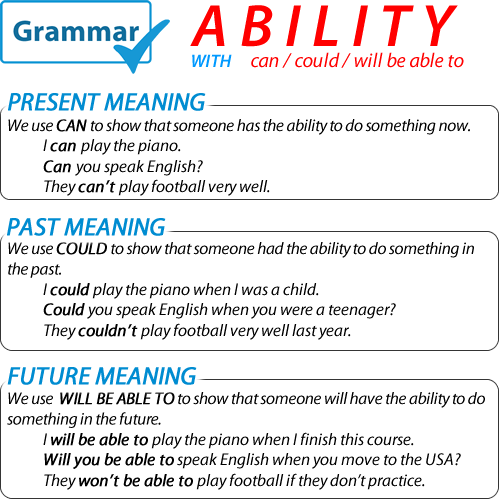
Understanding Ability in English: CAN, COULD, and WILL BE ABLE TO

In English, we use different forms to express someone’s ability to do something, whether in the present, past, or future. Let’s explore how CAN, COULD, and WILL BE ABLE TO are used to talk about ability.

1. CAN – Ability in the Present

We use CAN to show that someone has the ability to do something now.

  • Examples:
    • I can play the piano.
    • Can you speak English?
    • They can’t play football very well.

CAN is used for general abilities and skills someone possesses at the moment.


2. COULD – Ability in the Past

COULD is the past form of CAN. It is used to show that someone had the ability to do something in the past.

  • Examples:
    • I could play the piano when I was a child.
    • Could you speak English when you were a teenager?
    • They couldn’t play football very well last year.

Use COULD when talking about abilities that existed at an earlier time, but not necessarily in the present.


3. WILL BE ABLE TO – Ability in the Future

To express future ability, we use WILL BE ABLE TO. This shows that someone will have the ability to do something in the future.

  • Examples:
    • I will be able to play the piano when I finish this course.
    • Will you be able to speak English when you move to the USA?
    • They won’t be able to play football if they don’t practice.

WILL BE ABLE TO is necessary because we don’t use CAN directly for the future tense.


Summary:

  • CAN = Present ability
  • COULD = Past ability
  • WILL BE ABLE TO = Future ability

Wrong shortcode initialized

GRAMMAR – COMMON CONTRACTIONS

GRAMMAR – COMMON CONTRACTIONS

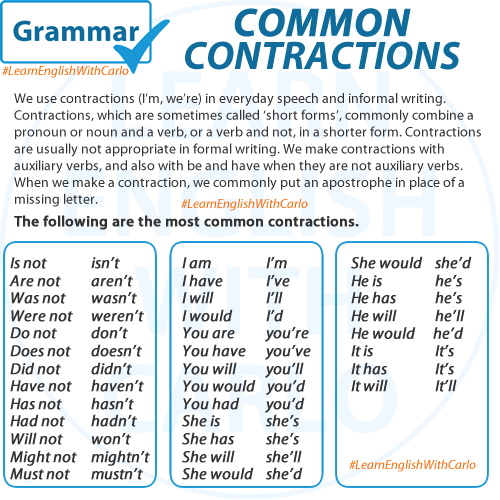
We use contractions (I’m, we’re) in everyday speech and informal writing. Contractions, which are sometimes called ‘short forms’, commonly combine a pronoun or noun and a verb, or a verb and not, in a shorter form. Contractions are usually not appropriate in formal writing. We make contractions with auxiliary verbs, and also with be and have when they are not auxiliary verbs. When we make a contraction, we commonly put an apostrophe in place of a missing letter.

The following are the most common contractions with examples:

  • Is not – isn’t

    • He isn’t coming to the party.
  • Are not – aren’t

    • They aren’t ready yet.
  • Was not – wasn’t

    • She wasn’t feeling well yesterday.
  • Were not – weren’t

    • We weren’t aware of the change in plans.
  • Do not – don’t

    • I don’t like mushrooms.
  • Does not – doesn’t

    • She doesn’t know the answer.
  • Did not – didn’t

    • He didn’t see the movie.
  • Have not – haven’t

    • I haven’t finished my homework.
  • Has not – hasn’t

    • She hasn’t called me back.
  • Had not – hadn’t

    • They hadn’t expected such a large crowd.
  • Will not – won’t

    • He won’t be able to join us.
  • Might not – mightn’t

    • She mightn’t come to the meeting.
  • Must not – mustn’t

    • You mustn’t touch the painting.
  • I am – I’m

    • I’m going to the store.
  • I have – I’ve

    • I’ve already eaten lunch.
  • I will – I’ll

    • I’ll see you tomorrow.
  • I would – I’d

    • I’d love to visit Paris someday.
  • You are – you’re

    • You’re very kind.
  • You have – you’ve

    • You’ve done a great job.
  • You will – you’ll

    • You’ll enjoy the concert.
  • You would – you’d

    • You’d be surprised by how much you can learn.
  • You had – you’d

    • You’d better leave early to avoid traffic.
  • She is – she’s

    • She’s coming over for dinner.
  • She has – she’s

    • She’s finished her project.
  • He is – he’s

    • He’s the new manager.
  • He has – he’s

    • He’s completed the assignment.
  • It is – it’s

    • It’s raining outside.
  • It has – it’s

    • It’s been a long day.
  • It will – it’ll

    • It’ll be fun to see everyone at the reunion.

GRAMMAR – Telling the Time

GRAMMAR – Telling the Time

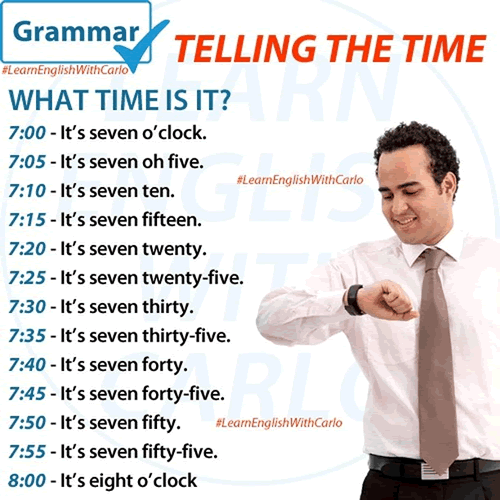
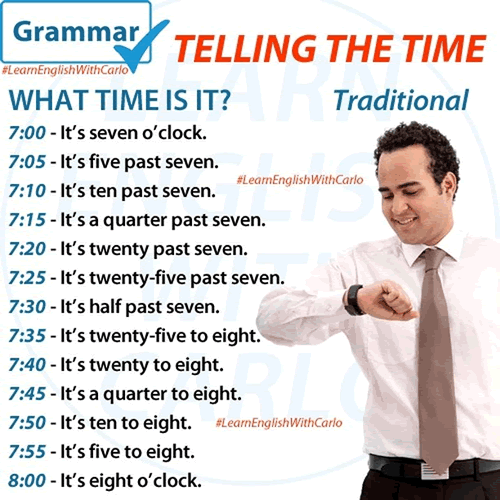
There are two ways to tell the time in English.

The TRADITIONAL British way and the NEWER American way.

In the traditional British way, we say the minutes, or portion of an hour (quarter or half), followed by a preposition (past, or to) and then the hour.

The US method is more direct and often easier for English learners to grasp. We say the time as if we were reading a digital clock.

So, for example, 09:20 would be “twenty past nine” in the traditional method, and “nine twenty” in the new method.

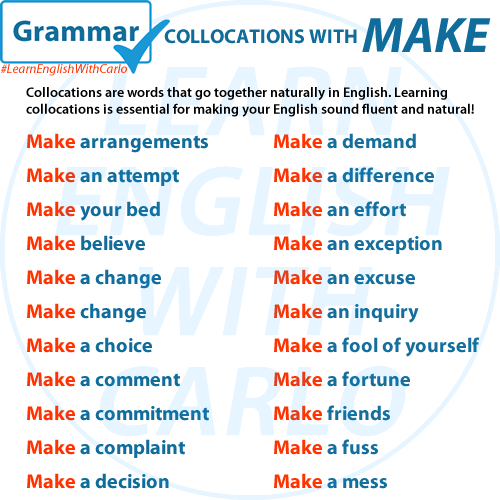
GRAMMAR – Collocations with MAKE & DO

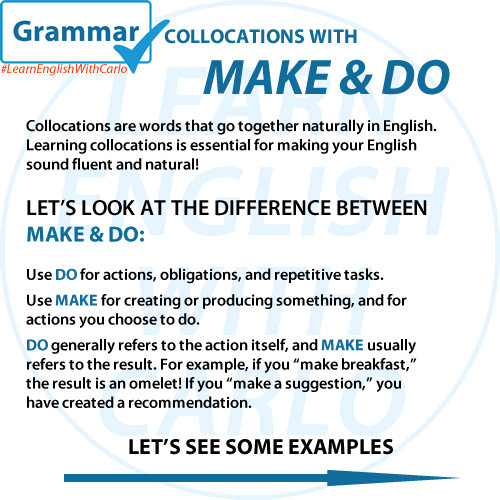
Collocations are words that go together naturally in English.
Learning collocations is essential for making your English sound fluent and natural!

LET’S LOOK AT THE DIFFERENCE BETWEEN MAKE & DO:
Use DO for actions, obligations, and repetitive tasks.
Use MAKE for creating or producing something, and for actions you choose to do.

DO generally refers to the action itself, and MAKE usually refers to the result.

For example, if you make breakfast, the result is an omelet! If you make a suggestion, you have created a recommendation.
Make arrangements
Make an attempt
Make your bed
Make believe
Make a change
Make change
Make a choice
Make a comment
Make a commitment
Make a complaint
Make a decision
Make a demand
Make a difference
Make an effort
Make an exception
Make an excuse
Make an inquiry
Make a fool of yourself
Make a fortune
Make friends
Make a fuss
Make a mess

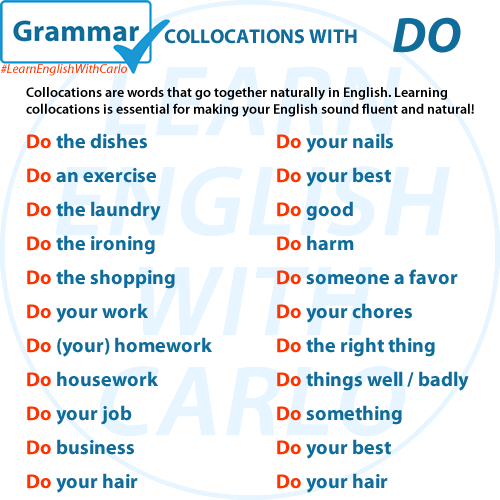
Do your nails
Do your best
Do good
Do harm
Do someone a favor
Do your chores
Do the right thing
Do things well / badly
Do something
Do your best
Do your hair
Do the dishes
Do an exercise
Do the laundry
Do the ironing
Do the shopping
Do your work
Do (your) homework
Do housework
Do your job
Do business
Do your hair

Wrong shortcode initialized

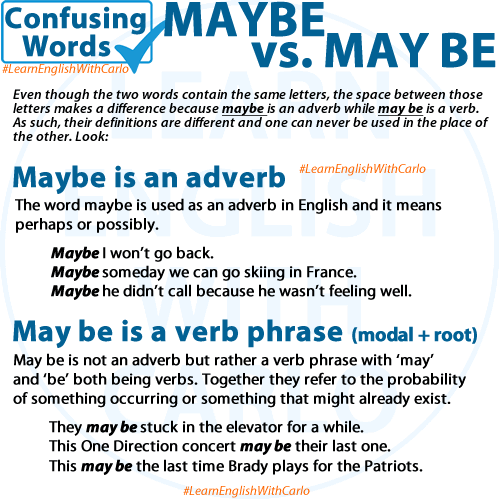
GRAMMAR – MAYBE vs MAY BE

MAYBE vs MAY BE

Even though the two words contain the same letters, the space between those letters makes a difference because maybe is an adverb while may be is a verb. As such, their definitions are different and one can never be used in the place of the other. Look:

MAY BE (Verb Phrase)

  • Definition: May be is a verb phrase that uses the auxiliary/modal verb may followed by the verb be.
  • Usage: May be suggests possibility and is often used to say that something might happen, might be true, or might exist.
  • Examples:
    • “She may be the one calling you later.” (There is a possibility she will call.)
    • “It may be a good idea to wait until tomorrow.” (There’s a chance waiting until tomorrow is a good idea.)

Tip: You can often replace may be with might be in a sentence, and the meaning remains the same.

MAYBE (Adverb)

  • Definition: Maybe is an adverb that means perhaps or possibly.
  • Usage: Maybe is often used at the beginning of a sentence to suggest a possible idea or outcome. It can also be used to answer questions with uncertainty or to introduce a suggestion.
  • Examples:
    • “Maybe we should go to the park.” (Perhaps we should go to the park.)
    • “Are you coming to the meeting?” “Maybe.” (Possibly, but uncertain.)

Tip: Think of maybe as being similar to other adverbs like perhaps or possibly, used to indicate an unsure or tentative suggestion.

Key Differences

May BeMaybe
Verb phrase (may + be)Adverb
Describes a possibility about a situation, action, or conditionSuggests uncertainty or possibility on its own, similar to perhaps
Example: “He may be at home.”Example: “Maybe he is at home.”

Remember: If you can substitute perhaps or possibly in the sentence, maybe is likely correct. If you’re discussing the possibility of something being or happening, may be is likely correct.

Wrong shortcode initialized

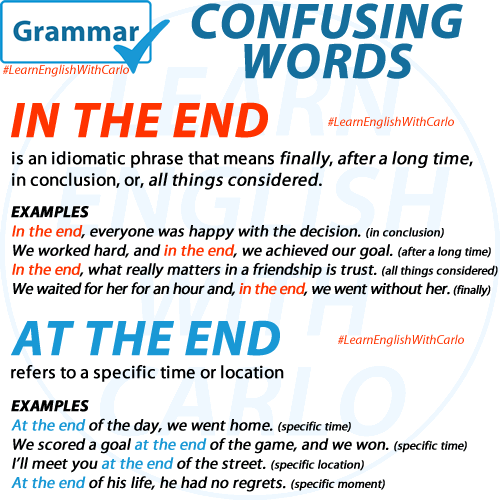
GRAMMAR – AT THE END vs IN THE END

GRAMMAR – AT THE END vs IN THE END

English learners often confuse the phrases at the end and in the end because they sound similar. However, their meanings and usage are distinct. Let’s break them down and look at some examples to help you use these phrases correctly.

What Does AT THE END Mean?

At the end refers to a specific time, place, or point. You use it when you’re talking about something that happens at the conclusion of a particular event, period, or location.

Common Structures:

  • At the end of + noun (e.g., at the end of the day)
  • At the end + location (e.g., at the end of the road)

Examples of AT THE END:

  1. At the end of the day, we went home.
    (Specific time: the conclusion of the day.)
  2. We scored a goal at the end of the game, and we won.
    (Specific time: the final moments of the game.)
  3. I’m going on holiday at the end of the week.
    (Specific time: the last part of the week.)
  4. At the end of his life, he had no regrets.
    (Specific point: the conclusion of his life.)
  5. The shop is at the end of the street.
    (Specific place: the farthest point of the street.)

What Does IN THE END Mean?

In the end is an idiomatic expression that means finally, after a long time, or after considering everything. It’s often used to summarize the outcome of a situation or to explain what happened after some effort, waiting, or deliberation.

Common Uses:

  • To indicate a conclusion after a process.
  • To show that something happened despite earlier uncertainty or effort.

Examples of IN THE END:

  1. In the end, everyone was happy with the decision.
    (Finally: after discussions, a positive result.)
  2. We worked hard, and in the end, we achieved our goal.
    (After a long time: persistence led to success.)
  3. In the end, what really matters in a friendship is trust.
    (All things considered: trust is the most important aspect.)
  4. We waited for her for over an hour, and in the end, we went without her.
    (Finally: after waiting a long time, they left.)
  5. He was reluctant to try sushi at first, but in the end, he loved it.
    (Finally: despite initial hesitation, he enjoyed it.)

How to Remember the Difference

Here’s a simple way to keep them straight:

  • Use at the end when you’re talking about specific points in time or space.
  • Use in the end when you’re talking about conclusions, results, or final outcomes.

Quick Tip:

If you can replace the phrase with “finally”, use in the end. If not, you likely need at the end.

Wrong shortcode initialized

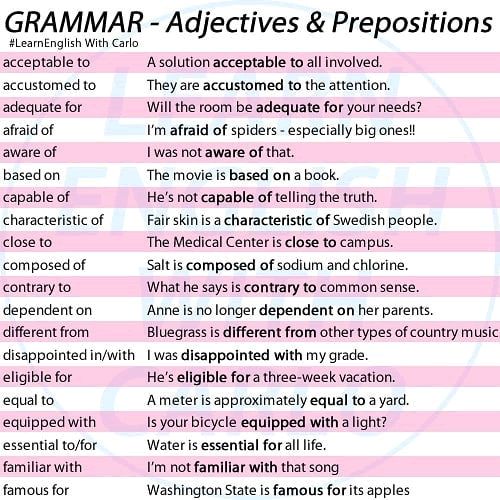
GRAMMAR – Adjectives & Prepositions

Some adjectives need a preposition before their object. There doesn’t seem to be a logical rule, I’m afraid! We just need to learn them.

  • A solution ACCEPTABLE TO all involved.
  • They are ACCUSTOMED TO the attention.
  • Will the room be ADEQUATE FOR your needs?
  • I’m AFRAID OF spiders – especially big ones!!
  • I was not AWARE OF that.
  • The movie is BASED ON a book.
  • He’s not CAPABLE OF telling the truth.
  • Fair skin is a CHARACTERISTIC OF Swedish people.
  • The Medical Center is CLOSE TO campus.
  • Salt is COMPOSED OF sodium and chlorine.
  • What he says is CONTRARY TO common sense.
  • Anne is no longer DEPENDENT ON her parents.
  • Bluegrass is DIFFERENT FROM other types of country music.
  • I was DISAPPOINTED WITH my grade.
  • He’s ELIGIBLE FOR a three-week vacation.
  • A meter is approximately EQUAL TO a yard.
  • Is your bicycle EQUIPPED WITH a light?
  • Water is ESSENTIAL FOR all life.
  • I’m not FAMILIAR WITH that song.
  • Washington State is FAMOUS FOR its apples.


Wrong shortcode initialized

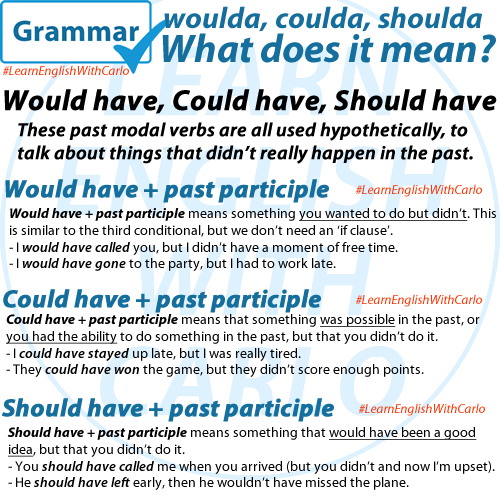
Woulda, Coulda, Shoulda – What Does It Mean?

You may have heard native English speakers use phrases like woulda, coulda, or shoulda. But what do they mean? These are informal, spoken forms of would have, could have, and should have. These past modal verbs are used to talk about things that didn’t happen, but that we imagine or wish had been different.

Let’s break down what each one means and how to use them.

WOULD HAVE + PAST PARTICIPLE

When we use would have + past participle, we are talking about something we wanted to do, but didn’t actually do. It’s similar to the third conditional, but without the need for an “if” clause.

Examples:

  • I would have called you, but I didn’t have a moment of free time.
  • I would have gone to the party, but I had to work late.

In these sentences, the speaker is imagining a different situation, but it didn’t happen because of other circumstances.

COULD HAVE + PAST PARTICIPLE

We use could have + past participle to talk about something that was possible in the past, or when someone had the ability to do something, but didn’t.

Examples:

  • I could have stayed up late, but I was really tired.
  • They could have won the game, but they didn’t score enough points.

Here, the speaker talks about missed possibilities—things that could have happened, but didn’t.

SHOULD HAVE + PAST PARTICIPLE

Should have + past participle expresses regret or advice about something that would have been a good idea in the past, but wasn’t done.

Examples:

  • You should have called me when you arrived (but you didn’t, and now I’m upset).
  • He should have left early; then he wouldn’t have missed the plane.

In these examples, should have is used to give a sense of what the right action would have been, but it’s too late now to change the past.


Summary:

  • Would have talks about things we wanted to do, but didn’t.
  • Could have talks about possibilities or abilities we didn’t use.
  • Should have talks about things that would have been good ideas, but weren’t done.

Understanding these past modals helps you discuss hypothetical situations and regrets about the past in English. So next time you hear someone say woulda, coulda, shoulda, you’ll know exactly what they mean!

Wrong shortcode initialized