Your Guide to Building Better Sentences When you’re learning English, you might hear a lot about clauses. But what exactly are they, and why are they important? This guide will break down the basics of …
Figures of speech are words or expressions used in a non-literal, creative way to make language more vivid and expressive.Writers and speakers use them to create imagery, add emotion, and make ideas easier to remember. …
QUIT “Quit” is a verb that means to stop or cease doing something. When someone quits an activity, job, or habit, they discontinue or give up that particular action or commitment. “Quit” can also imply …
Countable and uncountable nouns are two categories used to classify nouns based on whether they can be counted or not. Countable Nouns:Countable nouns refer to objects or entities that can be counted as discrete units.They …
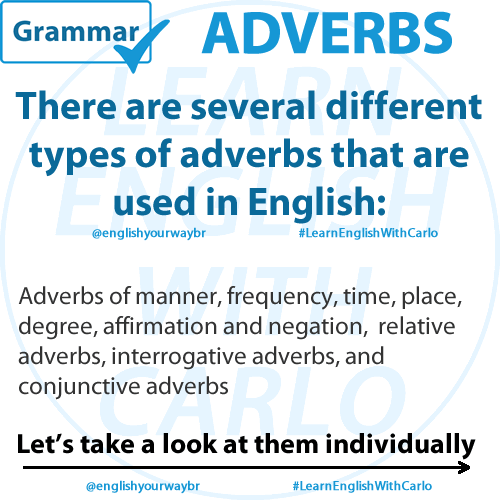
An adverb is a word that modifies or describes a verb, adjective, or other adverb. It provides additional information about how, when, where, or to what extent an action or quality is performed. Several different types of adverbs are used in English:
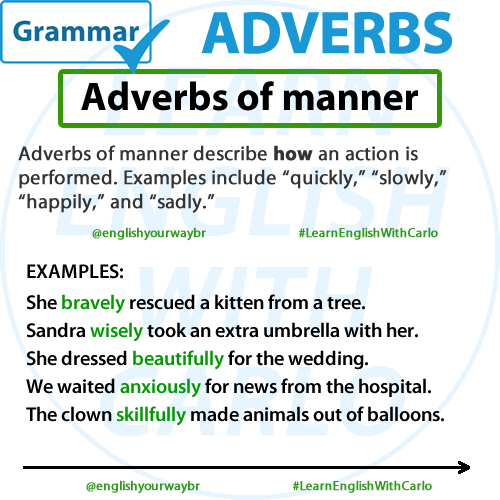
Adverbs of manner: Adverbs of manner describe howan action is performed. Examples include “quickly,” “slowly,” “happily,” and “sadly.”
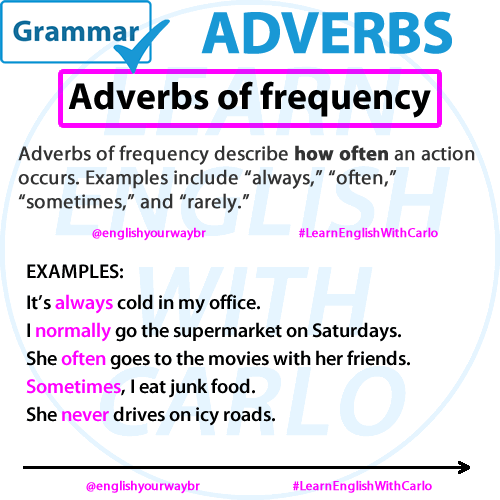
Adverbs of frequency: Adverbs of frequency describe how oftenan action occurs. Examples include “always,” “often,” “sometimes,” and “rarely.”
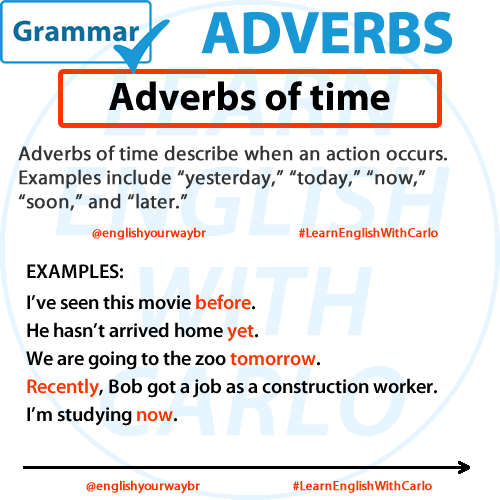
Adverbs of time: Adverbs of time describe whenan action occurs. Examples include “yesterday,” “today,” “now,” “soon,” and “later.”
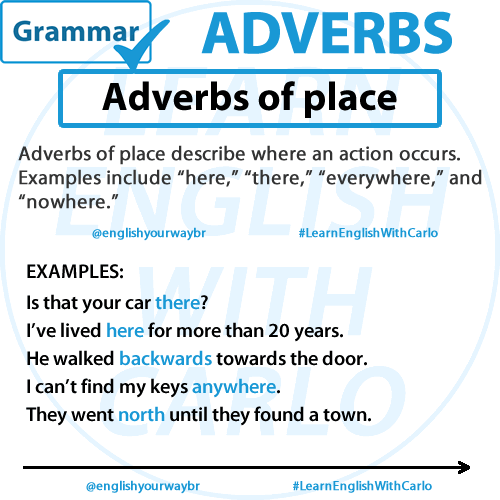
Adverbs of place: Adverbs of place describe wherean action occurs. Examples include “here,” “there,” “everywhere,” and “nowhere.”
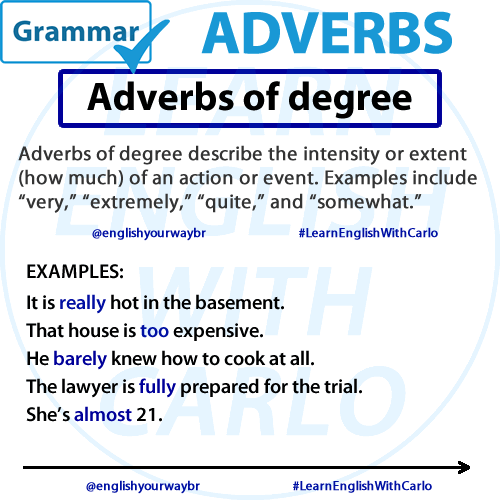
Adverbs of degree: Adverbs of degree describe the intensity or extent (how much) of an action or event. Examples include “very,” “extremely,” “quite,” and “somewhat.”
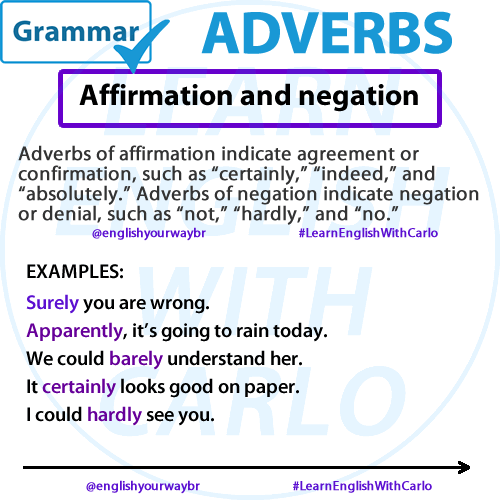
Adverbs of affirmation and negation: Adverbs of affirmation indicate agreement or confirmation, such as “certainly,” “indeed,” and “absolutely.” Adverbs of negation indicate negation or denial, such as “not,” “never,” and “no.”
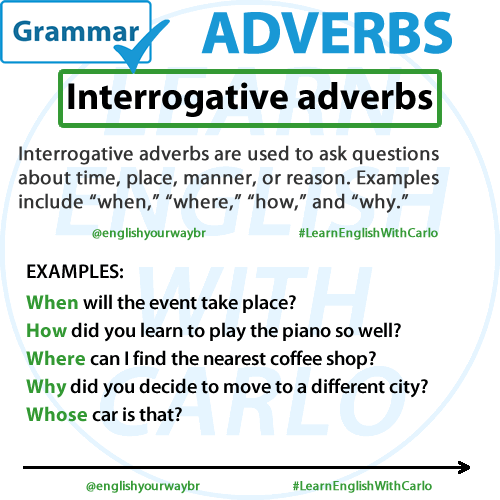
Interrogative adverbs: Interrogative adverbs are used to ask questions about time, place, manner, or reason. Examples include “when,” “where,” “how,” and “why.”
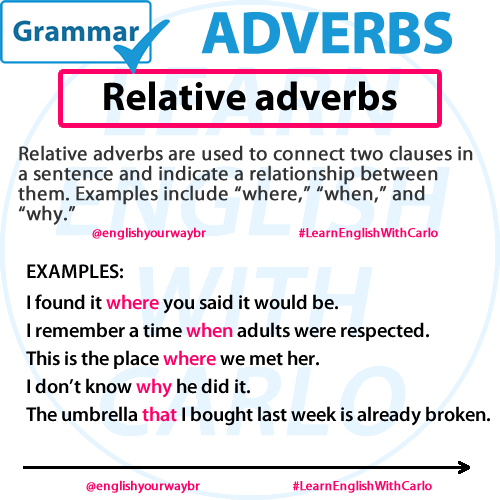
Relative adverbs: Relative adverbs are used to connect two clauses in a sentence and indicate a relationship between them. Examples include “where,” “when,” and “why.”
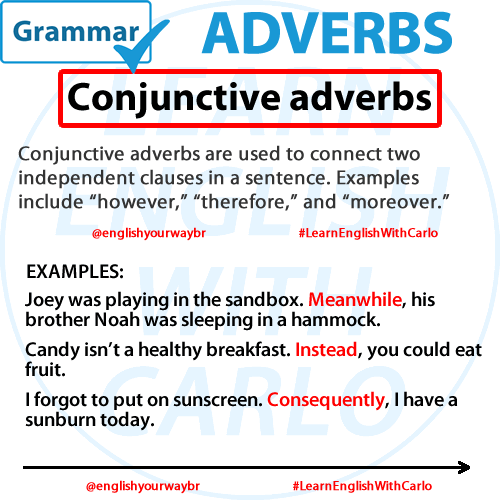
Conjunctive adverbs: Conjunctive adverbs are used to connect two independent clauses in a sentence. Examples include “however,” “therefore,” and “moreover.”
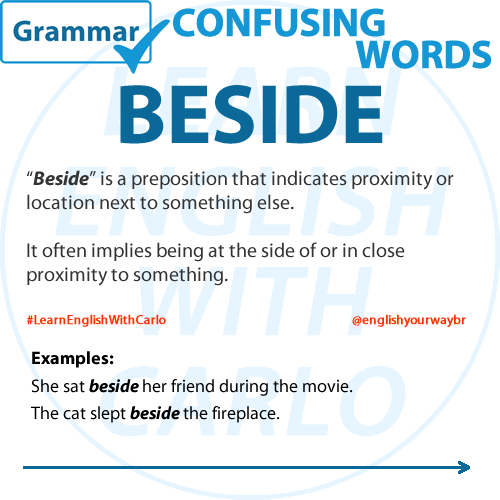
Beside: “Beside” is a preposition that indicates proximity or location next to something else. It often implies being at the side of or in close proximity to something.
Examples: She sat beside her friend during the movie. The cat slept beside the fireplace.
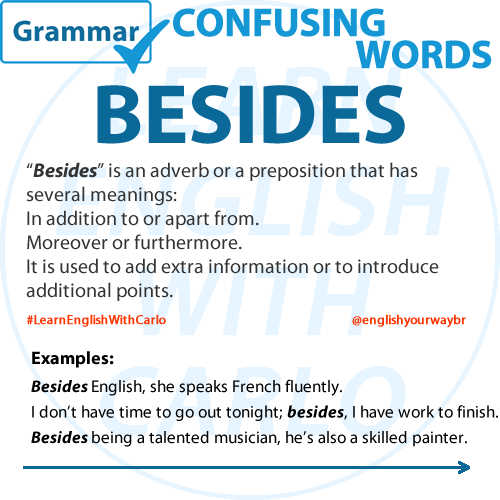
Besides: “Besides” is an adverb or a preposition that has several meanings: In addition to or apart from. Moreover or furthermore. It is used to add extra information or to introduce additional points.
Examples: Besides English, she speaks French fluently. I don’t have time to go out tonight; besides, I have work to finish. Besides being a talented musician, he’s also a skilled painter.
Remember, “besides” can also function as a preposition, similar to “beside,” but its primary use is as an adverb introducing additional information or points.
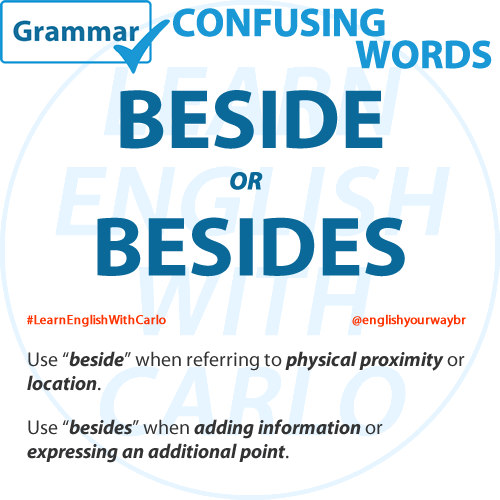
To differentiate between the two: Use “beside” when referring to physical proximity or location. Use “besides” when adding information or expressing an additional point.
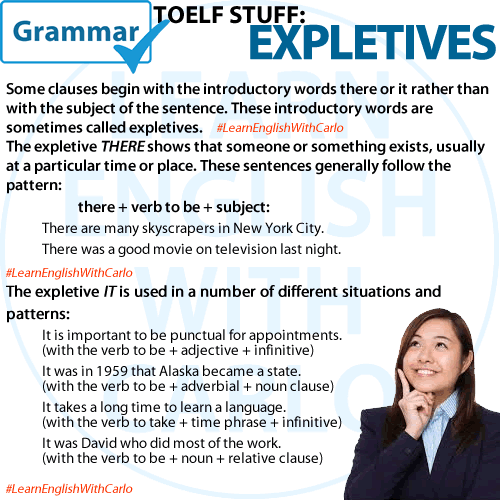
Some clauses begin with the introductory words THERE or IT rather than with the subject of the sentence. These introductory words are sometimes called expletives. The expletive THERE shows that someone or something exists, usually at a particular time or place. These sentences generally follow the pattern there + verb to be + subject:
There are many skyscrapers in New York City. There was a good movie on television last night.
The expletive IT is used in a number of different situations and patterns:
It is important to be punctual for appointments. (with the verb to be + adjective + infinitive)
It was in 1959 that Alaska became a state. (with the verb to be + adverbial + noun clause)
It takes a long time to learn a language. (with the verb to take + time phrase + infinitive)
It was David who did most of the work. (with the verb to be + noun + relative clause)
The present perfect forms have gone to and have been to are often confused in English. However, there are clear differences between the two forms.
The present perfect forms have gone to and have been to are commonly used to refer to movement to another place. Notice the differences in the examples below.
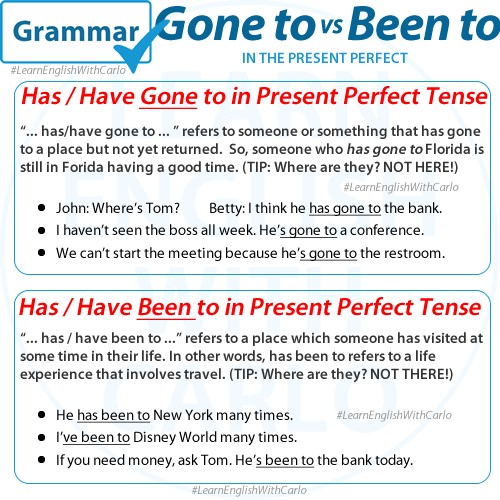
Has / Have Gone to in Present Perfect Tense
Has / have gone to refers to someone who has gone to a place but has but not yet returned. In other words, someone who has gone to Hawaii is still in Hawaii having a good time.
Here are some examples: He’s gone to the bank. He should be back soon. Where has Tom gone to? They’ve gone to a business conference for the week.
Has / Have Been to in Present Perfect Tense
Has / have been to refers to a place which someone has visited at some time in their life. In other words, has been to refers to an experience that involves travel. The form has / have been to always indicate that the person has returned or is no longer there.
Here are some examples: He’s been to London many times. I’ve been to Disneyland twice. If you need money, ask Tom. He’s been to the bank today.
Been to vs. Gone to Summary
Been to: Refers to visiting a place and returning.
Gone to: Refers to someone traveling to a place and still being there or on their way.
You can include examples for both in a structured table for better clarity.
Phrase
Explanation
Example
Been to
Visited a place and returned.
“I’ve been to Paris twice.”
Gone to
Traveled to a place and is still there or hasn’t returned.
“She has gone to the store.”
Other Similar Expressions
1. Been in
Definition:
Refers to someone being physically present in a place for a period of time, often emphasizing duration.
Examples:
“She has been in London for three months.” (She is still in London now.)
“I have been in this class since 9 a.m.” (I have not left the class yet.)
Common Usage Tip: Use been in to focus on time spent in a place or an ongoing stay.
Compare with:
“She has been to London three times.” (Emphasizes past visits, not ongoing presence.)
2. Been away
Definition:
Refers to someone being absent from a usual or expected location, often indicating time spent elsewhere.
Examples:
“I’ve been away for a week.” (I went somewhere else and just came back.)
“He has been away on business.” (He is currently not here because of work.)
Common Usage Tip: Use been away when referring to someone’s absence from their usual location or home.
3. Gone for
Definition:
Indicates someone has left a location for a specific purpose or duration.
Examples:
“She has gone for a walk.” (She is not back yet; she’s currently out walking.)
“They have gone for lunch.” (They are eating lunch somewhere now.)
Common Usage Tip: Use gone for to highlight the purpose of the absence or action.
4. Been there
Definition:
Refers to having personal experience with a situation or place, often informally.
Examples:
“I’ve been there before—it’s a lovely restaurant.”
“Oh, I’ve been there! It’s tough to lose your wallet.” (Refers to an emotional or relatable experience.)
“Been there, done that” (I’ve already gone through this, so I know how it goes.)
Common Usage Tip: This phrase can be literal (place) or metaphorical (situation).
Practice Exercise
Fill in the blanks with “been in,” “been away,” “gone for,” or “been there”:
I’ve ______ Paris for a year, and I love it here.
She has ______ a walk to the park; she’ll be back soon.
I’ve ______ on vacation, so I didn’t see your message.
He has ______ before — it’s hard when you lose your first job.
A lot of my students ask me for tips on ways they can improve their English outside the classroom.
Here are a few that Ilike to pass along.
Listen to songs in English and try to identify and understand the words and the meaning.
Watch TV series, movies and the news. Use English subtitles if you need.
Watch TED Talks or other lectures on YouTube. You can control the speed if the speaker is talking too fast.
Record yourself and listen to it. This is great if you are recording something and have the original source audio – then you can compare yours with the original.
Exchange text messages with other students and friends. This is a great way to help each other.
Change the operating system of your phone, TV, Cable TV, PC, laptop to English. This will help you a lot.
Read as much as you can in English – books, magazines, newspapers, etc.
Keep a notebook with you to write down any new words or things you don’t understand.
If you have any questions or doubts, please ask in the comments or send me a private message.
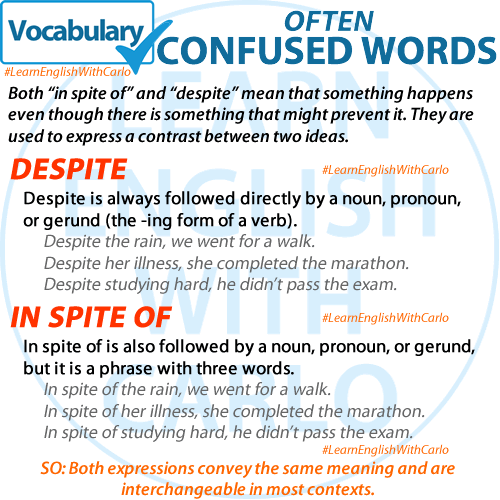
Both “in spite of” and “despite” mean that something happens even though there is something that might prevent it. They are used to express a contrast between two ideas.
Structure
Despite
“Despite” is always followed directly by a noun, pronoun, or gerund (the -ing form of a verb).
Example:
Despite the rain, we went for a walk.
Despite her illness, she completed the marathon.
Despite studying hard, he didn’t pass the exam.
In Spite Of
“In spite of” is also followed by a noun, pronoun, or gerund, but it is a phrase with three words.
Example:
In spite of the rain, we went for a walk.
In spite of her illness, she completed the marathon.
In spite of studying hard, he didn’t pass the exam.
Key Points to Remember
Length: “Despite” is shorter (one word) compared to “in spite of” (three words).
Formality: Both can be used in formal and informal contexts, but “despite” may sound slightly more formal or concise in some cases.
No ‘of’ after Despite: Never use “of” after “despite.” It’s always just “despite.”
Correct: Despite the cold weather.
Incorrect: Despite of the cold weather.
Same meaning: Both expressions convey the same meaning and are interchangeable in most contexts.
Examples with Explanations
Despite
Despite the heavy traffic, we arrived on time.
(We arrived on time even though there was heavy traffic.)
Despite being tired, she finished her homework.
(She finished her homework even though she was tired.)
In Spite Of
In spite of the heavy traffic, we arrived on time.
(We arrived on time even though there was heavy traffic.)
In spite of being tired, she finished her homework.
(She finished her homework even though she was tired.)
Practice Exercise
Ask your students to rewrite sentences using “in spite of” and “despite”:
It was raining. We went out.
Despite the rain, we went out.
In spite of the rain, we went out.
He was ill. He went to work.
Despite his illness, he went to work.
In spite of his illness, he went to work.
Visual Aid
Create a simple chart or visual aid to illustrate the structure differences:
Expression
Example
Structure
Despite
Despite the rain, we went outside.
Despite + noun/gerund
In Spite Of
In spite of the rain, we went out.
In spite of + noun/gerund
This visual aid can help students quickly grasp the differences in structure and usage.
Conclusion
By practicing these structures and understanding that “despite” and “in spite of” are interchangeable with slight differences in form, your students should be able to use both expressions correctly and confidently.
Phrasal verbs with “get” are versatile and widely used in English. They combine with prepositions or adverbs to convey various meanings, making them essential for both casual and formal communication. Here’s a closer look at some common phrasal verbs with “get,” their meanings, and examples to help you understand them better.
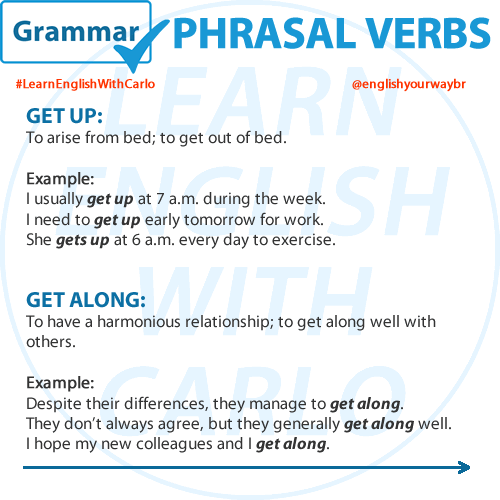
GET UP
Meaning: To arise from bed; to get out of bed. Examples:
I usually get up at 7 a.m. during the week.
On weekends, I prefer to get up late and relax.
This phrasal verb is frequently used when talking about starting your day.
GET ALONG
Meaning: To have a harmonious relationship; to interact well with others. Examples:
Despite their differences, they manage to get along.
My brother and I didn’t get along when we were kids, but now we’re very close.
This is a great way to describe relationships, especially when harmony is involved.
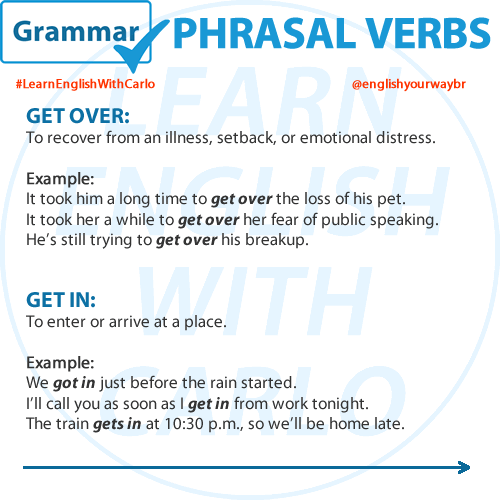
GET OVER
Meaning: To recover from an illness, setback, or emotional distress. Examples:
It took him a long time to get over the loss of his pet.
She’s finally getting over the flu and feels much better now.
Use this when referring to emotional or physical recovery.
GET IN
Meaning: To enter or arrive at a place. Examples:
We got in just before the rain started.
What time did you get in last night?
“Get in” is commonly used for arrival, often with a sense of timing.
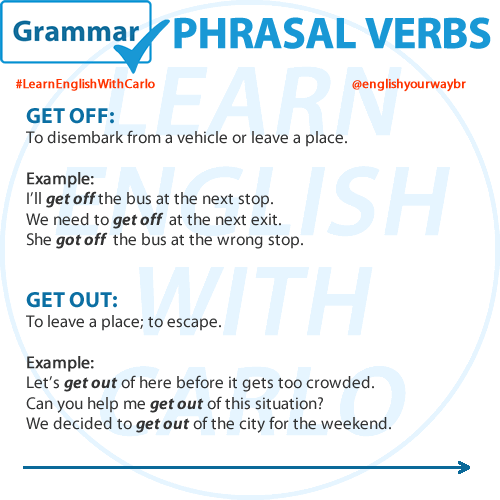
GET OFF
Meaning: To disembark from a vehicle or leave a place. Examples:
I’ll get off the bus at the next stop.
We need to get off at the first train station.
This is often used when referring to public transportation or leaving a location.
GET OUT
Meaning: To leave a place; to escape. Examples:
Let’s get out of here before it gets too crowded.
She told them to get out of the room immediately.
This phrasal verb is useful when talking about leaving quickly or escaping.
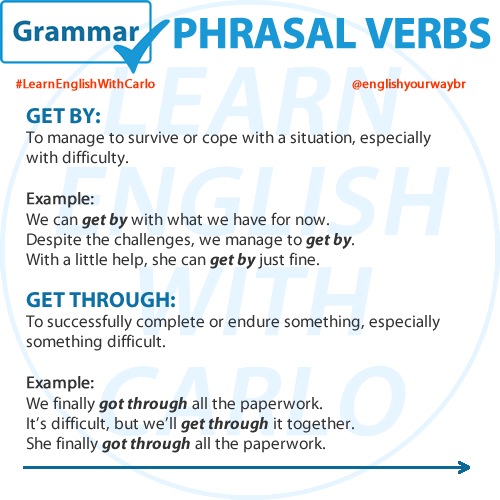
GET BY
Meaning: To manage to survive or cope with a situation, especially with difficulty. Examples:
We can get by with what we have for now.
He’s not earning much, but he manages to get by.
“Get by” often refers to managing with limited resources.
GET THROUGH
Meaning: To successfully complete or endure something, especially something difficult. Examples:
We finally got through all the paperwork.
She got through the exam even though it was very challenging.
This is a go-to phrase for describing persistence and overcoming difficulties.
GET ALONG WITH
Meaning: To have a good relationship with someone. Examples:
She gets along well with her coworkers.
He doesn’t get along with his neighbors because of frequent disputes.
Adding “with” specifies the person or group involved in the relationship.
GET AHEAD
Meaning: To progress or move forward, especially in one’s career or life. Examples:
She works hard to get ahead in her studies.
He took extra courses to get ahead in his career.
This phrasal verb is useful when discussing progress and achievement.
Tips for Learning Phrasal Verbs with “GET”
Context is key: Learn these verbs by practicing them in meaningful sentences.
Use them regularly: Incorporate phrasal verbs into your conversations and writing.
Observe native usage: Watch movies or listen to podcasts to see how native speakers use these expressions naturally.
Practice and repeat: The more you use them, the more comfortable you’ll become.
Phrasal verbs with “get” are a cornerstone of conversational English. Practice these examples, and you’ll soon use them with ease in your daily communication!
Agreeing in English can be simple and natural once you know the key structures. Whether the statement is positive or negative, these phrases will help you respond appropriately.
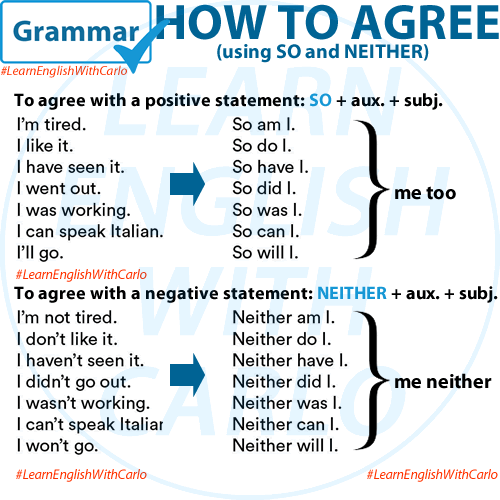
Agreeing with Positive Statements
Using “So + auxiliary verb + subject”:
A: I can swim. B: So can I.
A: I will call her later. B: So will I.
Using “Me too”:
A: I love chocolate. B: Me too!
Using “I + auxiliary verb + too”:
A: I have finished my homework. B: I have too.
Agreeing with Negative Statements
A: I haven’t read that book. B: I haven’t either.
Using “Neither + auxiliary verb + subject”:
A: I didn’t watch the movie. B: Neither did I.
A: I can’t drive. B: Neither can I.
Using “Me neither”:
A: I don’t like spicy food. B: Me neither.
Using “I + auxiliary verb + either”:
A: I haven’t read that book. B: I haven’t either.
Tips for Correct Usage
Always match the auxiliary verb (do, did, will, have, can, etc.) to the original statement.
Use “Me too” or “Me neither” for informal conversations—they’re simple and effective!